

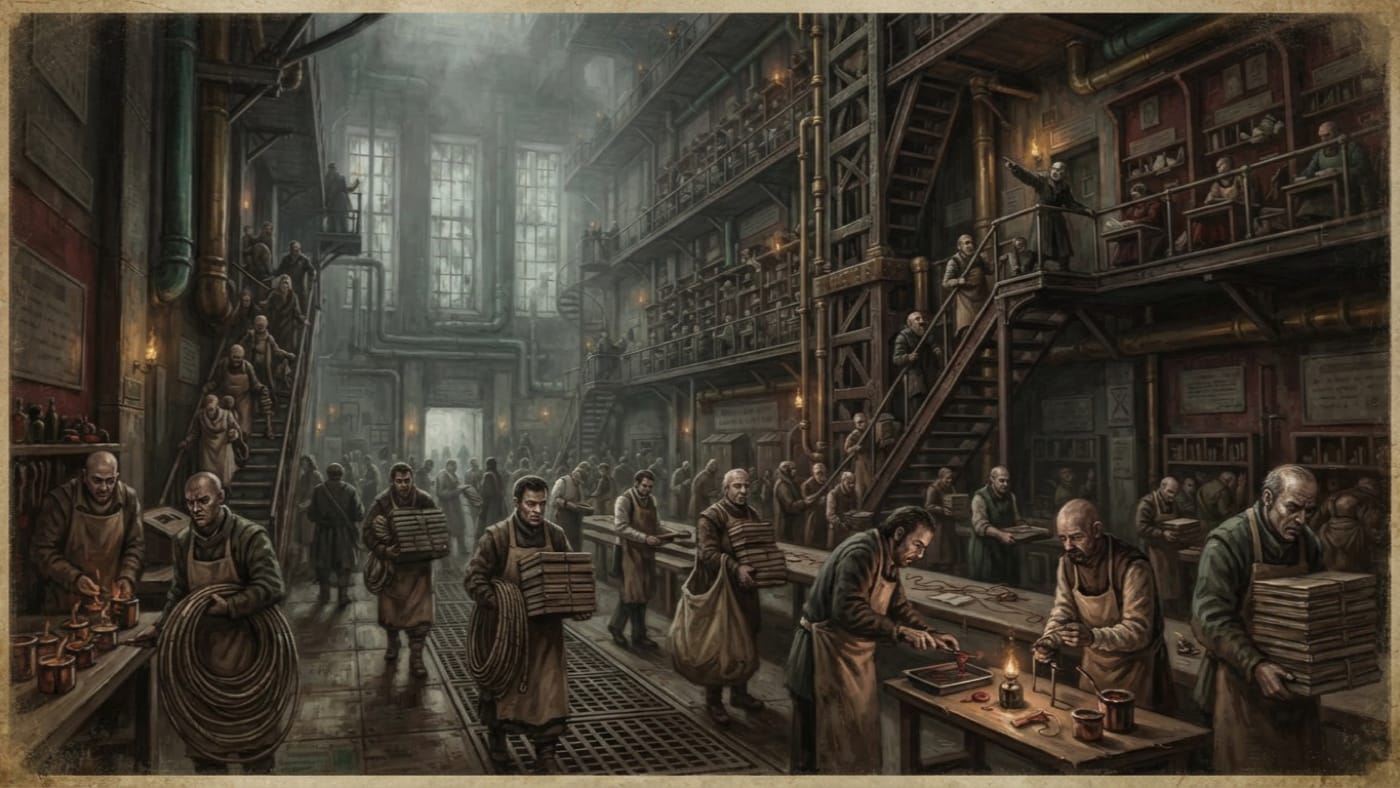
#On the Entry Rank
The Vow Runner sits on the lowest rung of the Oaths Witnesser ladder, beside the Token Clerk, and the Bureau of Oaths has never said where one title ends and the other begins. The professional schedule lists them as a pair with a slash between them. The Bureau loves the slash. It costs no ink to adjudicate and commits no office to anything. Two titles joined that way may be synonyms or neighbours. They may also be rivals who share a bench. The schedule declines to choose, and I decline to choose for it.
Runners are the lowest recorded rank in a profession whose only real commodity is credibility, and they have none of it yet. A qualified Witnesser can, after enough clean vows and quiet burials, have a name "invoked like a seal." A Runner's name gets invoked when an auditor wants to know who stood nearest the wax.
The title suggests legs. Every clerk who has ever bellowed down a corridor of the Bureau assumes the Runner runs: messages, cords, ledgers, the senior's forgotten gloves. The assumption is plausible, popular, and uncertified. I have found no ordinance that says what is run, to whom, or how fast.
#On Token and Record
The Runner enters a machine that turns breath into obligation. The machine is older than the Runner and will outlast them.
The procedure is documented and it is a good one. A Witnesser verifies the identity and capacity of each party, twice, once on paper and once in the flesh. A Witnesser screens for coercion with private questions, a coercion checklist and a hard look at the hands. The vow is recited in exact wording while the Witnesser listens for hesitation and variance. Then the vow is tokenized and recorded in the witness ledger and the registry. Last come the enforcement hooks: which penalties fall on breach, and who is notified when they do. Witness notes record conditions and also tone, cadence and breath. A marriage may be voided on a comma. A debt covenant may be upheld on an inhalation.
The tokens differ from region to region. Some districts tie waxed knots and some stamp cords. Others seal breath in vials or press seals onto slips, and each region privately believes the others are slovenly. The Synod tolerates the variety because a forger trained in one district's knots fumbles another's vials. "No promise binds unless Strasbourg hears it," says the countryside. Strasbourg does not hear most of it. Strasbourg reads it afterward in a ledger that smells of brine and candle-fat.
The issued tools of the profession are oath scripts, seal cords, the witness ledger, wax, knot-tokens, vow-slates and the coercion checklist. Its markers are a cord-sash with a witness token, clean gloves and a small bell charm. Those belong to the profession. Whether a Runner may carry them, may only touch them, or may only stand within reach of them while someone senior works is not set down. No separate Runner dress is documented. A novice arrives in whatever they own and learns quickly that the clean gloves are someone else's.
#On the Junior and the Signature
Every profession keeps one shortcut it is ashamed of and cannot give up. For the Witnessers it is the witness swap. A senior officer, overbooked or bribed or simply bored, sends a junior to "be present" at the vow and certifies it later from the comfort of a chair. The junior hears the words. The senior signs that the words were heard.
This is corruption. It is not delegation. Lawful procedure has the certifying Witnesser in the room, ear open, watching the hands. The swap moves the ear to one body and the authority to another, and the record lies about which was which. The sources do not name Vow Runners as the juniors used. They say "a junior," and the Bureau has always had several kinds of junior to spare.
Picture the arithmetic from the bench. A bride stumbles on the line that binds her property. The profession's own idiom says a stutter is a warning. The junior hears the stutter, and no rule I have found tells them whether they may stop the vow. The Witnesser whose name goes on the ledger never heard it at all.
Then the auditors come. They compare witness notes against scripts, check the identity verification and examine the tokens for tampering. They begin with exceptions, the vows approved despite the warning flags. When pressure rises, the profession's own catalogue names who goes first: junior witness clerks, shadow witnesses, and a scapegoat token-maker blamed for "irregularities." A signature protects its owner. Presence protects nobody.
Not everyone at the token table is a beginner. "Demotion to token duty" is a documented punishment for an established officer. Some of the people warming cord beside a novice are on their way down the ladder.
#On Liora's Feast
Saint Liora Knot-Hand is patron of the Bureau and of the profession. The approved hagiography places her in the first years after the Sundering, before the Concordat constituted the formal Synod. She bound thirty hungry households into mutual aid with witnessed vows and a strip of knotted cloth. She had no Bureau, no ladder and no Runner. Her miracle was done by one woman, a few neighbours as witnesses, and a cloth that ended up stiff with blood and kitchen smoke.
The Bureau keeps her feast on 14 Ember. Three distinct things happen that day, and the feast register verified by the Bureau of Records keeps them distinct. Witnessers retie a knot in their cord-sashes and recite that a vow unwitnessed is vapor. New Vow Runners receive their first tokens. Breach-Rite Witnessers fast.
Nobody has written down what the first token is. It may be a licence, a mark of rank, a practice-piece for clumsy fingers, or a real token bound to a real party's oath and handed over as a lesson in consequence. I have heard each answer given with total confidence by officers who had never handled the thing. The Creator knows. The register does not.
The feast also confers no access to the saint's own cloth. The First Knot-Cloth lies in the Registry of Bonds beneath the Basilica of the Ledgered Saints, or in the Third Vault, or in five strips if the Bureau of Relics is to be believed. On 14 Ember a novice handles ordinary cord. The relic stays wherever it is, which three offices still dispute.
#On the Teaching Hand
A Ghent catalogue once offered the faithful something better than ordinary cord.
"The complete and authenticated hand of Saint Liora."
Corrected. The object was a wax teaching model used in Vow Runner instruction. It was later stolen, kissed smooth by devotees, and resold as relic-grade anatomy. The Bureau of Relics downgraded it to Category D. The Bureau of Oaths requested custody anyway, citing "pedagogical embarrassment."
That is all the record gives us. Nobody has recorded who modelled the wax, when, or what exactly a Runner was meant to learn from it. A wax hand in a classroom of novices invites guesses about where the fingers go on the cord and how the knuckles sit when a knot is pulled tight. Those guesses are mine and nobody else's. I enter them as speculation.
What the episode does prove is the order of manufacture. The Bureau made a tool. A thief turned the tool into merchandise, and enough lips turned the merchandise into a relic. Not one link in that sequence needed the saint. It needed wax, a catalogue with a confident typeface, and buyers who wanted the holy thing so badly that they wore down a beginner's practice piece with kisses.
#On Advancement and Exposure
Above the Runner the ladder climbs through Chapel, Guild and Debt Witnessers to the District Oath Notary and the Court Witnesser. It then branches into the specialists: Breach-Rite Witnessers who bury what was promised, Coercion Examiners who hunt the wrong kind of hesitation, and High-Bond Witnessers who handle nobles and relic chains. At the top sits the Synod Registrar of Bonds, who is less a rank than a weather system.
The documented path upward has no fixed schedule. It runs through court cases handled cleanly, high-value vows witnessed without scandal, breach rites performed without a slip, and patrons kept quietly satisfied. The first three are skills. The fourth decides most careers. A Witnesser with a sponsoring patron learns that the patron expects dirty vows to be validated, and that a single coercion complaint can end a career overnight. "Don't witness hungry," the veterans say, meaning that a hungry officer sells validity cheap. Every Runner starts out hungry.
One status symbol in the profession is a personal set of vow tokens. Whether the first token on 14 Ember becomes the first piece of such a set, or gets surrendered back to a drawer, the Bureau has not recorded. I hope it is kept. A Runner may one day need proof that they once held something that was theirs, before their presence was spent on someone else's signature.