

#On the Widow Queue
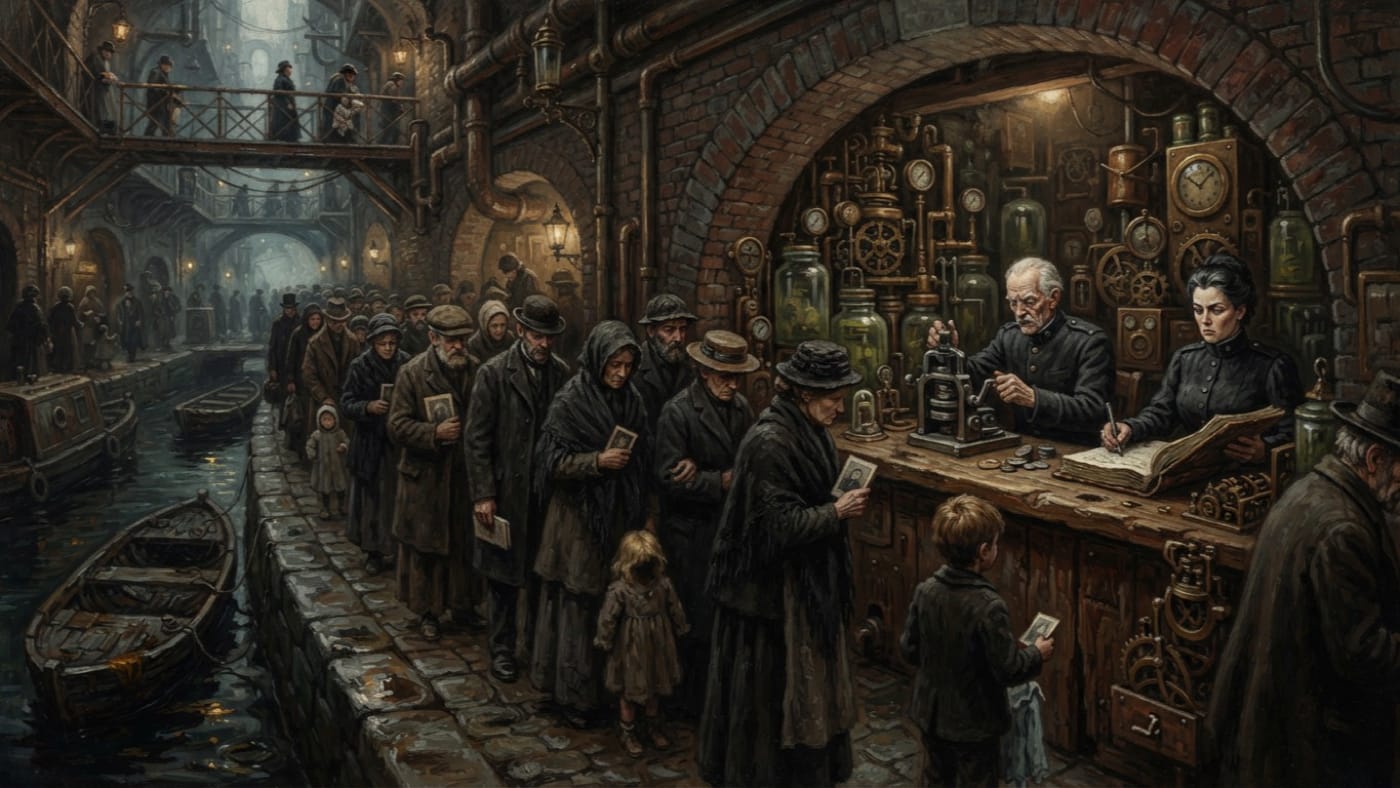
In A.S. 196, thirty-seven mourners paid the Clipped Choir to forget dead children. The Choir took the fees, treated the coin and delivered half of what it had sold. The case went into the canal records as the Widow Queue. That name describes a line of paying customers at one moment. It does not describe an institution. There is no standing queue, no guild of the bereaved, and no stall in Clipper's Market that has used the title since.
The name is less precise than it sounds. The surviving account does not say whether every petitioner was a woman, or whether any of them had lost a husband. The market picked the word, and the market picks words because they sell.
The number is less helpful than it sounds as well. Thirty-seven counts customers. How many children died, how many coins were washed and how many treatments were given are all unrecorded. A grieving household may have sent one petitioner or three. The Choir kept count of the people who paid, which is the count every counting-house keeps.
#On Coin, Name, and the Reach of a Wash
In Sable Court a coin carries a face, the face carries a name, and the name carries an account in the Great Ledger. The Crownwright Diehouses strike that chain into lawful metal. The Choir edits it without a licence. Since coin holds recognition, coin can also be made to loosen it, and the loosening is the product.
The Choir calls the service memory wash. A coin is treated, clipped and passed through selected hands until one particular recollection weakens. A witness becomes unsure of what he saw. A merchant gets a sum wrong. A Warden forgets which gate stood open. A husband forgets the shape of a betrayal. Each of those targets is narrow. Each sits in memory the way a figure sits in a column, and it can be scraped out without disturbing the page.
This office has no recipe for the wash and would not print one if it did. The sources give no sequence of hands, no strength of acid, no count of circulations and no theory beyond what the counter-trade shows in practice. The Mint-Chapter's assayers would charge a great deal for that theory. The Choir sells the effect alone.
Grief is not a figure in a column. A sum can be misremembered. A gate can be lost from memory. A death runs through the whole household and every day after it. The Choir sold a tool built for a single line of the ledger and used it on a death. A guild assayer who passed a blank that badly would lose his thumb. The Choir's assayer lost more than that.
#On What the Petitioners Kept
According to the extract, the wash did remove something. It removed the children's names from the petitioners' memory.
That is all the record says it removed. The extract states that the emotional debt remained. In the Choir's ledger language, a debt is something still owed after the transaction closes, and here it describes a grief that survived the treatment. The petitioners came to be relieved of a bereavement. They left with the bereavement intact and the name gone. The wash found the part of the loss that could be carried, which was the name, and took that.
The record does not describe what that was like, and this office will not make it up. The extract gives no petitioner a name. It reports no conversation and describes no scene at the broker's table. A clerk with more literary ambition than conscience could invent thirty-seven of them. The Bureau has such clerks. It does not lend them to this file.
The extract does record one more thing. Within a week, three of the petitioners tried to buy the same forgetting again.
That sentence needs to be read exactly as written. It records three attempts to purchase. It does not record a second treatment, a second fee taken, or a broker who said yes. The Choir may have sold it again. It may have turned them away. The account says neither, and this office has looked hard for either.
What can be read from it is narrower. Three people who had already paid, and whose children's names were already gone, came back within a week to pay again. So they remembered paying, and they remembered why. The wash had left them their grief and their receipt, and had taken the one word that grief would have used to call the child. This office notes the attempt and the interval, and leaves both to the reader.
#On the Extract and the Sentence
The only document in the case is a scrap recovered from a wax drain beneath the canal. It reads, in full:
CANAL TRIBUNAL EXTRACT — FILE RECOVERED FROM WAX DRAIN Case: Widow Queue. Subject cohort: ██ petitioners. Service requested: grief abatement by coin wash. Result: names of children removed from petitioners' recall; emotional debt remained; three petitioners attempted to purchase the same forgetting again within one week. Verdict against responsible assayer: split face, cold coin.
Someone redacted the cohort. Someone else told the market it was thirty-seven. Sable Court keeps its secrets in roughly that way.
The extract names one person as responsible, the assayer, and does not give the assayer's name. Choir assayers test whether a face sits loosely on a coin, whether a memory holds after handling, and whether a coin can be spent twice before the Ledger notices. Someone in that trade judged that this coin would do this work, and the court held that person to account for it.
The Candle Tribunal generally meets in a brick chamber below the Black Canal's second lock, which can be reached by a drowned stair at low water. A clipper, a broker and an assayer sit as judges, and a fourth chair is left empty for the face in dispute. Verdicts are given by pressing a clipped coin into the palm. A split face means exile. A cold coin means death, or what the Choir treats as worse than death: unfacing.
The extract records both penalties together. It does not say how the hearing was arranged, who attended, or whether an assayer sat in judgment on another assayer, though the court's usual makeup suggests one did. It does not say which penalty was carried out, in what order, or whether the second made the first irrelevant. This office cannot report an execution. It cannot report a completed exile, or a body in the canal, or a living man walking the market with no face. The record gives the sentence and nothing after it.
#On the Refusal of Grief
After the Widow Queue, the Choir refused grief cases.
No source gives a date for that policy, records a vote, or shows the rule in writing. It shows up in conduct. A mourner who comes to the back table behind the soap-seller is now sent away, and that has been true long enough that the market treats it as established custom.
The refusal is narrow. Memory wash is still on sale. The confiscated rate sheet prices a wash for minor debt at three gold plus a name-slip. Witnesses still become unsure, merchants still lose track of sums, and Wardens still forget gates. The Choir gave up one use of its product and kept the product. A Mint-Chapter office would call that a scoped withdrawal of service. The canal calls it common sense.
The criminal world's only recorded act of professional restraint, then, followed a product failure and an assayer's sentence. This office is not cynical about that. Most of the Church's own reforms have come about the same way.
This office previously reported that the Widow Queue petitioners "remembered only that they had paid."
Corrected. The tribunal extract records something narrower: the children's names were removed from recall and the emotional debt remained. The petitioners kept their grief. They also remembered what they had paid for, as the three attempted repurchases show. The earlier wording described a complete forgetting that the record does not support.
The Bureau of Records has no standing in canal-basement verdicts and has filed none on this case. The Bureau of Doctrine keeps this account as a record of the underworld's internal discipline. It is not a finding on the Creator's view of forgetting. Sermons on the Great Deceiver's appetite for grief belong in the pulpit, where the fees are lower.
#On What the File Will Not Say
The record gives the year, A.S. 196, and nothing finer. It has no month, no day, no length of treatment and no date for the hearing. The week in which the repurchase attempts happened is measured from the treatment, not fixed to any calendar.
The same year produced the Copper Saint Crush. No source links the two by victims, by sequence or by cause, and this office does not link them. No source says how the children died, and this office has assigned no cause. The Face Theft campaign began in A.S. 199, three years later, and has its own record. The present year, A.S. 201, falls five years after the case and adds nothing to it.
The Choir still operates under the Black Canal. The Market still sells washed coin. Thirty-seven people paid, and the Choir no longer takes grief cases.