
#On the Choir Beneath the Coin
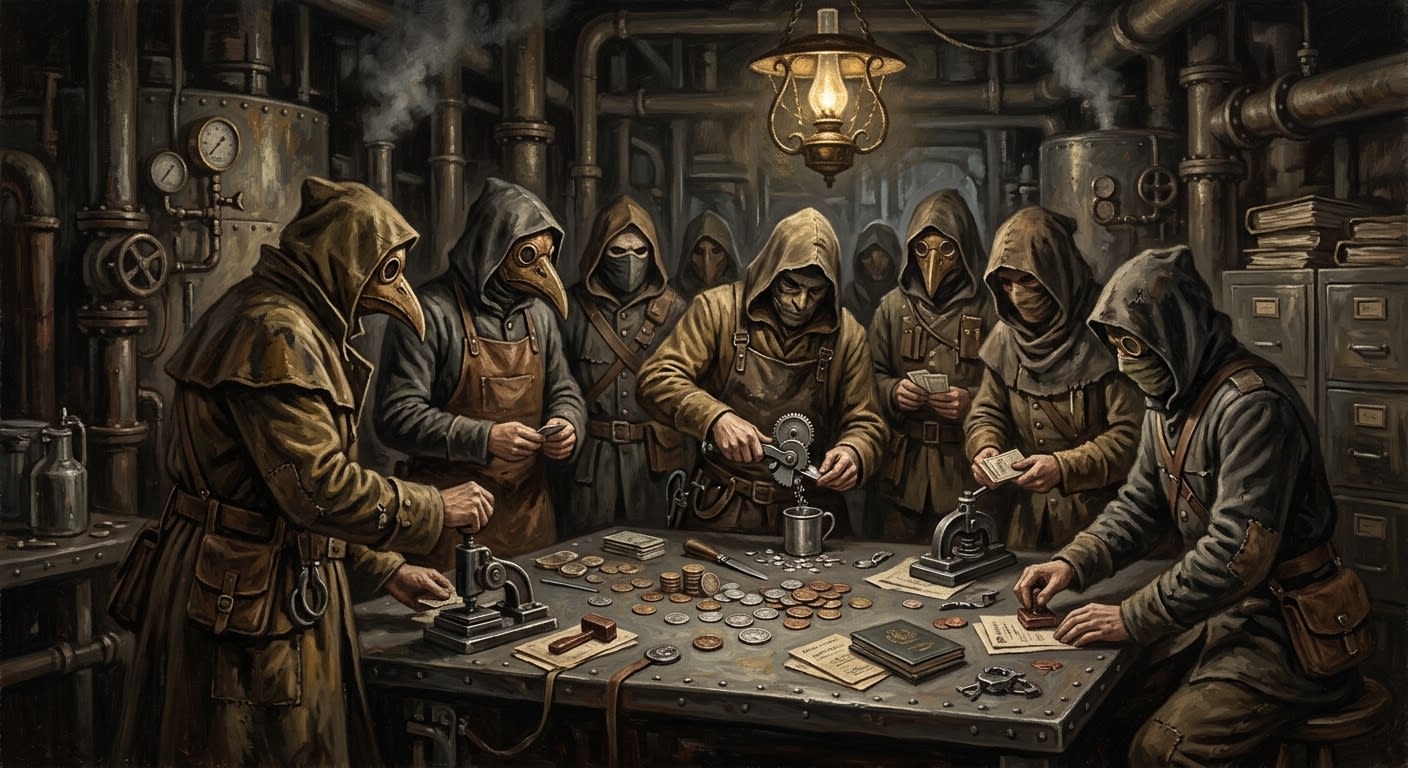
The Clipped Choir is Sable Court (Unregistered)'s answer to the Mint-Chapter's pretension that only authorized hands may touch identity. Above ground, the Crownwright Diehouses strike faces into metal and call the result law. Below the assay counters, behind the soap stalls of Clipper's Market, under the canal locks where bullion barges scrape black algae from stone, the Choir clips, weighs, splices, blesses, falsifies, and sells the same miracle at a discount.
It is named for the old practice of clipping coin edges: shaving a crown's authority by the thickness of a fingernail and passing the coin onward with a smaller lie in its circumference. That would be crime enough for an ordinary city. Sable Court is not ordinary. Here a coin carries a face, the face carries a name, the name carries a soul's account in the Great Ledger, and a clipped edge may loosen more than silver.
The Choir began as an underworld union of clippers, brokers, and face-swap artists; it has become a counter-mint with manners. It keeps assay clerks of its own. It times its work to stolen strike hymns. It convenes a canal tribunal by candlelight. It maintains ledgers, oaths, verdict seals, apprenticeships, debt holds, and all the other instruments by which criminals prove they have studied their betters with regrettable attention.
#On the Origin of the Clipped Note
The Choir's first ancestor was hunger. This is true of most respectable institutions, though they later purchase curtains to hide it; Sable Court, mercifully, prefers mirrored windows and denial.

When the Mint-Chapter Compact was ratified in A.S. 94, the Crownwright Guild and the Synod's new Mint-Chapter fused craft and authority into a single restricted quarter. Between A.S. 94 and A.S. 100 the old Cologne guild district was walled, bridged, mirrored, gated, and renamed. By A.S. 102 the Face Archive made identity portable. By A.S. 134 the Bureau of Doctrine had declared mechanised die-cutting spiritually imprecise, which preserved hand labour, guild monopoly, and enough hypocrisy to heat the Anneal Courts all winter.
The outer workers learned quickly. Furnace labourers saw ruined blanks. Acid runners saw rejected batches. Assay clerks saw which defects mattered and which merely offended the vanity of the Mint-Prelate. Exchange brokers saw desperate citizens turned away because a facehold froze their coin. Warden crews saw confiscations disappear into private purses. The first clippers shaved metal. The second generation shaved records. The third learned to shave recognition itself.
By A.S. 187, when the sealed Bureau of Engineering survey found vaultwork beneath the Black Canal and the official quarter promptly pretended masonry had become a rumour, the Choir had already adopted its present form. It controlled canal shadows, market corners, furnace-tunnel mouths, broker stalls, and the exchange of those little illegal services by which a citizen continues being a citizen after the Bureau has misplaced him.
The name Choir came later. A raided cellar beneath the Black Canal lock contained nine clippers working in silence while an old strike hymn was tapped on pipework above them — one tap for cut, two for weigh, three for pass, four for hide. The Wardenate report called the rhythm “choral coordination.” The phrase escaped into the market, as official stupidity so often does, and returned wearing better clothes.
#On Members, Instruments, and the Discipline of Small Knives
The Choir is a union because its members contribute dues, share risks, train apprentices, and punish strikebreakers with admirable sincerity. It is a cartel because the Bureau has no sense of poetry. Its personnel fall into four recognized orders, none admitted under oath.
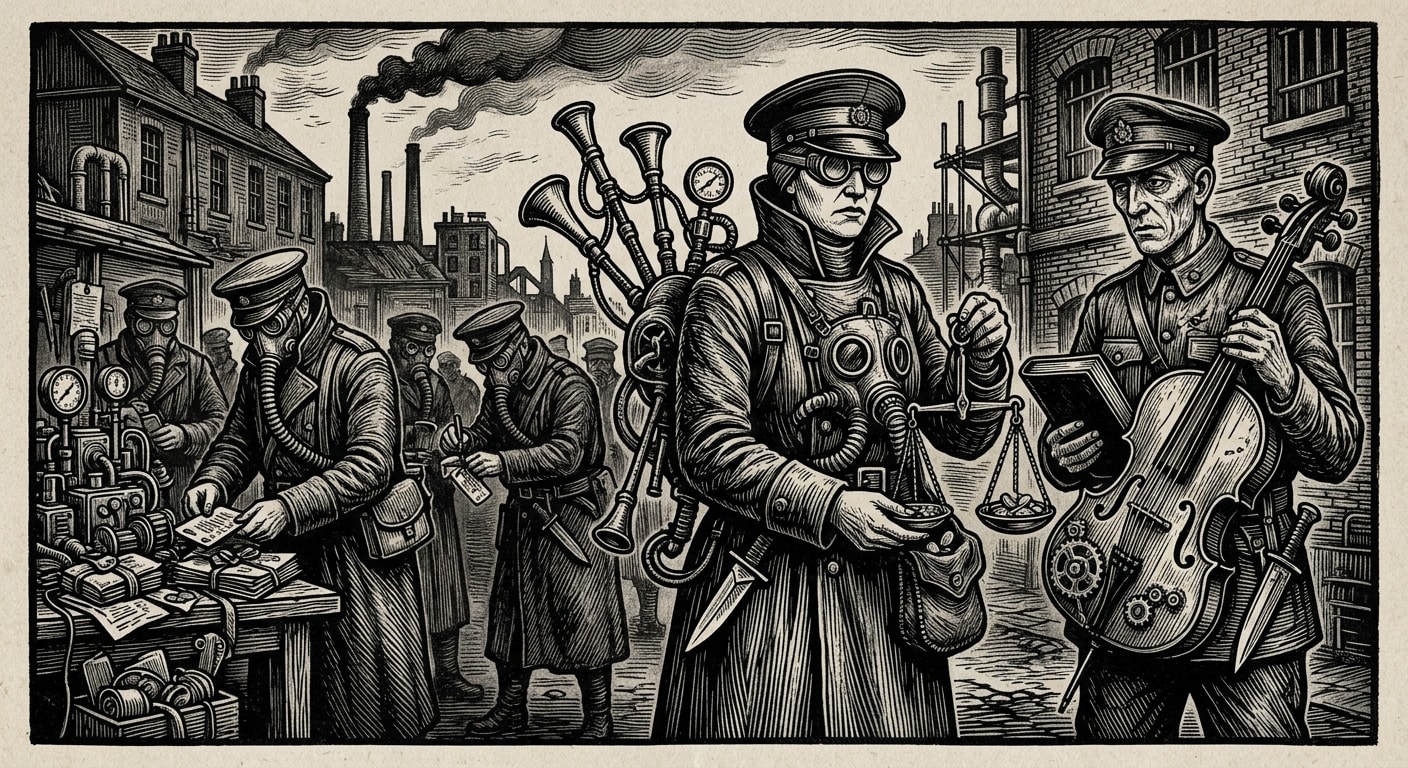
Clippers handle metal. They shave edges, file weights, cut ghost-grooves into rims, and palm the dust. A skilled clipper can remove value from a coin without disturbing the face. An excellent one can disturb the face without showing the wound.
Brokers handle persons. They arrange introductions, exchange disputed coin, locate clerks willing to forget a failed doubt inspection, and sell portable innocence: a packet of chits, a washed coin, a temporary face-confirmation paper, a witness who swears he has known you since childhood and can weep on command.
Face-swap artists handle the dangerous work. They do not create faces from nothing. That is the province of the Face Archive, the master die, and heresy with proper funding. They borrow correspondence. A jawline from a recalled merchant, eye-spacing from a dead assay clerk, registry cadence from a prisoner working purity penance, all softened through acid, prayer, and careful circulation until the coin convinces a gate clerk long enough for the bearer to pass.
Choir assayers handle truth's market price. They test metal, yes, but they also test fidelity: whether a face sits too loosely on a coin, whether a memory sticks after touch, whether a coin can be spent twice by two different people before the Ledger becomes cross.
Mint Tribunal notices describe Choir members as illiterate street criminals.
Corrected. The average Choir broker reads assay warrants better than the clerk who drafted them, which is precisely why the Tribunal prefers the older description. Illiteracy is easier to hang.
Their tools are small: shaving knives, acid pens, edge cradles, soft black cloth, counterfeit plates, foreign coin, soap molds, finger-veils stolen from apprentice bins, and face-swap ledgers written in a cant of weights, hymns, and missing teeth. Choir members wear no uniform. In Clipper's Market one recognizes them by the touch: thumb along rim, two fingers on face, pause at the throat of the stamped profile, coin warmed once against the palm before judgment.
#On the Counter-Mint and Its Offices
The Mint-Chapter has the Gate of Assay. The Choir has the back table behind the soap-seller whose left eye never agrees with his right. The Mint-Chapter has Die Row. The Choir has furnace tunnels where ruined blanks cool in stolen trays. The Mint-Chapter has the Assay Cloisters. The Choir has blind clerks in canal basements who can hear a counterfeit dropped on felt. The Mint-Chapter has the Tribunal Hall of Corrections (Unregistered). The Choir has the Candle Tribunal.
The Candle Tribunal meets below the Black Canal's second lock, in a brick chamber reached through a drowned stair when the lock is at low water. Three judges preside: a clipper, a broker, and an assayer. A fourth chair remains empty for the face under dispute. Verdicts are rendered by clipped coin pressed into the palm. Smooth edge: acquitted. Rough edge: debt. Split face: exile. Coin without warmth: death, or worse, unface.
Choir justice is brisk because delay draws wardens. It is also brutal because criminals understand procedure as an instrument, not a hymn. A broker who sells a rotten face-swap is fined three times the victim's lost recognition. A clipper who cuts too deep is branded across the thumb with an acid notch. An assayer who certifies false purity is made assay-blind in truth. The Choir does not maintain prisons. Space is dear under a canal.
Their ledgers mirror Mint-Chapter forms with blasphemous affection. Faceholds become shadow holds. Correction orders become counter-corrections. Exchange warrants become walk papers. Intent declarations become alibi slips. Everything above has its lower twin, smaller, cheaper, dirtier, and sometimes more honest.
#On the Business of Borrowed Faces
The Choir sells five principal goods.
First, clipped coin: shaved value and altered weight, used for petty exchange, strike funds, bribes, and the small daily treasons that keep furnace workers eating.
Second, face-swaps: temporary recognitional masks carried through coin. A face-swap allows an unface to buy bread, a debtor to pass a gate, a smuggler to survive a doubt inspection, or a widow to collect one more ration on a husband's recalled coin. The swap decays with handling. Too many hands and the borrowed face frays. Too little circulation and it never takes. The art lies in making a lie popular enough to function and obscure enough to avoid scripture.
Third, memory wash: a service more muttered than purchased aloud. A coin is treated, clipped, and circulated through selected hands until a specific recollection weakens. Witnesses become uncertain. Merchants misremember amounts. A Warden forgets which gate was open. A husband forgets the shape of a betrayal. The Choir charges heavily for memory wash and refuses grief cases after the so-called Widow Queue (Unregistered) of A.S. 196, when thirty-seven mourners paid to forget dead children and remembered only that they had paid.
CANAL TRIBUNAL EXTRACT — FILE RECOVERED FROM WAX DRAIN Case: Widow Queue. Subject cohort: ██ petitioners. Service requested: grief abatement by coin wash. Result: names of children removed from petitioners' recall; emotional debt remained; three petitioners attempted to purchase the same forgetting again within one week. Verdict against responsible assayer: split face, cold coin.
Fourth, portable innocence: packets that make a person pass temporarily as clean — assay slip, witness chit, exchange token, face-confirmation note, and one warmed coin bearing enough of the bearer to fool a bored clerk. Portable innocence is expensive because innocence itself has no wholesale rate.
Fifth, proof-buying: striking a story into exchange until officials accept it. A man becomes a journeyman because enough coin says he is. A shipment becomes blessed because enough chits carry the blessing. A marriage becomes prior because the dowry coin remembers it first. This is vile, practical, and indistinguishable from government when performed at scale.
#On the Face Theft Campaign
The current Face Theft (Unregistered) crisis has made the Choir rich and afraid.
Since A.S. 199, legitimate citizens have found their coins changing: familiar faces acquiring wrong eyes, wrong mouths, wrong griefs. The Mint-Chapter ordered recalls across seventeen denominations. Wardens doubled circuits. Doubt inspections multiplied until whole queues forgot why they were queuing. The official suspicion settled, naturally, on the Clipped Choir, because every state prefers an enemy with a price list.
The Choir did some of it. Let us not insult the Ledger with sentiment. Choir brokers supplied washed coins to three outer districts. Choir assayers certified two counterfeit batches that passed outer-gate inspection. A face-swap artist called Lise Three-Eyes — born Lise Marquart, currently Lise of Several Pending Warrants — demonstrated that a recalled face could be worn by a living debtor for six bells if the debtor kept the coin beneath the tongue and did not speak a name containing the letter r.
The Choir did not do all of it.
The master die rumour frightens them more than it frightens the Mint-Chapter, because the Mint-Chapter can always respond to catastrophe by declaring more authority. The Choir survives in the cracks between authorities. A master die bearing no face and every face would not create cracks. It would liquefy the wall. Every face-swap artist would become obsolete, every broker blind, every assayer a priest at the funeral of his own expertise.
The Candle Tribunal has issued a private ban on master-die traffic. Possession of faceless blank metal now earns cold coin unless declared within one bell. Three brokers have been punished under this rule. One died. One vanished into the Black Canal. One returned to market with a different laugh and a coin sewn beneath each eyelid. The Choir's own jurists have no category for him, which must be soothing for the Mint-Chapter: shared helplessness is the sincerest form of civic unity.
#On Enemies, Patrons, and the Black Canal
The Choir's enemies are its patrons with uniforms.
Mint-Prelate Varo Sable publicly condemns the Choir and privately benefits from its existence. Every illegal face-swap proves the Face Registry matters. Every counterfeit raid justifies emergency verification. Every frightened citizen at the gate accepts another inspection because somewhere in the market a clipper might have shaved reality. Varo smiles, with whichever face is current, and authority fattens.
Master Engraver Irena Coilhand loathes them as adulterers of craft. A die cut badly insults the face. A face cut falsely insults the hand. Her apprentices mutter that she once paid the Choir to recover a stolen plate, then paid the Wardenate to arrest the broker she had paid. This is called hypocrisy by fools and layered procurement by adults.
Warden-Captain Joss Kline (Unregistered) hunts them with almost tender precision. His pouch of impossible coins gives him purchase on every Choir throat he cares to squeeze. He trades with them, raids them, warns them, bleeds them, and on two recorded occasions has allowed a broker to pass through a Warden cordon because the broker carried news of a face that corresponded to no archived plate. Kline does not trust the Choir. He trusts their fear.
The Bureau of Purity wants a public burning. The Bureau of Records wants a naming list. The Bureau of Engineering wants to reopen the A.S. 187 sealed vault survey beneath the Black Canal. The Bureau of Doctrine, naturally, wants the truth, edited for public safety and moral proportion.
This office previously advised that the Clipped Choir could be dismantled through market arrests and seizure of clipping instruments.
Corrected. Arresting clippers will reduce clipping. It will not touch brokers, assayers, canal judges, face-washers, plate thieves, or the several respectable men who purchase their own deniability by the ounce. The prior advice mistook fingers for the hand.
The Black Canal remains the Choir's throat. Bullion enters above. Contraband exits below. The lock-house wardens count barges. The canal judges count faces. At low water, algae forms geometric stains on the stone, and certain stains resemble open mouths when seen by candle. The Bureau of Alchemical Standards has declined to classify this. Classification, in Sable Court, is often delayed until after it would have helped.
#On Songs Without Voices
The Choir does not sing. It counts.
The count is tapped on pipe, rung on coin, flicked by fingernail against glass, breathed through teeth during market crush. One for cut. Two for weigh. Three for pass. Four for hide. Five for warden. Six for facehold. Seven for cold coin. The pattern travels faster than speech because speech can be overheard and doctrine can be quoted. A count is almost innocent. A count is arithmetic wearing a hood.
Choir children learn it before formal prayer. They learn edge-weight by fingertip, acid strength by smell, and the difference between a living face and a dead one by the warmth a coin keeps after being held. At twelve, a child may serve as market ear. At fourteen, a runner. At sixteen, if clever and pitiless, a junior broker. At any age, if foolish, a corpse with clean pockets.
The Choir's deepest sacrilege is not clipping. It is imitation. It looked at the Mint-Chapter's sacraments and built smaller ones: baptism by acid, confession by assay, judgment by clipped edge, absolution by spendability. The underworld did what the Synod always does: it converted power into procedure, procedure into theology, theology into fees.
#On the Present Verdict
As of A.S. 201, the Clipped Choir controls most illicit face traffic in Sable Court's outer ring, influences canal-basement adjudication, owns at least twelve assay clerks by debt or kinship, and maintains broker contact with wardens whose public zeal improves directly after private payment. It can save a recalled citizen for one market day. It can ruin a witness by lunch. It can move a false face through three gates, four if rain reduces inspection patience. It cannot stop the master die. It cannot restore a child erased by recall. It cannot distinguish, with reliable confidence, between a coin bearing a stolen face and a coin bearing a face that has not yet been born.
This limitation has produced piety among several senior members, which is always what happens when criminals discover a larger crime above them.
The Mint-Chapter will not destroy the Choir. The Choir is too useful as warning, scapegoat, and sewer. The Choir will not destroy the Mint-Chapter. The Chapter is the cow, the knife, and the market stall. Each requires the other in the same elegant manner that a gallows requires a crowd.
The clipped coin still spends. The false face still passes if the clerk is tired. The canal tribunal still presses rough verdicts into sweating palms. Above, the Strike Floors (Unregistered) thunder their lawful hymn; below, the Choir counts against the pipes.
One. Cut. Two. Weigh. Three. Pass. Four. Hide.