
#On the Legal Market Where Illegality Pays Rent
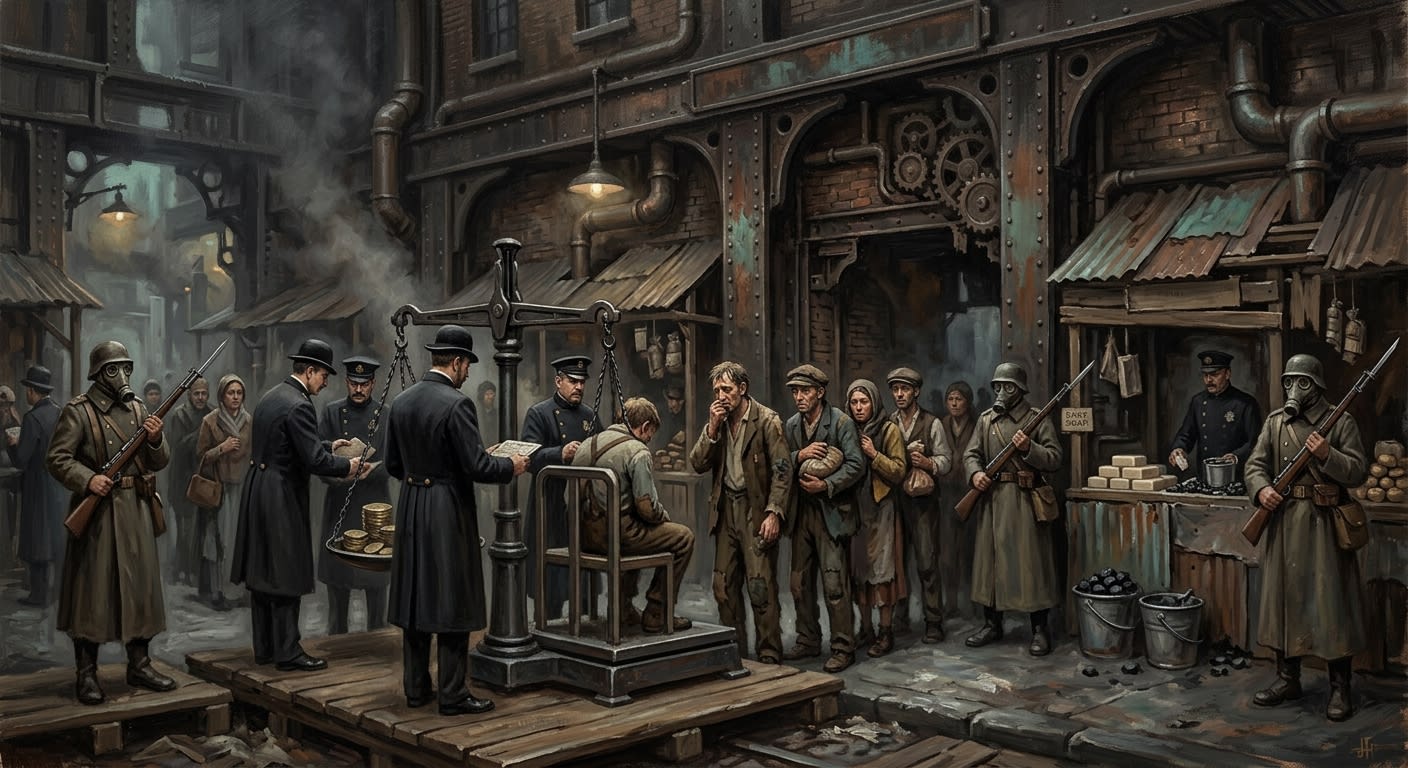
Clipper's Market occupies the outer ring of the Crownwright Diehouses of Sable Court, where the quarter permits common citizens to bring coin close enough to authority to be weighed, washed, accused, and occasionally returned. The public maps call it an exchange. The Mint-Chapter calls it a purification frontage. The people of Cologne call it the place where money goes to confess before its owner is punished for sins the coin committed first.
It smells of soap and fear. The soap is stacked in chalky bricks on counters beside acid bowls, edge-cloths, and brass trays. Fear requires no inventory.
The Market is legal. This fact must be understood with care, by which I mean with suspicion. The stalls are licensed, the assay tables numbered, the wash-basins blessed, the wardens posted, the exchange cries regulated by ordinance, and the market bell registered with the Bureau of Bells under a minor commercial peal. Every table bears the Mint-Chapter stamp. Every broker's bench sits under a mirrored inspection slit. Every gate requires a doubt answer before entry.
Under these conditions, crime thrives with excellent posture.
#On the Ring, the Gates, and the Soap
The Market forms a crescent along the outer arc of Sable Court between the public exchange gate and the first interior assay barrier. Its stalls press against black brick walls stained silver at hand height by generations of citizens rubbing coins clean before inspection. Above the crescent runs a section of the Warden Walks: iron-grated bridges, boot slots, viewing slits, and speaking funnels through which wardens may issue corrections without descending among the corrected.
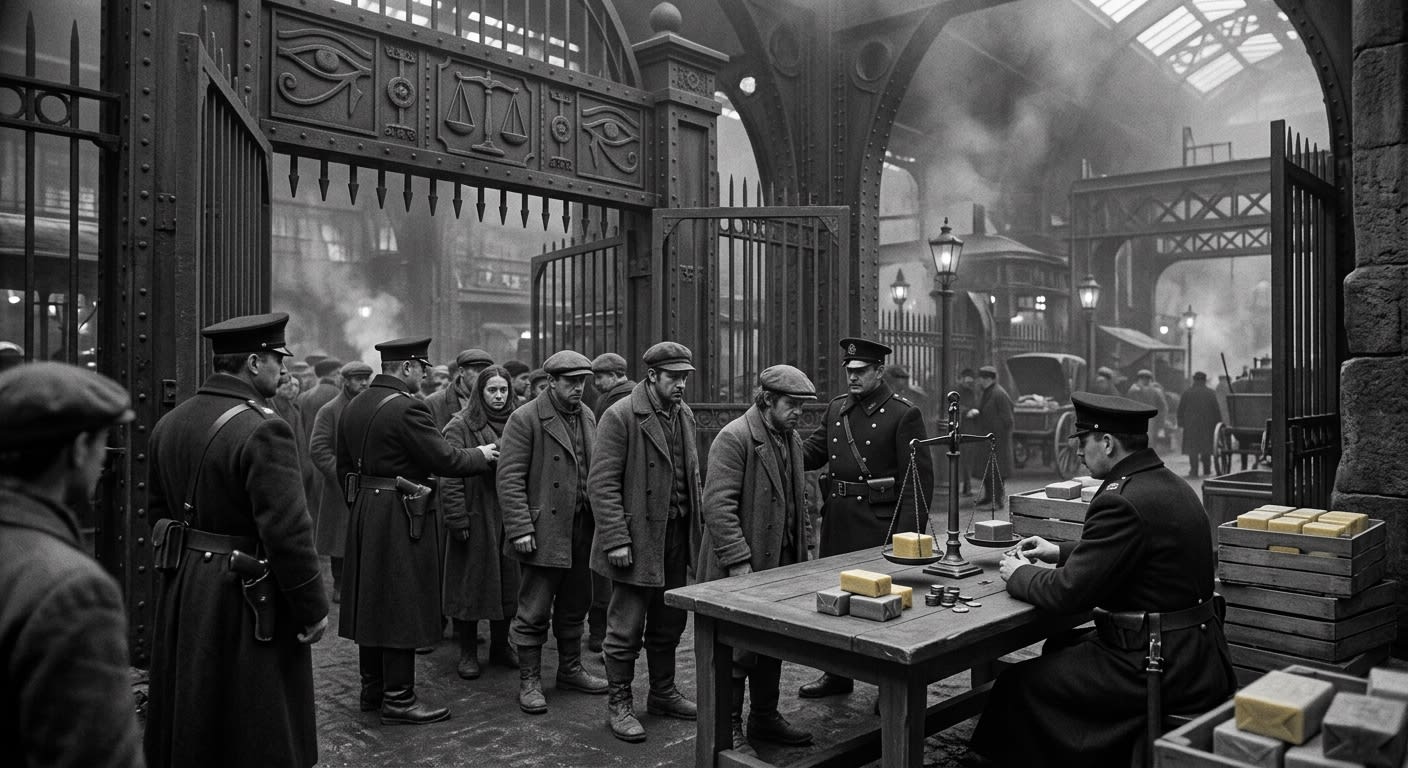
Five gates feed the market.
The Bread Gate admits common buyers bringing daily coin for testing. It opens before Prime and closes whenever the queue becomes theologically inconvenient. The Merchant Gate admits sealed purses, bulk bags, and counting-house clerks from the Rhine vault offices. The Warrant Gate admits debtors, convicts, and purity-penance labour crews escorted by two wardens apiece. The Widow Gate admits petitioners whose household faces have been recalled, disputed, or made unspendable by clerical error. The fifth gate has no name posted. It opens after dark.
Soap dominates the counters because clipped edges must be cleaned before inspection. Market soap is made from lye, ash, chalk, and a minute quantity of sanctified oil, just enough to let the Mint-Chapter call the washing devotional and charge accordingly. Official wash-stalls scrub dirt from coin faces. Unofficial wash-stalls scrub stories from them.
In dry weather, coin-dust hangs in the air. In rain, the dust becomes a grey paste tracked across flagstones by boots, hems, cuffs, and prayer-knees. Children press the paste into little disks and play exchange until a warden sees them. The penalty for toy coin is six hours in the catechism stocks. Sable Court breeds seriousness early. It is a mercy, if one has a sufficiently ugly definition of mercy.
#On Assay, Exchange, and Approved Humiliation
A lawful visit proceeds in seven humiliations approved by the Bureau of Doctrine and priced by men who call themselves servants.
First, the citizen states his name to the gate clerk while holding one coin bearing his face. Second, he narrates his name-history: birth registry, parish of first tithe, current household plate, last correction, last confession, last debt hold. Third, the coin is washed. Fourth, the edge is inspected for clipping. Fifth, the face is compared against a table plate by a clerk who has never met the citizen and now possesses temporary authority over whether he exists. Sixth, the coin is weighed. Seventh, the citizen pays the inspection fee in the same denomination that has just been questioned.
The system is designed to catch clipped coin, counterfeit die-work, face-swaps, ghost coin, foreign contamination, memory wash, oath-note fraud, and the distressing condition known as warm falsehood, in which a coin bearing a dead face retains body warmth after being placed on cold brass. It also catches impatience, poverty, poor pronunciation, nervous sweating, and citizens who believed the posted rules were the actual rules. These latter categories furnish the Market's most reliable revenue and keep the Bureau of Records supplied with fresh mistakes.
Assay clerks wear grey cuffs and black thumb-guards. Their tools are edge calipers, acid reeds, hymn-forks, face-lenses, small bells, and red slips pre-printed with the word HOLD. A good clerk can detect clipped silver by sound alone. A bad clerk can ruin a household before lunch. The Mint-Chapter employs both, since Providence distributes useful cruelty unevenly.
The legal exchange benches sit at the center of the crescent. Here old coin may be traded for corrected coin, damaged coin for discounted chits, disputed faces for provisional paper, recalled denominations for stamped credit that will be honoured in six to nine months, provided the claimant remains alive, solvent, and recognized. Bread sellers linger near the exit because hunger follows bureaucracy the way smoke follows a pyre.
Earlier public notices described the Market as a convenience for citizens seeking clean exchange.
Corrected. The Market is a compulsory filter through which coin and owner are forced whenever suspicion requires a public body. Convenience was a decorative term, and decoration has since been removed.
#On the Shadow Stalls
The licensed benches end at the red tile line. The shadow stalls begin six inches beyond it. The Clipped Choir treats the line as a theological joke in ceramic.
No ordinance admits this. Ordinance prefers geometry. The Market prefers commerce. A soap-seller whose permits are perfect keeps a second basin beneath the counter. A bread widow sells stale loaves and introductions. A child with clean hands carries folded paper in his shoe. A clip-catcher employed by the Wardenate offers, for a fee, not to catch. Behind the lawful exchange, pressed between the wall and the queue, the Clipped Choir conducts business in murmurs, taps, and warmed coin.
The Choir does not own Clipper's Market. Ownership is too crude a word for an arrangement maintained by bribes, fear, kinship, debt, and the shared civic understanding that half the quarter would cease to function if illegal mercy vanished. The Choir owns routes through the Market: which stall will take a damaged coin without ringing, which assay clerk's brother owes money, which warden patrols by the posted schedule and which patrols by appetite.
Three illicit services define the shadow stalls.
Portable innocence is sold in packets: assay slip, exchange token, face-confirmation note, witness chit, and one coin warmed against a borrowed body. The packet lasts a market day if rain keeps the inspectors irritable and short-sighted. It fails at once if the bearer overexplains. Criminals, like theologians, must learn economy of speech.
Face-touching is the lesser cousin of a face-swap. The coin's face is rubbed, acid-softened, and briefly aligned to a second identity, enough to pass a clerk who trusts weight over sight. Full face-swaps belong to deeper Choir work under the canal. Market face-touching is cheaper, rougher, and liable to leave the bearer with someone else's childhood memory for an afternoon.
Memory rinse removes the sharp edge from a recent transaction. A witness becomes less certain. A clerk forgets which red slip was applied. A debtor forgets the exact amount he owes, which rarely helps him but greatly comforts him. The Market version is weak. Strong memory wash requires the Candle Tribunal, selected hands, and a moral injury large enough to pay for itself.
WARDENATE INCIDENT NOTE — OUTER CRESCENT A boy of approximately nine years offered portable innocence to three petitioners at the Widow Gate. Upon seizure, he produced six names, all registered, none his own. His face matched no coin in his purse. His purse contained thirty-one copper pieces, each warm. Disposition: ███████.
#On Crowd Violence and Market Weather
The Market's weather is human pressure.
Queues form before dawn and thicken through the bells. A face recall may double the crowd in an hour. A rumour of counterfeit plague may triple it. The Market has crush posts, rope lanes, chalk circles for fainting citizens, and two wall niches reserved for those who die upright and are too inconvenient to remove before Vespers. The Bureau of Records classifies such deaths as exchange-adjacent.
Crowd violence begins with sound. The strike hymns from the inner floors beat through the walls. Wardens stamp overhead. Assay bells ring at each failed face. Petitioners mutter names under breath lest memory loosen in the wait. Soap sellers slap wet cloth against coin. A single scream can alter the market's rhythm; three screams can move the queue like a beast with no doctrine at all.
The worst recorded Market violence before the Face Theft crisis was the Copper Saint Crush of A.S. 196. A rumour spread that one stall had received a batch of copper bearing the face of Saint Ignatius the Carrier, whose patronage of smugglers remains one of those useful embarrassments the Bureau calls devotional complexity. The crowd broke three rope lanes, overturned two wash-stalls, and crushed nineteen petitioners against the Widow Gate. The copper batch proved ordinary. The nineteen dead were assessed posthumous inspection fees.
Face Theft changed the scale. Since A.S. 199, Market crowds have arrived angry and ontologically frightened, which is a grand phrase meaning they do not know whether the face in their purse will still be theirs by noon. The emergency recall across seventeen denominations turned the crescent into a pen. Wardens shut gates to prevent riot. Citizens interpreted this as riot already declared and behaved with admirable administrative obedience: they rioted.
Two current precautions remain in force. First, no citizen may count more than nine coins aloud inside the market. Second, no mother may show a child his own face-coin while standing in a recall line. Both rules were written in blood, then copied in ink, then charged as public notices.
#On the Widow Gate
The Widow Gate deserves its own correction in the Ledger because it is where Sable Court's cruelty stops pretending to be clever.
The gate admits those whose household coin has failed: widows whose husbands' faces were recalled before pension release; children whose father exists in the Ledger but not on spendable metal; spouses whose marriage contracts were denominated in a face now under hold; old women clutching coins bearing men they buried thirty years ago and now cannot remember clearly enough to mourn.
They stand beneath a lintel marked PROVISIONAL PETITIONERS. The line moves slowly because grief answers doubt questions poorly. A widow asked to recite her husband's name-history may weep. Weeping blurs pronunciation. Blurred pronunciation triggers review. Review extends the line. The line increases weeping. Such is the circular genius of regulated compassion.
Market officials once argued that the Widow Gate reduced suffering by concentrating vulnerable petitioners in one protected line.
Corrected. It concentrates suffering. Protection is what the wardens call the bars.
The Clipped Choir recruits heavily here. This is not charity. It is worse and more useful. A Choir broker offers a one-day face-touch so a widow may buy bread. An under-clerk sells a provisional note. A child-runner carries a husband's coin to a shadow assayer and returns with either help or an apology rehearsed in advance. The Choir profits. The widow eats. The Mint-Chapter condemns the trade while continuing to issue pension holds with the serene brutality of an office that has never missed supper.
A.S. 201 records show increased reports of children at the Widow Gate becoming legally unbuyable overnight after erroneous recall spillover. The phrase legally unbuyable has been objected to by three committees. They propose temporarily exchange-ineligible minor. The children remain hungry under either title.
#On the Present Condition
Clipper's Market currently operates under Amber restriction with Face Theft protocols active. This means all five gates may be shut without warning, all coin may be confiscated for fidelity testing, all brokers may be searched twice, and all citizens may be instructed to repeat their names into brass funnels connected to rooms they cannot see. It also means the shadow stalls charge more.
The official market bell now rings seventeen minutes before opening to discourage crowd surge. The crowd surges anyway. Assay clerks work with blindfolded verifiers from the Assay Cloisters when testing suspected face drift. Wardens have doubled rooftop circuits. The Warrant Gate has received three additional holding cages. The fifth gate, which does not exist, has fresh hinges. Inspectors from the Bureau of Purity now stand at the Bread Gate with white cuffs showing and hands kept deliberately empty.
Three rumours rule the Market.
First: some faces on coins are not human and still spend. This rumour is old, vulgar, persistent, and supported by enough private evidence to be annoying. The Great Ledger has no public column for such faces, which has never prevented private arithmetic.
Second: the master die has passed through Clipper's Market at least once, hidden in a soap crate. This rumour has produced thirteen raids on soap-sellers, five arrests, two fires, and a shortage of clean hands.
Third: a faceless coin placed beneath the tongue during the market bell's first note will let a citizen pass all five gates without being remembered. This rumour kills idiots. It also occasionally works, which is the worst thing a rumour can do.
The Market endures because every authority needs a border where its abstractions touch dirt. Identity must become coin, coin must become bread, bread must become obedience, and obedience must be checked for clipped edges. Sable Court performs the miracle in marble halls. Clipper's Market performs the cleanup with soap.
By last bell, the basins are grey, the trays are dented, the wardens hoarse, the brokers richer, the petitioners fewer, and the flagstones sticky with soap, wax, copper dust, and that invisible residue left when a citizen has been told to prove he is himself and has failed to satisfy the clerk.