

#On the Nature of True Coin
"A clean strike makes a clean soul." — Inscription above the Gate of Assay, Sable Court
I have inspected the Crownwright Diehouses on four occasions — the first as a young clerk, the last as Warden of the Sacred Ledger — and on each occasion I have left with fewer certainties than I carried in. This is, I am told, the intended effect. Sable Court does not trade in metal. It trades in recognition. The coin is incidental. What the Synod mints in those soot-black halls, behind mirrored windows that watch the street with the patience of confessors, is the legal fact of a human face.
Understand: in the Theocracy, a name is a ledger entry and a face is a coin. The two are bound by the Great Ledger's oldest concordance — the Face Registry Compact of A.S. 94, ratified four years after the Concordat by joint seal of the Bureau of Records and the Bureau of Tithes. What the Compact established, with the quiet violence of administrative innovation, was that every soul entered into the Ledger would have its likeness struck into metal and circulated. The coin would carry the face. The face would carry the name. The name would carry the soul's account. Lose the coin and you lose nothing — coins are minted in batches. Lose the face — have it revoked, corrected, or recalled — and you lose your place in the economy of salvation.
The Crownwrights understood this before the Bureaus did. They had been engravers since before the Sundering, guild families in the old Cologne quarter who cut seals for Rationalist magistrates and ecclesiastical courts with equal skill and equal indifference. When the Concordat bound every parish from the Baltic to the Tagus, and every parish needed stamped currency bearing the Flaming Sword, the Crownwrights offered their services. The Synod accepted. The Synod always accepts a competent monopoly.
#On the Founding and the Compact
"Who strikes the die strikes the world." — attributed to Mint-Prelate Albrecht Sable, first of his line, A.S. 94
The quarter takes its name from the founding Prelate — Albrecht Sable, a canon lawyer of Cologne cathedral who saw in the Concordat's currency mandate an opportunity that lesser men would have mistaken for a clerical appointment. The Synod needed coins. Albrecht had engravers. The negotiation lasted nine days and produced the Mint-Chapter Compact: a joint charter binding the Crownwright Guild and the Synod's new Mint-Chapter into a single administrative organism, with the Guild providing craft and the Chapter providing authority, and both providing surveillance over the other in perpetuity.
The quarter was carved from Cologne's old guild district between A.S. 94 and A.S. 100 — the same years the Council of Cologne was binding every diocese in Europe to Strasbourg. The timing was doctrine. Where the Council bound souls, Sable Court bound faces. The customs gates went up first. Then the watchwalk bridges, linking rooftop to rooftop above the streets so that wardens could move through the quarter without descending to the level of the coined. Then the mirrored inspection windows — glass treated with a proprietary Crownwright technique that permits observation from within while reflecting the observer's face back at him from without. The theological implications of this glass were debated for eleven years by the Bureau of Doctrine before being classified as "architecturally devotional."
The Face Archive was established by Synod mandate in A.S. 102 — the same year the Queue Road's Permit Directorate was constituted, the same administrative expansion that gave the Theocracy its grip on movement and identity simultaneously. Every face struck into coin requires a master plate in the Archive. Every plate is filed, cross-referenced with the Ledger, and sealed under triple lock. Touching an Archive plate without Mint-Chapter authorisation is an annihilating offence — the offender's own face is struck from every coin in circulation within the quarter-bell, and within the week his name ceases to function in commerce. I have witnessed this process. It is quieter than execution and more final.
#On the Quarter's Shape and Logic
The Diehouses occupy a ringed enclave within Cologne's south quarter — eight districts arranged in concentric arcs around the Face Archive at the centre, the whole thing sealed by customs gates and threaded with canal spurs for bullion intake. The air smells of hot metal, acid wash, and the particular acrid sweetness of annealing coal. Fog clings low from the steam vents. In winter, the quarter produces its own weather — a fine ash-snow from the annealing stacks that settles on everything and tastes of iron.
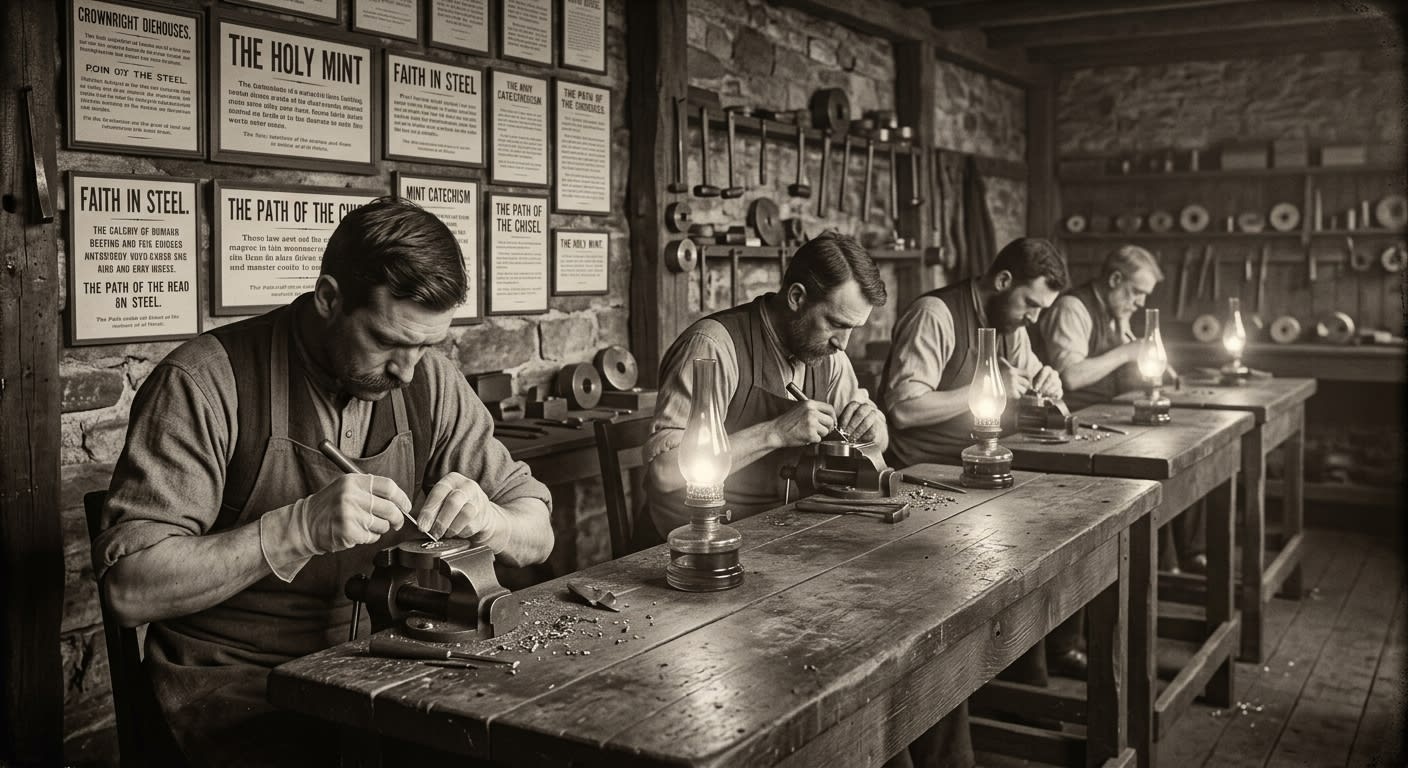
Die Row runs along the northern arc — the engraving halls where Crownwright masters cut faces into steel with tools inherited through guild lines older than the Synod. The work is done by hand. It has always been done by hand. The Bureau of Doctrine ruled in A.S. 134 that mechanised die-cutting produced "spiritually imprecise" currency, a ruling the Crownwrights lobbied for and the Bureau delivered with a straight face. The engravers wear finger-veils — silk wraps over each digit — because bare fingertips are considered "blasphemous tools," capable of transferring the engraver's own identity into the die. Whether this is superstition or observed phenomenon depends on whom you ask. The Bureau classifies it as "procedurally relevant."
The Anneal Courts lie south of Die Row — furnace yards where struck blanks are tempered. The Assay Cloisters sit east, where acid baths and prayer determine the purity of every batch. The Strike Floors occupy the western arc — cavernous stamping bays where press-hammers fall in rhythm with hymns sung by the shift choir, each strike timed to a specific syllable of the Mint Catechism. The sound carries through the quarter at all hours. It is, depending on your theology, either the heartbeat of legitimate governance or the percussion section of institutional murder.
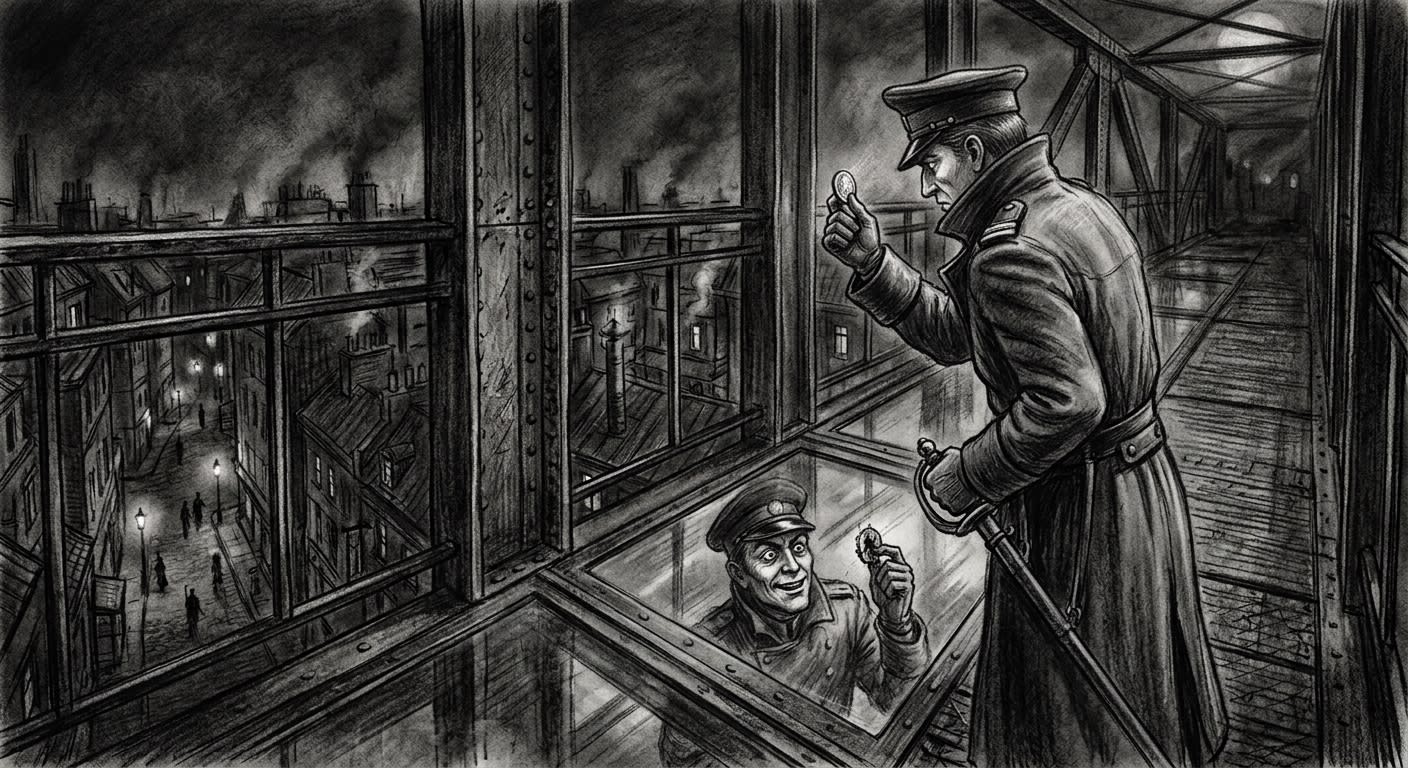
The Warden Walks bridge the rooftops — a second street layer where Mint Wardens in black sashes patrol above the population, observing through slit-windows cut into the bridge floors. The wardens move in counting circuits — timed routes that produce a rhythm audible from below. Citizens learn to mark their days by the boot-pattern overhead. The effect is surveillance made architectural, which is to say, Cologne made honest about what every Synod city already does.
Clipper's Market occupies the outer ring — the legal exchange where coin is tested, traded, and occasionally confiscated. It smells of soap and fear. The soap is for cleaning clipped edges. The fear needs no explanation.
The Black Canal cuts through the quarter's southern wall — a single spur connecting the Rhine barge network to the bullion intake locks. The lock-house is garrisoned at all hours. Beneath the waterline, according to the Bureau of Engineering's sealed survey of A.S. 187, lies an older vault system predating the Crownwright charter. The Mint-Chapter denies this. The canal algae grows in geometric patterns the Bureau of Alchemical Standards has declined to classify.
#On the Economy of Faces
Every coin in the Theocracy carries a face. Every face is a legal instrument.
This is the principle Sable Court exists to enforce, and its implications are as vast as they are vicious. When a citizen is entered into the Great Ledger, the Bureau of Records assigns a registry number. The Mint-Chapter then commissions a die — a face cut into steel by a Crownwright master, approved by the Assay Cloisters, blessed by the shift choir, and struck into metal. The resulting coins circulate through the Synod's economy carrying that face. The face is legal tender. The face is identity. The face is, in the Theocracy's accounting, the soul made portable.
The consequences cascade with bureaucratic elegance. A face recall — ordered by the Mint Tribunal when a face is disputed, revoked, or "corrected" — removes a person from commerce. Their coins are gathered, re-struck, and issued blank or bearing a replacement. The recalled person does not die. They become unspendable. Merchants refuse their custom — the coins no longer carry their authority. Landlords revoke their leases — the tenancy was denominated in their face. Employers terminate their contracts. The recalled person stands in the middle of a functioning economy and finds that nothing functions for them. The Bureau of Records classifies this as "administrative dissolution, non-lethal variant."
The Crownwrights call it unfacing. The street calls it worse.
Sable Court's economy runs on this architecture. Die engraving, coin striking, and assay testing are the visible industries. The invisible one is identity itself. The Mint-Chapter charges correction levies for face disputes. The Crownwright Guild charges identity fees for new entries. The Wardenate charges inspection tolls at every gate. Confession is filed as an "intent declaration" attached to exchange permissions. Even buying bread requires an assay slip confirming the change in your pocket bears a valid face.
The black market mirrors the formal economy with precision. Clipped coin, face-swaps, and counterfeit dies circulate through Clipper's Market's shadow stalls. The Clipped Choir — a union of clippers, brokers, and face-swap artists operating under the pleasant fiction of "labour mutual aid" — manages the underworld with the same administrative thoroughness as the Mint-Chapter manages the surface. They have their own assay clerks. Their own hymn-timing. Their own tribunal, conducted by candlelight in canal basements, where verdicts are rendered in clipped coin pressed into the palm.
Earlier editions of this Codex stated that the Crownwright Guild operated independently of Synod oversight. This was a drafting error by a clerk who has since been corrected. The Guild has always operated under Mint-Chapter authority, as the Compact of A.S. 94 establishes in terms that brook no misunderstanding, and the clerk's confusion was a personal failing, not an institutional one.
#On the Anomaly
The memory problem began — or was first documented, which in the Theocracy is the same thing — in A.S. 187, when the Bureau of Alchemical Standards conducted a routine audit of the Face Archive and discovered that three plates had been altered overnight. The alterations were minor: a jawline softened, an iris darkened, a hairline advanced by perhaps two millimetres. The faces were still recognisable. They were simply wrong — wrong in the way a familiar room is wrong after someone has moved a single chair.
The Bureau investigated. The investigation produced a sealed report. The sealed report produced a sealed sub-report. The sub-report's conclusions are classified, but the effects are public knowledge in every market square in Cologne.
Faces on coins anchor memory. When a citizen's face circulates — in pockets, in counting-houses, in the offering plate at Mass — the face becomes fixed in the minds of those who handle it. You know your neighbour because you have held his face in your hand. You remember your dead because their coins remain in your drawer. The mechanism is, according to the Bureau of Doctrine's reluctant classification, "theologically adjacent to the reliquary effect" — a sacred resonance between image and identity that the Concordat's currency mandate accidentally industrialised.
The corollary is hideous. When a face is revoked — struck from the Archive, recalled from circulation — the memory unsticks. Merchants hesitate mid-transaction, unable to recall who sold them the salt. Witnesses forget suspects. Families argue, with increasing distress and decreasing certainty, over whether a brother existed. The recalled person does not vanish from the world. They vanish from the world's ability to notice them. A man without a coined face is a man without a footprint.
The Bureau of Doctrine classified this as a "Category Two Localized Identity-Scribal Anomaly" in A.S. 194 and has not reclassified since. The Mint-Chapter insists the effect is minor and manageable. Warden-Captain Joss Kline — who keeps a private pouch of coins he calls "impossible," each bearing a face that corresponds to no living person and no archived plate — insists otherwise, but Kline is not paid to insist. Kline is paid to patrol.
#On the Present Condition
The current crisis arrived in A.S. 199, wearing someone else's face.
Citizens of Cologne's outer districts began reporting a peculiar distress: their coins had changed. The faces on them — their own faces, carried daily, known by touch — were subtly wrong. A wife's coin bore her husband's jaw but another man's eyes. A merchant's coin bore a face he had never seen and could not stop remembering. Within three months, over four hundred complaints had been filed with the Mint Tribunal. Within six months, the complaints stopped — because the complainants could no longer remember what their own faces were supposed to look like.
The Mint-Chapter ordered an emergency face recall across seventeen denominations. The recall produced chaos. Citizens who had already lost their faces found their coins confiscated and their identities suspended. Citizens whose faces were intact found themselves queued beside the faceless and wondered, with increasing panic, whether the queue itself was contagious. Die Row worked triple shifts. The Strike Floors thundered through the night. The hymn-timing slipped — twice — and two batches were struck with faces the shift choir could not identify and the Assay Cloisters could not account for.
The Unface Society — a heretical cell operating from the furnace tunnels beneath Anneal Courts — has claimed responsibility, though the Bureau of Purity doubts a cell of six engravers and a disgraced archive scribe could orchestrate a campaign of this sophistication. The Society's stated aim is the abolition of the Face Registry — the destruction of every plate in the Archive, the flooding of the Theocracy with faceless coinage, the liberation of identity from metal. The Bureau of Doctrine classifies their aim as "theologically terminal" and their method as "technically impossible."
The Bureau of Doctrine is, on the second count, incorrect. There exists — the Mint-Chapter has denied this in four separate depositions, each denial more emphatic and therefore more revealing than the last — a master die. A single steel cylinder, cut before the Compact was ratified, bearing no face and every face, capable of overwriting the Archive's concordance by the simple act of circulation. Strike a coin from the master die and the coin carries no identity. Handle the coin and your own identity loosens — your face drifts on the metal in your pocket, your plate shifts in the Archive, your name stutters in the Ledger. Circulate enough such coins and the entire Face Registry becomes unreliable. The Synod's grip on identity — on who exists, who is owed, who may confess, who may buy bread — dissolves coin by coin.
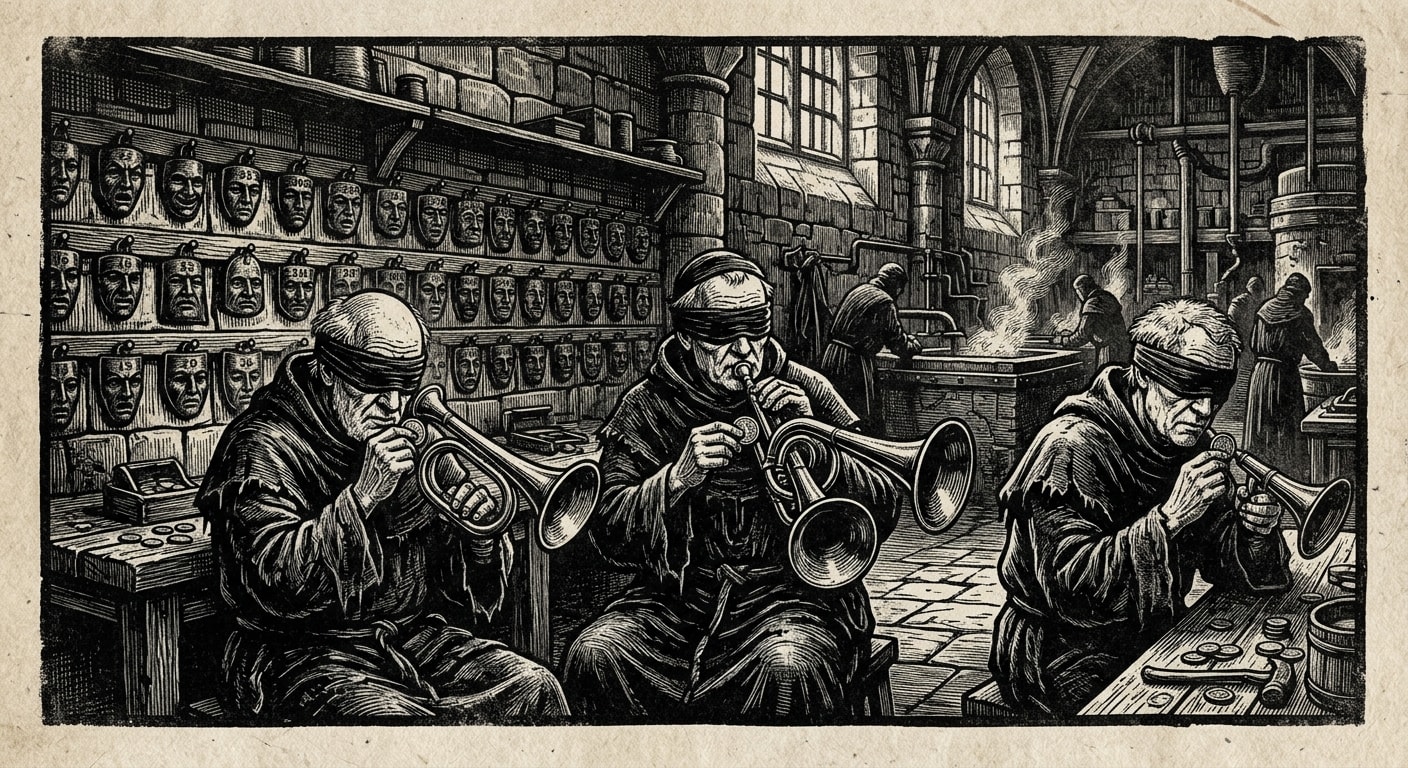
Whether the master die is myth or hardware, the crisis is real. The Mint-Chapter's emergency measures have stabilised the outer districts, but the inner quarter remains under what Varo Sable calls "enhanced verification protocols" and what the population calls siege. Doubt inspections at every gate. Warden circuits doubled. The Face Archive sealed to all access below Mint-Prelate clearance. The Assay Cloisters have begun testing not just the purity of metal but the fidelity of faces — a new procedure involving hymn-frequency comparison between the struck coin and the archived plate, conducted by blind assay-clerks who have never seen the face they are testing.
A previous entry in this Codex referred to Sable Court as "the cleanest quarter in the realm." This was the Heartlands elite's assessment, which the Bureau endorsed for public consumption. The Bureau hereby corrects the record: Sable Court is the most controlled quarter in the realm. Cleanliness was never the relevant metric.
The investigation continues. The Bureau of Purity has dispatched an Inquisitor-Assayer — a specialist in currency heresy whose name is, with characteristic irony, not coined. The Crownwright Guild has closed its apprentice rolls for the first time in a century. Master Engraver Irena Coilhand has not left Die Row in eleven days and has begun wrapping her prayer-scarves around the dies themselves, which the Bureau of Doctrine has classified as "irregular devotional practice" rather than the more honest "desperation."
Warden-Captain Kline patrols the Walks with his pouch of impossible coins and says nothing to anyone. He has been seen, in the late watches, holding individual coins up to the mirrored windows and studying the reflections. What he sees in the glass, he has not reported. The Bureau has not asked.
#The Ratification
I have told you what Sable Court is. A mint. A prison of faces. A mechanism for making identity portable, taxable, and revocable. I have told you what it does — which is to say, I have told you what the Theocracy does when it discovers that a human soul can be bound to a disk of metal and circulated at the Bureau's convenience. I have told you about the crisis, because crises are what happen when the Synod's machinery produces consequences it did not authorise.
I have not told you whether it works.
The coin in your pocket carries a face. The face carries a name. The name carries a soul's account in the Ledger of Souls. Sable Court is where that chain is forged — link by link, strike by strike, hymn by hymn. Whoever controls the dies controls the chain. Whoever controls the chain controls who is real.
The Crownwrights have controlled it for a hundred and seven years. Whether they will control it tomorrow depends on whether the master die is real, whether the Unface Society is as small as the Bureau believes, and whether Varo Sable's third face is his last.