

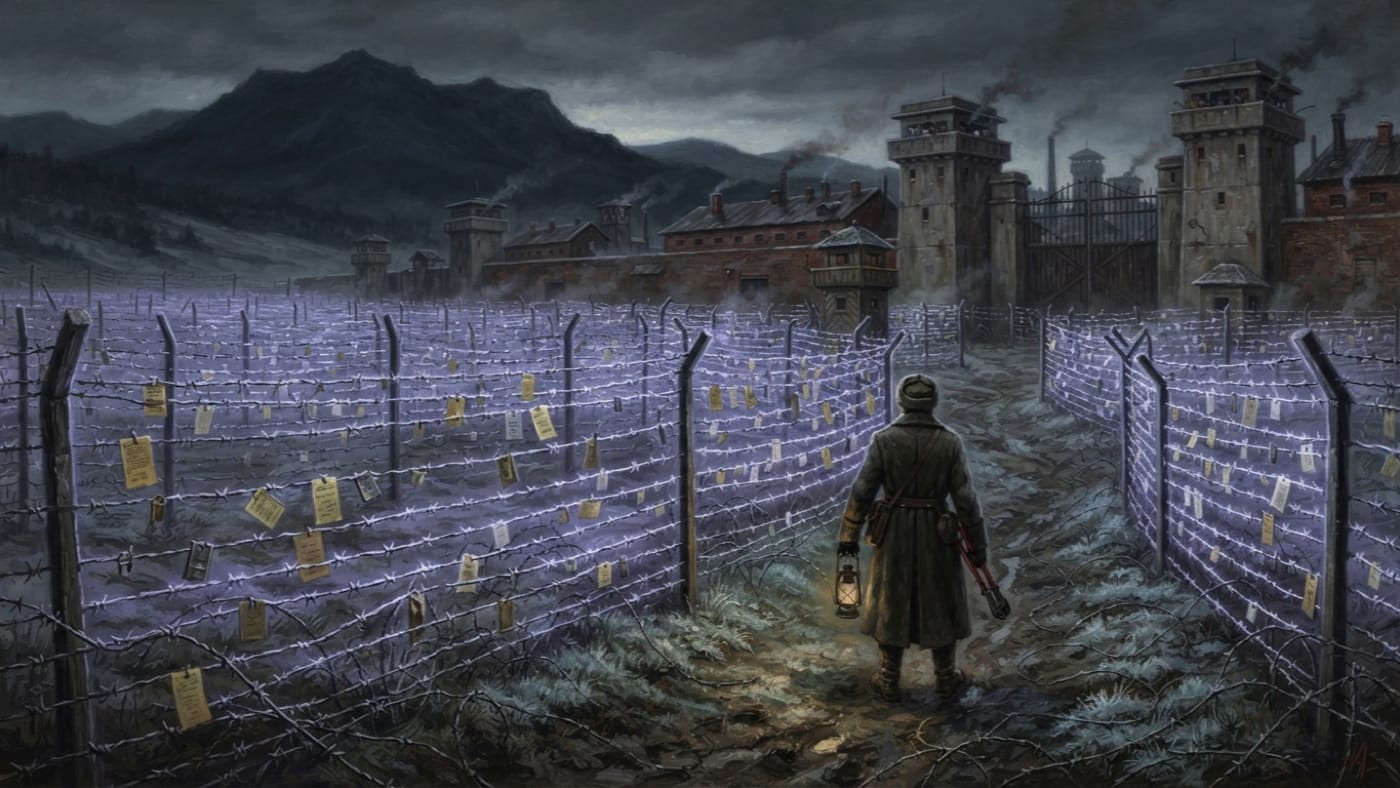
#On the Sound in the Orchard
"If the wire hums, stay humble." — Proverb of the Orchard
Every wire hisses. String barbed steel across a Carpathian ridge, hang it with ration tags, transit chits and confession receipts, run current through it, and the passes will play it all day like a psaltery left out in the rain. The Wire Orchard at Bastion-Przemyśl makes this noise from dawn harvest to curfew bell. The causes are dull and mostly known: slotted paper, loose wax, strand tension and the buzz of current. That noise belongs to the Bureau of Engineering and its oilcans. This entry does not concern it.
The Wire-Hymn is the other sound. It is low and harmonic, and it comes on some nights and not on others, following no calendar the Bureaus have been able to write down. The garrison calls such a night a Humming and stays indoors when duty permits. A lane where it is heard is a singing street. The Bureau of Bells filed it as Wire-Hymn Resonance, and the soldiers kept the shorter name.
No choirmaster composed the Hymn and no rubric orders it. It appears in no peal-table of the Bell Codex. Nor was it a single event: it recurs. Przemyśl stands third of the seven bastions on the Sagittal Line, counting from the north, with the eastern Carpathian heights of Atheron across the valley. The Hymn sounds in the iron the bastion strung to keep him out.
#On the Names and Their Accompaniments
"Names are heavier than bodies." — Proverb of the Orchard
The parent survey of the bastion records that the resonance starts in the outer strands, which are the oldest wire, and moves inward through the grid toward the towers. What soldiers report hearing in it is names.
Some are names on the day's rolls. Some appear on no current roll at all. The bastion account records names of the dead and names of persons who have not yet arrived at Przemyśl. I give these as the witnesses gave them. A sentry who hears a dead man's name has heard a dead man's name. Whether the dead man said it is a question for the Bureau of Doctrine, and Doctrine has refused to take it up. A name heard before its bearer arrives may be prophecy, or rumour working backward, or a clerk's memory adjusting itself after the fact. The Ledger cannot tell these apart, and neither can I.
The surveys also record what comes with the names. Tags lift on their strings when there is no wind. Ink on freshly stamped forms creeps into spirals. Sleepers wake with wax in their ears that they did not put there. Bells fall out of time with one another. Patrols lose their way in streets that are perfectly straight.
On the severe nights, which the bastion account puts at three or four a year, the wire is said to move. Lanes that ran straight at dusk are bent by dawn. Some close, and others open where the map shows posts. No account I hold describes a witness watching a strand move. The morning finds the Orchard laid out differently, and the night sentries swear they never slept. Both reports go into the file, and the file does not choose between them.
"The resonance begins in the outer strands — the oldest wire, strung in A.S. 75." — Bastion-Przemyśl survey, as it has been read by later correspondents.
Clarified. A.S. 75 (1785 CE) dates the Orchard's first full extension to two miles, and with it the oldest strands the survey identifies. It dates the wire, not the Hymn. No file in my keeping dates the Hymn's beginning or its first recorded occurrence. The three-mile consolidation belongs to A.S. 92, two years after the Concordat of Strasbourg and no part of it.
#On the Bureau's Explanation
"Never argue with a stamp." — Proverb of the Orchard
The Bureau of Doctrine's recorded position is that the Hymn is "a resonance phenomenon consistent with wind conditions in the Carpathian passes." The position is short, and it is sealed.
The Bureau of Bells replies that the Hymn follows no known tonal system, answers to no known wind pattern, and sometimes sings the names of people who have not yet arrived at the bastion. The parent survey credits Bells with seventeen analyses. None produced a report Doctrine would accept. Bells is the office constituted in A.S. 52 to decide what metal may say in public, and it takes the Hymn personally: an uncertified source in a frontier fence is chanting with more conviction than any bell-master on the Line.
Bells classed the matter as a Category Two Localised Acoustic-Administrative Disturbance. The Bureau of Records classed it as Pending. Neither classification describes how the sound works. Each describes which drawer its papers go in. Engineering has added only that replacement wire "does not always agree," and has been allowed to say no more.
The Orchard survey for A.S. 201 notes that Hymn reports have increased during dry wind. Doctrine regards this as confirmation. Bells regards it as weather that happens to coincide with an anomaly. Both offices quote the same line in their memoranda. The quarrel has outlived several of the clerks paid to keep it going.
BELLS REFERRAL — ORIGIN OF RESONANCE Known to: ████████ Suspected by: Bureau of Bells Source beneath Orchard: ████████████ Disposition: NOT FOR PRESENT CONSIDERATION
#On Keeping a Lane Through It
"If the wire says your name, don't answer. It's counting you." — Common superstition, Orchard Ring
The Orchard Wardens maintain the grid and walk its lanes, and on Humming nights they go on doing both. Their precautions are those of the whole garrison, and they are modest.
They lay a salt line across a tower threshold and sweep it back into place each morning. They put wax in their ears, untroubled that the Hymn's best-documented companion is men waking with wax they never put there. They carry silent paper: blank sheets kept inside the greatcoat so that whatever writes finds nothing to sign.
Blank paper is listed contraband at Przemyśl. A refugee caught with an unwritten sheet in Taghouse Row has, in the clerks' reckoning, carried a weapon that can be loaded with any name. A Warden carries the same sheet past the same clerks in the same coat pocket as a matter of piety. I have found no exemption that reconciles the two. I have also found no clerk willing to search a Warden's coat on a Humming night.
The Chapel of Counting blesses the Wardens' cutters. When a strand is cut, a replacement barb goes up within the hour. The Wardens say the replacements are identical, and Engineering's remark stands beside their testimony without comment. A Warden whose lane has moved overnight must still report it open or closed. The form has no third box. The Warden ticks one, and the next patrol walks whatever the tick turns out to mean.
Nobody has shown that any of these measures works. The salt has never been tested against a control threshold, and no one has asked a man who answered his name to fill in a form. The superstition does not say what happens to those who answer, and no record I hold says it either. What the precautions certainly do is fill the night with chores, and a man laying salt is not lying awake listening.
#On Names Admitted to the Ledger
"You can't eat truth." — Proverb of the Orchard
In any other place the Hymn would be a ghost story. At Przemyśl it is an administrative fault, because Przemyśl is the bastion that issues existence. Taghouse Row stamps the tags, and the tags carry life-days, the dates between which a man may eat. Sealwright-Master Joryn Malk controls the production of seals in the Candleworks. Archivist-Prelate Odran Kelle keeps the confession archives beneath the Chapel. Provost-Marshal Vanna Rook runs the dawn harvest and posts the harvest boards, whose names shift overnight. Every name in the bastion has an office responsible for it.
A name spoken by the wire belongs to none of them. Nobody can stamp it. When the wire names a man already on the rolls, the clerks feel audited from outside. When it names a man who is not on them, it threatens to add someone the ration ledger never allowed for. When it names a man the ledger has already crossed out, it disputes a correction the Tribunal considers settled. The Hymn decides nothing about rations, lanes or deaths. It does recite names without a seal, in a bastion that has spent its whole history insisting that a name without a seal does not exist.
Locals say the hum changes with audit pressure, and that they can hear a raid coming. I do not claim that an audit summons the Hymn. I do record that the people about to be audited hear it. A frightened household listening to its own fence would hear something whatever the fence was doing.
The stamp die reported missing in A.S. 200 (1910 CE) is filed in the same bastion. Its serial number appears in the records of two bastions at once. That is a dated report of loss. It does not prove a theft, and no document I hold connects the die to the Hymn. Both anomalies concern names that may be printed or recited without authority. They are filed in the same building, in separate drawers, and the drawers stay separate in this Codex.
#On the Present Account
This entry is a compilation of A.S. 201 (1911 CE) records, and the year belongs to the compilation. It dates the bastion and Orchard surveys and the current-condition returns. It does not date any inspection by me, and the Hymn did not begin in it.
As of that year, the Orchard holds. Doctrine holds that the cause is wind and Bells holds that it is not. Records holds the file. The Underwire keeps its own silent corridors, which are a separate problem with a separate file. Atheron's heights are still visible from the Orchard Ring on clear mornings. No file I hold credits him with the Hymn. Pride is close enough to listen, and that is a different thing from owning the voice.
The Wardens lay their salt. The clerks count their tags. On some nights the oldest wire starts up again and the inner lanes follow, and every man inside the Orchard keeps his name to himself until dawn.