

#On the Row as Surveyed
"Never argue with a stamp." — Proverb of the Orchard
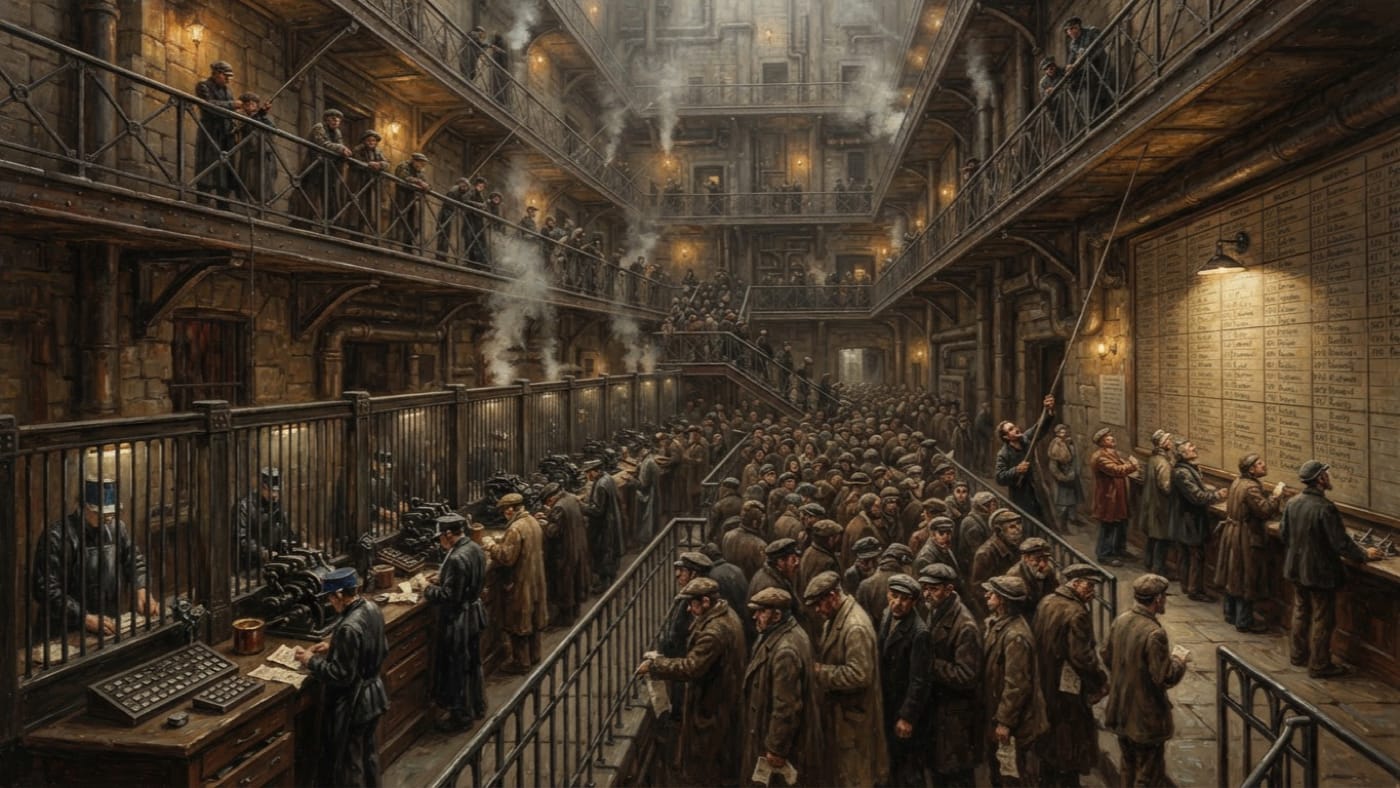
Taghouse Row is the administrative core of Bastion-Przemyśl. It is the old fortress stone at the centre of the bastion, converted into permit halls, stamp counters and confession vaults. The bastion lies in Zone 4, where the Sagittal Line crosses the western Carpathians, and it faces east toward the highlands held by Atheron. The wire guards the bastion's edge. The Row guards its arithmetic.
This survey records the district as it stands in A.S. 201 / 1911 CE: its halls, its counters, its queues and the pressure now bearing on all three. It does not record when the conversion was made, by whom, or at what cost in masons. The files available to me do not say, and I decline to plaster the gap with a year.
The Row smells of hot wax, ink, sweat and damp paper. Incense has been tried. Incense lost.
#On the Old Core
"A tag is warmer than a coat." — Proverb of the Orchard
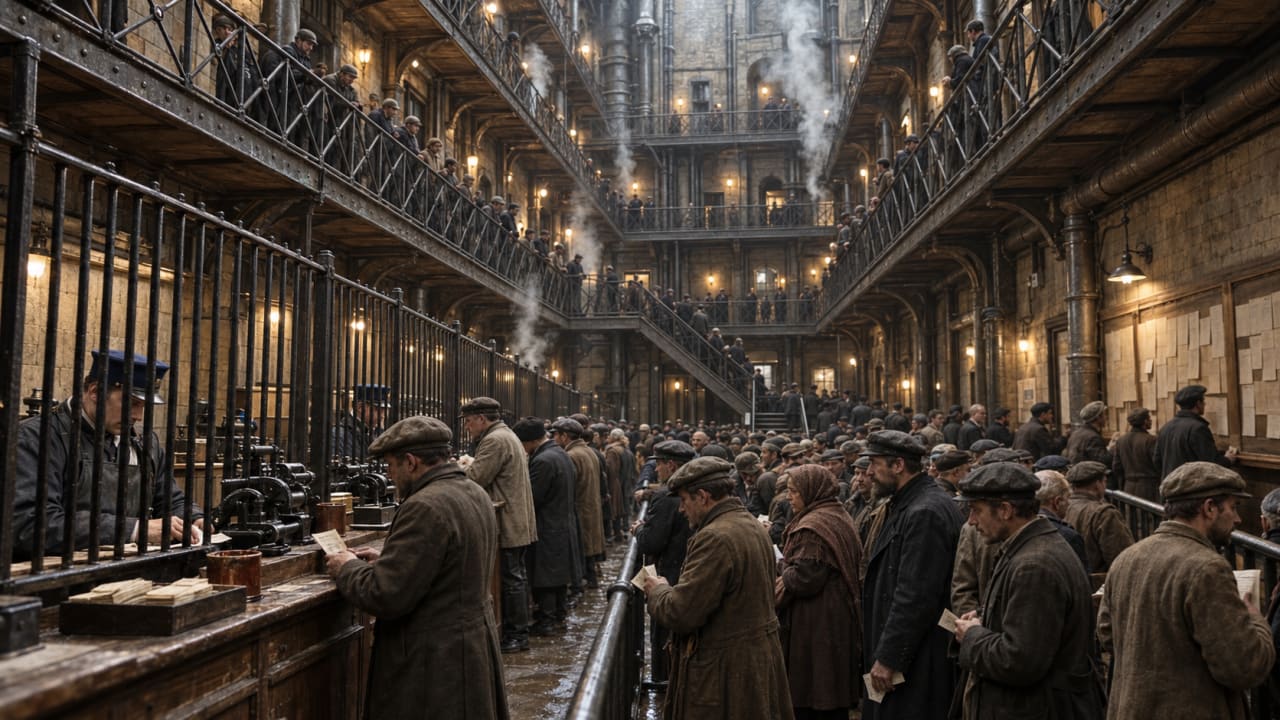
The fortress at the centre of Przemyśl was built by men who expected to be shot at, and its walls are still as thick as that expectation. The permit halls run three storeys deep inside the old stone. The stamp counters fill the length of the former courtyard, and the petitioners' lines bend back on themselves at the walls and begin again. The plan follows the logic of a reliquary: the precious matter sits at the centre and the faithful press against the grille.
The counters are barred. Behind the iron sit clerks in ink-black aprons, with presses, wax pots and trays of tags awaiting their seal. In front of the iron stand the people whose names are on those tags, and the people whose names soon will be. The presses thud across the courtyard with the regularity of a bell rung by someone who long ago stopped hearing it.
The Taghouse Steps are the worst stretch of the queue: sweat, wet paper, and the stamp crushes that follow word that a counter is closing. By common complaint the Steps are also where clerks skim life-days from tags passing through their hands. The complaint is old and general, and no file I have read proves it. Everyone who has stood there repeats it, which amounts to a kind of census.
Stamp Station 7 is the station the record names. Archivist-Prelate Odran Kelle wrote in a letter, itself stamped before it was filed, that its queue has not been shorter than forty persons since A.S. 147. I reproduce the sentence as his. Nobody has stood at Station 7 counting heads for fifty-four years, and the letter dates a queue, not a building.
At night the bastion's streets go dark under curfew, and the stamp halls stay lit. Seen from the Orchard Ring, the Row is a block of lit stone in an unlit town, still at work.
#On Verification
"You can't eat truth." — Proverb of the Orchard
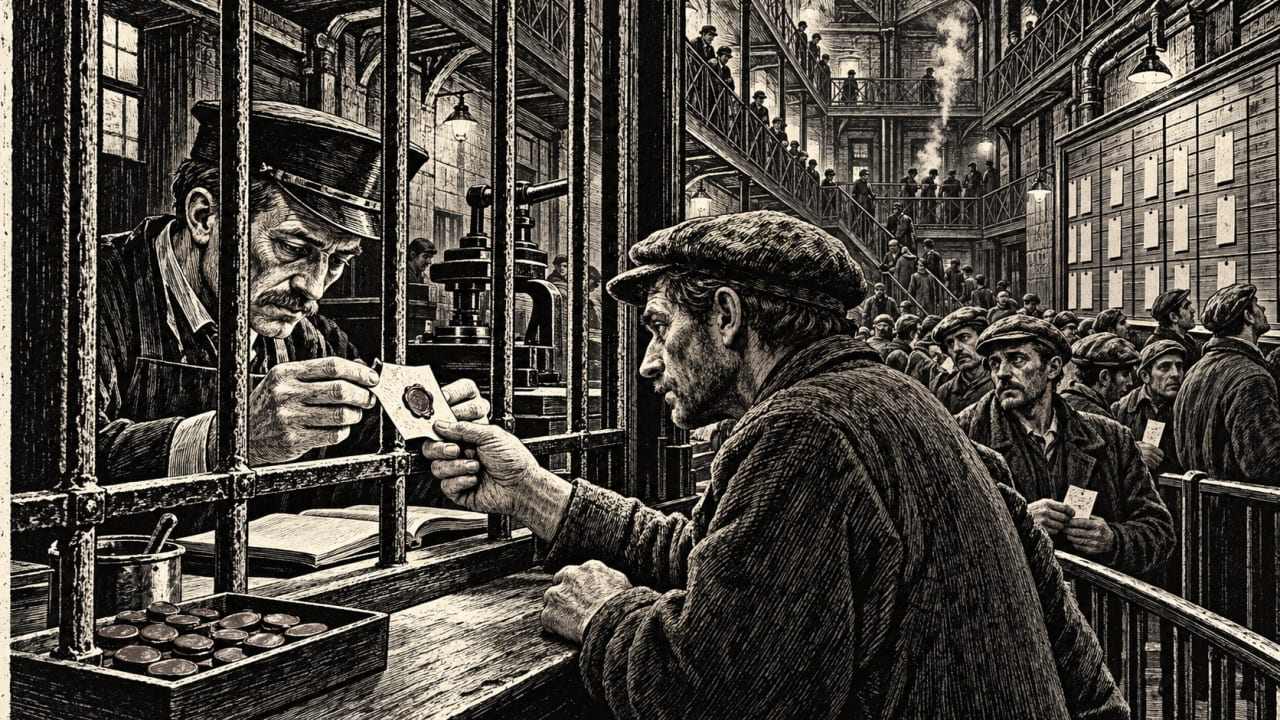
What the counters verify is the ration tag. The Wire Orchard account lists its contents: name, number, date of issue, date of expiry, permitted lane, food class, labour class, confession status and a wax seal. The sealwrights read the finer particulars of that seal with confidence, and petitioners read them with dread. The sources disagree over whether colour or cut shape carries rank, and I decline to settle a dispute among wax.
Between issue and expiry the bearer may eat, sleep under a roof, pass through the lanes his tag permits, and appear in the Ledger as a person. The days between the two dates are life-days. Locals count them the way a canon counts his prebends, and conceal the total just as carefully.
Three objects must be kept apart at the counter, because the bastion's whole economy depends on the difference. The tag carries permission. The wax seal-blank is sealing material, poured in the Candleworks Quarter, and it passes from hand to hand as currency among people with no use for coin. The stamp die reproduces recognized authority on that wax, the same impression a thousand times over, each as valid as the first. A blank buys one permission. A die makes them. How wax, blank and die are brought together is guild business, and Joryn Malk does not publish it.
The counter's work is to decide whether the paper before it is the paper it claims to be. Ink fades. Paper goes damp against the skin, a damp tag smears, and a smeared date is a discrepancy. Discrepancy is the raw material of the Logistics-Penance Tribunal.
No source in my keeping describes a full renewal at the Row from first desk to last. It gives no fixed sequence, no interview script, no fee table, and no processing time that holds from one week to the next. I will not supply them. The documented facts are these. A renewal passes a counter, and a press falls or it does not. Freight clearances and ration renewals share the same counters and the same presses, so a grain brick awaiting its manifest seal waits as a labourer waits for his.
Beyond the Row, at the forward checkpoints, paper alone has not been sufficient since the Compulsory Marking Decree of A.S. 113. There, papers and bodily marks must agree. That quarrel belongs to the lanes and their inspectors. The counter in the courtyard asks a narrower question, and it asks it of the tag.
#On Expired Permission
"Names are heavier than bodies." — Proverb of the Orchard
Expired tags are supposed to be surrendered at Taghouse Row. The Wire Orchard survey records what is done with them instead. People keep them in boots, sleeves, hair knots, bread sacks, mattress seams and the stitched pockets of funeral veils. They trade them and they alter them. Households keep strings of expired tags as family relics: a tag tree, hung where another house would hang its saint.
The street calls an expired tag rotfruit. Taking on another person's tag string is grafting. Both are orchard words, because the bastion has always described its arithmetic as harvest.
That arithmetic runs in two directions, and the Row stands where they meet. A tag still valid after its bearer has died can feed the living: a widow, a brother, a mother drawing a half-bowl against a name the audit has not yet found in the soup. A tag that has expired or been confiscated puts a living person outside the Ledger. The street word for that condition is paper-grave. The Erased still breathe. Their bread, their bunk and their passage stop, and the bastion is arranged so that a heartbeat without a record soon becomes expensive.
Beneath the Row's official business runs the Underwire, where forged papers, dead men's tags and vinegar for lifting old wax are sold from culvert stalls. The Gleaners shelter the uncounted there and swap tags between the living and the recently dead. The Church counts this as sacrilege against the Great Ledger of Souls. Those it feeds count otherwise. I record no particular petitioner, household or successful forgery, because none is documented to me, and the Row has enough invented persons already.
#On the Harvest Boards
"Dawn is a knife with paperwork." — Proverb of the Orchard
Before first bell the Provost's patrols go into the Orchard Ring with hooked poles. At first light they return with bodies on carts and tags on strings: ration tags, transit chits and identity tags, cut from the dead or worked loose from the barbs. The tags are entered in the morning ledger against the day's projected intake. When the count agrees, the bastion goes to work. When the incoming tags exceed the projection, the Tribunal audits and adjusts.
The harvest boards are where this becomes public. They are lists of names posted in Taghouse Row, close enough to the counters that a petitioner can read them over the shoulder of the man in front. A name on the board at curfew may be gone by dawn. A name missing at curfew may be there.
The queue hears three explanations. The Bureau of Records calls the alterations clerical optimization. The soldiers say the Provost. Accounts of the Gleaners credit that cell with sabotaging the harvest lists, which would put a third set of hands into ink already crowded. No file I hold names the hand behind every changed name. None establishes any mechanism stranger than a pen.
The dawn harvest takes deserters only. — Public assurance of the Orchard Ring, repeated at the harvest prayer and before the boards.
Withdrawn from this survey. The morning ledger is balanced against projected intake, and intake includes more than deserters. The assurance remains in liturgical use beside the boards. The Codex no longer repeats it as fact.
For the people at the counters, the boards are a second verification posted above the first. A man may hold a valid tag, sealed and dry, and find his name gone overnight from a list he has no means to petition. He then carries that tag to a counter whose clerk has already read the board. No published rule says which document prevails. Whatever is decided is decided at the grille, in front of the queue, and entered in a ledger the queue will never see.
#On the Offices Within the Row
"Wax-rich." — Przemyśl slang for the powerful
Taghouse Row has no governor. It has a tenant, three suppliers, and an office that would like to become its landlord.
The Synod Chapterhouse issues the decrees the counters apply. The Logistics-Penance Tribunal has its seat in the Row itself. Its charge is manifest discrepancies, ration accounting and administrative correction, and its methods are audit, confession and erasure. The Tribunal is one institution within the district. The district also contains the queues, the Steps, the boards, the presses, the freight clerks, the petitioners and the stone.
Three persons outside the Row hold what its counters cannot work without. Provost-Marshal Vanna Rook commands enforcement and the dawn harvest, and a Tribunal verdict without her squads is a sentence written on damp paper. Odran Kelle administers the Chapel of Counting and its confession indices, which the Tribunal reads whenever a column needs a reason. The Chapel is a separate district with vaults of its own, and the Row's confession infrastructure is not his archive moved across town. Joryn Malk controls the wax blanks and the dies, so a correction can stall for want of wax as easily as a confession can hurry it.
Their leverage meets at the grille. None of them sits behind it.
#On Revalidation
"Every honest seal is now a question." — Taghouse Row clerk, quoted anonymously at the clerk's request
In A.S. 200 / 1910 CE a stamp die was reported missing. That year dates the report. It does not date the theft, if there was one, or the first forged impression, if one has been made.
The administrative danger is easy to state. A die reproduces recognized authority. Whoever holds the missing one can, in principle, press seals the counters cannot tell from their own. Every tag so sealed is a permission the Ledger never authorized and must still feed. The counters of Taghouse Row exist to tell true paper from false, and the missing die tells them their own presses may have a twin.
The answer has been revalidation. The Wire Orchard survey records that the loss has forced three emergency revalidation drives, and that each exposed more expired persons than the previous count had admitted possible. I have no manual for these drives, and the survey supplies none. Its finding is enough. Three times the Row has called its tags back to the counters, and three times the counters have found the bastion more expired than its books had said.
That is the pressure in the courtyard now. A petitioner whose tag is in date may be called to show it again. A tag that passed last season may be refused this one. Every drive lengthens the queue on the Steps, and every refusal sends one more person toward rotfruit, grafting and the culverts.
The Bureau of Records sent investigators. Their preliminary report states that the die's serial number appears in the records of two bastions at once. What this establishes is one number in two sets of records. The report does not name the second bastion. It does not show that two physical dies exist, it does not locate the missing one, and it names no hand. Talk in the Row says a rival bastion is printing lives, and I file it as talk. No document I hold accuses Malk, Kelle, Rook or the Gleaners, and I will not be the first stationer to do so.
The Provost-Marshal has found a use for the emergency. Rook presents the dawn harvest as a matter of security, and argues that an office unable to account for its dies should answer to the command that already walks the wire. Her aim is to absorb the Tribunal under Provost command. At the time of this survey it is still only an aim. The Tribunal sits in the Row under its own name, and its clerks still wear their own aprons.
The Bureau of War has modelled what follows if the die stays lost and forged tags multiply: tag inflation, then ration riots, then mass erasures. The model is conditional and gives no starting date. It has been filed and stamped, and none of it has happened.
#On the Present Condition
The Row goes on. The presses fall in the old courtyard, and the halls hold their three storeys of paper. The boards change between curfew and dawn, and the queue reads them before it reaches the grille. By the Archivist-Prelate's account, the line at Stamp Station 7 is as long as he says it has always been.
The Nine-Hour Rubric of A.S. 195 left one sentence about the district: the falling Spire-Crusher should have crushed Taghouse Row, and instead it folded into forty feet of rubble. The sentence describes what did not happen. It gives the Row neither a ruin nor a rebuilding.
Out on the wire, the Orchard Eye sweeps the eastern ditch. It is Tower Nine in Przemyśl's numbering, and its patrol log of A.S. 199 is still missing and still denied. The tower's business is the wire. The Row's business is what the wire sends back.
The die has not been recovered, and no holder has been named. The serial number remains in two registers. The Tribunal has not been absorbed. In the courtyard, petitioners hold damp tags in their fists and wait to learn whether they still exist.