

I've finished reading the sources and am now writing the article.
#On the Ground Beneath the Ground
This survey is compiled in A.S. 201 (1911 CE), and the year belongs to the compilation alone. Nothing beneath Bastion-Przemyśl was dug, opened, named or discovered in that year by any record I hold. The Underwire is older than this paper. If the culverts hold, it will outlast the paper too.
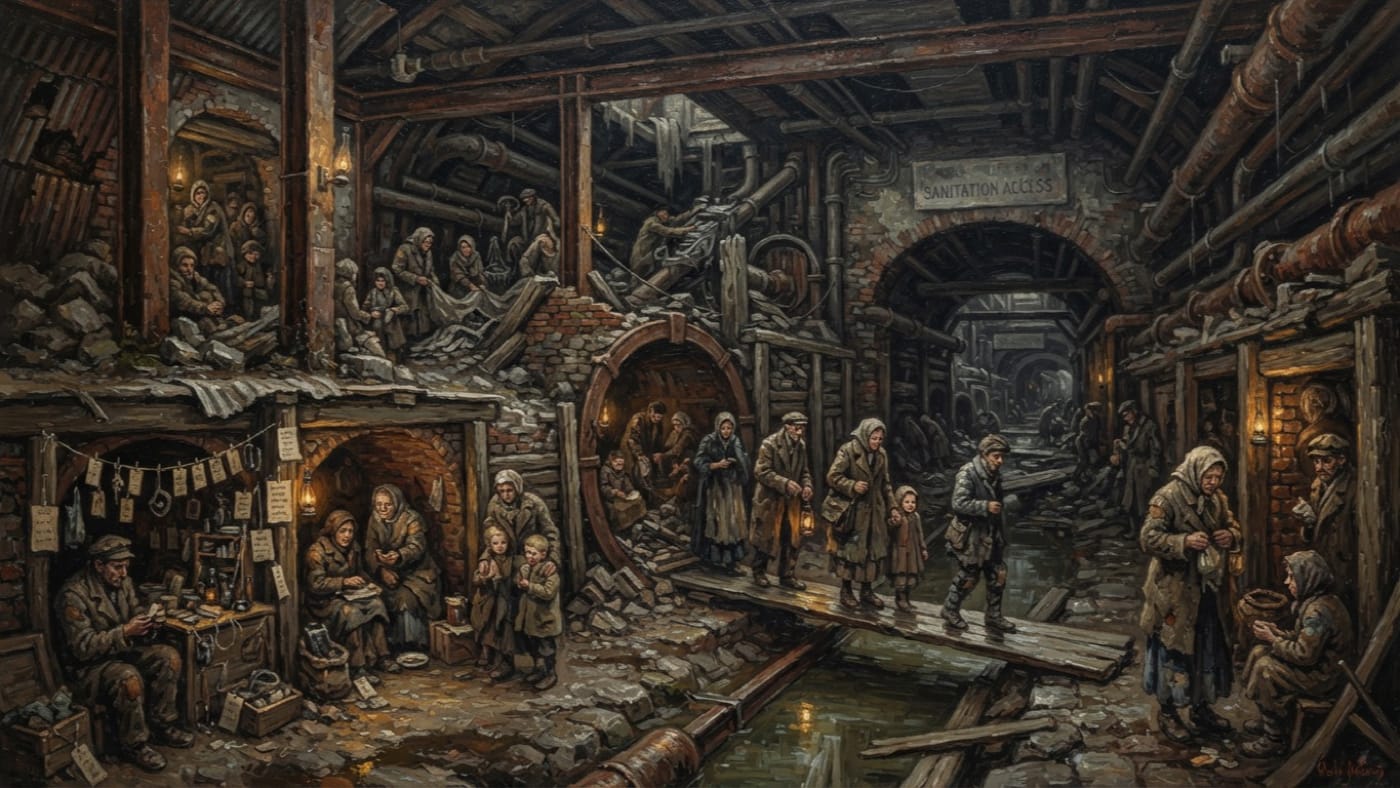
The word names ground. Below the Wire Orchard, the three-mile grid that holds the western Carpathian approaches of the Sagittal Line against Atheron's eastern highlands, lies a body of passages, cellars and wet cuts that the garrison calls the Underwire. A farmer calls his whole low field the bottom land without supposing that the stones in it have elected a mayor, and the garrison uses its word the same way. Several trades work this ground. Two organized bodies are named in the bastion's files as working there: a cartel known as the Underwire Runners and the heretical mutual-aid cell known as the Gleaners. Neither holds the deed. Brokers, stallkeepers, fugitives, widows and children who belong to no roll also live in the galleries, and none of them asks either party's leave to breathe.
#On the Terrain Beneath the Orchard
No campaign that any file records built the Underwire. It accumulated. The bastion stands on the site of an older orchard with its irrigation ditchworks, and that orchard's root cellars and buried water channels survive below the posts. The fruit trees that remain in the outer lanes are wrapped in rust-iron and used as anchor points. Their cellars were put to work in their own way.
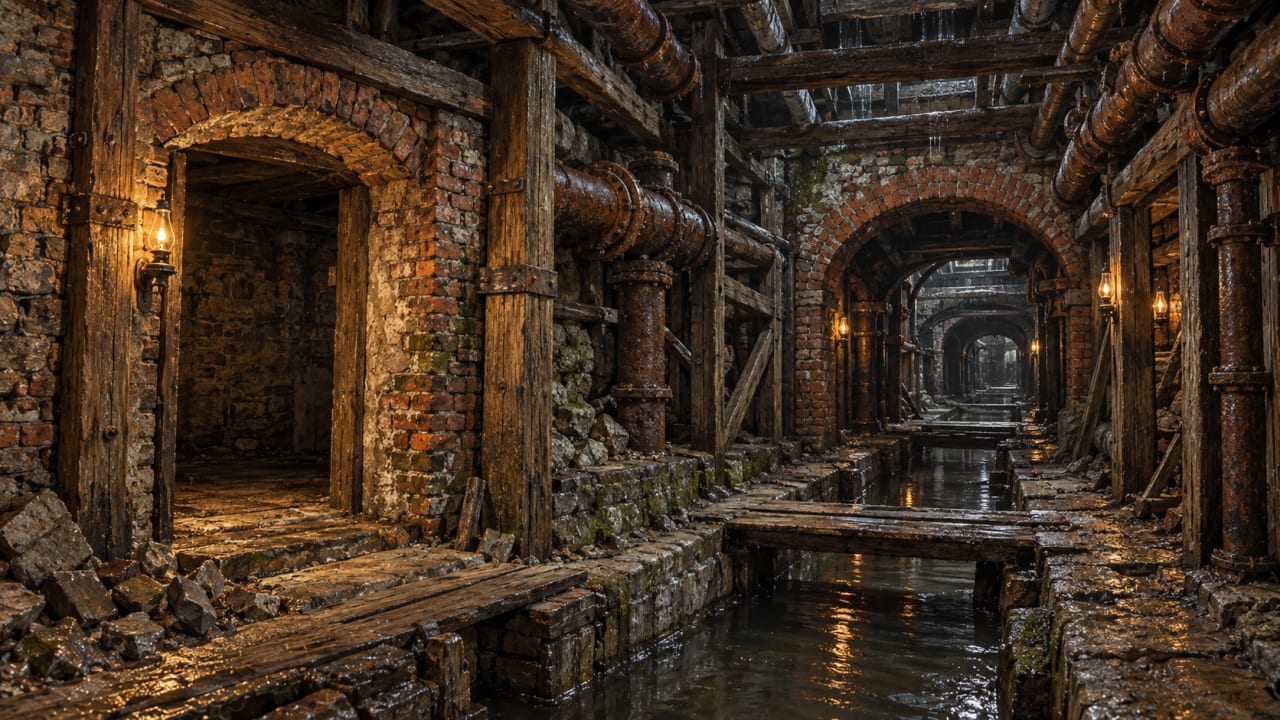
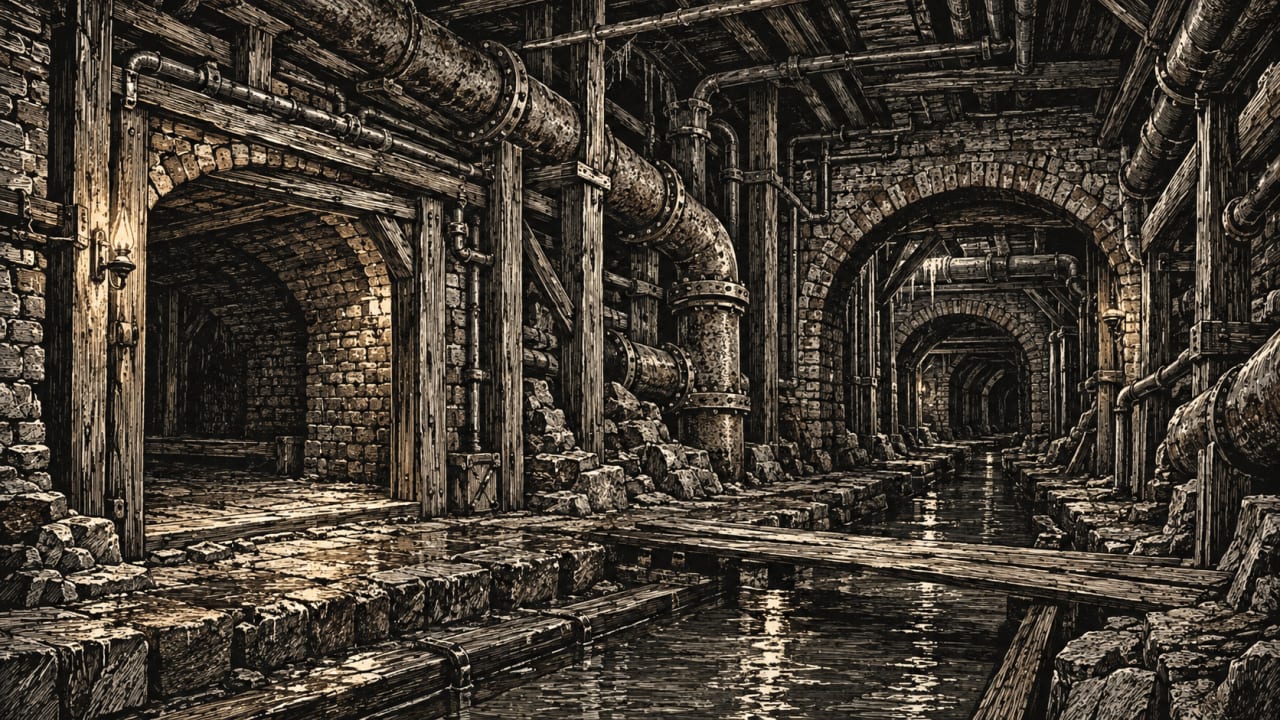
The rest of the terrain came from every engineer who ever needed a hole. The documented passage types are culverts, drainage galleries, old trench galleries, half-collapsed trenches, cable ducts and smugglers' cuts. Some carry ditch water. Some carry current toward the pylons. Some were trenches before the wire moved east of them, and were roofed, abandoned, partly filled and later reopened by people whose names Records did not want. The smugglers' cuts join things that were never meant to be joined, which is the purpose of a smugglers' cut.
The Orchard reached its first full extension of two miles by A.S. 75 (1785 CE). By A.S. 92 (1802 CE), in the consolidation that followed the Concordat, it had grown to three miles and received a permanent Logistics-Penance ward. Those dates belong to the works above. Three miles is the Orchard's extent, not a measured length for anything below it. The files do not assign any gallery to any construction season, and I will not do the assigning for them.
The district sheet gives the smells as mould, cold metal and lamp oil. The hazards are the bastion's general hazards with less air: sinkholes, trench fever, tetanus and collapse. Light is rationed above ground, where only the towers and the stamp halls glow after curfew, and below ground it is bought by the hour in oil. There are also silent corridors, where sound simply stops. The Bureau of Purity has investigated them twice. Both teams filed reports consisting entirely of the words "Nothing to report." The two reports were composed seven years apart, in different hands, and are identical in wording. The cause is unknown and stays unknown here.
The terrain meets the surface where the bastion is weakest and wettest. Tower Nine's searchlight sweeps the eastern ditch. The Ditch Locks control the water, and the district sheet records drowning cages there along with a smuggler toll shrine. One documented escape account runs from the galleries to the marshes beyond the southern gate. Where every other route ends, and whether the marsh leads anywhere, the record does not say.
The Underwire: sanitation access. — Official designation of the galleries beneath the Wire Orchard, as maintained in bastion works registers.
Corrected in scope. Sanitation crews do maintain parts of the passages. Smugglers, the Runners, the Gleaners and the stall trade also maintain them, and use them, by every account the bastion keeps. The designation stays on the register. This survey no longer treats it as a description.
#On Souls Without Current Instrument
At Przemyśl a person exists between two dates. The ration tag records a name, a number, a date of issue and a date of expiry, a permitted lane, a food class, a labour class, confession status and a wax seal. While it is valid the bearer may draw food, sleep under a roof and walk the lanes it permits. Once it expires, is confiscated, or was never issued, the bearer drops below the economy. The Ledger stops recording them and they go on breathing.
The offices have several names for such people. The street says Uncounted, Blank or Erased. The Chapel of Counting keeps the careful index heading Souls Without Current Instrument. The terms overlap without being synonyms, and none of them points to one legal cause, one organization or one condition of the soul. A man whose tag lapsed on Tuesday and a child who never received one share a heading and very little else.
The documented injuries are clerical. Confessions were misfiled. Women's ration ledgers were merged with the records of corpses, and those women were fed as dead until they stopped being fed. Children were born between census windows and are administratively premature at any age. Patients were released from hospital without having their existence reissued. Labourers carried expired tags because renewal required a counter, a queue and a clean seal, and one of the three was always lacking. Prisoners lost their places when a transport column lost a page. Refugees were misfiled at the Pilgrim-Screen.
The Underwire takes them in because nowhere else is cheap enough. Deserters come down with the Provost behind them and no tag to show anyone. Deserters' widows come down with their dead husbands' permissions, which are valid until an audit notices and fraud the moment it does. The tunnel children have the least documentation of any inhabitants. The files name them and nothing more: no household, no count, no origin. I will not supply a biography for any child the Ledger has refused to record. The Ledger's refusal is an injury already, and fabrication would make it worse.
#On the Trade in Permission
Coin is meaningless at Przemyśl. Bribes are paid in wax: seal-blanks, which pass from hand to hand among people who cannot eat a crown. The Underwire market follows the same arithmetic. It sells the conditions of being allowed to exist, and food and medicine come after.
The stock recorded across the bastion's accounts includes forged tags, dead people's tags, bootleg ink, antibiotics, seal-blanks, tower passwords, information and the occasional blank confession slip. The blank slip is the most dangerous thing in the galleries. It is a weapon that can be loaded with any sin and aimed at any name. The culvert stalls add their own goods: brand paint, false wrist plates, smudged pilgrim triangles, condemned-class cover strips, soot to age new paper and vinegar to lift old wax.
These goods exist because paper failed. In the Paper Plague of A.S. 112 (1822 CE), two hundred refugees passed the western perimeter on falsified identities, and eighty-seven died in the lockdown that followed. The Compulsory Marking Decree of A.S. 113 (1823 CE) answered by writing on bodies. At the forward checkpoints flesh and document must now agree. A borrowed tag on a living wrist is exactly the disagreement that inspectors with pigment charts are trained to find. So the costliest item below the wire is the plausible inconsistency: a flaw a tired inspector will take for a human error and not a crime. Perfection draws Purity, and a good forgery limps. How a given limp gets past a given inspector is undocumented, and this office does not teach forgery to its readers.
The Runners set much of the price. They present themselves as maintenance crews. Their real trade, by the bastion's account, is smuggling and escape routing, carried on through tunnels, codes and blackmail. They know the routes and the curfew gaps. The fortress account says they also know the moment the Tower Nine light passes the eastern ditch. That is commercial power over a terrain, and it does not amount to government of it. No chief is named. No ledger of the cartel survives in any file I hold. The independent brokers, antibiotic traders and stallkeepers trade alongside the Runners, and the record nowhere describes them as the cartel's tenants.
Never for sale: tower patrol schedules. — Bastion governance sheet, listing what Przemyśl's corruption cannot buy.
Clarified. The official schedule remains unpurchasable, as far as any audit has shown. Tower passwords, searchlight timings and curfew intelligence are reported for sale below the wire all the same. This survey does not say how the two statements are reconciled, and it reproduces no timing from either.
Debt is enforced by Ledger Bailiffs, and payment can become conscripted labour or confession reassignment. A broker who extends credit to a tagless client is lending against a body. Nobody below the wire mistakes this for charity.
#On the Harvest and the Gleaners
Every dawn before first bell, Provost-Marshal Vanna Rook sends the harvest patrols into the Orchard Ring with hooked poles. They come back with bodies on carts and tags on strings. The morning ledger is balanced against projected intake, and the Logistics-Penance Tribunal adjusts whatever does not balance. The Underwire lives on the other side of that arithmetic. Each name struck from the boards is one more person looking for a culvert.
The Gleaners are one user of this terrain. They are not its sum. The bastion files give their territory as the ditch edge and the tunnel theatre, and their methods as tag swaps, safe pits and false hymns. Nobody knows how many safe pits there are or where they lie. A person enters one when their tag fails and leaves when a better tag, a route or a family's money turns up. Recruitment is attributed to the Underwire Theatre, an illegal playhouse in the galleries where the recorded hazard is tunnel collapse. No lyric, cipher, membership count or chain of command has reached my desk. The cell's origins are undocumented. Purity has been hostile to it since A.S. 183 (1893 CE), which proves the cell existed by that year and proves nothing earlier.
The published accounts list what the cell does. It returns tags to widows. It burns forged papers. It sells clean wire. It guides deserters under dead lanes toward the southern marshes. It cuts bodies down before the official harvest, so that the name stays attached and the body stays fit for burial rites, when family payment can be raised. A family that cannot pay gets the ditch-pits. Rope, oil, tunnel labour and silence all cost money, and the cell works inside the same scarcity as everyone else. It is credited as well with sabotaging the harvest lists, which puts a third set of hands into ink that Records and the Provost already crowd.
The terrain stays hungry around the cell. Toll shrines collect. Blackmail is a recorded Runner method. A tagless stranger in a dark gallery is prey to anyone with a lamp and a knife, because no office will take a complaint from a person it does not recognize. The Bureau tolerates the Gleaners until an audit finds too many bodies recovered privately, and then it purges them. Arrested members are charged with theft of Synodal property, and the property may be tags, wire, bodies or names.
#On Confession and Recovery
The Chapel works the same people from the opposite end. A person without a valid tag can still confess, and Archivist-Prelate Odran Kelle's chaplains encourage them to. A confession makes a trace. A trace can be attached to labour, punishment, reassignment or a burial invoice. Once a tagless penitent has knelt at the grille, the Great Ledger has a claim on them again.
The Chapel calls this recovery. The Gleaners call it capture-by-mercy. The two words describe one hook seen from opposite ends of the line, and the Underwire population is caught between them. Some of the people below came down because their confessions were misfiled in the first place, so the instrument that would restore them is the same instrument that lost them.
Confession Vault A-13 holds slips whose subjects have vanished from the ledgers while the sins stay legible. Clerks report whispers at night. Kelle calls the vault acoustically troubled, and Purity keeps it under watch. The Underwire's own account is that the erased pray backward in A-13 until someone remembers the name that goes with the sin. I file that as Underwire rumour, which is the most precise filing available. It establishes no resurrection, no restoration of identity by any means stranger than ink, and no passage from any gallery into any vault. Gossip has dug that tunnel. No engineer's record shows it.
#On the Failures That Feed the Network
The Przemyśl Battery Misfire of A.S. 199 (1909 CE) is the clearest recent case of a failure above the wire becoming stock below it. Four rounds from the western service rise struck the friendly rail junction. Eleven men died. Eight received names in the public roll. Three untagged labourers received a count. A junior scribe wrote their given names in a side margin, and that margin was cut from the page. The cut is still visible.
The third round broke a Taghouse storage wall and scattered blank issue slips across the yard. Forty-two were officially recovered. Fifty-one were later identified in circulation. Records explains the difference as double counting, counterfeiting or prior misissue, and has chosen none of the three. I record both figures and do not subtract one from the other. Within a week twelve Underwire brokers had become noticeably prosperous. The cause of the misfire remains unresolved as of this compilation, and nothing in the inquiry blames the Underwire for it. The galleries did not fire the guns. They only made use of what the guns scattered.
In A.S. 200 (1910 CE) a stamp die was reported missing from Taghouse Row. The year dates the report. It does not date a theft or identify a holder, and nothing in my files names Sealwright-Master Joryn Malk, the Chapel, the Provost, the Runners or the Gleaners. The response has been revalidation. Three emergency drives have called the bastion's tags back to the counters, and each drive has found more expired persons than the previous count admitted were possible. Each refusal at a counter adds one more person to the galleries. The Bureau of Records does not count them, because they are the people it has stopped counting.
The patrol logbook of Orchard Tower Nine is also missing. Its date of loss, contents and destination are unrecorded. I note the absence here because the book recorded who walked where under the tower's eye, and the Underwire is the part of Przemyśl most interested in such a book. Interest proves nothing about where the book went.
#On the Present Condition
As of this survey in A.S. 201, Underwire traffic is reported to exceed anything sanitation can explain, and nobody has counted it. The revalidation drives continue. The Bureau of War's model of tag inflation, ration riots and mass erasures remains a conditional forecast with no starting date, and none of it has happened. Rook, Kelle, Malk and the Tribunal each press on the galleries from their own office. None of them governs the galleries, and the record does not show them governed from below either.
The survey closes in A.S. 201 / 1911 CE on the following findings. The terrain is an accumulation of culverts, cellars, galleries and cuts, of unmeasured extent and officially classed as clean. Its people are alive and administratively absent. Its markets deal in permission. Its organized users are many, and none is sovereign. Everything else the Bureau would like to know is still underground.