

#On the Passage Before the Hearing
This entry is a present documentary compilation, entered in A.S. 201, 1911 by the common reckoning. The year dates the compilation and nothing else. No record of the passage's raising, naming, opening or refitting has reached the Bureau of Doctrine, and I have not supplied one to tidy the file.
The Appeal Throat is one component of Gate Nine, the last clearance complex on the Queue Road. It is a passage. It is not the Gate, which is the whole complex, and it is not the Hall, which is the room at its far end. Three outer lanes feed the Waiting Fan, where travellers are sorted by paper colour, cargo and debt condition. The Fan narrows into the Throat. The Throat delivers into the Hearing Hall, the cold stone chamber where the Court sits. The record gives that order and very little else about the ground. It gives no length, no plan and no crossing street. I have not invented any of them.
The Throat has a roof and is built of timber, while the room it leads to is stone. I draw no conclusion from the change of material, and the Directorate has offered none.
The Throat decides eligibility. A petitioner has to become someone the Hall is able to hear before the Hall will hear him. The Fan sorts him by what he carries. The Throat then asks whether the sorting has left him anything to appeal with.
#On Boxes, Slots and Boards
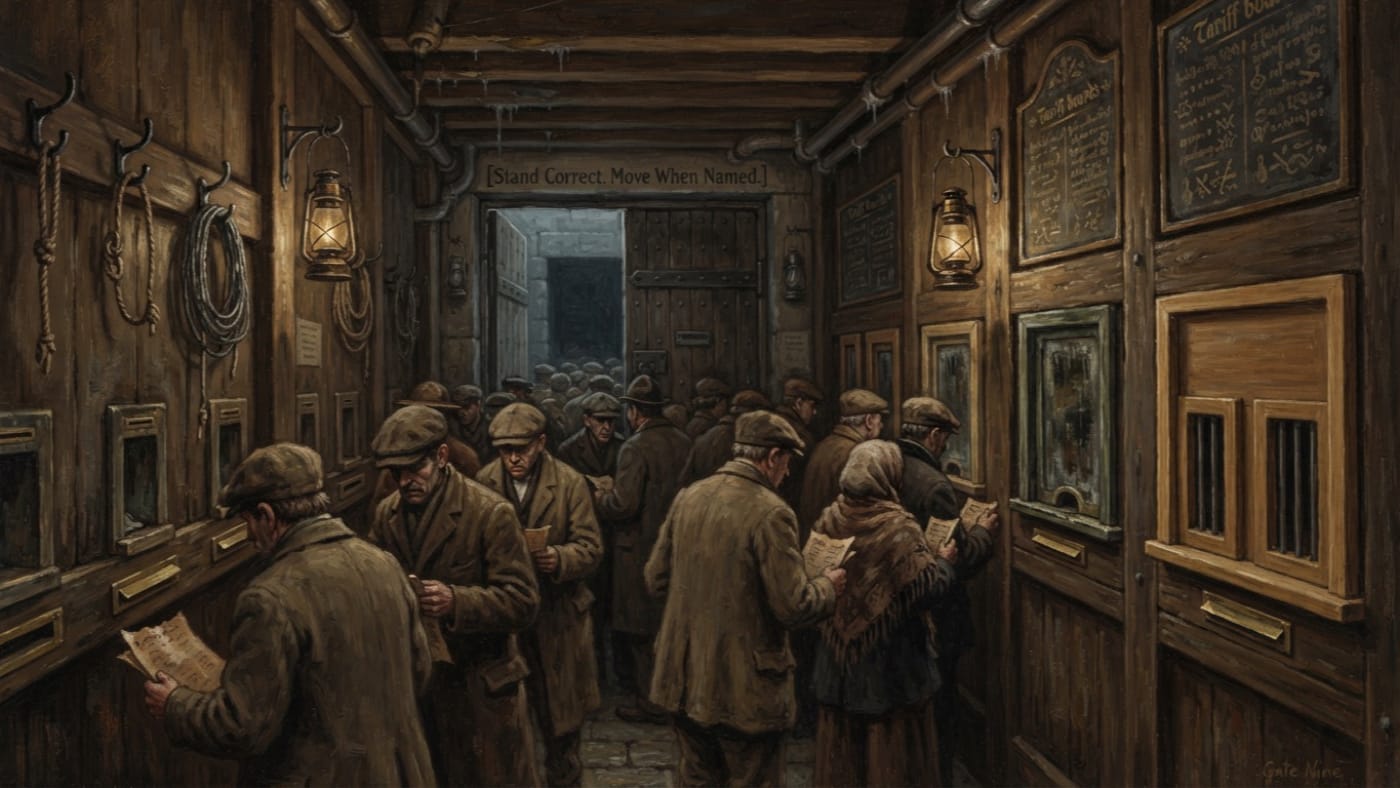
The parent survey lists the passage's fittings in one sentence, and I keep to that list. It names witness boxes, confession slots and tariff boards. It also names hooks, which hold lanterns, ropes and, now and then, wrists. Nobody has recorded how many boxes stand along the passage, how wide the slots are cut, how the roof is framed or what the floor is laid with. Anyone who says they know the board count is selling something, and Stamp Court Row is close by.
People walk past these fittings with their papers held out in front of them. The paper on this Road is easy to recognise. It is damp from the lanes, browned with vinegar ink, and the corners have been clipped for audit at earlier gates. The lanterns on their hooks give off the Road's usual tallow smoke. The stamp-clicks of the Hall carry back down the timber, and the murmur of the Fan follows people in. A passage gives a crowd nowhere to go except forward, and this one has no other purpose.
The tariff boards hang there to be read. The posted order forbids touching them. I find the rule more revealing than any figure the boards might show. An office that has to forbid people from touching its prices has learned how people's hands behave when they are reading them.
#On Witness and Fee
The published dossier on the presiding officer puts the Gate Nine Daily Order at this passage. It is posted where the Throat narrows the crowd, so that everyone has to read it on the way in.
The first five lines are crowd discipline. The last four are a chain, and each link makes reconsideration depend on something the petitioner has to hold already. An appeal needs testimony. Testimony costs a fee. The fee needs a mark, and the mark needs standing. Follow the chain back and it ends at a person whose standing nobody has removed.
A petitioner whose standing has been struck has nothing at the far end to grip. The act that struck him is the one thing he would appeal, and the chain does not let him begin. The posting allows no exception. It names no relief for the struck and no office that hears complaints about the rule. The Throat has no jurisdiction of its own that might grant one. It is a corridor, and a corridor rules on nothing. It only displays the conditions.
The witnesses mostly come from outside. The Witness Rental Houses of Stamp Court Row supply testimony to Gate Nine hearings. Their established methods are coached statements, purchased contradiction and perjury rings. None of this proves that every witness at the Throat is hired, or that every hired witness lies. Most testimony on the Road is ordinary, and the Houses do best when it stays that way. The record also does not say who owns the witness boxes, who staffs them, or whether the Houses have any claim to the timber they stand in. The boxes belong to Gate Nine's fittings. Who sells what goes into them is a separate question.
Mother Venn and Garrik Two-Names jointly run the largest documented ring in the trade. They do not own this passage, they did not found the trade, and nobody has shown that they direct the whole cartel. They have a ring, and it is the largest. That is the full extent of what is documented about them.
The Bureau's survey of the Hearing Hall states that "the largest house answers to Mother Venn and Garrik Two-Names."
Corrected according to the dedicated survey of the Witness Rental Houses. That survey records the largest ring, run jointly by the two of them. A House is a building, and a ring is a body of witnesses. The Hall's wording is withdrawn for any reading of the Throat.
#On Confessions Entered
The slots are the Throat's quietest fittings and the hardest for me to describe. A slot is an opening, not a booth. The Bureau has no record of what is on the far side of these openings, who receives what is passed through them, or how it is filed. I have no interior for them to describe, so I will not describe one.
The wider procedure is on record. Confession booths stand beside the courts, and they index every admission by timestamp. An admission made this season can be set beside one made later. Any difference between the two is kept and can be used against the person who made both. The Throat's slots belong to that procedure, and I hold nothing more exact about them.
Four accounts meet in this passage, and the Road profits whenever a petitioner mixes them up, so I keep them apart here. Minute credit is earned by eligible recorded waiting and can be transferred or sold. Minute debt comes from missed marks, failed audits, penalties and wrong-lane conditions, and it compounds. One petitioner can carry both on the same paper. The witness fee is a separate matter. It buys access to testimony, and the posted order makes testimony the condition for any appeal. Confession is separate again. Confessions and favours are what the Court accepts in exchange for its mercy. That mercy is granted in the Hall by Mistress-Court Sera Nox. It is not dispensed at a slot in a timber wall.
The published surveys do not all agree on whether an accepted claim can be set against a charge. I record that they disagree and leave it unresolved. I hold no rate of exchange between these four accounts and I have made none up.
#On What Reaches the Bench
Three authorities shape what the Throat displays, and none of them sits in it. The Permit Directorate sets the rates. Whether any particular board at the Throat has kept up with them is not in my file. Clerk-Prime Yoren's Time Clerks' Collegium keeps the ordinary ledgers, and those ledgers decide whether a mark exists for a fee to rest on. The Gate Nine Court hears appeals and decides them in the Hall.
The Court keeps hours, and those hours are for the Hall. Witnesses arrive at second bell. The Mistress-Court hears selected formal appeals at fourth. Anyone giving testimony at those sittings has to go through the passage to reach them. The record ties no other hour to the Throat. It says nothing of when the passage opens or closes, and it names no keeper of the boards.
My account ends at the Hall's threshold, under the motto painted in black above the door: Stand Correct. Move When Named. The desks, benches, cells and stamp room on the other side belong to the Hall's own entry. The Throat's work is done once a petitioner crosses that threshold with a witness, a fee, a mark and standing. A petitioner without them is still in the passage, reading boards he is not allowed to touch.
#On the Present Compilation
This compilation inherits the pressures of A.S. 200. That spring, minute prices on the Road doubled without any published decree. That autumn, Gate Nine closed for sanitation, and within three days bodies were piling up in the Barricade Maze. Those were events of the Gate and of the Road. The Bureau holds no record of any incident inside the Throat in that season, no count of dead in its timber, and no name of the officer who ordered the closure. I enter none of them.
As of A.S. 201 the Directorate has strengthened the Waiting Fan's railings and added two witness windows to the Appeal Throat. The record gives no installation date, no contractor, no total number of windows after the addition and no effect on intake. More windows give the order on the wall more places to be satisfied. They do not change what the order requires. Gate Nine remains under Amber assessment. That assessment belongs to the parent complex, and the Throat has no seal of its own.