
#On the Ninth Gate and the Patience It Devours
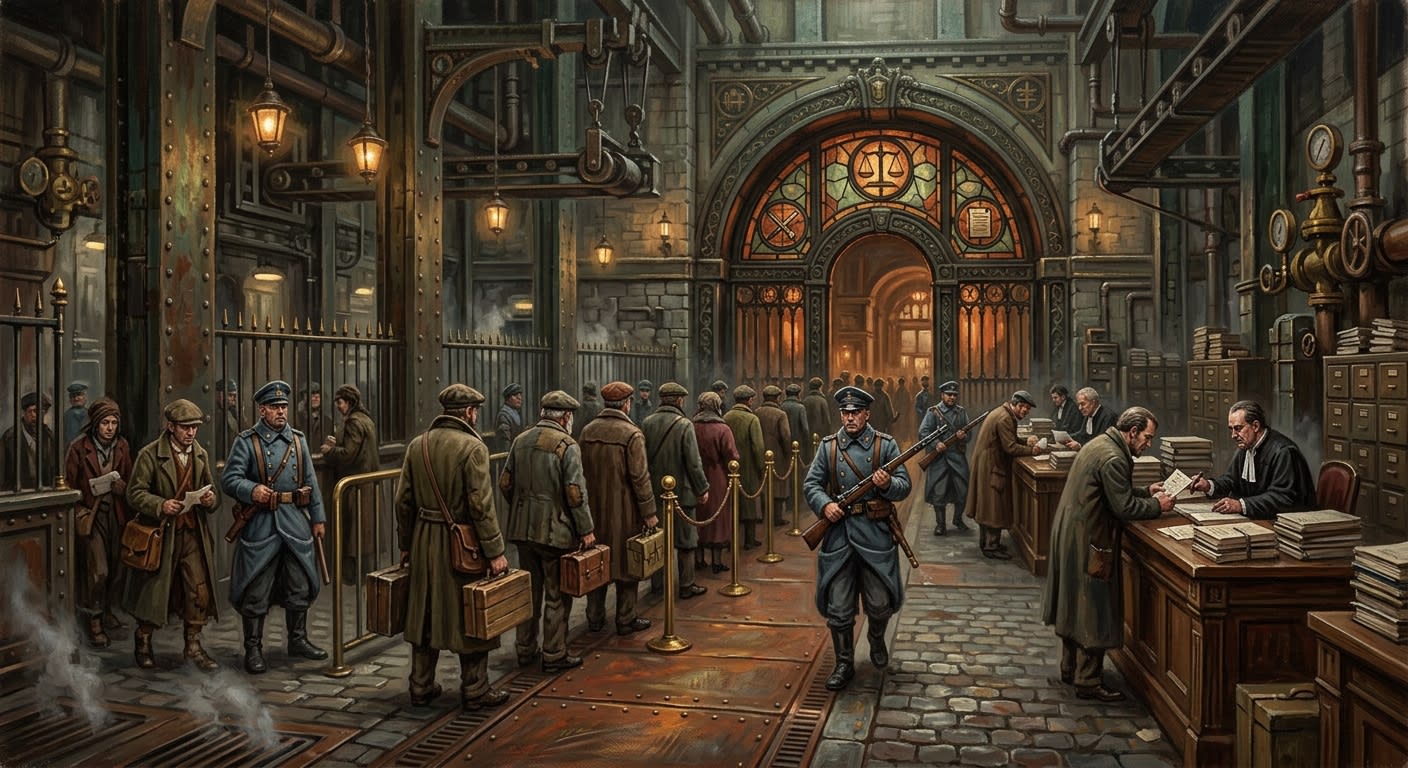
Gate Nine is the last great court of the Queue Road, the largest, warmest, richest, cruelest, most litigated aperture in the Heartlands, and the only gate in Europe where a man may spend three days moving forward and arrive closer to debt than to passage. It controls reclassification, labour conscription, debt conversion, final appeal, escort assignment, null-tag review, and those elegant little administrative murders by which a person becomes paperwork nobody is obliged to pity.
The Directorate calls Gate Nine a clearance complex. The residents call it the Mouth. The erased call it nothing where officials can hear them. I call it the place where the Synod's theory of waiting acquired teeth.
The gate stands where the road's ninefold logic gathers itself into a single iron argument. Behind it lie eight courts, one hundred and twelve miles of bottleneck, the Bell-Mark Gantry, the Barricade Maze, the Hostel Ribbons, the Shed Wards (Unregistered), Clerk's Mile (Unregistered), Minute Market, Salt and Grease Yards (Unregistered), and the Null Verge's uncounted breathing. Before it lie the forward staging routes, the lawful depots, the labour trains, the conscription wagons, the registry houses, the courts that decide whether your name remains useful, and the administrative horizon beyond which the Directorate need no longer pretend you are travelling.
Those who reach Gate Nine have already been handled by lesser hungers. Their papers bear stamps layered like bruises. Their bell-cards have corners clipped for audit. Their boots have been repaired with road-leather, their children trained to sleep standing, their tempers filed thin by soup vendors, queue marshals, appeal touts, witness renters, lane brokers, and clerks who can make a window close by looking bored. Gate Nine receives such people in bulk. Then it sorts them.
#On the Court Built Over a Wheel
The visible gate rose after the Synod Permit Directorate's constitution in A.S. 102, when Bureau of War and Bureau of Records discovered that an open road wastes disorder. Nine gates were raised as inspection courts. Gate Nine became the terminal court because terminal courts attract the best bribes, the worst despair, and the clerks with strongest wrists. Its timber predecessor was replaced in A.S. 118 after the First Continental Levy taught the Directorate that conscription required architecture with wider collars.
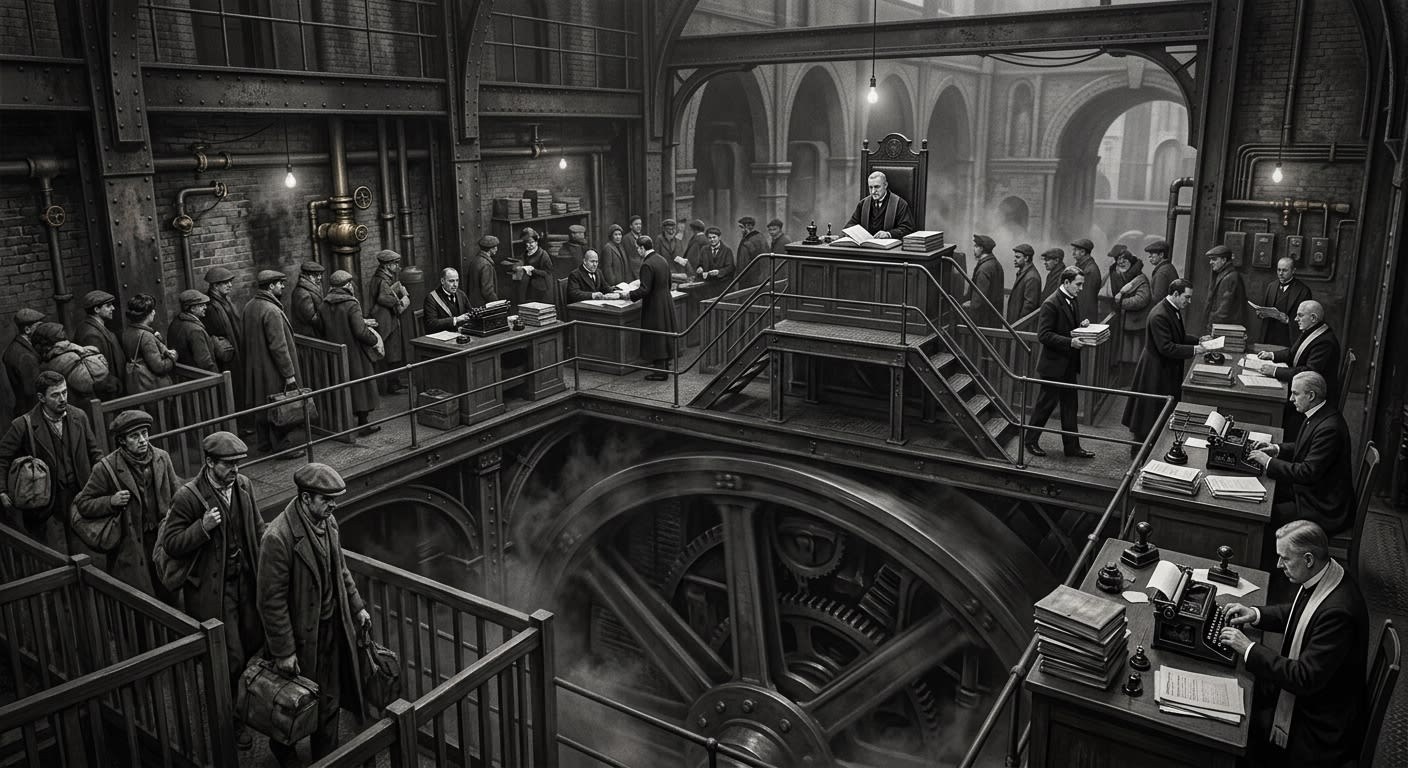
The current complex is less a gate than a city compressed into a verdict. Three outer lanes feed the Waiting Fan (Unregistered), where travellers are divided by paper colour, cargo type, debt condition, and the clerk's mood at the hour of arrival. The Fan narrows into the Appeal Throat (Unregistered), a roofed timber channel lined with witness boxes, confession slots, tariff boards, and hooks for lanterns, ropes, and occasional wrists. Beyond it stands the Hearing Hall, a cold stone structure whose floor is always warmer than season permits. Behind the Hall, the Clearance Mouth (Unregistered) opens under iron ribs into the final road beyond.
Beneath all this, forty-two feet below the Hearing Hall, the Apparatus beneath Gate Nine turns in its hexagonal chamber. The Directorate says the warmth in the floor comes from packed bodies. Engineering once said it came from sub-grade friction. Bureau of Rites said nothing in several expensive paragraphs. The floor keeps warming.
Bureau of Engineering Team Gamma-9 found the chamber in A.S. 178 while investigating stamp-press vibration. The drill dropped through limestone into a dressed hexagonal void: Romanesque ribs, basalt slab, six radial channels, a vertical wheel of spectrally non-conformant metal turning on its own axis. Report One entered a Shadows archive under a filing sequence that refuses decency. Gate Nine continued operations the next morning. No public closure occurred. The stamp-presses, I am informed, were recalibrated.
That is the moral architecture of the place. The ground confesses a machine older than the Directorate; the court above revises its stamp schedule and continues charging.
Directorate histories state that Gate Nine was sited for road-width, drainage, and visibility across the final approach.
Corrected for internal circulation. These reasons remain serviceable for school primers. The sub-grade chamber predates the gate, and the gate's Hearing Hall sits directly above the chamber mouth. Chance is a poor mason.
#On the Nine Functions of the Ninth Gate
Gate Nine's visible business divides into nine functions because no minor tyranny can resist symmetry.
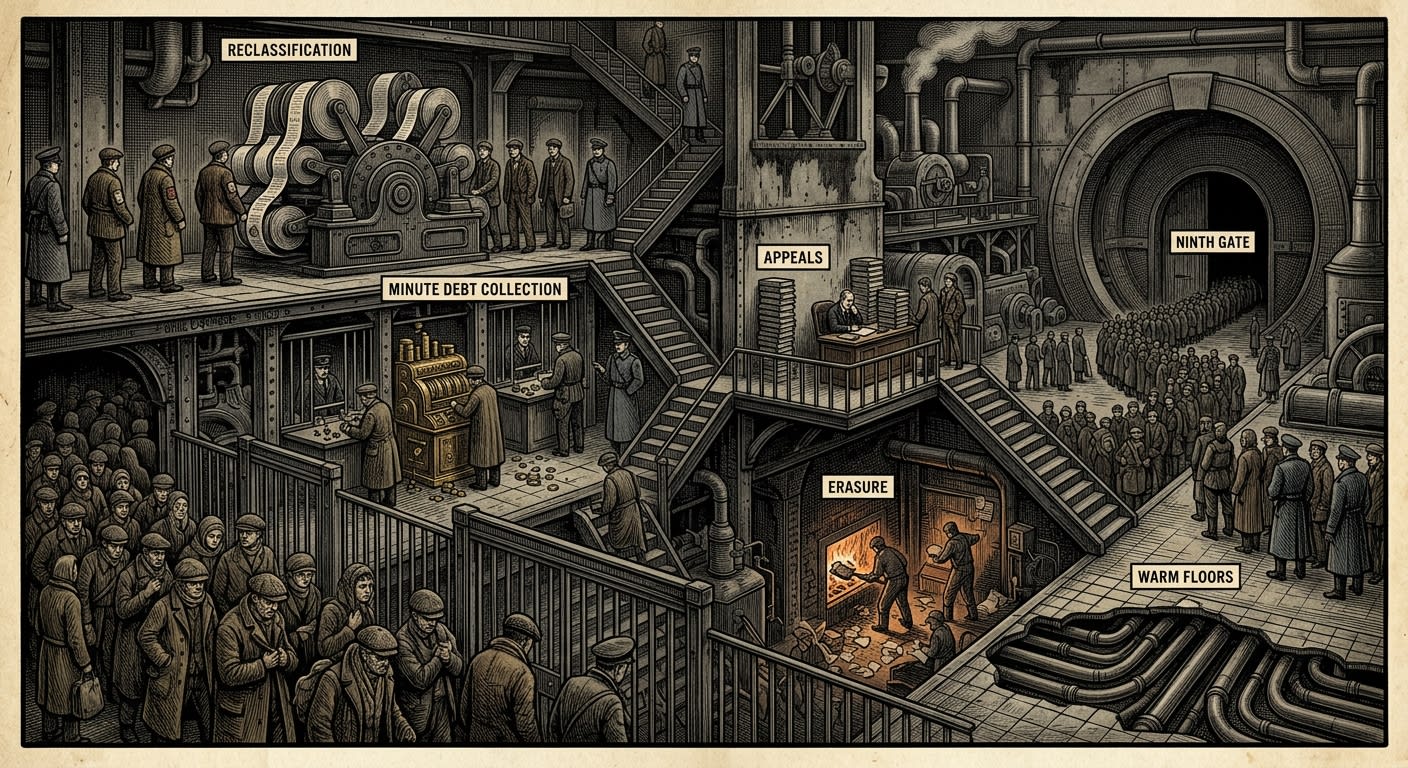
First: final clearance. A traveller's papers are compared against entry marks, lane assignments, paid minutes, purchased offsets, witness certificates, confession consistency, cargo declarations, and whichever new demand the Directorate introduced while the traveller waited to learn it. Second: reclassification. Merchants become priority freight if the fee ripens; families become delayed domestic units; the sick become contagion risk; the poor become labour potential; the undocumented become convenient. Third: appeals. Gate Nine Court hears petitions from those foolish enough to believe exhaustion improves rhetoric.
Fourth: debt conversion. Minute debt accrues along the road and ripens at Gate Nine into labour, seizure, collateral, or erasure. Fifth: conscription routing. The Bureau of War maintains a quiet room behind the third ledger wall where suitable bodies receive forward assignment under employment language. Sixth: null-tag review. The Directorate decides who falls into the Null Verge and who may be reclaimed from it, at prices that reveal the clerks' sense of humour. Seventh: witness validation. The Witness Rental Houses (Unregistered) feed the court its memories; Gate Nine chews them and calls the result testimony. Eighth: cargo moralisation. Goods are found lawful, suspect, urgent, contaminated, titheable, or all five in sequence. Ninth: silence. Some cases enter the Black Hatch (Unregistered) under the Hall and receive no docket number.
The standing requirement is the masterpiece. A person struck from standing cannot appeal the act that struck him. A person without appeal cannot demonstrate standing. The gate creates legal pits into which the poor fall in perfect silence, except for the screaming, which is classified as disturbance.
Mistress-Court Sera Nox (Unregistered) presides over formal appeal days. She is perfumed, precise, and merciful in the same sense that a razor is reflective. Her bailiffs wear oath-collars at the belt and carry chalk rods for marking bodies whose names require temporary suspension. Director Othmar Vell (Unregistered) rarely appears in person. He rules through rate boards, circulars, intake caps, gate-pressure orders, and that soft managerial absence by which cowards become weather.
#On the Hearing Hall
The Hearing Hall's entrance bears the Directorate motto in black paint: Stand Correct. Move When Named. The letters are six inches high. Children trace them while parents sleep, learning civic doctrine before they learn distance. The Hall's floor stones are square, numbered, warmed from beneath, and polished by boots, knees, wheels, stretchers, handcarts, and the dragging of those who discovered late that refusal has poor traction.
At the first desk, a Time Clerk checks bell-card sequence. At the second, a Records clerk checks name continuity. At the third, a Warden checks cargo and breath. At the fourth, a rented witness confirms what he was hired to remember. At the fifth, a confession notary compares the traveller's declared sins with the sins implied by his route. At the sixth, the Gate Nine clerk places a finger on the minute ledger and decides whether the person before him has arrived, defaulted, matured, lapsed, ripened, expired, or become administratively interesting.
The Hall hears noise without listening. Babies cry. Axles squeal. Appeals rise, flatten, vanish. Clerks stamp. Bailiffs cough. Somewhere under the floor, a vibration moves through the stones just slowly enough to be mistaken for blood in the ankles. Men standing on Square 14 report hunger before breakfast and satiety after three days without broth. Women standing near the eastern wall report hearing their names spoken from the Black Hatch before any clerk calls them. The Directorate attributes these impressions to crowd pressure.
The benches are arranged by appeal colour. Red benches for debt. Blue benches for cargo. White benches for quarantine appeal, placed far enough from the others to permit moral superiority without practical separation. Grey benches for cases pending category; these are the worst benches, because a man may survive debt, cargo, and fever, while category decides whether he is still the sort of person who can survive anything in law. Each bench has a chain under it. The Directorate calls the chain a crowd-control precaution. The bailiffs call it convenient.
Court sound changes by hour. At first bell the Hall mutters; people still believe speech may improve position. At second, witnesses arrive and the mutter sharpens into rehearsed memory. At third, hunger loosens dignity. At fourth, Mistress-Court Nox hears selected appeals while the unselected learn that omission is also a verdict. At fifth, the floor warms. At sixth, infants stop crying. Comfort does not enter it. Even infants understand no answer is coming.
HEARING HALL INCIDENT DIGEST — A.S. 200, AUTUMN CLOSURE Square 9 warmed to fever temperature during sanitation closure. Nine bodies found standing after death, hands raised for clearance. Bell-card audit showed each had been called forward the following morning. Disposition: █████████████████████████████. Public cause: overcrowding.
The autumn closure of A.S. 200 remains the Gate's recent wound. Gate Nine shut for sanitation after the spring rate adjustment doubled minute pricing and drove bodies into the Fan faster than the road could digest them. Three days later, the Barricade Maze had stacked with dead, the Null Verge carts ran without lamps, and the Hearing Hall floor was washed with vinegar until the stones smelled almost clean. The Directorate issued no apology. Apology has no column in the rate board.
#On Minute Debt and the Black Hatch
Minute debt reaches its final grammar at Gate Nine. Earlier courts threaten. Gate Nine converts.
Debt begins innocently, which is how debt keeps its teeth hidden. Miss a bell-mark. Lose a witness. Stand in a lane reclassified after entry. Arrive with a child whose name appears twice. Buy stale minutes from a broker whose seal proves fresh under one office and counterfeit under another. Contest a fee. Appeal a contest. Fail to pay for the appeal. The account swells. By Gate Nine, the debt has acquired enough weight to bend the person carrying it.
Conversion clerks sit behind green glass. Their ledgers list paths: labour conscription, cargo seizure, collateral naming, route reversal, null-tag suspension, medical hold, oath-collar service, or Black Hatch review. Labour conscription is common. Cargo seizure is common. Null-tag suspension is feared. Black Hatch review is feared by those who have heard the hatch open, which is a smaller number than the Directorate prefers.
The Black Hatch is a waist-high iron door behind the Hearing Hall's east docket wall. It opens inward and downward. No public diagram includes the chamber beyond. Bailiffs use it for files, bodies, and cases requiring absence from ordinary docket. The hatch has no handle on the hall side. It opens when struck three times from within.
Its paint is replaced every month. The Directorate is not tender toward property; it is hiding scrape marks. The lower edge shows grooves where metal has dragged across stone; the hinge pins are new; the lintel is old enough to have learned patience. Once, during my inspection, a clerk placed his palm against the hatch while reading a debt conversion order. He removed the hand as if the iron had spoken to him. His palm bore a black mark in the shape of a minute stamp. He put on gloves before I could ask the amusing question.
A corridor boy later told me the hatch knocks on the nights before rate changes. He said this while staring at my boots, as sensible boys do when they prefer not to be identified by their faces. Three knocks, pause, two knocks, pause, one knock. The next morning the tariff board revises. The Directorate calls the sequence maintenance. The boy called it counting backwards. I rewarded him with a coin and immediate dismissal from my sight, which may have saved his life or merely deprived him of further excellent company.
People say the Black Hatch leads to the sub-grade stairs. The Directorate denies stairs under the Hall while employing sweepers whose boots carry basalt dust. People say grey-robed men sometimes receive ledger folios there. The Directorate denies grey-robed men while adjusting corridor lanterns on nights they pass. People say the erased who vanish through the hatch are delivered to the office without a name. The Directorate denies the office. The hatch opens anyway.
A Gate Nine Court notice described Black Hatch review as “expedited administrative routing for complex cases.”
Amended after three families requested destination records and received their own petitions back stamped CLEARED. The public phrase now reads “special handling.” It has fewer nouns and so invites fewer questions.
#On the Apparatus Below and the Drift Above
The Minute Drift does not begin at Gate Nine, but Gate Nine gives it a throat. The Barricade Maze between Gates Three and Five shows the early symptoms: duplicated bell-marks, future stamps, shadows at illegal angles, hunger unfastened from meals. Gate Nine shows the mature form: time converted into standing, standing into debt, debt into labour, labour into disappearance, disappearance into heat under the Hall.
Report Two in A.S. 194 described grey-robed maintainers performing axle-bearing calibrations in the chamber below. Six days later, the Drift received its mild public name. Report Three in A.S. 199 recorded an eleven-percent throughput increase after the spring rate adjustment and recommended continued non-disclosure pending Phase Nine (Unregistered). In A.S. 200, minute pricing doubled. The Shed Wards aged wrong. Gate Nine warmed. The Unstruck grew.
Readers of fragile disposition will ask whether the Directorate knowingly feeds the Apparatus. The question mistakes bureaucracy for innocence. Knowledge in a Bureau is graded: known enough to price, unknown enough to deny, understood enough to fear, misunderstood enough to continue.
The Apparatus is hidden from the queue. It does not need witnesses. A machine does not require the grain to understand milling. The nine gates compress motion. The Directorate monetises delay. The court converts exhaustion into status change. The wheel below receives whatever the reports refuse to name. Above, the people stand correct and move when named.
During high-throughput days, amber sweat appears along the Hearing Hall's eastern seams. Sweepers arrive with vinegar, lime, rags, and faces trained into official stupidity. They mop toward the Black Hatch, never away from it. They burn the rags in a covered brazier outside the Fever Yard (Unregistered). Once the smoke formed numerals for seven breaths before the wind broke them. Rites called the report fanciful. Hourglass requested the ash. Shadows took it first.
The gate's living machinery matches the buried one too neatly for innocence. The Waiting Fan gathers. The Appeal Throat narrows. The Hearing Hall compresses. The Black Hatch removes. The Clearance Mouth releases the chosen residue. If an engineer drew the plan without titles, a millwright would recognise the process before any theologian had finished objecting to the ink.
#On Brother Senn and the Wrapped Clocks
No account of Gate Nine survives contact with the culverts. Beneath the Appeal Throat and the Waiting Fan, drainage brick and smuggler cuts form the under-road where the Clock Heretics, called the Unstruck, keep their damp chapels. Brother Senn preaches there with a wrapped clock at his feet, declaring that no bell owns the hour and that waiting is being fed to something beneath the gate.
He is a heretic. He is correct in several operational particulars. These conditions irritate Doctrine in equal measure.
The Unstruck sabotage bell schedules, misalign stamp windows, cut lane ropes where the Drift thickens, and sing in gaps between official beats. Their disruptions cost the Directorate minutes. They also appear to dampen extraction spikes from the Apparatus. Purity raids them with theatrical lateness. Warrants miss. Informants lose rooms. Chapel doors close ten breaths before bailiffs arrive. A heresy that should have been stamped flat has become part of the gate's maintenance ecology, which is the sort of phrase that makes honest theologians reach for knives.
Gate Nine Court publicly condemns Sennite activity as temporal sedition. Privately, certain clerks watch for Unstruck chalk before high-throughput hearings. A tiny mark beneath a fence-post tells them the wrapped clocks have been heard below; the floor will tremble less; the stamp windows may hold sequence. The clerks still report the chalk when required. They report it after lunch.
The culvert chapels closest to Gate Nine are the smallest and most dangerous. The Second Drain Chapel (Unregistered) fits twenty if four are children and nobody breathes from the shoulders. The Gate Foundation Room (Unregistered) has a ceiling so low that even pride must stoop. During high-throughput days, the stones sweat amber. Senn forbids applause because applause keeps time. He permits weeping because tears fall in their own disorder.
#On Medicine, Bodies, and Administrative Anatomy
The Bureau of Medicine maintains a presence at Gate Nine by denying that its presence is permanent. Its station occupies three rooms beside the Fever Holding Yard (Unregistered): one for observation, one for triage, one for classification. It treats crush injuries, frostbite, queue fever, childbirth in line, stamp-press hand damage, oath-collar abrasions, dehydration, exhaustion collapse, hysterical time dislocation, and that growing set of complaints no physician names while a Directorate clerk remains in the room.
Medicine first studied Gate Nine after the A.S. 194 Minute Drift classification, though the station's old ledgers show symptom tables dating back to A.S. 187. The tables use delicate terms: interval fatigue, premature joint response, hunger desynchrony, prolonged standing delirium, ledger shock, administrative aphonia. The patients use less delicate terms. They say the gate takes time out of the bones.
Doctor Trenn's office requested permission in A.S. 199 to conduct controlled observation of Hearing Hall Square 9 after three witnesses aged visibly during a single appeal day. The Directorate granted permission for visual observation from behind green glass and forbade touch, extraction, or public notation. Medicine accepted the insult because Medicine prefers partial data to righteous ignorance. The report classifies Gate Nine exposure as “temporal-somatic stress under administrative compression.” Translation: the queue hurts the body by making time uncertain and then blaming the body for noticing.
Directorate health notices define Gate Nine collapses as heat, cold, malnutrition, crowd fear, or private weakness.
Corrected in restricted Medicine correspondence. These causes remain frequent. They do not account for future bruising, backward fever, repeated last words, or the nine confirmed cases of bell-card ink appearing under fingernails.
The Fever Holding Yard is where civic honesty goes to cough. Sick travellers are held in open sheds until their condition clarifies into clearance, quarantine, burial, or labour uselessness. Mothers lie beside freight; old men bargain with orderlies for shade; children learn to identify officials by boot sound. Medicine measures. Mercy prays. The Directorate waits to see which outcome costs less.
Medicine's most interesting Gate Nine file is the Bell-Card Ink Study (Unregistered), though the title tries to look dull enough to live. Eleven patients presented with black crescents under the fingernails after standing near docket stones during delayed hearings. In all eleven, the ink matched Directorate stamp compound by smell and stain behaviour, yet no ink had touched the hands. Five patients later remembered hearings that had not occurred. Two could recite tomorrow's rate board until sedated. One died with his fingers curled as if around a stamp handle. The report recommends further observation, which is Medicine's most passionate form of screaming.
Doctor Trenn's marginal note on the file reads: “The body is receiving the record before the office creates it.” I admire the sentence. I distrust the implication. A bureaucracy in which bodies become advance copies of forms has crossed from administration into prophecy, and prophecy, when left to clerks, becomes pricing.
#On the Null Verge and the Erased
Gate Nine governs the Null Verge by refusing to govern it. The Verge lies beyond the last recognized district, south of the final fence-line, where erased persons live under blank tags and municipal absence. They are struck from Directorate ledger, stripped of bell-mark standing, and kept close enough to supply labour without becoming a population.
Erasure at Gate Nine can be temporary, permanent, partial, clerical, punitive, medical, or accidental. These categories matter to clerks and almost no one else. A temporary erasure may last six hours and cost a family its place in line. A permanent erasure removes inheritance, ration standing, appeal right, and name continuity. Partial erasure leaves the person able to work but unable to claim wage. Clerical erasure is a mistake by definition and a policy by habit.
The Null Verge Custodians collect the bodies, the sick, the inconvenient, and the misfiled. Their carts move at night without lamps. Reeve (Unregistered), who has no first name, stamps transfer slips with an issuing mark no office has admitted. Many slips end at quarry details, road gangs, rear depots, and labour camps behind Bastion-Brest. Some end at the Black Hatch. Those slips return blank.
Families sometimes buy back a name. The price changes according to season, court pressure, clerk illness, and whether the family has already displayed enough grief to attract a surcharge. Witness renters supply memories for the unnamed. Copyists forge childhoods. Mercy offers burial prayer without registry correction. Records accepts late name restoration if the applicant proves he existed during the period for which existence was denied. The requirement is difficult. That is the point.
The Verge has its own catechism, built from prohibitions. No lamps. No cooked food. No names after dusk. No asking which cart came last. No counting people aloud. No singing with a clock in earshot unless Senn's chalk mark appears on the culvert stone. The erased obey better than the registered, which the Directorate cites as evidence that erasure promotes order. I cite it as evidence that hunger can teach etiquette to corpses before death has the courtesy to arrive.
Gate Nine exports the erased as the road exports minutes: upward, invisibly, at profit. Quarry ledgers receive blank-tag labourers. Rear depots receive night crews. Bastion work-gangs receive bodies whose names would only slow the manifest. The Black Hatch receives a smaller number and returns no receipt. In a clean world, this would be called human trafficking. In ours, it is called special handling, because words with fewer syllables pass more easily through barred teeth.
#On the Present Condition
As of A.S. 201, Gate Nine is operating under Amber administrative assessment, which means every office knows something is wrong and none has selected a posture likely to reduce revenue. The floor remains warm. The Black Hatch opens on unscheduled nights. Minute pricing has not returned to pre-A.S. 200 rates. The Shed Wards continue to age ahead of their papers. Sennite chalk appears and disappears near fence-posts with embarrassing accuracy. Medicine's station has requested more ink, more cots, and fewer Directorate observers. It received ink.
The Directorate has strengthened the Waiting Fan with new railings after the autumn crush, added two witness windows, painted the motto again, and posted three fresh notices condemning illegal clocks. It has not reduced intake. It has not published Report Three. It has not explained Phase Nine. It has not acknowledged any chamber under the Hall.
The Gate Nine Court hears appeals at fourth bell. Sera Nox sits perfumed under the tariff board. Bailiffs collar defaulters. Clerks lift stamps. Mothers hush children before names are called. The warm floor holds the day's patience in its stones. Beneath it, the wheel turns, slow or quick according to whatever law owns the chamber. Above it, the road waits, pays, ages, and moves when named.