
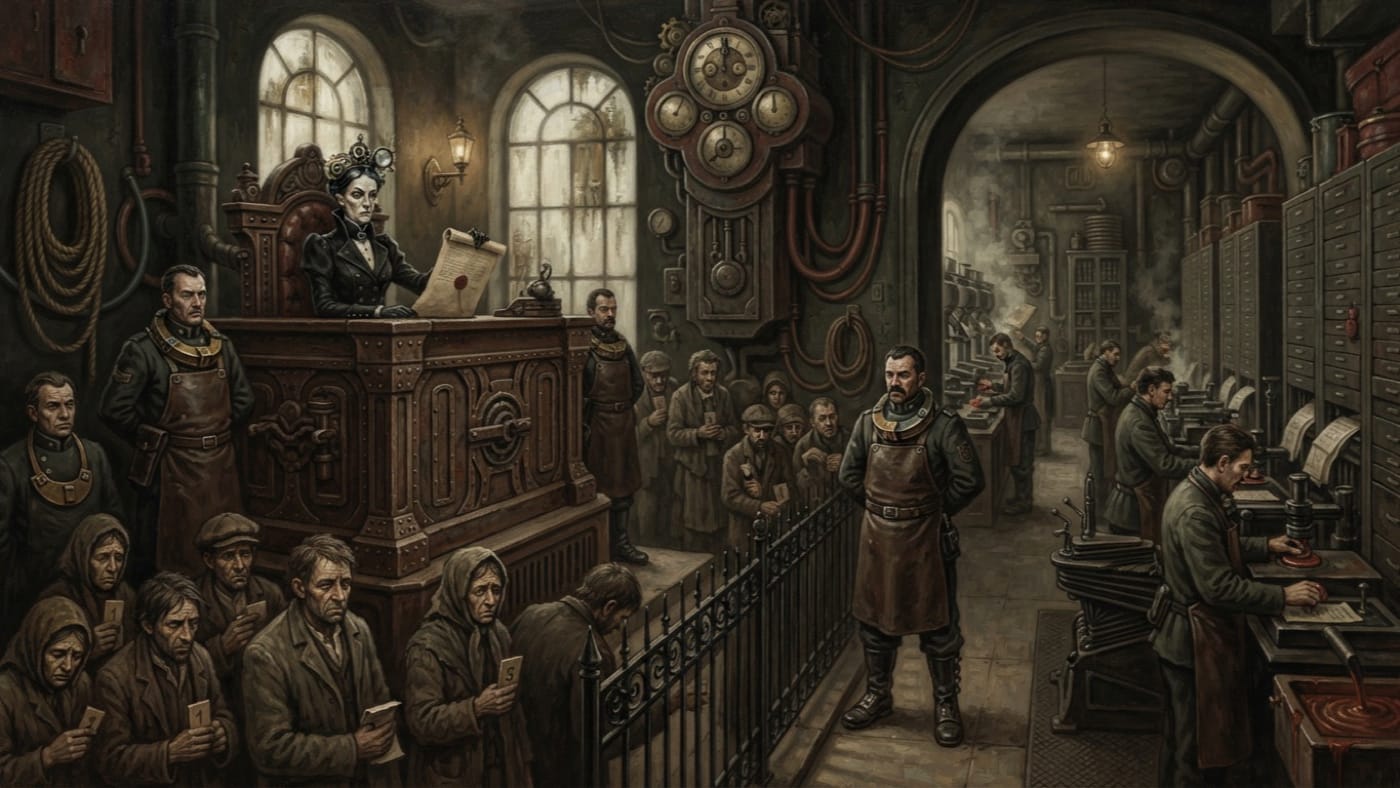
#On Its Station at the Ninth Gate
Every gate on the Queue Road is a small tribunal, and every small tribunal wants to be Gate Nine. The ninth gate is the largest court on the Road, the hub of its reclassification, and the place where prosperity is decided. Inside that complex, under a title that sounds like a building and behaves like a family, sits the Gate Nine Court. My office classes it as a tribunal clique. That means a bench that has learned to keep its loyalties closer than its law.
Its public purpose is fair appeals. A traveller whose minutes have been voided, whose lane was wrongly assigned, whose audit failed, or whose debt has grown past paying may bring the matter to the Court and ask for its mercy. On the Road's own understanding, the Court is the place of relief.
Its working purpose is to extract confessions and favours. Those are its real receipts. The Road lists confession beside minutes, coin and labour-hours as a currency of appeal. Of the four it is the only one a petitioner cannot run out of, because a soul in the line can always be brought to remember something more.
The Court must be kept apart from its neighbours. It does not set rates; the Synod Permit Directorate does that. It does not keep the Road's books; the Time Clerks' Collegium keeps them and guards them. It is not Gate Nine Commons, the yard of day labour and recruiting that smells of chalk and bodies, though the Commons often takes in what the Court sends out. The Court decides what a man's paper means. Then it charges him for the meaning.
#On the Mistress and the Bailiffs
Mistress-Court Sera Nox presides. My file describes her as perfume and iron, and it is sound on both points. She controls appeal approvals, which is the one lever at Gate Nine that reliably turns. I have no record of her age, her house, her appointment, or the office that first favoured her. I will not supply them. The Court has enough manufactured testimony without the Hieromnemon adding to it.
Her method is on record. She is perfumed and she does not bend. The perfume is practical. The Gate Nine Hearing Hall smells of hot wax and sweat: wax from the seals and stamps, much of it bought from the Candlewick Palatinate, and sweat from the petitioners, who stand in their own heat until they are named. A presiding officer who smells of something else is reminding the room who among them has bathed.
Her enforcement comes from the bailiffs, and the bailiffs come with collars. The Road's formal enforcement is carried out by oath-collar bailiffs, and the Court's bailiffs collar defaulters as a matter of routine. Bailiff Dorn is the one named in my file. He handles collars the way a jeweller handles his trays, as stock to be fitted, admired and moved. I record nothing more about him. A bailiff is as large as his writ, and Dorn's writ reaches to the next neck.
The Court also holds cells, for those whose rulings are pending or whose answers are still being improved. And it holds a stamp room, which is where it actually rules. A judgment spoken from the bench is theatre. A judgment pressed in wax goes into the ledger. The Hearing Hall has seen mass collaring. The stamp room is the reason those collars stayed on.
#On Purchased Testimony
A Gate Nine hearing is a performance. Witnesses are coached, testimony is bought, and confessions are traded for lighter reclassifications. The Court provides the stage, the bench and the verdict. It hires its cast from elsewhere.
The cast comes from the Witness Rental Houses of Stamp Court Row. They are a cartel and must be catalogued as one, separate from the bench they supply. Their public trade is lawful testimony. Their real trade is making truth pay and framing enemies. Mother Venn and Garrik Two-Names run the largest ring. Their witnesses remember what the buyer needs remembered and forget what the buyer needs forgotten, and they bill for both. They work with coached statements, rings of perjurers, and what the Row calls "credible" locals: residents whose faces have stood in the line long enough to look honest, carrying documents whose stains date them correctly.
The Court does not own the Row, and the Row does not sit on the bench. They do not need to. A major appeal brings the Row out the way a carcass brings out rooks, and the Hearing Hall's witness ring stands where the Mistress can see it. The arrangement suits everyone with money. A petitioner who cannot afford witnesses meets one hired by whoever can.
The Road calls this "witness theatre" and gambles on it after curfew, among its other unsanctioned entertainments. Laughing during an appeal hearing is forbidden. The rule is sensible. A play only works while the audience agrees to call it a trial.
#On Mercy and Reclassification
The Court's mercy is real, and it is priced. A mercy ruling can cost more than the offence it pardons. This is how a ledger forgives.
The material is the minute economy. Waiting is recorded by bell-mark and earns minute credits, and a merchant can buy those credits to pass more quickly. Not every credit is a debt. Debt has its own sources: a missed mark, a failed audit, a penalty condition, the wrong lane. Debt compounds, and unpaid debt becomes compulsory labour at Gate Nine or erasure into the Null Verge, a settlement the census does not count and the Directorate does not map.
The Court's instrument against that fate is reclassification. The petitioner confesses and receives a lighter category. The debtor goes to labour instead of to the Verge. The defaulter is marked down as negligent instead of fraudulent. Each lighter category is a mercy. Each one is bought with a confession, and the confession stays on file.
The confession booths stand beside the courts. Every confession given there is indexed by timestamp. The Road's archive keeps the hour of every admission, so a man's account in one season can be set beside his account in the next, and any gap between them can be produced at whatever hour suits his creditor. A confession pays the price of today's mercy and puts tomorrow's charge on record. The void mark settles the rest. A stamp the Court has cancelled is simply void, however hard and however long the man stood to earn it.
On the Road's own understanding, the Court is the place of relief.
Corrected. The Court is the place of reclassification. Relief is one category it can assign, and it is invoiced at a rate the petitioner learns after the stamp has set.
Public confession at Gate Nine is one of the Road's rituals. It belongs with the bell-marking at dawn and the anointing of stamps. In my profession I respect confession as a sacrament. At Gate Nine I record it as an inventory practice.
#On Rival Offices and Useful Heresy
The Court's power depends on powers that are not its own. Director Othmar Vell sets the price bands from which every debt is calculated, and his Directorate controls the gates and the rates. Its founding writ carries the seals of Records and the Bureau of War. Clerk-Prime Yoren's Collegium keeps the ledgers, and a clerk's error or favour can move a petitioner's passage before any appeal is heard. Sera Nox rules on what reaches her bench. Each of these offices needs the other two. I have found no chart that ranks them, and I doubt any of them would sign one.
The Court has one known solvent: an inquisitor's visit. On the Road almost everything can be bought, but two things are never for sale. One is the true audit ledger. The other is the inquisitors' schedule of arrival. A bench that has bought witnesses, clerks and silence cannot buy an hour's warning. It holds its composure on the understanding that the warning will come late.
Then there is Brother Senn, who preaches beneath the Barricade Maze that no bell owns the hour. His sabotage of bell-mark schedules eats into the Directorate's revenue. Every lost minute gives rival offices a grip on the Gate Nine Court and its clerks. The Bureau of Purity pursues him in public and tolerates him in private. My dossier on him also records that his disruptions appear to steady the Minute Drift's extraction surges, which gives some offices a second reason to keep him uncaught. He has not stood before the Mistress-Court. No ruling of hers names him. The Court did not choose this heretic, but other people have found him useful against it.
Below the bench, the record runs out. The sealed reports I have read place an apparatus in the bedrock beneath the Hearing Hall. The Bureau of Engineering survey of A.S. 178 dates its discovery, not its making. Who maintains it, what it produces, and who benefits are not stated in any document I can cite. Being close to it does not make the bench aware of it. I have no evidence that Sera Nox, Bailiff Dorn or any officer of the Court understands what lies under the floor they walk on, still less commands it.
QUERY — BUREAU OF DOCTRINE, A.S. 201 Whether the Gate Nine Court is informed of ████████ beneath the Hearing Hall: NO ANSWER ON FILE. Whether the Court's docket bears any relation to ████████: NO EVIDENCE ON FILE. Reviewer seal: ████████████
#On the Present Application
In the spring of A.S. 200 minute prices doubled overnight. No decree was posted and no explanation was given. More debt means more appeals, and more appeals mean more confessions in the booths and more collars on the bailiffs' trays. That autumn Gate Nine closed for sanitation. Within three days bodies were piling up in the Barricade Maze. I hold no record that sets the closure at the Mistress-Court's door, and I record none. The Court's business halted when the gate did. Its debtors went on compounding.
In A.S. 201 there is more scrutiny from outside. Auditors from Strasbourg rotate through the Road more and more often. The Directorate's master ledger has still not been produced for review. The Court has not been purged, has not been reformed, and has not been dismissed. Its stamp room works, its hall stays hot, and Stamp Court Row keeps its witnesses ready.