

#On Their Present Station
"No appeal without witness. No witness without fee." — From the public order posted at Gate Nine, between the rule against touching the tariff boards and the rule requiring standing.
This survey records the Witness Rental Houses as they stand in A.S. 201, 1911 by the common reckoning. It claims nothing earlier. The year dates the account and leaves the trade undated. No founding, first premises, charter or full roll of members has reached the Bureau of Doctrine. This office has declined the usual remedy of making them up.
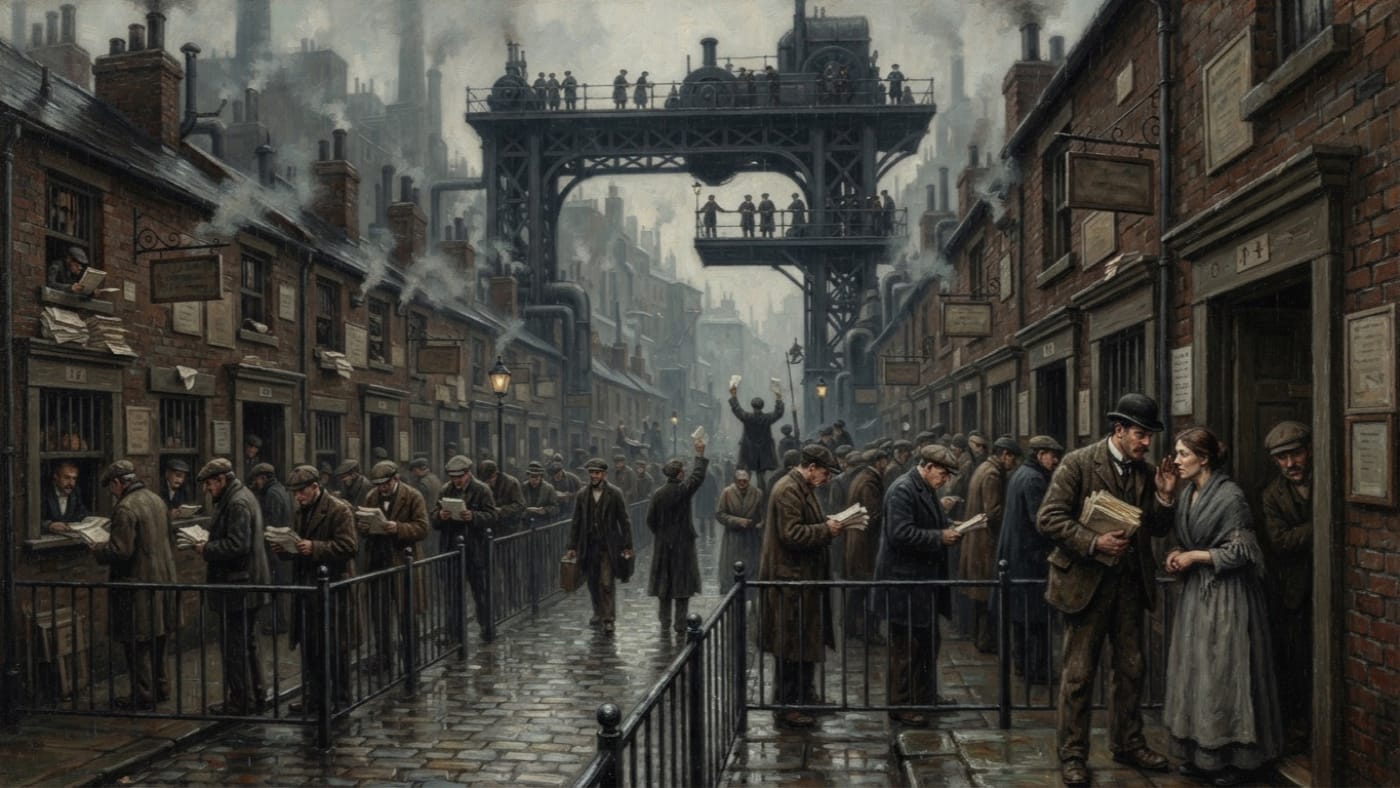
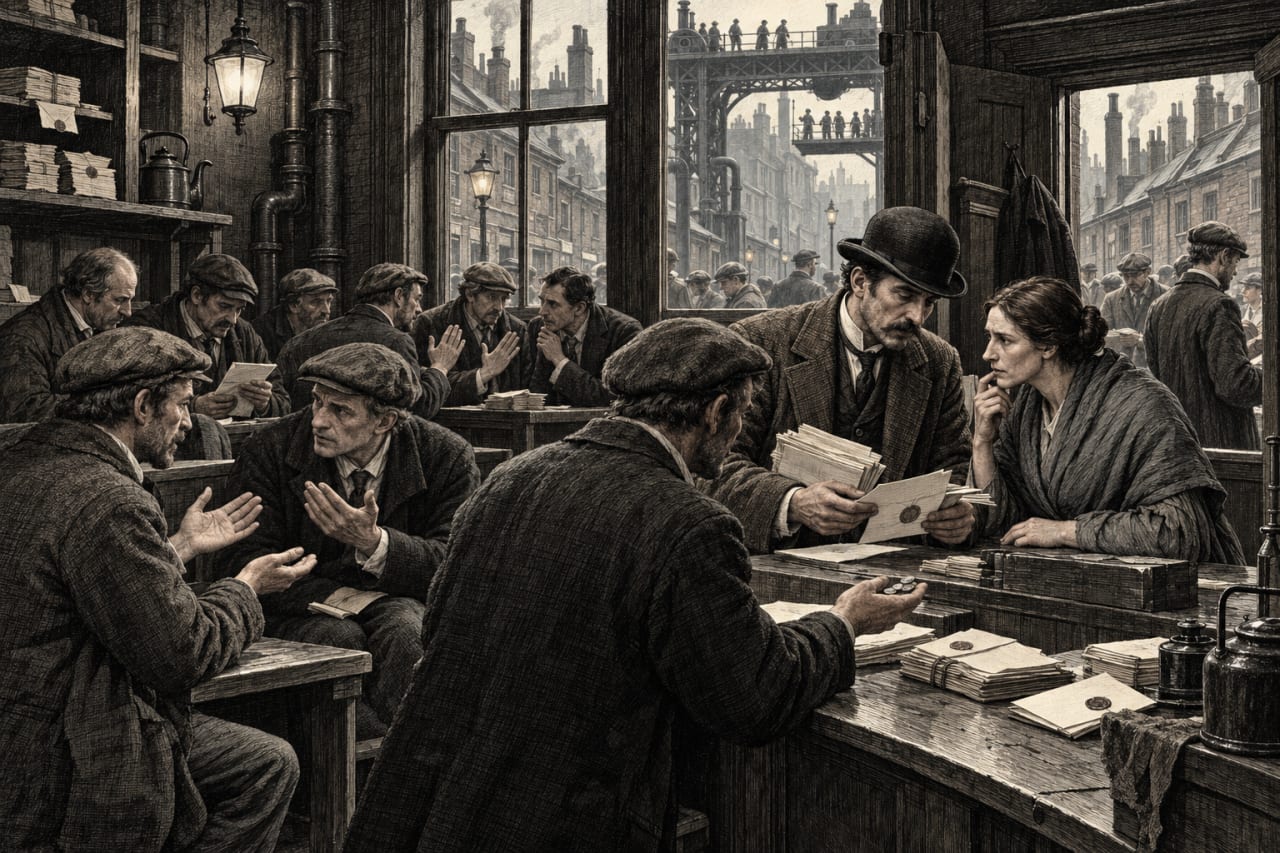
The Houses are a cartel. Their premises stand on Stamp Court Row, the district of the Queue Road given over to appeals and punishments. The air there smells of hot wax and old paper, and every doorway has something to sell to a person who is about to be judged. The buildings matter least. A House is a threshold, a bench, a list of names and a kettle. This survey concerns what goes out through the threshold. The cartel sells recollection that a court will admit. It supplies the facts that other offices act on.
Three words have to be kept apart, because the Road runs them together whenever that suits it. A House is premises. A ring is a body of witnesses worked together under one management. The cartel is the whole trade of Houses and rings on the Row, to the extent that it can be seen working as one trade. The record establishes the cartel and names its largest ring. It does not say how many Houses stand, how many rings work out of them, or who sits at any table where the whole might be governed. I have found no such table. A cartel that has a table usually leaves crumbs, and Stamp Court Row is careful about its crumbs.
The Houses describe their trade as legal testimony services. The phrase is accurate, which is why it is useful. Testimony is given, it is entered at law, and a fee is paid. The phrase proves no statutory licence and grants no immunity. The cartel's established fraud also does not prove that every witness it sends is lying. A clerk at Gate Nine hears true accounts and false ones from the same bench, given in the same posture by people in the same clean collars. The Houses profit because he cannot tell them apart, and profit more because he has stopped trying.
#On Credible Locals
The Houses' stock is people. The Road's own survey puts the adjective in quotation marks: "credible" locals. On the Queue Road, credibility is a physical condition before it is a moral one. It shows in a face the clerks have seen at the same fence-post for years without trouble. It shows in a collar washed often enough to look pale and seldom enough to look honest, and in open palms at the window, lowered eyes and short answers. A soup vendor of long standing is credible. So is a hostel warden who rents sleep by the quarter-hour. A copyist with clean cuffs and split fingers is credible beyond all reason, because the clerks recognise their own injuries in him.
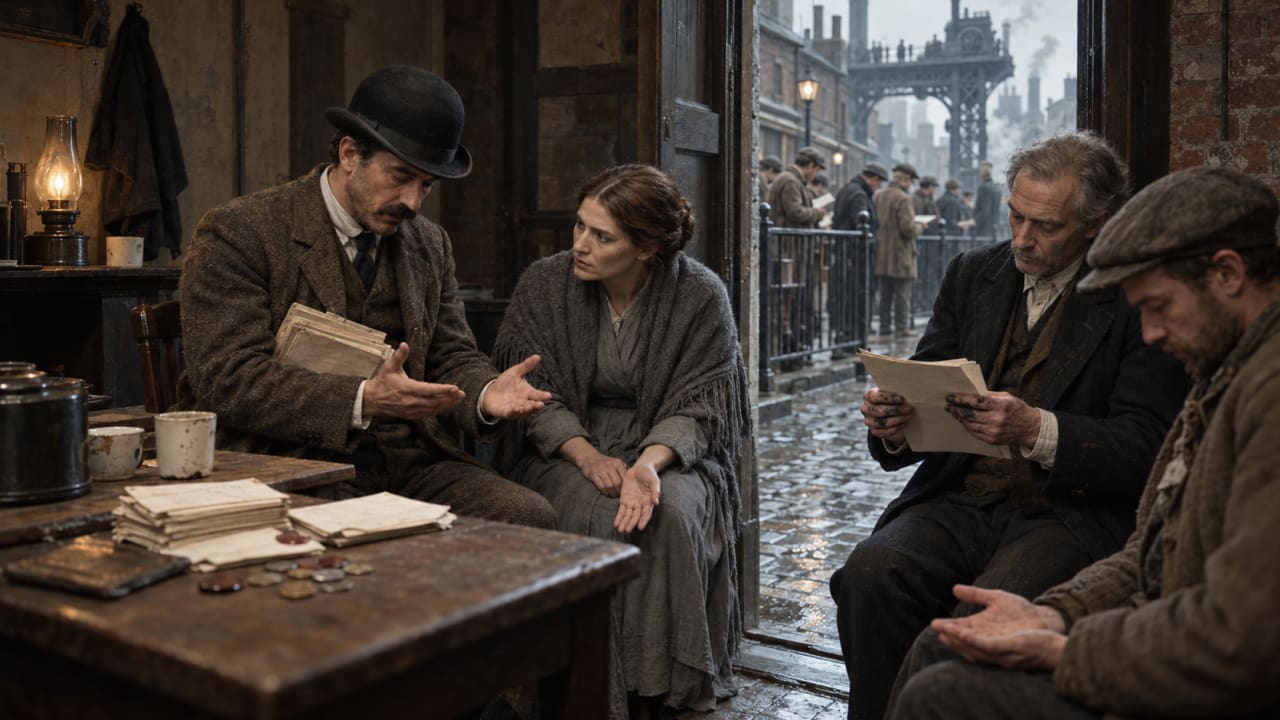
A gate-court wants more than a face. The Houses' second resource is documents: bell-mark slips, lane tokens, hostel receipts and appeal dockets that agree with the witness carrying them. Paper on the Road is marked by the Road. The clerks call the scorch a seal leaves on cheap paper a wax bite. A wax bite in the right place dates a document better than its written date does. So does vinegar ink faded to the correct brown, or a corner clipped for audit at the gate where a corner should have been clipped. Without papers, a witness is an actor. With them, the same witness is admissible.
What the customer buys is an account that holds up when compared with others. Without its vestments, that is all coaching is. A coached statement is a recollection rehearsed until it can stand up to the second asking. At Gate Nine the second asking always comes, and a third follows from another desk. Coaching keeps the witness consistent with the appellant, with the other witnesses, and with whatever the clerks have already written down. One contradiction anywhere in that chain can sink an appeal. The Houses sell the chain.
The Road names both of the skills on sale. The witnesses remember what needs remembering, and they forget what needs forgetting. Forgetting is the harder art. Remembering a lane, an hour or a grey coat at a turn takes drilling. Forgetting, in front of a court that files every admission against its timestamp, requires that nothing anywhere in the record contradict the silence. Paid omission is the most delicate thing the Houses sell. It leaves no words behind to be caught.
The record does not say how the Houses find, train, rank, discipline or dismiss their witnesses. I have no examination, no apprenticeship, no grades of membership and no penalty for a witness who wavers. The Road offers a type, the Witness-for-Hire, who smiles like a knife and remembers what you need remembered. A type is not a constitution. I will not write one for a cartel that has had the sense not to write its own.
These people must not be confused with the Oaths Witnessers, whom the Bureau of Oaths licenses to stand at sworn vows. A Witnesser's credibility is protected by an institution. A rented witness's credibility is his stock in trade, and the Row protects it the way a grocer protects his scales. The gate-courts admit both, and few clerks bother to ask which kind is standing in front of them.
The Houses do not need every witness to be false. The trade works better if most of what they sell is ordinary truth, delivered on time by someone the court already trusts. A little perjury placed among honest testimony is harder to find than a whole bench of liars. The Road's surveys establish perjury rings. They do not establish what share of the Row's testimony is false, and that share is the figure every customer would most like to know.
#On Hours Certified
The Road pays in waited minutes. At the Bell-Mark Gantry over the Third Gate, a clerk's press comes down on each traveller's paper and marks the hour. From that mark, the Synod Permit Directorate counts the minutes until clearance. Those minutes become a claim. The claim can be spent on passage, set against a charge, or sold. A credit earned by a man who stood six hours in sleet can be bought by a merchant who would rather not stand. The merchant moves on. The standing man is left holding coin and chilblains.
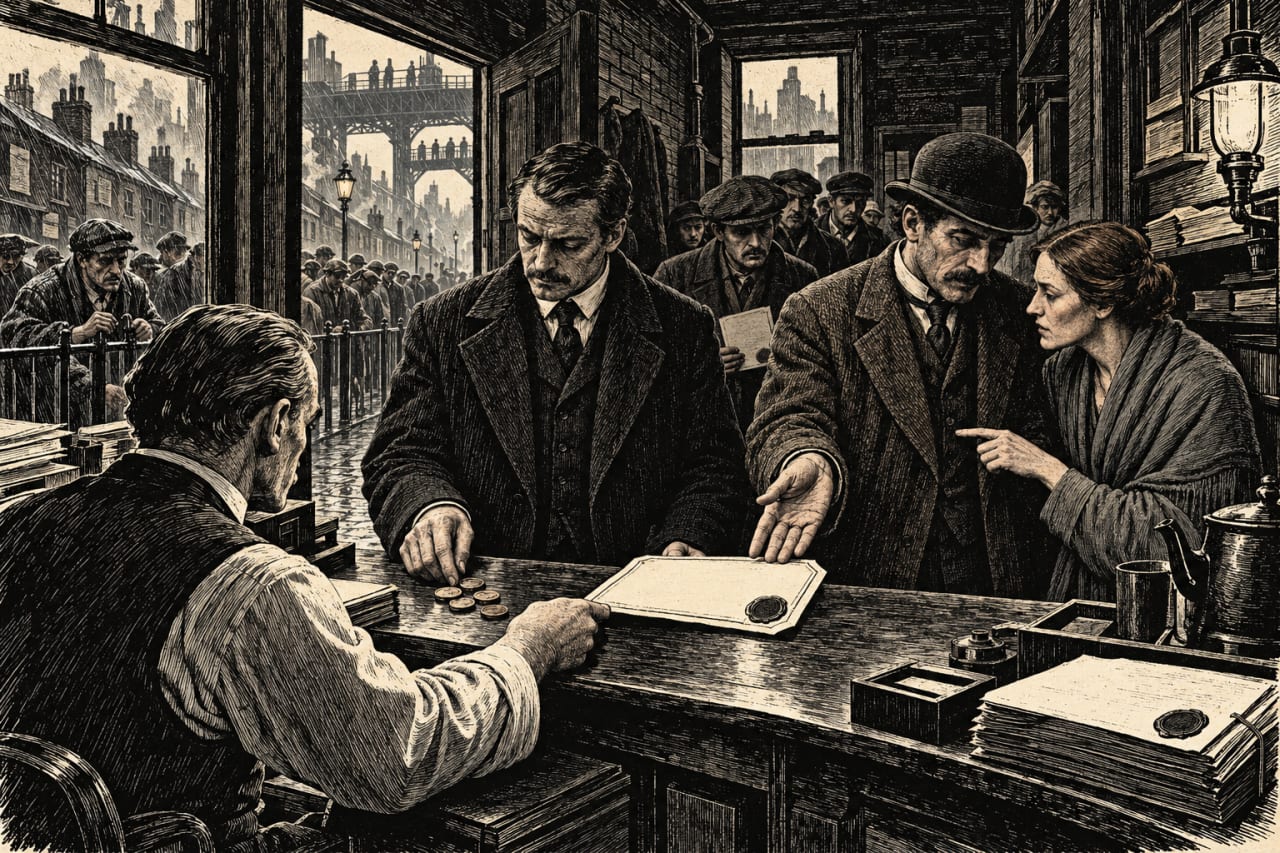
Debt is a different matter and has to stay one. Ordinary waiting earns credit and does not punish anyone. Debt comes from other sources: a missed bell-mark, a failed audit, a penalty condition, standing too long in the wrong lane. Once it starts, it compounds. At Gate Nine, unpaid debt is converted into compulsory labour or into erasure into the Null Verge, where a blank tag on undyed linen replaces a name. A traveller can carry credits and debt on the same paper and lose by both of them.
A Witness Certificate works on the claim. It attests that the bearer stood through hours the bearer never stood. The Road's survey ties these certificates to the perjury rings of Stamp Court Row. Their effect is plain. A claim for four hours becomes a claim for nine, because someone credible says he saw the claimant waiting through the other five. The certificate changes the accepted account of waiting, and on this Road the accepted account is the only one with a price. It makes no minute. The cartel has never been shown to produce time or to touch the machinery that measures it.
What happens to the certified hours once they enter the books is a question for Clerk-Prime Yoren's Collegium, which keeps the books, and for Director Othmar Vell, whose Directorate sets the rates. The Houses do neither job. They put a sentence into a ledger, and the ledger does the rest.
Pairing should not be read as fraud by itself. Most paired witnesses on the Road are kin, lane-neighbours or strangers who agreed at a fence-post to hold one hour between them. The pairing exists because the Drift makes honest memory unreliable. Inside the Barricade Maze, between Gates Three and Five, travellers swear they stood a week while the sun says a day. Bells ring twice. Hunger comes before the meal or after it. Two truthful people can come out of the same lane with accounts that do not match, and both can be right about what their bodies went through.
Disagreement proves nothing about perjury. A court that convicts every contradiction punishes the Drift's victims for having been in it. It is my own analysis, and I offer it without enthusiasm, that this gives the Houses a peculiar advantage. Honest witnesses from the Maze contradict one another because the Maze did something to them. Coached witnesses agree because they were paid to agree. A clerk who prizes consistency above everything will prefer the purchased account, and he will think himself rigorous for doing so.
#On the Appeal and Its Contradictions
The appeal is where the Houses earn most of their money, and the procedure has to be set out in order. Responsibility on this Road disappears in the gaps between steps.
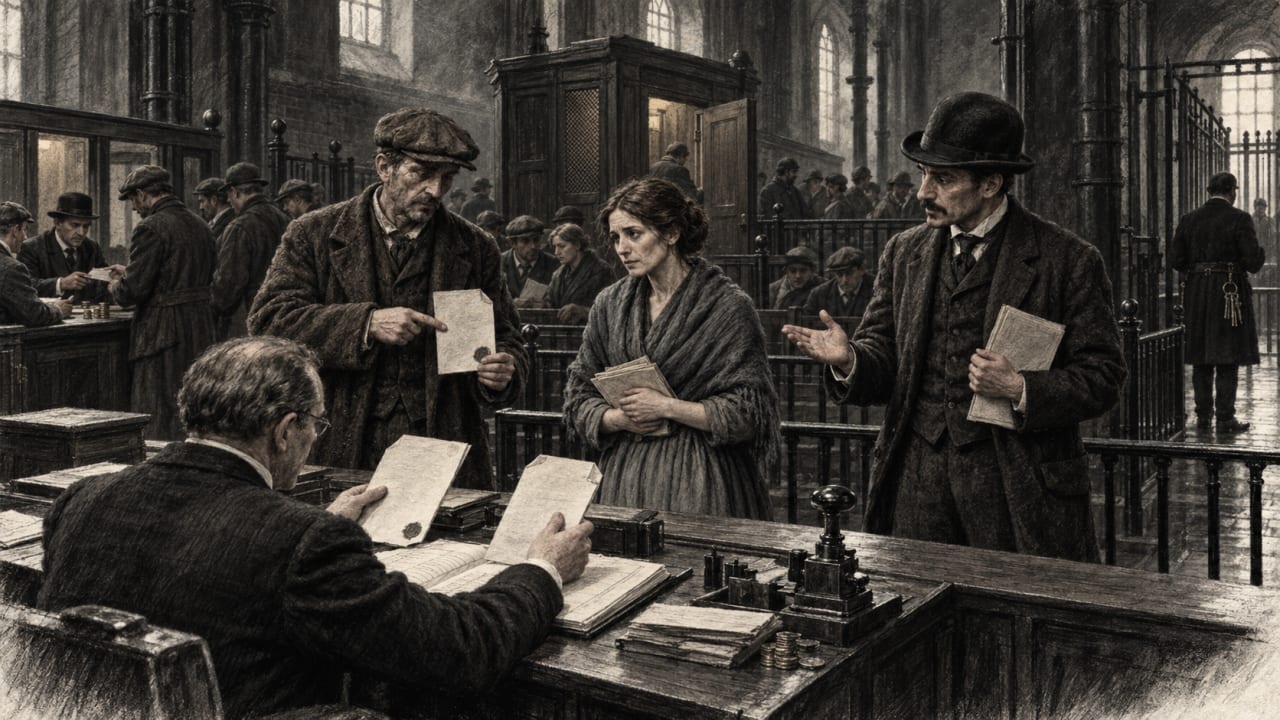
An appellant contests a classification. The traveller has been marked a defaulter, a fraud, a lane-breaker, a debtor past paying, or something that sends a body to labour or the Verge. The posted order at Gate Nine sets the terms. No appeal without witness. No witness without fee. A petitioner who arrives alone has already lost a step before the bench has looked up.
The witnesses arrive at second bell. Stamp Court Row sends them, and at that hour the Hearing Hall's mutter sharpens into rehearsed memory. At the fourth desk, a rented witness confirms what he was hired to confirm. That may support the appellant, or the office that classified him, or the appellant's creditor, or anyone else who paid. The Houses take money from either side.
That is the trade in purchased contradiction. Testimony that can add five hours to a friend's claim can just as easily take five hours from an enemy's. The Road's own account of the cartel names its true purpose as making truth pay and framing enemies. A purchased contradiction is testimony turned adversarial for a fee. A witness stands up to say the opposing account is wrong: the man was in the wrong lane, or was seen in a hostel bed during the hours he claims, or stood behind the fence-post and not at it. Its force is the ordinary force of a credible stranger speaking firmly to a tired clerk. No memory is altered and no soul is worked upon. The clerk does the rest. A petitioner who cannot afford witnesses meets one hired by someone who can.
Next comes confession. Confession booths stand beside the courts. A petitioner who admits a smaller fault may be given a lighter classification: negligent in place of fraudulent, labour in place of the Verge. That is the Gate Nine Court's mercy, and it is real, and it has a price. The Houses help petitioners reach that bargain by supplying an account into which the confession fits. A confession that contradicts the petitioner's own witnesses is worth less than one that agrees with them.
Every confession is indexed by timestamp. That fact changes the whole arithmetic of the trade. An admission made at one bell-mark can later be set beside an admission made at another. If they differ, the difference is the petitioner's offence against his own record, and it stays on file to be produced whenever a creditor or an office finds it useful. A concession that buys mercy this season leaves an admission for some later season to use. Bought testimony that fits today's confession has to keep fitting tomorrow's, and a petitioner who has hired one consistent account may find himself hiring it again.
Judgment comes after that, and it is not the cartel's. Mistress-Court Sera Nox hears selected appeals at fourth bell and decides which are approved. Her bailiffs carry collar keys at the belt and close collars on those she has not saved. The Collegium enters the result. The Directorate's rates set the size of whatever debt survives the ruling. The Gate Nine Court, meaning the bench, its bailiffs, its cells and its stamp room, is a tribunal clique. It does not belong to the Row, and the Row does not sit on it.
Three more names need separating. Gate Nine is the clearance complex, with its Waiting Fan, Appeal Throat and Hearing Hall. Gate Nine Court is the clique that presides inside it. Gate Nine Commons is the labour and recruiting district that takes in much of what the Court sends out. The Houses supply witnesses to the second, and their witnesses' words help decide who ends up in the third.
The Houses supply the facts that rulings, collars and ledger entries are applied to. They issue no ruling, sign no collar warrant and order no erasure. Strictly, this makes them innocent of every sentence. In practice, it makes them part of every one.
#On the Largest Ring
Mother Venn and Garrik Two-Names jointly run the largest documented ring within the cartel. The record names them together and goes no further. It does not say which of them keeps the roster or the accounts, whose name comes first on an invoice, or whether either would accept the other as senior. Neither is established as the cartel's head, the owner of every House, its founder, or the proprietor of anything at Gate Nine. They run a ring, the largest one, and that is the full extent of their documented authority.
A preliminary note of this office described Mother Venn as keeping the largest House on Stamp Court Row.
Corrected, and the correction carries into this survey. The published account records the largest ring, run jointly with Garrik Two-Names. A ring is a body of witnesses, and a House is premises. The ring belongs to the cartel, and the cartel does not belong to the ring.
The titles establish nothing either. "Mother" has no ordination, foundling-house, children or initiation under it that I can find. "Two-Names" refers to two names that nobody has listed. On the Queue Road a title is something the Road fastens to a person, the way it fastens a tariff to a breath. I draw no conclusions from either, and I warn readers against drawing any.
What the ring sells is the same as what the cartel sells, in larger quantity. Its witnesses supply useful recollection and useful omission, and the Road says they bill for both. Scale matters in an appeal. A large ring can supply several mouths that agree. A small one supplies one mouth and hopes. In a court that compares accounts, the side with more consistent witnesses has an advantage that has little to do with the truth of the matter.
The ring's documents are missing from the record. This office holds no customer list, no signed specimen certificate, no tariff and no contract carrying either partner's name. Gate Nine's records name no case argued by their witnesses. The largest ring on the Road is known mostly by reputation and by the survey that ranks it. The ranking is established. Its measure is not: whether "largest" counts witnesses, appeals, receipts or simply how often the name is heard on the Row. I report the rank and leave the measure blank.
The ring's prominence is still worth stating plainly. A Road that will not move without testimony gives great influence to whoever holds the most testimony, and Venn and Garrik hold the most. Their influence is borrowed entirely from the court's need for a person to swear to what the paper failed to record. They hold no gate, bell or seal, and no place in the Directorate House. On the Queue Road, the court's need does not run out.
#On Witnesses Above the Third Gate
The appeal is where the Houses do their most public work. The Gantry is where they do their most technical.
The Bell-Mark Gantry spans the Road at the Third Gate. It is an iron frame of catwalks, stamp cages, bell-hammer housings and pulley baskets, and below it travellers raise their papers on hooked poles to be marked. The clerks press. The bells ring for the ledger wheel. Custody of the mechanism belongs to the Directorate, with Hourglass observers and Purity attachments added since. None of it belongs to the Houses.
On the side balconies stand the witnesses, and the record says exactly what they certify.
Each condition guards against a particular fraud or failure. A mark before the bell steals time from the Directorate. A mark after the ledger has advanced makes a gap the books cannot account for. A mark outside the lane window belongs to another class of traveller. A mark on the wrong paper puts one person's hours on another person's life. The balcony witness is the human check on the press, and a paid one.
Official witnesses fail. They faint, which is unsurprising after hours above a crowd in Road weather. They vanish. Some of them, according to the record, begin insisting that the bell sounded from below the road and not above it. When that happens, the Witness Rental Houses of Stamp Court Row supply replacements.
That service has nothing to do with appeal work. A replacement on the Gantry argues for no one. He watches four conditions and attests to them, interval after interval, while the clerks work. It is still a supply of credible people to an office that cannot produce its own, which is the cartel's whole business.
The record sets limits here, and I keep them. It establishes that the Houses supply Gantry replacements. It does not establish a monopoly, an exclusive contract, an appointment by any office, a term of service or a total number of replacements. It does not hold the Houses responsible for the witnesses who vanished. It does not say that every replacement comes from Venn and Garrik's ring. Any House on the Row may send a body up the balcony ladder.
The witnesses who said the bell came from below deserve one more paragraph, because their complaint has not gone away. The Drift reached the Gantry after the spring of A.S. 200. It brought duplicate marks, future stamps and ink that dried before the press came down. A balcony witness asked to certify that the mark fell after the bell may now watch a mark that seems to come before the clerk's hand moves. I cannot say what such a witness ought to attest to, and the Directorate has not said either. A replacement from the Row has every commercial reason to attest to the ordinary sequence and leave the rest out. Whether any of them has done so is not in my files.
#On the Route from the Culverts
Ira of the Second Bell is a courier of the Clock Heretics, the Unstruck. The record says her route runs from the culverts under the Barricade Maze to the Witness Rental Houses.
Her method is well attested. She carries chalk chips in her mouth so that paper searches find nothing. On the Queue Road a search is a search for writing: seams, boot-soles, hat-bands, the inside of a loaf. The procedure has no column for the mouth. After mud, chalk is the commonest dust on the Road, and a chip found on a body proves only that the body has been on the Road.
The route begins below the Directorate's costliest lanes, in the drainage brick, maintenance cuts and prayer-holes where Brother Senn's congregation keeps its chapels. It ends on Stamp Court Row, where the cartel sells accounts of who stood where, and when, and in which lane. This office has no map of the ground between, and I will not draw one. I cannot say which culvert she leaves by, which gate she passes, or which House she reaches.
The rest is absent from the record. It does not say who receives her messages, what they contain, or what is agreed when they arrive. It does not say whether the chips carry marks, counts or nothing beyond the fact that she came. It does not say whether Mother Venn or Garrik Two-Names receives her, knows her name or shares her faith. Using a place as a destination does not make the people who keep it Unstruck. A cartel that sells testimony to anyone who pays has every reason to receive heretics, debtors, merchants and Directorate men at the same bench without asking any of them about the hour.
She is said to know which drainage grates sing before a rate change. That reputation is attributed and unverified. I repeat it only to record that it is still unproved.
The congregation she serves stands at Seal Amber: visible pursuit by the Bureau of Purity, no martyrs, and an internal holding that tolerates useful interference. That posture applies to the congregation. It gives no protective writ to Ira by name. It gives none to the Houses she visits, or to the Row.
What is established is a route with two ends. A woman walks it with her mouth shut, and the record stops at the threshold where she arrives.
#On the Present Market
The Road in A.S. 201 is under more pressure than at any point in its filed existence, and the pressure lands on claims.
In the spring of A.S. 200, minute prices doubled without any published decree. That autumn, Gate Nine closed for sanitation. Within three days, bodies were stacking in the Barricade Maze faster than the Custodians' carts could take them away, and the Hearing Hall floor was washed with vinegar until the stones nearly passed for clean. Prices have not come back down. Auditors from Strasbourg rotate through the Road more and more often. The Directorate's master ledger has not been produced for their review.
This office does not attribute any of these events to the Witness Rental Houses. They did not set the rates, close the gate or fill the Maze. What follows is my own analysis, and I have not one ledger of the cartel's to support it. The doubling did not change what a witness is. It changed what a witness is worth. When a minute costs twice as much, an attested hour is worth twice as much to whoever holds it and costs twice as much to whoever loses it. A Witness Certificate that would once have rescued a modest claim now rescues a larger one. A purchased contradiction that would once have cost an opponent a morning now costs him a week.
The closure added time. Appellants waited for hearings while their debts compounded. A debt that might have gone to labour had longer to ripen toward the Verge. When the gate reopened, more people had more reason to hire witnesses and less reason to ask where the witnesses came from.
Outside scrutiny makes a second market. An audit needs witnesses as much as an appeal does. A ledger that may have to be explained creates demand for people who can explain it, and for people who can be relied on to have seen nothing. I know of no auditor who has hired from the Row. I also know of no auditor who has asked any clerk where his corroboration came from.
None of this proves profit. I have no receipts, no new contracts, no expansion of premises and no new ring. It would be convenient to report that the Row did well out of the closure. Convenience is the Row's trade, and I will not compete with it.
The Road's survey names one occasion that reliably draws the Houses' attention: a major appeal. The present year has no shortage of claims that would qualify. Whatever case Gate Nine hears next, the Row will send its witnesses at second bell.
#On the Record Retained
What the Bureau holds on the Witness Rental Houses in A.S. 201 is thin and exact. It holds a cartel on Stamp Court Row with a lawful description and established frauds. It holds a stock of credible people and agreeable papers. It holds a certificate that enlarges claims to waiting, a service that supplies both sides of an appeal, and a supply of replacement witnesses for the Gantry balconies. It holds one ring, the largest, run by two people whose division of labour is unknown. It holds a courier's route that ends on the Row and whose messages remain unread.
It holds no founder, charter, count of Houses, roll of members or single contract. It holds no ruling against the cartel and no evidence that one is coming. The Gate Nine Court has not dismissed the Row's witnesses. The Directorate has not prohibited certificates. The Collegium has not refused to enter testimony bought with coin. Each of those offices needs the Houses more than it dislikes them.
The floor of the Hearing Hall stays warm, and what lies beneath it is outside this survey. Standing on that floor gives the Row no knowledge of what is under it. I have found no witness from Stamp Court Row who claims any such knowledge, and if one ever does, I know what such a claim would cost.
This office relies on the Road's figures. Those figures rest, at some remove, on testimony given at Gate Nine. My seal therefore sits on paper the Row has handled, and I seal it anyway, because there is no other paper on the Queue Road.