
#On the Throat
"A perfect throat — pay or choke." — saying of the river-belt underworld, entered in a provost's day-book beside a fine
The Bend Ferry is the seventh node of the Rope-Ferry Chain, and the crews call it the Throat because it swallows. The river turns here, and in turning it runs faster than at any other crossing the Chain keeps. The current comes round the bend with the whole of the upper reaches behind it and leans on the mainline the way a tithe-assessor leans on a widow. Ferrymen call it the throat current. Clerks call it a scheduling consideration. The river gives it no name and collects regardless.
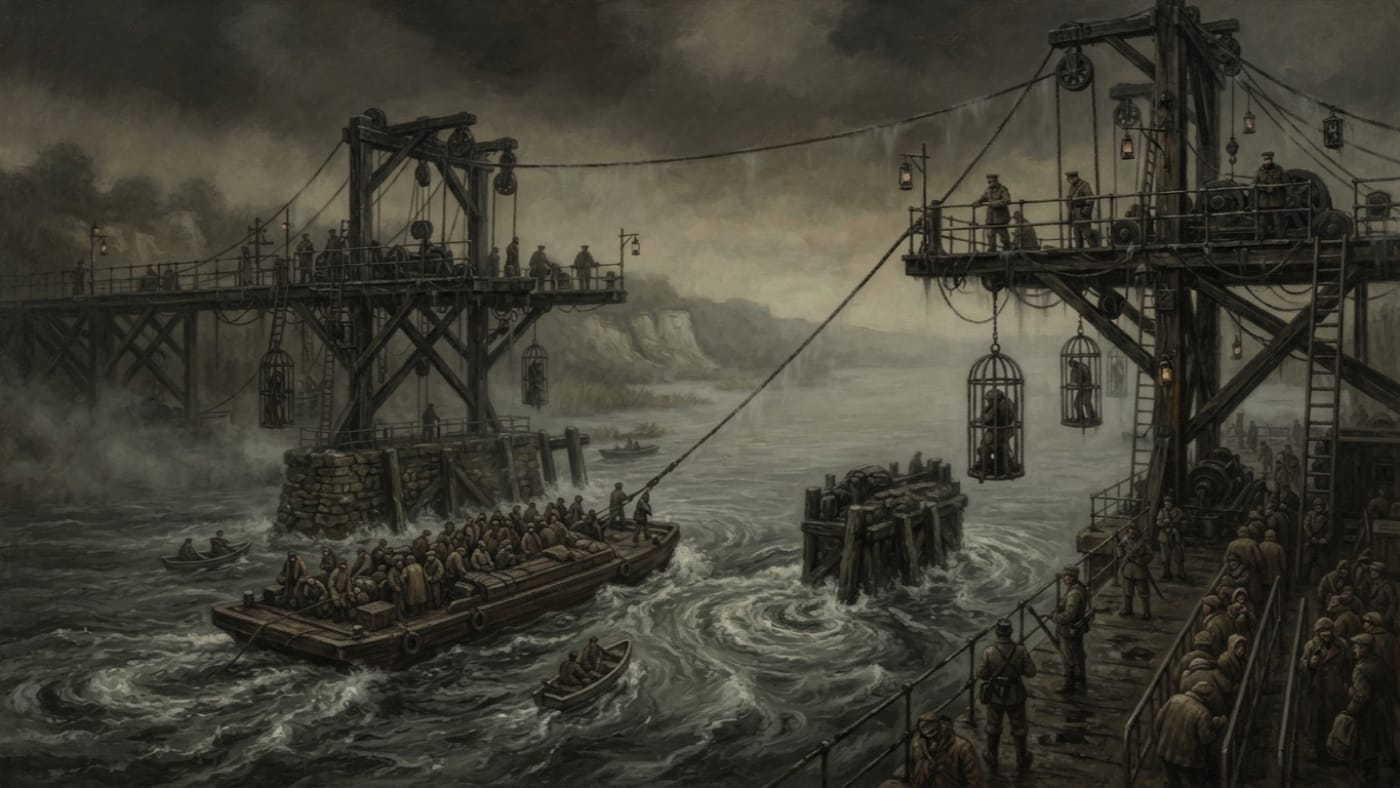
The works are the Chain's ordinary works, made anxious. A flat barge rides on a tarred hemp mainline drawn taut through iron pulleys. Timber gantries carry the line above the water, and catwalks run along the gantries so that men may die at height as well as at depth. Lanterns signal from the gantry heads to the patrol skiffs below. Behind the dock ward lie reed flats and mud banks, and further off, when the fog permits, a chalk bluff. The fog does not often permit. It hangs on the cables in the manner the Chain's old hands describe as settling in to read.
Below the crossing stand the drowned pilings of a bridge older than the Chain, and the current works them into whirlpools. The drowning cages of the Dock Provosts hang above it. The ward smells of ozone and fear. The ozone I cannot account for. The fear accounts for itself.
The Chain carries Heartlands supply toward the outer theatres: grain, lamp oil, lye, the condemned. A break at any node starves every node below it within days, which makes every node a hostage. The Throat is the hostage most often shown the knife.
#On the Crossing
Nobody crosses the Throat on arrival. One queues.
The queue lanes behind the dock ward are where the traveller first pays, and he pays in minutes. Time permits are sold in blocks, renewed at cost, and scalped by children when the clerks are slow, which is always. Rope dues are added for the upkeep of the line, crossing fees for the use of it, and cargo-weight tithes for the impertinence of owning anything. The dock wards say a minute costs a meal. At the Throat a minute can cost rather more, because the current does not consult the permit.
At the head of the lane come the three examinations held at every crossing on the Chain. A Transit clerk examines the paper. A rope captain checks the cargo against its ferry weight ticket, since a mainline loaded past its reckoning in a throat current is a mainline proposing to part. A provost examines the face. Then the barge is loaded under guard and the ropehands lean into the haul. The pulleys squeal, and the whole floating ledger swings out over the fastest water on the route, its passengers told to stand still and its cargo told to weigh what the ticket says.
If it arrives lighter, someone confesses. The discrepancy confession slip turns every missing sack into a sin with a signature. The slips go to Ink Dock, where they are filed, cross-referenced, and later traded as leverage by whoever reaches the cabinet first. Cargo lost to the current is still cargo lost. The river does not sign.
#On Those Who Hold the Rope
No single officer governs the Bend. Three of them govern the whole Chain, and the Throat is where their jurisdictions grind.
Chain Superintendent Halvick Sorn keeps the master schedule and decides the closures. He fears a snapped node above every other thing the Creator has permitted on earth, and the Bend is the node he fears most. Rope-Master Lysa Kett, called Splicehand, controls rope supply and the maintenance crews. Only her licensed splicers may touch a mainline, and her hands are stained black with the proof. When her guild restricts supply, the Throat hangs on older rope. Provost-Captain Merrow Venn controls arrests and confiscations. The Bend and the night patrol lanes belong to her Provosts, and her cages hang there, measuring sentences in tides.
The Schedule Choir sings the timing calls from the gantries. Since the River Ledger began writing in earnest it has sung interpretations as well, and this has given it a voice in closures that no choir was ever chartered to hold. The Ferry Chokepoint Brokers work the queue, selling slots, witnesses, and copied fragments of whatever the rope last wrote. After curfew the Black Ferrymen run their crossings through the reed channels by lantern code, using hidden berths and bribed clerks. The dock wards maintain that the Provosts sell the very black runs they are paid to stop. I record the rumour without endorsement, and without surprise.
The Reed Mothers keep their huts in the reed flats. They shelter children and the sick, and they move them when the rope writes something that ought not to come true. The Provosts raid them. The Reed Mothers rebuild. Each party holds the other responsible for the arrangement.
#On the Seven Hooks
The first verified series at the Bend showed three names, the number seven, and the date 18 Brumaire.
On 18 Brumaire a squall came down on the Throat and seven cargo hooks failed. Two ropehands drowned, both named on the rope. A clerk named on the rope was pulled into the river by the strap of his own satchel. Four labourers also died. Their names had not appeared, because at that time they were not registered to the node.
Three names, seven hooks, seven dead. The Transit Office called this partial correspondence, and on its own terms the Office was correct: the rope had accounted for every registered soul and for none of the others. The crews called it perfect cruelty. They were correct as well, which happens less often than the Office would like.
The year of the series does not appear in the files available to me, and I decline to supply one. The names of the dead are entered where names belong. The four who were never entered remain where the Chain keeps such men, in the difference between the counts.
#On the Writing and the Ruins
The Ledger writes oftenest at Node Seven. In the winter fog of A.S. 200 the Throat's mainline printed fourteen names in a single event. The Codex records fourteen names. It does not record fourteen corpses, and I will not supply them to round off the figure.
The crews use all three of the Chain's countermeasures. They tar-seal the cable before fog, and the writing rises through the pitch in blisters. They hang bell-cards from the gantries, and the cards tremble when the writing begins. They sign witness crossing forms swearing that every soul aboard is present and accounted for. These three signatures are a separate instrument from the three witnesses compelled to copy a manifestation, though both make work for the same clerks. None of the three countermeasures has been shown to prevent anything. All of them remain approved.
The River Ledger does not write on new rope.
Twelve feet of new rope blackened at the Bend Ferry before it had entered service, as the Transit Office acknowledged in its A.S. 201 circular erratum. The Ledger still prefers wet, strained, older mainline. The exception stands beside the preference, unexplained.
Salvage divers report a stone housing beneath the eastern abutment of the old bridge, sealed by silt and iron banding, near which compass needles tremble. The Bureau of Alchemical Standards has sealed every proposed correlation between that housing and the Ledger's manifestations. What may be printed is printed here.
NODE SEVEN SUBSTRUCTURE — DIVER TESTIMONY, EXCERPT Housing: eastern abutment. Seal: silt, iron banding. Recovered object: ████████████ Inscription matched: ████████████████████ Correlation file: SEALED, BUREAU OF ALCHEMICAL STANDARDS
After the fourteen names, Superintendent Sorn requested authority to reroute the mainline thirty yards upstream. Authority was denied. The line hangs where it hung.
#On the Present Crossing
Throughput on the whole Chain has fallen nine per cent over three seasons. The figure belongs to the Chain, and the Bend has no separate figure of its own, though every ferryman between Upper Splice and the Mouth could tell you where he would look for one. Rope supply tightens under the Splicehands. Quarantine cordons widen. The Queue Road delivers more bodies to the lanes than the ferries can lift. In heavy fog the Throat's crews now refuse crossings. The Provosts threaten them, the Choir sings objections from the gantries, and the brokers sell places on whichever barge is finally made to go.
It goes. It nearly always goes. The cages still hang and the pilings still stand in the current. The Bureau of Purity burns the luck-knots cut from written rope. The monthly anomaly packet goes to Strasbourg, which asks, as is its custom, for clearer copies.