
#On the Nature of the Chain
"Flow is mercy." — Inscription above the Ink Dock, painted by a clerk who had never missed a meal.
One does not cross the Rope-Ferry Chain. One is processed through it. The distinction matters — as all distinctions matter to those who profit from drawing them — because the Chain is not a bridge, has never been a bridge, and was built to ensure that no bridge could ever replace it.
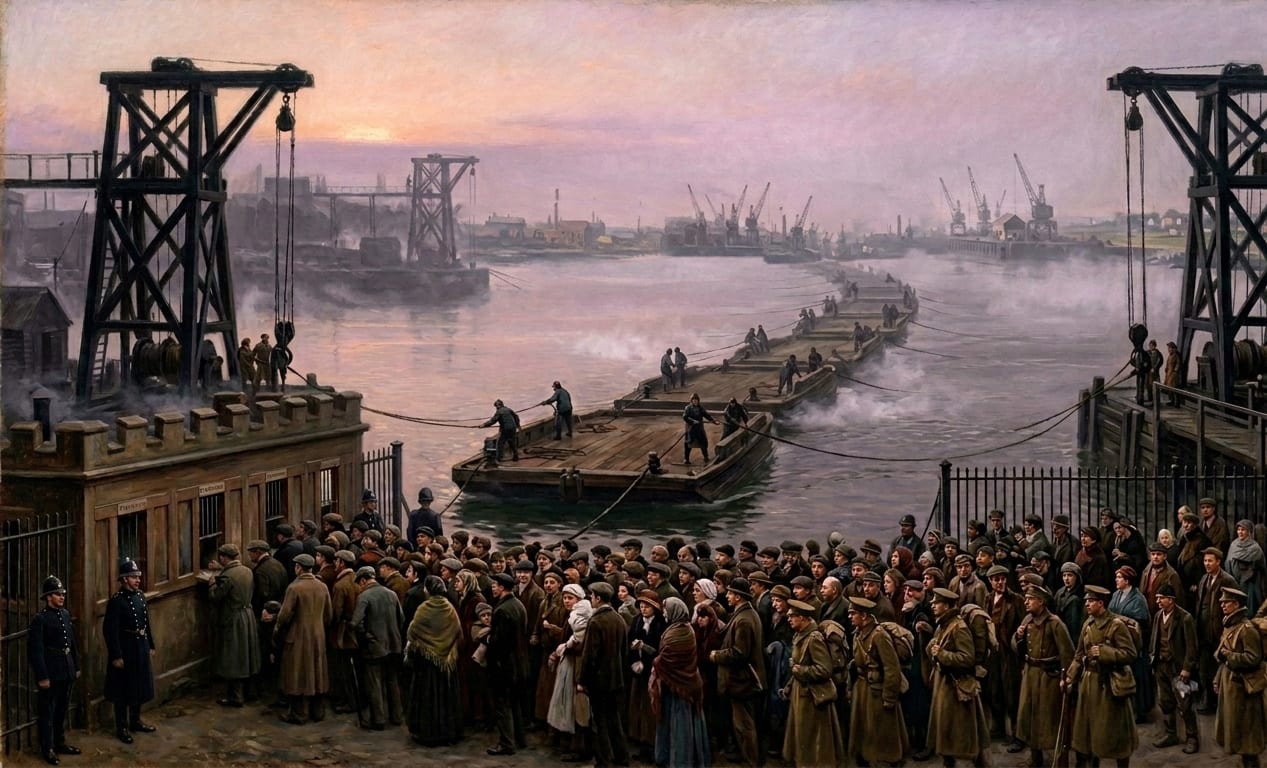
Twelve ferries. Twelve flat-bottomed barges lashed to cables strung across a river broad enough to swallow cities, each ferry tethered to the next by schedules, rope-work, and an administrative apparatus so magnificent that it has achieved something the Bureau of Records itself has failed to manage: the monetization of waiting. The river runs from the Rhine tributaries through the forward heartlands toward the outer theaters — Zone 2 into Zone 3, heartland into hinterland — and every sack of grain, every conscript, every crate of hymn-steel headed for the Sagittal Line must cross it somewhere along its length.
There are no alternatives. That sentence requires emphasis. There are no alternatives, because the old bridges were destroyed in the campaigns of A.S. 65–90 and the Synod has declined to rebuild them. The official reason is "defensive prudence" — a bridge may be seized, a bridge invites advance, a bridge is permanence and permanence belongs to the Creator, not to logistics. The unofficial reason is revenue. A bridge lets people cross without asking. A ferry lets people cross after they have asked, waited, paid, confessed, been stamped, and thanked the Synod for its mercy.
The Chain stretches approximately forty leagues along the river, though the exact distance depends on which clerk's map you consult and whether that clerk has been promoted since the last survey. Each ferry crossing operates as a node — a dock ward behind it, a garrison of rope-splicers before it, and between them the teeming queue of every soul in the Church's lands who requires something on the far bank. Eight named nodes, each with its own economy, its own petty magistrate, its own smell. Upper Splice reeks of tar and sweat. Ink Dock reeks of vinegar ink and wet wool. Cofferdam Ward reeks of sawdust and rot. The Quarantine Piers reek of lye and sickness. The Ration Slip Market reeks of broth and panic — always panic, because the market opens at dawn and closes when the food runs out, and the food always runs out before the queue does.
The Shoal Ferry, which the crews call "the Knee," stinks of mud and fish oil. The Bend Ferry, which they call "the Throat," stinks of ozone and fear — the current there runs fast enough to snap a barge sideways, and every season it does exactly that to at least one vessel whose cargo-counter overloaded it by the precise margin that his bribe required. And the Lower Chain-End, which everyone calls "the Mouth," stinks of coal smoke and hot metal, because the Mouth is where the outgoing convoys assemble and the smiths work the pulleys and the last prayers are said before goods vanish into the eastern approaches.
#On the Founding
"We did not build the Chain. We built the permit system. The Chain built itself around it." — Chain Superintendent Halvick Sorn, A.S. 199, annual report
The river crossing existed before the Synod. Bridges spanned it in the Rationalist era — stone and timber, paid for by toll-guilds, maintained by the municipalities they enriched. The bridges were destroyed between A.S. 48 and A.S. 65, during the Great Retreat, when retreating garrisons burned every crossing behind them to slow Wrath's westward advance and Sloth's creeping fog. What the garrisons left behind were stumps — drowned pilings, tunnel mouths at old abutments, submerged archives, the bones of toll-keepers who refused to leave their booths.
By A.S. 78, the Synod required crossings. The Queue Road was driving traffic eastward; the Line required supply; and the river sat between them like a tailor's shears through a bolt of cloth. Bridges were proposed. The Bureau of War rejected them — correctly, for once — on the grounds that a permanent crossing would invite a permanent target. Ferries were approved instead: temporary, deniable, revocable. A ferry can be cut loose. A ferry can be denied. A ferry, above all, can be controlled by whoever holds the rope.
The first three ferries were operational by A.S. 80. Flat barges, hemp cables, iron pulleys bolted to oak gantries on both banks. The crews were conscripted from the old bridge-toll families — men who understood rivers and, more importantly, understood extraction. Within two seasons, the system had expanded to seven crossings. Within five, to twelve. The Synod Transit Office was constituted in A.S. 84 to impose order on what was already becoming a corridor of petty extortion, and by A.S. 92 — the year the first Bureaus were formally constituted under the Concordat — the Chain Superintendentate was ratified as a permanent administrative organ.
ERRATUM — Bureau of Records, Filed A.S. 197 A prior edition of this entry attributed the Chain's founding to "logistical necessity." The Bureau wishes to clarify that the Chain was founded out of mercy, which is the same thing but sounds better in the Ledger.
The first catastrophe came in A.S. 97 — the same year the Queue Road suffered its merchant-panic crush. A spring flood tore three nodes free of their cables. The barges spun downriver with their cargo and crews; the cables whipped across the dock wards like the tails of maddened horses. Fourteen dead from rope-snap injuries alone. The Synod responded with the Superintendentate's full charter, the rope-dues levy, and the first schedule — a printed timetable governing which ferry crossed at which hour, distributed to every node and enforced by provost squads with the authority to drown anyone who violated it in the iron cages that the Bureau of War had, with characteristic foresight, already installed.
#On the Governance
"The schedule is a god with no face." — Rope-Ferry Chain proverb
Three people run the Chain. Officially, the Synod Transit Office governs from Strasbourg, issuing quarterly throughput targets and annual audits. In practice, Strasbourg is a signature on a writ that arrives six weeks after the decision it authorizes has already been implemented. The Chain governs itself, and it does so through three individuals whose titles sound modest and whose authority is absolute.
Chain Superintendent Halvick Sorn controls the schedule and the master closure slate. The slate is a single piece of oak, charcoal-written, locked in a floorbox beneath the Ink Dock Hall. It lists which nodes are open, which are closed, and for how long. Whoever holds the slate holds the river. Sorn is a man who has never been off-schedule in twenty-three years of service — never late for a meal, never early for an appointment, never seen to hurry or linger — and who is terrified, in the quiet marrow of his administrative soul, of a break. A true break. A cascade failure. He has seen what happens when one node goes down: the downstream nodes starve within days, the upstream nodes choke on their own surplus, and the provosts lose control of the queue lanes. He has seen it once. He does not intend to see it again.
Rope-Master Lysa "Splicehand" Kett controls the rope supply and the maintenance crews. Her hands are stained black with tar to the wrist, permanently, the way a scribe's fingers are stained with ink. She leads the Splicehands — the Rope Guild — and the Guild's monopoly on mainline cable is the Chain's structural spine. Only a licensed splicer may touch a mainline rope. Only a Guild assessor may certify a cable's integrity. Only Kett may declare a rope condemned. The Guild's leverage is simple: if the ropes fail, everything fails. The Guild's corruption is equally simple: controlled shortages, "accidental" delays, maintenance schedules that mysteriously align with contract renewal seasons.
Provost-Captain Merrow Venn controls arrests, confiscations, and the drowning cages. She smiles like a receipt — a precise expression, itemized, acknowledging the transaction without warmth. Her provost squads patrol the nodes at night, operate the quarantine cordons, and conduct the raids on the reed flats that periodically sweep up smugglers, refugees, and anyone else who has failed to produce the correct paper at the correct time. The confiscated goods are logged with admirable precision; they are then redistributed through channels that the log does not describe.
Between these three — the schedule, the rope, the cage — the Chain functions. The Transit Office in Strasbourg believes it governs. The three of them allow Strasbourg to believe this, because the alternative would require Strasbourg to visit, and nobody in Strasbourg wants to visit the Chain.
#On the Economy
"A minute costs a meal." — Rope-Ferry Chain proverb
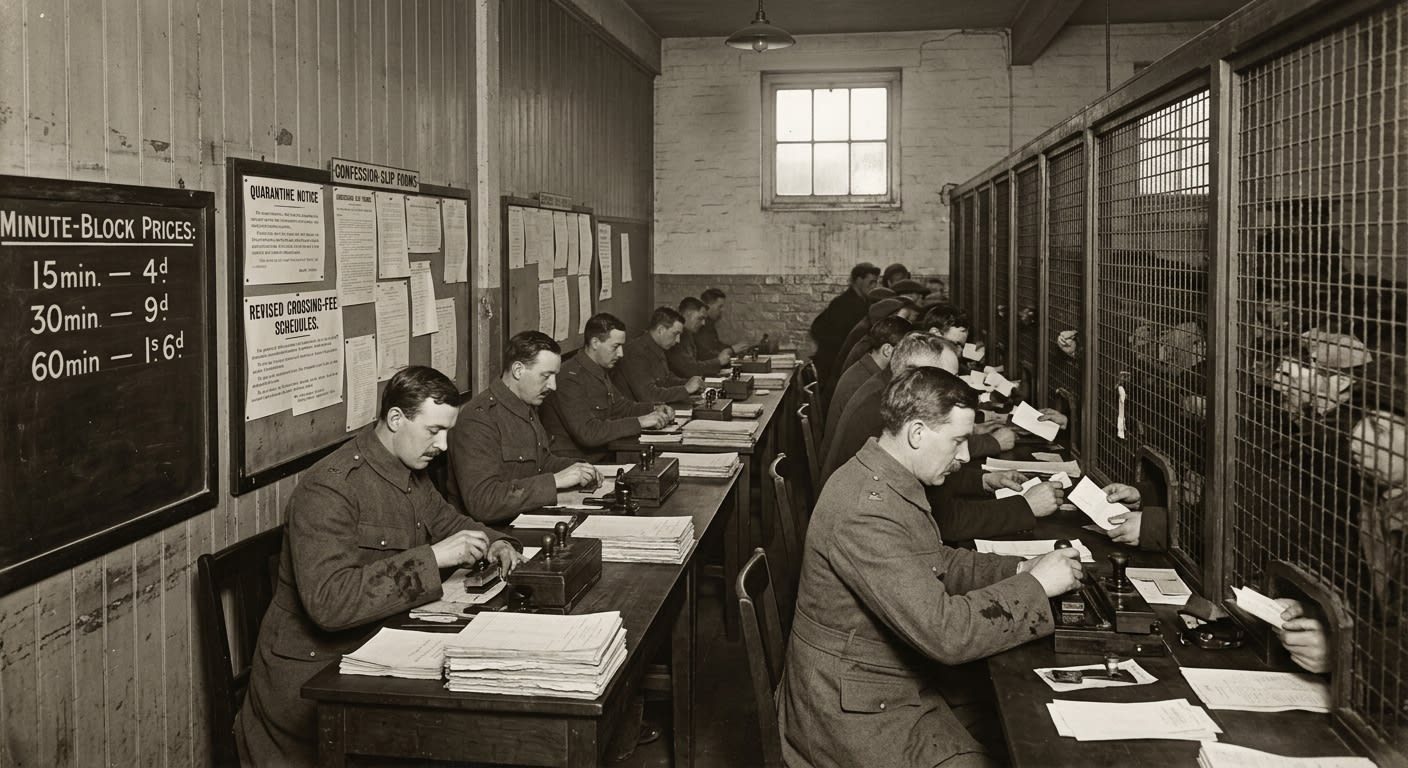
The Chain's economy runs on time. This is literal. The fundamental unit of currency along the river is the time permit — a stamped slip of paper, issued by the Ink Dock clerks, authorizing the bearer to wait in the queue for a specified number of minutes. You do not pay to cross. You pay to wait to cross. The crossing itself is free. This is the kind of theological distinction that makes the Bureau of Doctrine weep with professional admiration.
A minute-block — the smallest denomination — costs approximately one day's bread ration. A priority crossing — the kind that moves you to the front of the queue within the hour — costs what a labourer earns in a month. The price fluctuates with season, weather, cargo weight, quarantine status, and the personal disposition of whichever clerk is stamping permits that morning. The clerks are not corrupt. The clerks are responsive to market conditions, which is corruption wearing its Sunday vestments.
Beyond time permits, the Chain trades in confession slips. When cargo goes missing — and cargo always goes missing, because the Chain handles ten thousand manifests per season and the counters are human and the bribes are constant — the discrepancy must be accounted for. The Synod's solution, arrived at by some genius of administrative theology, is the discrepancy confession. You confess to the loss. The slip is filed at Ink Dock. The loss is sanctified, the Ledger balanced, and the goods — wherever they actually went — are reclassified as "offerings rendered unto Providence." The confession slips, naturally, become their own currency. A man with many confessions on file is a man who has lost much cargo. A man who has lost much cargo is a man who knows where cargo goes. Knowledge is power; power is leverage; leverage is the only thing worth owning on the Chain.
The Ration Slip Market operates every morning at dawn in the fifth node. The brokers arrive before the queue-liners, set their prices before the sun clears the gantry towers, and control the food supply with the efficiency of a well-run siege. Dead chits — expired ration slips, supposedly void — circulate freely among the brokers, revalidated by forged stamps or simply accepted by vendors who cannot afford to refuse them. The Bureau of Records, if it knew the scale of dead-chit circulation, would dispatch auditors. The Bureau of Records does not know, because the Chain's ledgers claim perfect throughput and the Chain's clerks have a professional interest in maintaining that claim.
#On the River Ledger
"If your name shows on the rope, don't cross." — Rope-Ferry Chain superstition
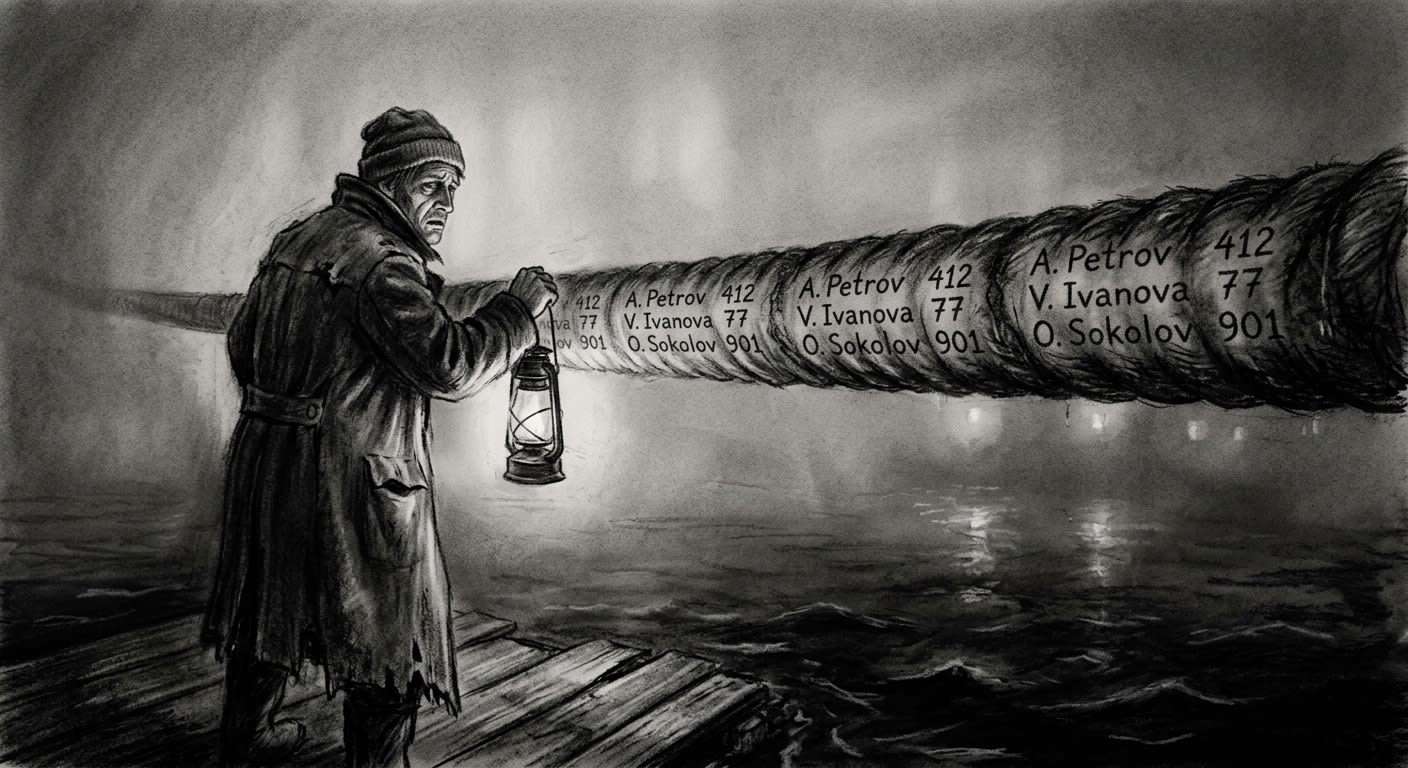
At certain fog densities — and the fog along the river is frequent, thick, and malicious in ways that no meteorological explanation satisfies — the mainline cables undergo a transformation that the Bureau of Alchemical Standards has classified as "Category Two Localized Scribal Anomaly" and declined to investigate further. Wet rope fibers darken. The darkening arranges itself into legible forms. Names. Numbers. Dates. They appear along the cable in a hand that no one recognizes — too regular for human script, too irregular for any known stamp or printing method — and they correspond, with a precision that the crews find unbearable, to events that have not yet occurred.
The crews call it the River Ledger. They have developed countermeasures: tar-sealing the rope before a crossing, hanging bell-cards on the gantries, requiring three witnesses to sign a "witness crossing" form that theoretically negates whatever the rope has written. These countermeasures do not work, but they are practised with the devotion of men who have nothing else to practise. The Schedule Choir — the guild of chanters who sing the timing calls that synchronize ferry crossings — has begun incorporating the River Ledger into their omens, interpreting the manifestations as divine scheduling corrections. This gives them influence over closure decisions, which gives them power, which is the actual point.
[SECTION REMOVED — Bureau of Alchemical Standards, Classification Pending] [Content pertaining to the correlation between River Ledger manifestations and ████████████████ beneath the old bridge ruins at Node Seven has been sealed under ████████ pending review. The Bureau notes that the word "correlation" is used advisedly; the word "causation" would require a theological ruling that the Bureau is not prepared to request.]
The manifestations have increased in frequency since A.S. 199. Three names per fog event was the historical average; the most recent events have produced eight, ten, fourteen. Provost-Captain Venn has stationed additional skiff patrols at the nodes where manifestation density is highest. The patrols are there to maintain order. The patrols are also there to read the names before the crews do, because a name on the rope is leverage, and leverage is what Venn collects.
#On the Night Crossings
The Chain officially ceases operation at curfew. The ferries are tied off, the queue lanes emptied, the gantry lanterns doused. This is the official position and it is a lie so complete, so structurally integrated into the Chain's economy, that removing it would collapse the system faster than a flood.
The Black Ferrymen run the night route. They are not a guild — guilds are licensed, and licensing is the one thing the Black Ferrymen cannot afford. They are crews: three or four men to a skiff, operating in the reed channels between nodes, pulling passengers and cargo across the river by hand-line rather than mainline cable. The crossings are slower, wetter, and more dangerous than the daytime operation. They are also cheaper, undocumented, and available to anyone the daytime system has decided to exclude — refugees without papers, smugglers with cargo too sensitive for manifest inspection, soldiers absent without leave, priests carrying relics whose provenance would not survive a quarantine audit.
The lantern codes are the Black Ferrymen's language. A sequence of blinks from a gantry tower — two long, one short, three long — means the provost patrol has passed Node Four heading south. A steady amber from a reed-hut — safe to load. A red flash from anywhere — scatter. The codes change weekly. The provosts know this. The provosts also know that approximately a third of their own number supplement their income by selling patrol schedules to the Black Ferrymen, and that the remaining two-thirds supplement their income by arresting Black Ferrymen and confiscating their cargo, which is then sold back to the Black Ferrymen through intermediaries. The economy is circular, self-sustaining, and invisible to the Transit Office ledgers.
#On the Quarantine Piers
The Quarantine Piers occupy the fourth node — a cluster of floating platforms, rope-fenced, staffed by the Lye Order. The Order's mandate is the prevention of plague. Their actual function is the administration of fear.
Every person crossing the Chain is subject to quarantine inspection. The inspection involves a lye wash — a caustic bath administered by washers wearing leather aprons and expressions of professional indifference — followed by a stamp review, a cargo manifest comparison, and, if the inspector feels moved by the Spirit or by the promise of a bribe, a full-body search conducted with the thoroughness of a theological interrogation. A clean quarantine stamp is worth more than coin on the Chain, because a clean stamp means passage. A revoked stamp means detention. Detention means the Piers, and the Piers have a mortality rate that the Bureau of Records attributes to "pre-existing conditions exacerbated by temporary accommodation."
The Lye Order has expanded its cordons three times in the past decade — each expansion coinciding with a rumour of plague that the Order itself was best positioned to start. The cordons choke the queue lanes, slow throughput to a crawl, and generate a secondary economy of emergency quarantine stamps sold at prices that would make the Bureau of Tithes envious. The provosts tolerate this because the Lye Order shares its intelligence. The Superintendentate tolerates this because quarantine delays reduce throughput, and reduced throughput justifies increased fees. The system feeds itself.
#On the Drowning Cages and Other Instruments of Mercy
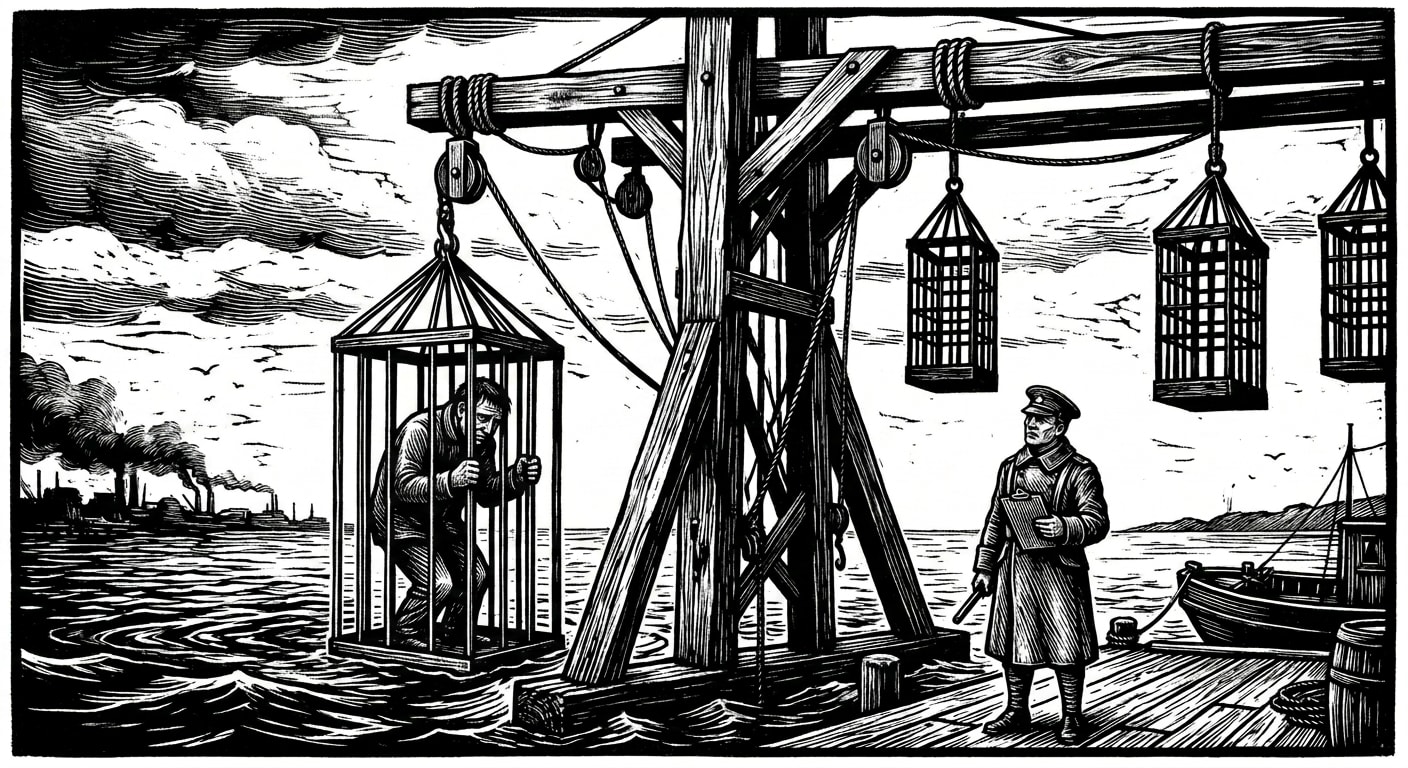
The drowning cages hang from the gantry towers at the Bend Ferry — iron lattices, just large enough for a man to stand but not sit, suspended above the water at a height calibrated so that the river, at high tide, fills the cage to the prisoner's chest. At low tide, the prisoner stands in air. At high tide, he stands in water. The sentence is measured in tides, not hours. Three tides is a warning. Seven tides is a punishment. Twelve tides is a message.
The Bureau of War installed the cages as detention apparatus. The provosts use them as inventory correction — a man who disappears into a cage at high water and does not reappear is logged as "crossing casualty, weather-related." The Chain's records show remarkably few executions. The Chain's records show remarkably many weather casualties. The distinction is maintained with the rigour one expects from an institution that has learned to file murder under meteorology.
#On the Reed Mothers
Behind the Quarantine Piers, in the reed flats where the river shallows into marshland, the Reed Mothers maintain their huts. They are not licensed. They are not sanctioned. They exist because the Chain requires someone to shelter the children of the pressed, to nurse the sick whom quarantine has refused, and to hide the people whom the system has decided do not exist.
The Reed Mothers communicate by coded laundry lines — the arrangement of cloth on the drying ropes signalling safe passage, danger, provost patrol, or food available. They have tunnels through the reed beds connecting their huts to culvert mouths that empty into the river upstream of the Quarantine Piers. They are raided twice a year, lose their shelters, rebuild them within a week, and are raided again. The provosts raid them because they must. The provosts also leave a warning — a lantern flash, two short, one long — before they raid, because Provost-Captain Venn has three children of her own and understands, in whatever part of her conscience survives the receipt-smile, that the Chain without the Reed Mothers would be a system without a pressure valve.
#On the Present Condition
The Chain is failing. It is failing in the manner that all Synod infrastructure fails — slowly, profitably, and with meticulous documentation of the failure's absence. Throughput has declined nine percent over three seasons. Rope quality has degraded as the Splicehands Guild restricts supply to inflate dues. The River Ledger manifestations are accelerating, printing more names per fog event than at any point in recorded history, and the crews are beginning to refuse crossings on heavy-fog days regardless of the schedule. Quarantine cordons expand. Ration supplies shrink. The Mouth reports grain shortages that the upstream nodes deny shipping. The Queue Road sends more bodies than the ferries can process.
ERRATUM — Synod Transit Office, Filed A.S. 201 The claim that throughput has declined is retracted. Throughput has been restructured to prioritize doctrinal cargo over civilian supply. The decline is a feature. The hunger is a consequence. The consequence is regrettable. The feature is permanent.
Superintendent Sorn's annual report to Strasbourg — the one submitted through channels, stamped and sealed — describes "manageable seasonal fluctuation." His private assessment — the one written on the back of a condemned rope-inspection sheet and locked in his personal strongbox — describes a system one bad winter from cascade failure. A flood, an ice-shear, a deliberate cable-cut at a critical node, and the downstream towns starve. He has requested bridge construction authority four times. Four times denied. "Defensive prudence."
The Black Ferrymen grow bolder. The Reed Mothers grow more necessary. The Lye Order expands its cordons. The Splicehands restrict their rope. The drowning cages fill. The River Ledger writes. And the Chain, lashed together by hemp and paper and the bureaucratic conviction that a system too profitable to fail cannot fail, continues to creak across the water, carrying its cargo of grain and conscripts and confession slips from the heartland that produces them to the Line that consumes them, one stamped minute at a time.
The local proverb says it best: "Cut one line, the hunger travels."