
#On the Origin of the Profession
"The river is a confession. Only the properly named may cross."
Every bridge the Synod destroyed between A.S. 48 and A.S. 65 created something the Bureau of War had not anticipated and the Bureau of Tithes had silently prayed for: a chokepoint. Where stone once carried men over water without requiring them to pause, to name themselves, to open their papers and their mouths simultaneously, there remained only drowned pilings and a current running fast enough to kill anyone fool enough to swim it.
The ferries came first — flat barges on hemp cable, pulled by men whose hands smelled of tar and whose politics extended no further than the width of the river. Then the passwords came, because the Synod does not permit movement without speech, and speech at a crossing must be the correct speech, spoken at the correct hour, to the correct guard. Then the passwords changed, because passwords that do not change are walls that do not lock, and the Bureau of Doctrine had decreed rotating ciphers at sundown across every transit node from the Rope-Ferry Chain to Latchford. And then — because passwords changed faster than ink dried, and because the guards enforcing them were often illiterate, and because a mispronounced saint-name at Irongate once sealed a convoy of four hundred in a quarantine pen for eleven days — the Broker appeared.
The Ferry Chokepoint Broker is what the Synod's permit system produces when the system grows too thick for the Synod's own officers to parse it. A human patch cable. A clerk who has never held a commission, a priest who has never been ordained, a ferryman who owns no barge, yet who can move a man from one bank to the other because he knows which seal satisfies which guard, which password is current at which hour, and which prayer-phrase — spoken with just the correct stress on the second syllable of Edras — will turn a hostile inspection into a routine clearance.
The profession has no charter. The Bureau of Records does not acknowledge it. The Bureau of Purity has, on three occasions, classified it as a heretical trade and, on three subsequent occasions, reclassified it as a tolerated ancillary function. The reclassifications correspond precisely to the three occasions on which a Bureau of Purity senior inspector required an emergency crossing and found that no one but a Broker could arrange one.
#On the Substance of the Work
"They exist to translate desperation into acceptable paperwork so that crossings don't collapse into slaughter."
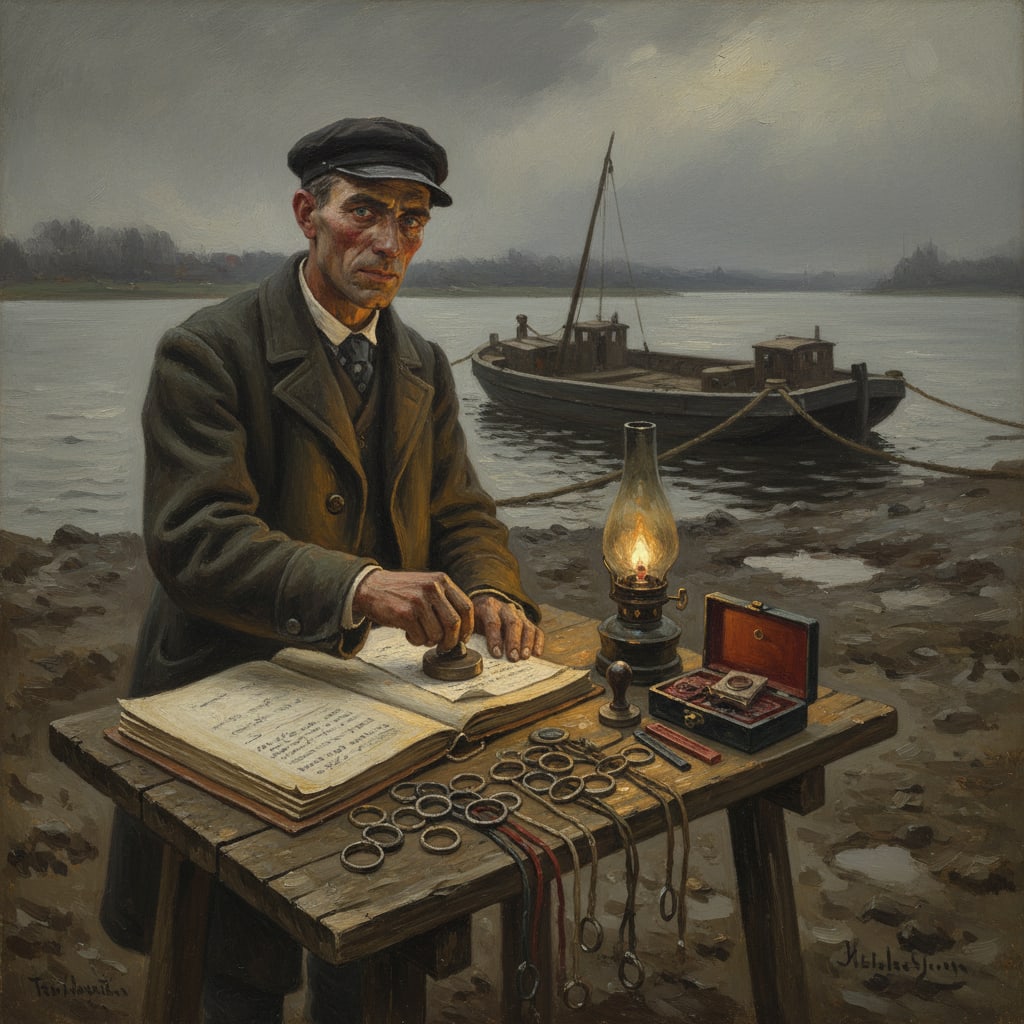
The Broker's raw materials are names, seals, time, and fear. His workspace is the queue — the mud-suck bank, the algae-stinking lockhouse, the tavern near the dock where oarsmen drink and guards pretend not to. His tools fit in an oilskin folio: forged seals, password rings threaded on gut-cord like rosaries of transgression, phonetic prayer cards inked in waterproof oil, and a wax kit that can manufacture legitimacy between one bell-toll and the next.
The day begins before dawn, in rumour. Which ferries are running. Which pontoons are real — because certain pontoons exist only in the ledger, having been swept downstream three seasons ago while the clerk who filed their status report declined to update it. Which pilots are sober, which are bribable, and whether the distinction matters at the crossing in question. The Broker buys intelligence from oarsmen, sells pre-paid queue slots to convoy captains, and triages the morning's clients by a calculus that no Bureau has codified: who can pay, who will snitch, and who will panic on the boat.
The work accelerates at midday, when the queues thicken. Families. Merchants hauling cargo manifests that require seven stamps and contain nine. Deserters whose papers list a regiment that was dissolved last month. Pilgrims carrying relics whose provenance the Broker does not examine, because provenance is the Bureau of Relics' problem and the Broker has enough problems. He generates cover: a pass slip, a witnessed identity affidavit, a donation receipt that transforms a bribe into an offering. He secures the password chain — what phrase, to which guard, at which hour — and then he controls the client, because the client is the variable that kills.
The password system deserves particular attention, because it is the mechanism that makes the Broker indispensable and the mechanism that will, one day, kill him. The Synod rotates crossing passwords at sundown. The passwords are saint-phrases — the third verse of the Canticle of Edras, the opening invocation of the Minor Lauds, a specific declension of the Penitential Creed that changes weekly. The passwords are distributed from Strasbourg via sealed courier. The couriers arrive late. The couriers arrive with the wrong version. The couriers do not arrive, because the couriers themselves required a crossing to reach the ferry, and the ferry's guards would not accept the previous password because it expired at sundown.
The Broker carries the current phrase. He carries tomorrow's phrase, because he has bribed the upstream lockhouse clerk. He carries last week's phrase, because certain guards have not been informed of the change and will accept an expired password if it is spoken with sufficient confidence. And he carries, in a sealed pocket sewn into his sleeve, the Split Prayer (Unregistered) — a two-part password, half given to the client and half retained by the Broker, so that if the client is taken, interrogated, and confesses, he confesses only half a phrase. Half a phrase is gibberish. Gibberish is not treason.
#On the Founding Incidents
Three events elevated the profession from riverbank opportunism to structural necessity.
The first was the Silt Week — a spring flood, unremarkable in force but catastrophic in its administrative consequences, that washed the bridge records from three crossing nodes along the Rhine tributary system. Thousands of souls became "unverifiable" overnight. Their names existed in no surviving ledger. Their passage rights had been entered on paper that was now silt. The ferries halted. The Synod dispatched audit teams. The audit teams required crossings to reach the affected nodes; the affected nodes could not process the audit teams because their records were the records that had been lost. The Brokers — unnamed then, unchartered, mere touts working the bankside — saved the solvent first, forging temporary clearances from memory and bluff. The insolvent rioted. The rioting birthed the first ferry militias, armed dock gangs who controlled the crossing by violence until the Bureau restored its files six weeks later.
ERRATUM — Bureau of Records, Filed A.S. 134 The Silt Week was a successful demonstration of the importance of record-keeping, conducted at regrettable river-depth. The Bureau thanks the river for its pedagogical contribution.
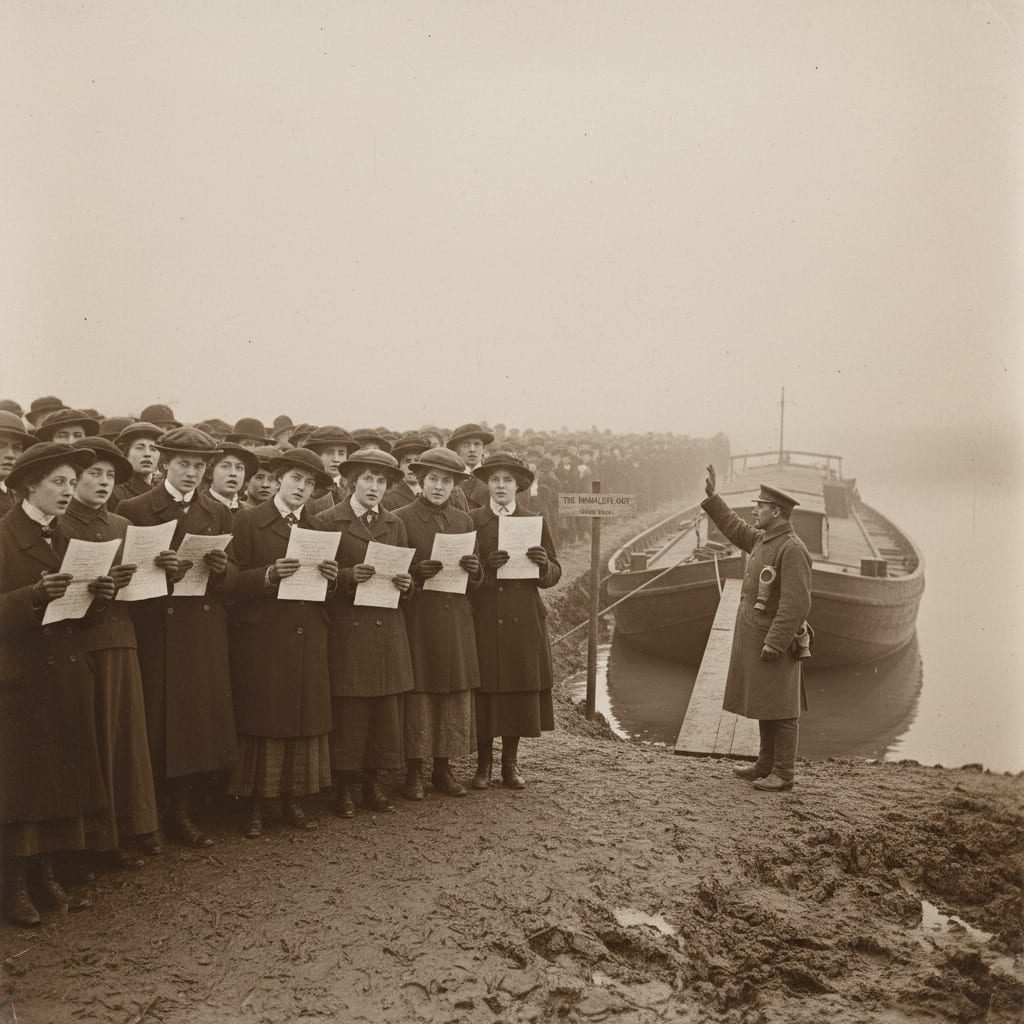
The second was the Nominalist's Gate Affair. At Nominalist's Gate — that grim monument to paperwork, where ferries capsize under the weight of ledgers and the mud kills alphabetically — a single mispronounced saint-name triggered a mass denial. The guard at the lead barge heard Adras where the password required Edras. He refused the crossing. The queue backed up. The second guard, hearing the confusion, refused the next twelve supplicants on principle. By afternoon, three hundred souls stood on the trench-bank with valid papers, valid seals, valid transit writs, and one shared deficiency: a consonant. The Brokers, afterward, began carrying phonetic prayer cards — inked guides showing the correct pronunciation of every current password, annotated with the regional accent of the guard most likely to be on duty. The cards are contraband. The cards are essential. The Bureau of Purity confiscates them on Tuesdays and purchases them on Wednesdays.
The third was the Bellwater Breach — the incident that transformed the profession from a bureaucratic convenience into a spiritual necessity. At a minor crossing south of the Chain's seventh node, a water-demon learned to mimic the ferrymen's call-and-response. The thing sat beneath the hull, repeating the correct phrases in a voice indistinguishable from the pilot's, and the barge-hands — hearing the right words at the right time — hauled on the cable and pulled the vessel straight into an ambush that cost seventeen lives and a season's grain cargo. The Synod responded by layering the password system with sanctified call-and-response protocols: challenge phrases blessed by the Bureau of Bells, response phrases calibrated to harmonic signatures that no demon had yet been observed to replicate. The Broker, naturally, counterfeits these too, because a client who cannot produce a sanctified response is a client who does not cross, and a client who does not cross is a client who does not pay.
#On the Hierarchy and Its Factions
The profession's internal ladder is steep, narrow, and unlit. At the bottom: the Runner, a child or desperate adult who carries messages between lockhouses, ferries, and taverns, who is paid in scraps and protected by the understanding that killing a Runner is bad for business. Above the Runner: the Slip-Cutter, who can forge a basic pass slip and wrangle a witness — the witnesses being strangers paid to attest identities they have never encountered, a practice so universal that the Bureau of Oaths has invented a special classification for it: "third-party devotional attestation." Above the Slip-Cutter: the Chokepoint Broker proper, who owns relationships at a specific crossing and who controls the flow of names, seals, and time through that crossing like a valve controls pressure.
At the summit — rare, feared, and useful enough to be left alone by everyone except the Judges — stands the Nominalist: a doctrine specialist who has memorised the entire password rotation schedule, who can recite the correct saint-phrase for any crossing on any day of the month, and who understands the theology of passage well enough to argue a guard into compliance using the guard's own catechism against him.
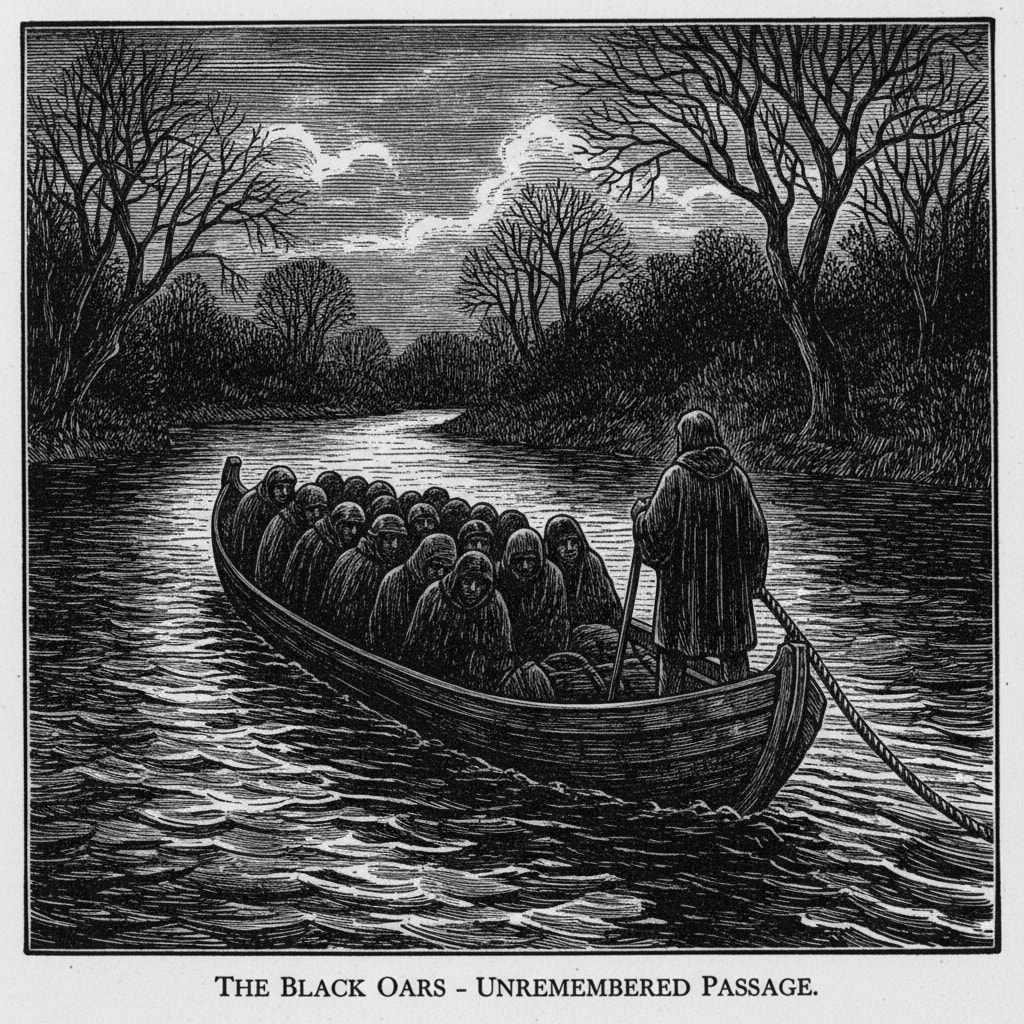
Two factions divide the trade. The Clean Slips prefer tolerated paperwork — semi-licensed passage brokering that operates within the Synod's vast grey margin between legality and enforcement. They maintain contacts in the lockhouses, pay the expected bribes at the expected rates, and keep their forgeries subtle enough that an auditor could, if he chose, overlook them without risking his own stamp. The Black Oars dispense with the pretence. They run the night crossings — unlisted, unstamped, conducted in silence on boats with no names painted on their hulls — and they serve the clients whom Clean Slips will not touch: deserters, the erased, smugglers of contraband too dangerous for daylight, and the occasional fugitive from the Bureau of Purity whose confession has already been filed and whose body the Bureau expects to follow it.
The two factions need each other. Clean Slips provide intelligence about guard rotations and password schedules; Black Oars provide the escape routes that Clean Slips require when a sting goes wrong. The arrangement holds until it breaks, and when it breaks, someone drowns.
#On the Present Condition
"The river remembers."
The Ferry Chokepoint Broker persists because the system that created him persists. The passwords change at sundown. The seals expire at the pleasure of whichever clerk stamped them. The Rope-Ferry Chain monetises waiting. Latchford monetises permission. Nominalist's Gate monetises spelling. Between these monuments to controlled movement, the Broker occupies the space that the Synod has constructed and refuses to furnish — the gap between the rule and the crossing, between the password and the mouth that must speak it.
Mother Vellum-of-the-Reed, the profession's patron legend — a scribe who "sold names to the nameless" and vanished mid-crossing, her barge found drifting with its oilskin folio open and every page blank, as though the river had drunk the ink — would recognise the trade she is said to have founded. The tools are better. The passwords are more complex. The penalties are more severe. But the river is the same river, and the crossing is the same transaction it has always been: a man on one bank who needs to reach the other, and a second man who knows the price.
The Broker charges that price, pockets his share, and burns his password scraps at shift's end. He rinses his hands in river water mixed with ash — to break "name-cling," the superstition that the river retains the names spoken above it and that demons can follow a name upstream to its speaker. He does not speak a client's true name on the bank. He does not look back at the water after a crossing. He carries a bell-sliver in his pocket seam, saint-dust under his nails, and a reed-knot bracelet on the wrist that holds his folio.
He believes none of it helps. He practises all of it anyway. The river is old, and the Broker is not, and superstition is the only theology that costs nothing to maintain.