
#On the Rope That Writes
"If your name shows on the rope, do not cross." — ferry superstition, recorded at Ink Dock and denied by Ink Dock within the same hour
The River Ledger is a Category Two Localized Scribal Anomaly affecting the mainline cables of the Rope-Ferry Chain. That is the Bureau's phrase, and like many Bureau phrases it performs the first duty of language badly and the second duty of language superbly: it fails to explain the thing while making the failure sound authorised.
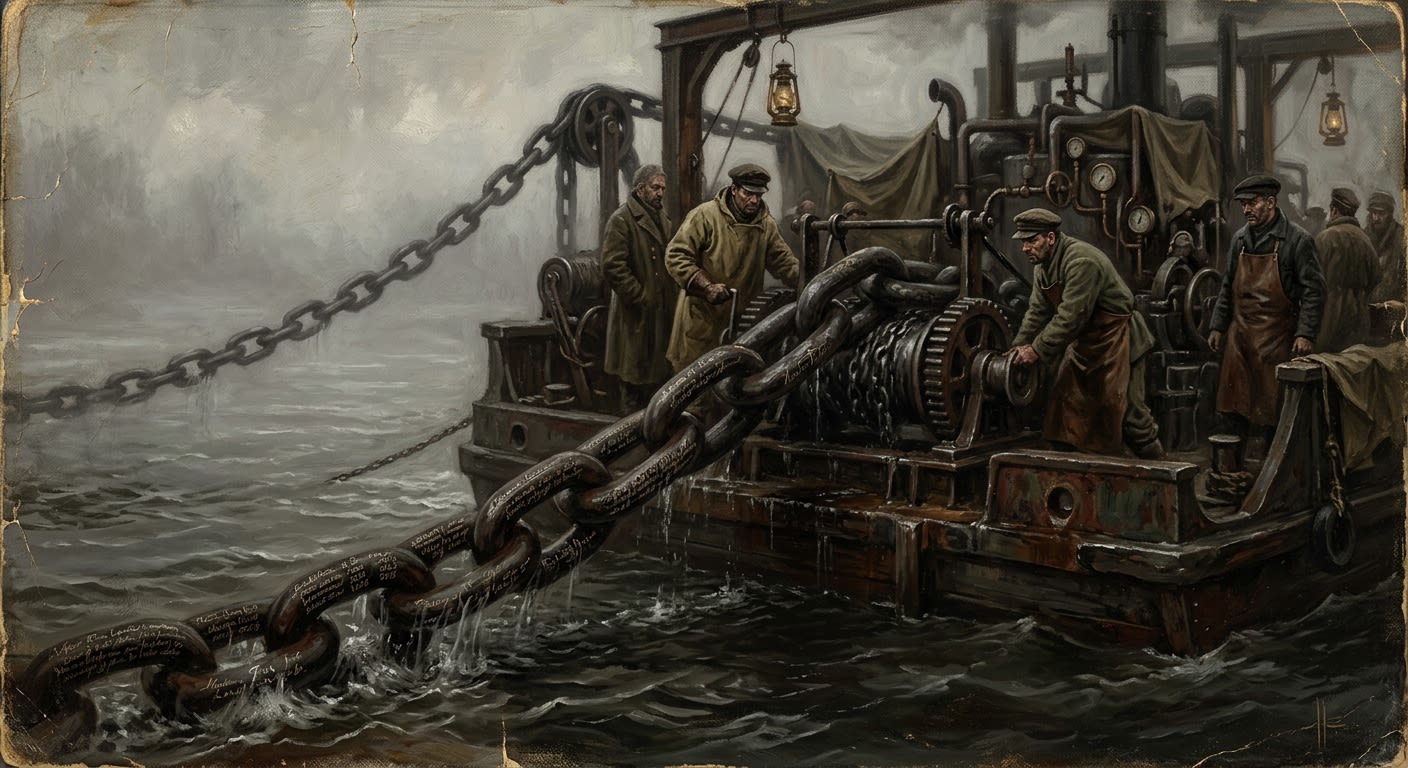
At fog density sufficient to wet hemp, dim lanterns, and make the gantry bells sound as though rung under cloth, the mainline cables darken. The darkening arranges itself into writing. Names. Numbers. Dates. Sometimes cargo weights. Sometimes tide-counts. Once, at Node Seven, a child's baptismal name written beside a drowning-cage sentence three days before the child's father stole a quarantine stamp and earned the cage.
The hand belongs to no clerk. It is too regular for panic, too irregular for stamp-work, and too cruel for accident. Each letter emerges inside the rope-fiber, blackening from within as if the river had found ink in the hemp's memory and decided to improve the schedule.
#On Manifestation and Method
The River Ledger does not write on dry rope. It does not write on new rope. It favours mainline cable already bearing strain — the thick, tarred lines hauled across pulleys until their fibers have learned the weight of barges, cargo, livestock, conscripts, coffins, and all the other commodities by which the Synod proves its love for mankind. Auxiliary lashings remain blank. Decorative prayer cords remain blank. The little luck-knots ferrymen tie under the gantry rails remain blank unless cut from a mainline after a manifestation, at which point the Bureau of Purity burns them and fines the widow.
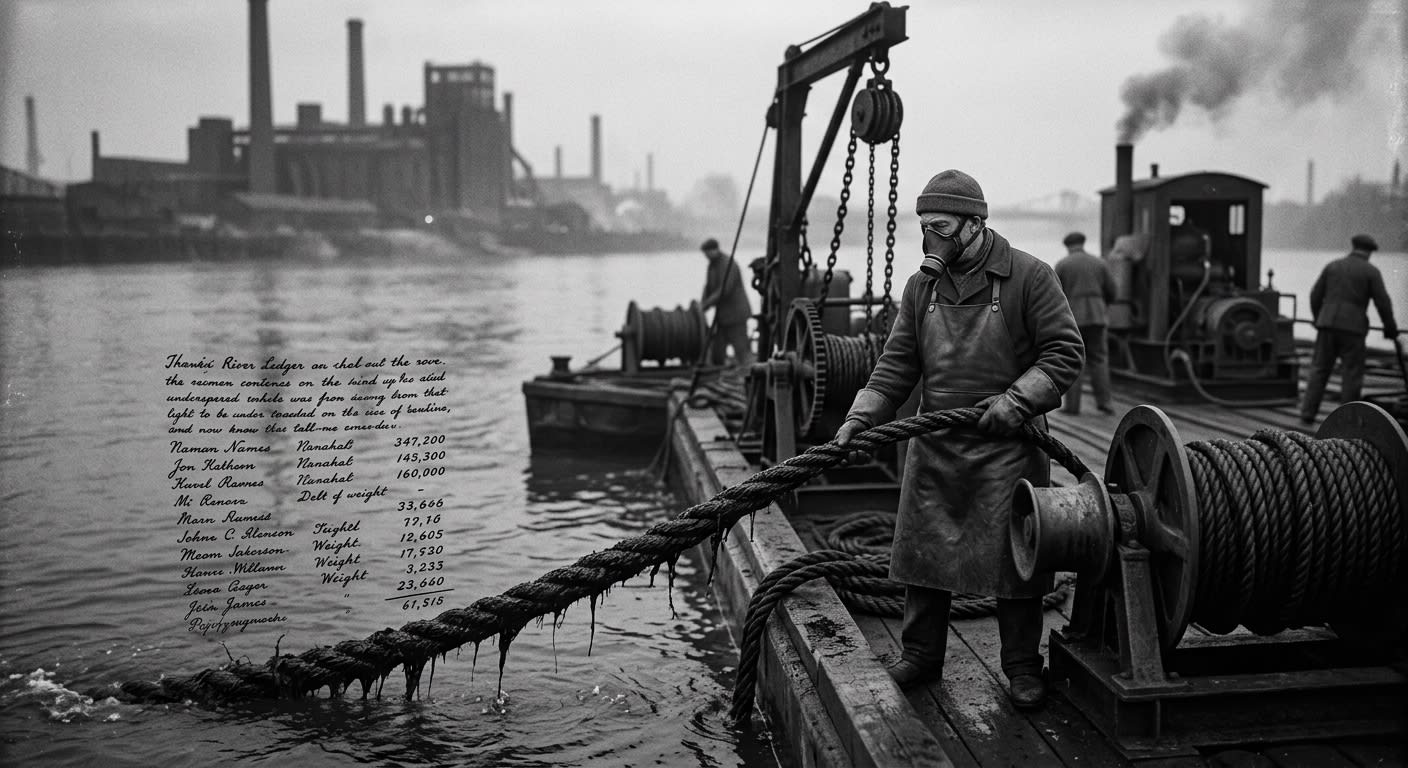
The writing begins as bruising. Ferrymen first see a darkening along the wet cable, a stain too linear for rot. Then the stain articulates. A vertical stroke. A hook. A number. A saint-day mark. The letters lengthen while watched and shorten when spoken over, which has led the Schedule Choir (Unregistered) to chant over manifestations with aggressive piety. This does not stop the writing. It makes the Choir feel employed.
Three witnesses are required for official copying: one Transit clerk, one ropehand, one person selected from the queue and compelled to sign before being permitted to know what he has signed. The copy is entered at Ink Dock, duplicated at the Chain Superintendentate, and forwarded to Strasbourg in the monthly anomaly packet. Strasbourg receives the packets. Strasbourg files the packets. Strasbourg responds, when it responds, with requests for clearer copies.
#On Accuracy, Which Is the Least Convenient Virtue
The Ledger's authority derives from its accuracy. A superstition may be ignored. A wrong omen may be mocked. A rope that writes twelve names and watches eleven drown within a fortnight acquires jurisdiction.
The first verified series at the Bend Ferry listed three names, a number seven, and the date 18 Brumaire. On 18 Brumaire, seven cargo hooks failed at the Bend Ferry during a squall; two named ropehands drowned, one named clerk was dragged into the water by his own satchel strap, and four unnamed labourers died whose names did not appear because, at the time, they were not registered to the node. The Transit Office (Unregistered) described this as partial correspondence. The crews described it as perfect cruelty.
Early Chain memoranda described River Ledger entries as post-event staining caused by iron-rich riverwater reacting with stressed hemp.
Withdrawn A.S. 199 after three copied entries were shown to precede their corresponding drownings by intervals of two days, five days, and one unhelpfully exact span of forty-seven minutes. The iron-rich riverwater theory remains in public pamphlets because pamphlets are cheap and panic is expensive.
Arrests appear with similar precision. A name beside a cage-count, a docket mark, or a tide number usually means the provosts will have the named person by that many tides. This has produced a doctrinal discomfort so sharp one could shave a bishop with it. If the rope writes an arrest before the arrest, do the provosts serve justice, or obey hemp? Provost-Captain Merrow Venn answered this by stationing skiff patrols at manifestation nodes and ordering them to read before the crews do. A practical woman. Morality annoys her; usable power does not.
The numbers are worse. A date may be denied. A name may be hidden. A number follows cargo. The Ledger prints weight shortfalls before audit. It lists missing sacks before the barge unloads. It once wrote "12" beside the mark of the Ration Slip Market (Unregistered); twelve children were found under the planks the next morning, alive, unpaid for, and administratively offensive. The Reed Mothers (Unregistered) claimed them. The Transit Office claimed the blankets.
#On Countermeasures and Their Uses
The crews have devised countermeasures, and the Bureaus have certified them with the tenderness shown by doctors prescribing incense to a man whose leg is off.
Tar-sealing is the oldest: hot pitch brushed over the cable before fog sets. It hides the fibers. It also stiffens the rope, increases snap risk, ruins the hands of the brushers, and causes the writing to emerge through the pitch in raised black blisters readable by touch. Bell-cards hung from gantries produce a sweeter failure. The cards tremble when the writing begins and sometimes ring once without wind. The Bureau of Bells has called this "acoustic compliance." The ferrymen call it the rope clearing its throat.
Witness crossing forms require three signatures pledging that all persons aboard the ferry are present, named, and accounted for. The logic is that witnessed reality resists anomalous revision. The practice has created a profitable trade in hired witnesses, false names, and conveniently blind clerks. On the Chain, every remedy becomes a market by the second tide.
The Schedule Choir interprets the Ledger as divine correction. They sing timing calls to synchronize ferry crossings; now they sing the rope's entries into omens. A name written high on the cable means delay. A name written low means search. A number beside a knot means closure. The Choir's authority over closure decisions has grown since A.S. 199, which proves once again that terror, when chanted in harmony, becomes policy.
#On Node Seven and the Sealed Correlation
The official files contain one silence wider than the river: Node Seven, called the Throat (Unregistered).
The old bridge ruins beneath Node Seven predate the Chain. Drowned pilings stand below the current like rotten teeth. Salvage divers report a stone housing under the eastern abutment, sealed by silt, iron banding, and something that makes compass needles tremble hard enough to chip enamel. The Bureau of Alchemical Standards sealed all content pertaining to correlation between Ledger manifestations and whatever lies beneath those ruins. It specified that the word correlation was used advisedly, since causation would require a theological ruling.
NODE SEVEN SUBSTRUCTURE NOTE — EXCERPT SEALED Diver testimony: cable darkening intensified over eastern abutment. Recovered object: ███████████, cold despite summer handling. Inscription matched: █████ entries from River Ledger series 199-C. Recommendation: do not cut the mainline above the structure. Reason: ██████████████████████████████████████
The Ledger writes most often near Node Seven. The Bend Ferry's cages hang there. The current runs fastest there. Ozone and fear cling to the gantry timber. Superintendent Halvick Sorn requested authority to reroute the mainline thirty yards upstream after the A.S. 200 winter fog series printed fourteen names in one event. Authority denied. Defensive prudence, cost, inadequate evidence, and the quiet preference of every distant office for experiments conducted on other people's rivers.
#On the Commerce of Foreknowledge
A name on the rope is a death sentence, an arrest warrant, a salvage tip, a bargaining chip, or a breakfast rumour, depending on who reads first.
Provosts want the names before the crews. The crews want the names before the queue. Brokers want the numbers before the auditors. The Ferry Chokepoint Brokers pay well for copied fragments, especially partial cargo marks and tide-counts. A broker who knows that a manifest will be short by dawn can sell protection before the theft occurs, arrange the theft after payment, and file a confession slip that makes the whole affair smell of Providence. In the Chain's moral vocabulary, this is weather with invoices.
The Reed Mothers read differently. When a child's name appears, they move the child. When a widow's ration number appears, they hide the chit. When a cage-count appears beside a known deserter, they cut a reed-channel skiff loose and pray the Black Ferrymen are not too drunk to row. Their success rate is officially zero because official records do not recognise their interventions. Their unofficial success rate is why the provosts raid their huts twice a year instead of burning them.
#On the Present Acceleration
The River Ledger has accelerated since A.S. 199. Three names per fog event was once the average. Eight became common. Ten ceased to shock. Fourteen at Node Seven brought the Superintendent's hands to the point of visible tremor, which for Sorn is the equivalent of another man setting fire to his hat.
Throughput has declined nine percent over three seasons. Rope quality has degraded as the Splicehands (Unregistered) restrict supply. Quarantine cordons expand. The Queue Road sends more bodies than the ferries can process. Heavy-fog crossings now face crew refusals, provost threats, choir objections, broker interference, and the rope itself composing ahead of schedule.
Transit Office A.S. 201 circular states that River Ledger frequency has not increased; only reporting diligence has improved.
Clarified under sealed annex. Reporting diligence did not produce fourteen names on one cable, nor did it blacken twelve feet of new rope at the Bend Ferry before the rope had entered service. Reporting diligence is innocent. The river is not.
The Chain remains operational. Permanently conditional. The phrase deserves its own little reliquary. The ferries still cross. The cables still hold. The Ink Dock still stamps. The drowning cages still measure sentences in tides. And in fog, when lanterns dull and fish die near the pylons and the pulley blocks murmur with voices no ferryman admits hearing, the rope darkens from within and writes the next correction to the schedule.