
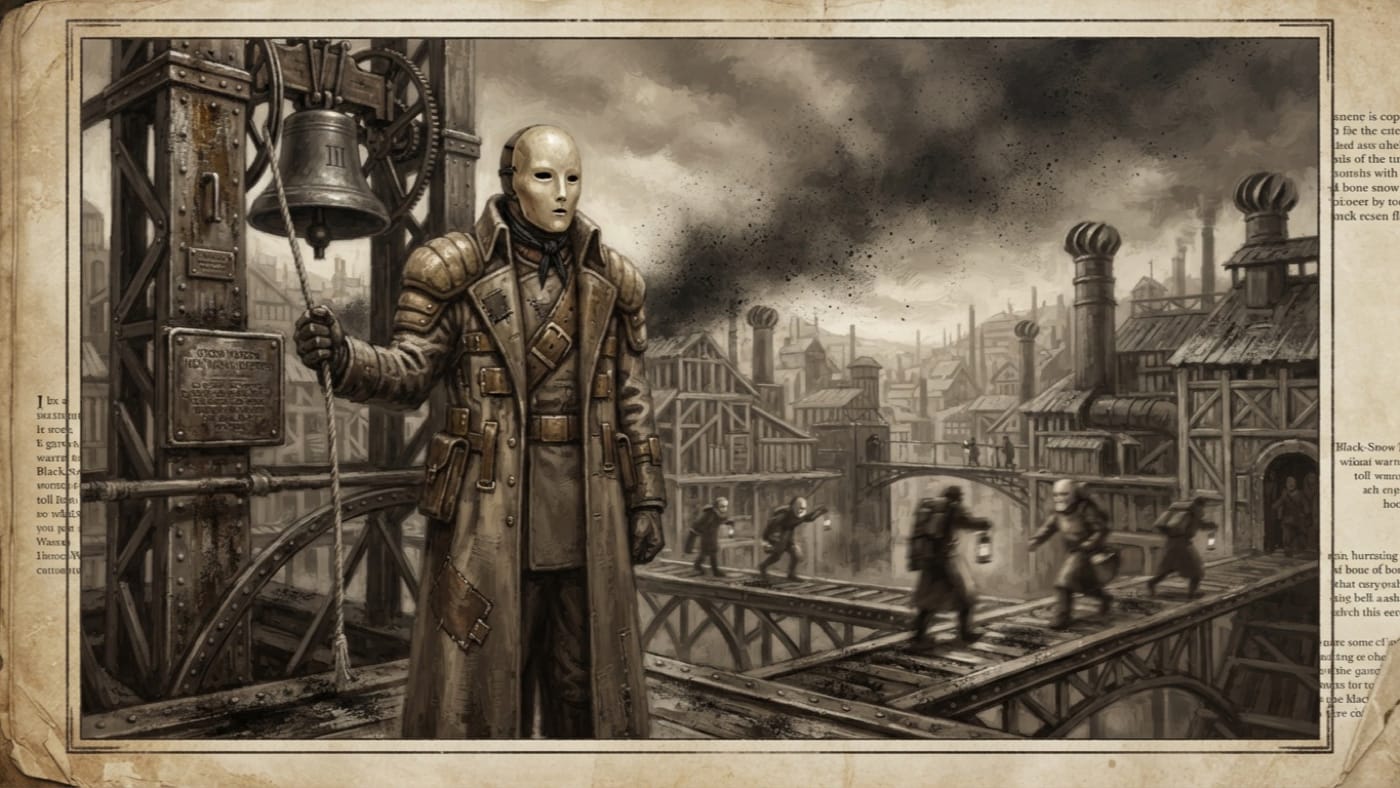
#On the Face at the Bell Rope
The bone-mask of Storm Warden Ilex Marr is the most familiar object in Black-Snow Lor and the least examined. Every child in the Warrens can draw it. No clerk in the Synod can say who made it.
Its wearer commands the Lor Storm Warden Corps and stands with a hand on the closure rope when the black snow comes off the eastern flats. One bell warns. Two bells prepare. Three bells close the town and seal the Breath Cordon. The face that gives these orders is pale bone and lacquered reed. It has appeared at storm watches, at Chapterhouse audiences, and at the single recorded deposition before the Bureau of Purity, and it has never once left its owner's head in public view. A bell-rigger reports that Marr sleeps in it. The survey of the Warrens records that Marr wears it at meals. No one with a seal has tested either report.
Lor is a town of masks. Half its population breathes through carved bone from first bell to all-clear, and every honest piece among them bears a stamp declaring whose hands shaped it. Marr's bears none that anyone has been permitted to find.
#On Bone, Reed, and the Missing Mark
The visible construction is easily recorded. It is a single fitted full-face piece, smooth across the cheeks, with no carving, ridge or ornament. It has a narrow mouth and two eye slits. At the throat, a seal of black cord and ash-wax closes the gap where an ordinary respirator would let in the wind. The mask wears no expression and never has. The effect is not restful.
Ordinary craft tells us what this mask ought to be. The Mask-House of the Bone-Guild of Rib and Reed chooses bone to suit the wearer. Draft crews get horse. Civilians who need a close fit get human rib. Officers who want durability get long-bone laminates. Wardens and bell-riggers get skull-thin plates for full-face storm masks. Every piece is salt-limed, polished, lacquered, fitted with reed filters and stamped with its maker's mark behind the jaw hinge. The poorest half-mask on Maskers' Row carries that stamp. Elsewhere in ash country, civilians carve masks from femurs and pack the hollows with herbs. This is crude work, and no one mistakes it for anything finer.
No maker's mark is visible on Marr's mask. The Guild's craft records list no commission for it, and Rib-Mother Sael has sworn under oath that the Guild did not make it. These are three separate facts. The first concerns what the eye has seen, the second what the ledger lacks, and the third what one interested witness has sworn. None of them names a maker.
No one has examined the donor, the bone, the filtering medium or whatever fittings sit behind the throat seal. A mark may lie under the cord. The Bureau has not looked.
#On the Voice Behind the Shutter
The mask's best-documented property is acoustic. Marr's speech comes out of it hollow and without depth, as though spoken from inside a wall, and it is neither loud nor soft. The acoustic note filed from Ribwatch Tower Three records that the voice can be understood through storm cloth at twenty paces.
I was present at Tower Three, though not for the most important question. The black snow was falling lightly. Marr stood at the bell-frame with one gloved hand on the closure rope and the blank face turned toward the eastern flats. I asked about forecasting methods. In that flattened tone I received cycle tables, particulate loads, pressure clicks in the lattice screens and the interval between ash-sled sightings. Each number sounded as if it had already been filed. I did not ask about the mask.
A closure command has a plain use for such a voice, and no theology is needed to explain it. When the third bell sounds, sight fails, breathing hurts and panic outruns every posted notice. Orders must pass through shutters and vent corridors and arrive without inviting debate. A voice with no face behind it gives the listener nothing to plead with. It carries, and it does not quarrel. Nobody bargains with a wall.
Lor's children understood this before its clerks did. In the game called Marr Says, one child calls closure orders in a hollow voice from behind a shutter while the others race for chalk circles before the third knock. The Ash-Chapel of Saint Lorn banned the game from its yard after three children refused to leave their circle for an hour because the real Marr had not released them. The ban failed. The game proves that children know who is obeyed and proves nothing more.
#On the Explanations in Circulation
Maskers' Row turns out theories as freely as its kilns turn out lime-smoke. Four circulate widely enough to earn a line in the ledger.
The first holds that the mask conceals lung-rot calcification climbing the face. The second holds that Marr was disfigured in the northern Storm Pit sinkhole of A.S. 194, when pre-founding bones surfaced and the ash blew upward from below. The sinkhole is documented. Marr's presence at it is not. The third holds that the mask was cut from a single skull recovered from the bonefield vaults beneath the vent spine. The fourth holds that Marr died during an off-cycle storm and the office found it administratively simpler to keep ringing.
The Bureau of Doctrine recognizes none of these. A fifth theory reached print.
A warren-sheet circulated in A.S. 200 alleged that Storm Warden Marr's mask is demonic in origin.
Withdrawn from citation. No sanctioned inspection has established that the mask is demonic in origin, and none has established that it is human in origin. The sheet's author treated the lack of an examination as if it were the examination's result.
My own preference, entered here as a preference and not a finding, is the theatrical answer. On this view an ordinary face sits under the bone, and Marr has understood that authority over other people's breath works better without one. It is the most human explanation and therefore the most damning. I hold it with all the confidence of a man who has never seen beneath the cord.
#On the Offices That Defer Inspection
The Breath Office holds that the mask cannot be inspected without Marr's consent. Marr has not consented. The Office cites no statute for its position, and no one has asked it to, because every office in Lor profits from leaving the question shut.
Breath Comptroller Juno Varr sells clean minutes and shelter tokens, and the closure bell decides when those accounts come due. If the mask hides disease, her office must declare contamination protocols against its own strongest instrument of closure. Sael's Guild keeps the bell frames tensioned and the shutters sealed. Having denied the mask under oath, the Guild gains nothing from a finding that some unlicensed hand out-carved it. If the mask proves to be relic-work, the Bureau of Relics will arrive with calipers and incense. If it proves demonic, the Bureau of Purity must purge the one official whose timing keeps the town breathing.
The Bureau of War has drafted replacement papers three times, and each draft stalled at the same line: who rings next? The record answers unkindly. In late A.S. 199, Marr rang closure eight minutes before the Breath Office posted its warning, and the storm arrived nine minutes after first bell. The full accounting belongs in the Warden's dossier. War's annex filed a shorter lesson: a list of officers with clean boots cannot replace competence of that order.
#On the Standing Disposition
The joint frontier assessment of A.S. 201 rated the risk of replacing Marr as high and public confidence as fear-based and stable. It deferred the mask inquiry until an emergency no longer exists. Storms have arrived off-cycle since A.S. 199, so the emergency has not ended, and the inquiry waits.
The physical questions remain open: what bone, whose hand, what sits in the filter cavity and what holds the throat seal. The other question remains open too, and the Bureau prefers that it go unspoken during storm season. When the next off-cycle fall comes over the flats, Lor will look to the towers, and the face at the rope will tell it nothing.