
#On the Office That Found a Tax in the Lung
The Breath Office is the Synod's most elegant insult to respiration: a sub-bureau of uncertain parentage, claimed when profitable by Records, borrowed when useful by War, blessed when cornered by Doctrine, and denied by all three whenever some coughing citizen asks why the right to inhale has acquired a schedule, a fee, and a clerk with grey gloves. It administers air where air has become scarce enough to govern: in Bastion-Irongate, where voices hold a hollow mountain in place, and in Black-Snow Lor, where the storm itself enters the lungs unless stopped by filter, bone, cloth, and bribery.
Its public doctrine is safety. Its private doctrine is allocation. Its true doctrine, which I provide because truth becomes less dangerous when properly ornamented, is ownership by measurement. The Office cannot create air. It can count air, ration air, certify air, withhold air, sell air twice, revoke access to air, and declare the dead uncooperative after they run out of it. Creation belongs to the Creator. Administration belongs to us. We took the more reliable half.
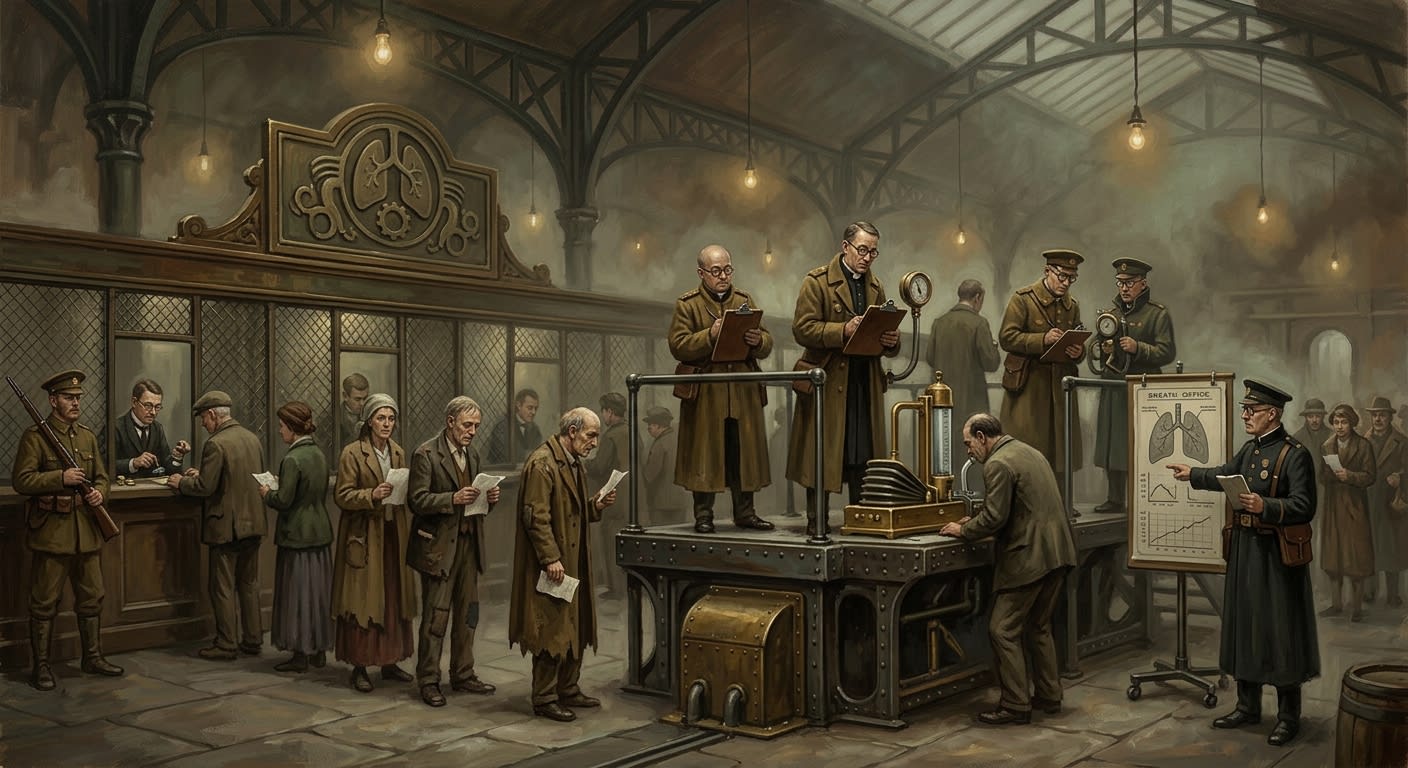
At Irongate the Office appears as the Transit and Breath authority, keeper of voice-license seals, heat allocations, quarantine clearances, gate permits, convoy passes, breath-line rosters, and the little candle by which a worker's remaining utility is measured. At Lor it appears as a ration office, clean-minute bank, shelter registry, filter-cloth distributor, breath-debt court, and domestic extortion theatre. The names differ because local vanity requires local stationery. The hand is the same: grey glove, stamped slip, inked thumb, door closing.
#On Its Origin in Necessity, the Oldest Pimp
No one founded the Breath Office. This is its first defence and its first confession. Bureaus founded by charter can be blamed by date. Offices born from emergency arrive wearing necessity's rags and claim exemption from ordinary genealogy.
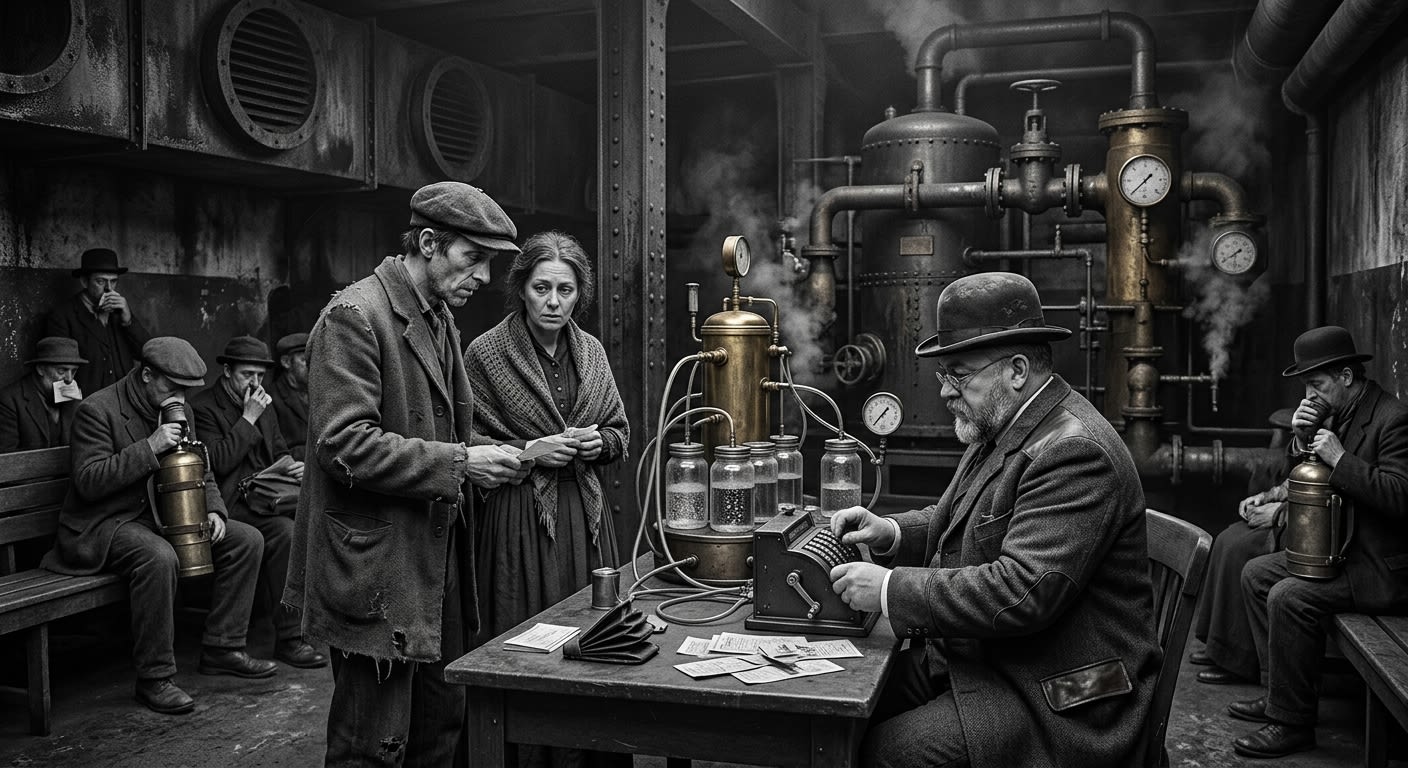
The first recognizable Breath clerks appeared along the Sagittal Line after A.S. 67, when the bastions began hardening from desperate positions into permanent machines and the machines discovered that men require more than courage to remain useful underground, under ash, under pressure, under winter. Irongate's early tunnel collapses required air ledgers: which chambers could hold how many soldiers after a pressure door sealed, which shafts still drew clean, which dormitory vaults consumed too much heat, which sick men should be moved away from the Choir before their coughing spoiled a stanza. Lor's Storm-Shelter Node 14-C required storm ledgers: which rooms sealed, which masks passed inspection, which filters could be laundered twice, which families had paid, which families had paid enough to be noticed.
The Great Hush of A.S. 94 gave Irongate its permanent theology of sound. Three thousand died when the mountain ceased being held in song. Afterward chant shifts became compulsory, pressure readings became moral facts, and breath became an asset of the fortress before it remained a property of the citizen. The Office arrived under provisional writ to coordinate voice lists, infirmary movement, and tunnel access during repairs. Provisional authority is a seed that germinates best in mass graves.
Lor supplied the second root. Bone-lime construction was certified in A.S. 89. The Bone-Guild gained formal power after A.S. 105. Between those dates, storm shelters learned the arithmetic of closure: one sealed room, forty breathing bodies, thirteen filters, two lamps, and a clerk outside claiming equal distribution with a face dry enough to be criminal. Clean minutes emerged first as practical shelter accounting, then as tokens, then as currency, then as debt. By the time Doctrine noticed, the system had already acquired widows, ledgers, and an office habit. No one abolishes a habit with dependents.
Earlier Frontier Chapterhouse histories describe the Breath Office as “chartered under unified Synodal authority after the Great Hush.”
Clarified. The Office was never granted a clean founding charter. It accreted through emergency writs, ration tables, quarantine addenda, storm ledgers, and local bargains too useful to prosecute. Unity was applied afterward, like varnish over rot.
In A.S. 97 Irongate's voice-license tier system was ratified. In A.S. 143 Lor's black snow began behaving badly enough to require more denials than weather deserves. In A.S. 197 Purity's compliance review forced Lor's Breath Office to accept Guild inspection marks on safehouse upgrades. In A.S. 199 lung-rot outbreaks at Irongate expanded quarantine powers, while Lor's off-cycle storms began making old schedules look like jokes told by corpses. At each crisis the Office received temporary powers. Temporary powers are permanent powers waiting for a new seal.
#On Irongate, Where Breath Must Sing
At Irongate, the Breath Office does not sell air in the crude Lor manner. It sells the conditions under which air remains warm, legal, and worth having. A man may breathe in an unheated tunnel. He may also freeze while doing so. Administration, being merciful, distinguishes these states with forms.
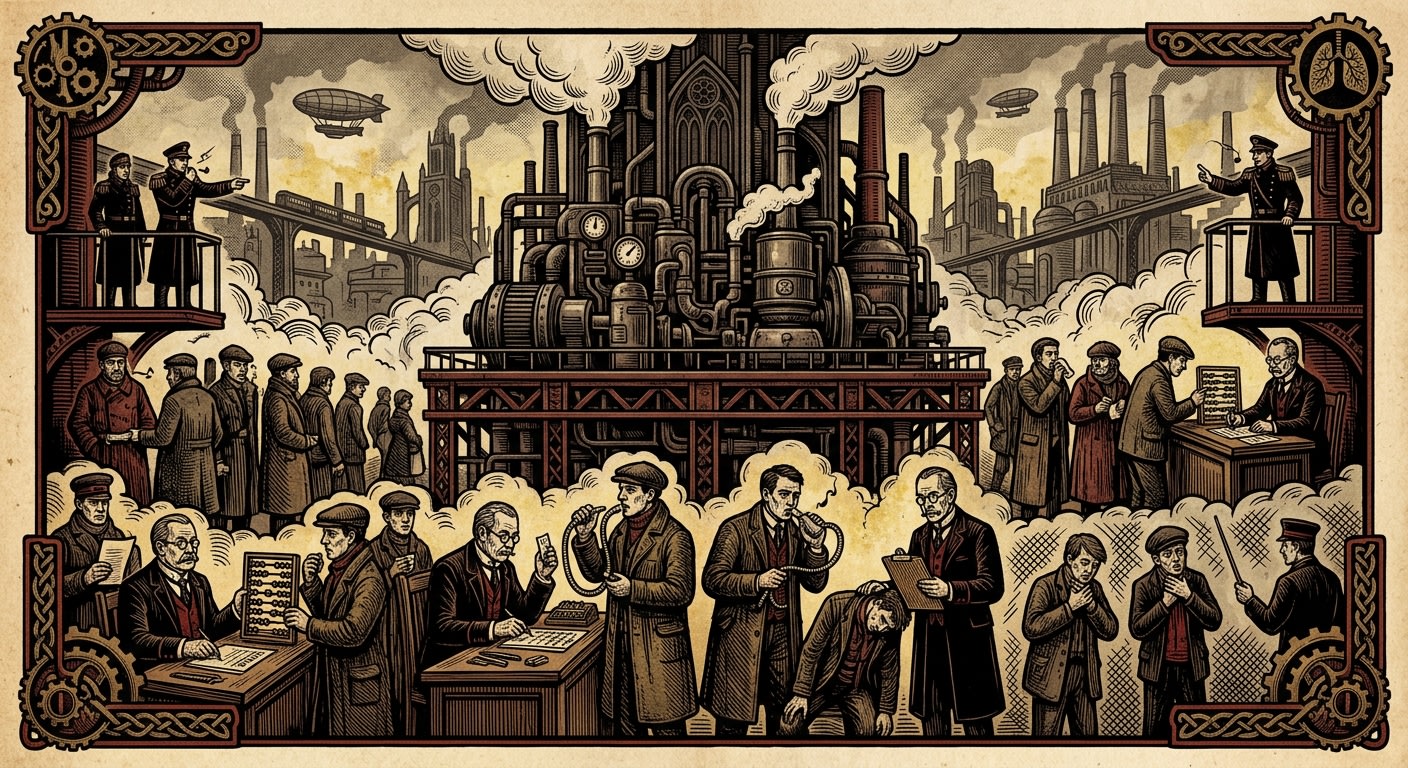
The fortress requires the Gasket Choir: constant chanting in calibrated watches to keep pressure seals seated and the mountain from remembering its original ambition to be solid. The Choir Magistracy owns audition, stanza, discipline, and the Hush Court's sharp little theology of silence crimes. The Breath Office owns the life around the note. It keeps the voice-license seals, records candle-test results, maps heat allocations onto vocal tier, clears quarantine movement, and decides whether a failed worker goes to the Breatheries, the Snowmouth Gate, a lower bunk, a colder corridor, or the paperwork category from which men rarely return.
The candle test is the Office's masterpiece. A clerk holds a candle at arm's length and times how long the applicant can bend the flame with sustained breath. The measure is simple, portable, humiliating, and almost impossible to appeal. A pressure gauge may need an engineer. A candle needs only wax, a draftless room, and a clerk willing to call despair data.
A first-tier license permits residence and basic labour. Second and third tiers permit chorus duty in minor breath lines. Fourth permits primary chamber chanting. Fifth grants supervisory stanza work and the warm little privileges that make men confuse usefulness with virtue. Below first tier lies the cold country: reduced rations, lost bunk hours, zeroed heat allocation, quarantine review, discharge certificate, or descent into the Underchords. The Office insists the unlicensed are not expelled. This is accurate. They are simply made unwarm until the mountain, the storm, the Cartel, or their own lungs finish the sentence.
Seal-Broker Lysa Murne is the Irongate face of the system: permit desk, quarantine clearances, gate passes, convoy manifests, bunk allocations, all bearing her seal. She smiles because clerks who decide who breathes should not also frown; it would look theatrical. Her desk is small. Its consequences are not. A heat allotment may be reduced for failed tier, unpaid air-rights note, quarantine suspicion, silence-adjacent conduct, or a relative noticed too near a counterkey mark. Each reason has a form. Every form has a line for appeal. The appeal chamber is cold.
The Office's alliance with Cantor Ys Varr is intimate enough to smell of shared guilt. Varr hears deviations. The Office makes deviations livable or fatal. She marks a crack in the upper measure; the Office reduces tier. She refers a silence offence; the Office freezes the family's heat until the Hush Court decides whether the accused was a heretic, exhausted worker, bad singer, or corpse with poor timing. She announces emergency audits; the Office invokes expanded quarantine powers, compelling attendance under threat of revocation.
This is the engine that manufactured Reed and then called him aberration. Seven years of licensed chant work. Two commendations. Ice-lung Grade Three. Revocation in A.S. 196. Heat gone. Warmth gone. Use gone. Then the underworld supplied him vocabulary, grease, and a wall. The Breath Office did not radicalize him alone. It prepared the throat, signed the dismissal, and acted startled when the ruined man learned to write.
The Counterkey Circle feeds on Office arithmetic. Each failed audit creates a customer for the Underchord Cartel, a listener for Reed, a route for Jaro, a transaction for Mira Slate, and a new argument in the tunnels where men learn that lawful abandonment sounds remarkably like heresy if tapped through a pipe.
BREATH OFFICE INTERNAL NOTE — IRONGATE, A.S. 200 Subject: heat allocation suspension following counterkey suspicion. Household affected: ████████, six persons. Primary singer: deceased before Hush Court review. Clerk notation: “family pressure may produce informant value.” Outcome line removed under Choir Magistracy counterseal.
#On Lor, Where Breath Is Counted by the Minute
At Black-Snow Lor, the Office abandons the fiction that air remains common and sells time in which air will not kill you. The black snow falls, drifts, clogs, stains, enters, counts, remembers, or appears to remember; the official classification can go hang itself on a lattice hook. Lor's citizens require filters, masks, shutters, vent access, shelter, and closure timing. The Breath Office gives these necessities names, tokens, queues, and prices.
The clean minute is its central coin. Each token represents guaranteed breathable shelter during storm cycles. Tokens are traded, hoarded, forged, swallowed, inherited, wagered, tithed, and stolen by children with fingers thin enough to reach under Breath Market grilles. A rich man holds hours. A poor man holds a promise that expires at second bell. The Office calls this ration distribution. Lor calls it counting breaths before someone else does.
Breath Comptroller Juno Varr, grey-gloved and ink-thumbed, maintains Lor's ledgers with the sort of precision that makes dishonesty durable. She records filter cloth, lamp oil, shelter capacity, storm-window tokens, clean-room access, breath-debt accounts, and the little adjustments by which one household's guaranteed air becomes another household's accounting error. Her gloves are immaculate. The thumbs are not. The Bureau of Records loves symbols until symbols begin testifying.
Breath debt binds the town more efficiently than chains. Owed rations are paid in berm shifts, filter laundry, ash-sled duty, name surrender, or shelter-right forfeiture. A debtor's burrow may be reassigned to a creditor while the debtor descends to the unvented lower warrens, where the air is warmer because too many bodies have exhaled into it and thicker because hope is particulate there. The Office files this under labour settlement. The Warrens file it under coughing.
Lor's Breath Office also keeps the Clean Room: vinegar-washed, lime-scented, filtered, guarded, and more sacred in practice than half the chapels on the Line. Fifteen minutes costs a bone-chit. An hour costs a day's ration. A night costs whatever Varr's clerk decides the supplicant can be made to lose. The Clean Room is where fairness performs under supervision. It is also where the worst bargains are made, because desperation breathes more deeply in good air.
The Office's quarrel with the Bone-Guild of Rib and Reed is the frontier argument in its purest form: who owns the infrastructure that keeps the citizen alive? The Guild says no safehouse stands without Guild lattice. The Office says emergency authority permits non-Guild upgrades when storms intensify. Rib-Mother Sael says cheap shutters kill people with straight lines. Juno Varr says capacity must expand. Both women are correct enough to be dangerous.
The present A.S. 201 dispute over shelter-upgrade permits has sharpened into a knife held between the storm and the poor. If the Office certifies non-Guild rooms and they hold, the Guild monopoly cracks. If they fail, the dead will be entered as storm casualties, the landlords will produce Breath Office stamps, and the Guild will be blamed for insufficient prevention of work it was forbidden to inspect. This is administrative genius of a black kind. I almost admire it. Almost.
Breath Office notice 201-LOR-12 describes emergency non-Guild safehouse certification as “temporary relief without prejudice to existing craft rights.”
Corrected for internal doctrine. The certifications prejudice everything. A safehouse that holds without Guild lattice becomes evidence against monopoly. A safehouse that fails becomes evidence against the dead, who did not choose better shelter. The notice has been retained for public use because public use is where sentences go to sin.
Storm Warden Ilex Marr is Varr's necessary rival. Marr rings closure. The Office sells capacity. Marr cancels commerce by bell. Varr monetizes the interval before the bell can make an objection irrelevant. Their feud is not personal, though both have the good taste to make it appear so. It is metaphysical: the bell says now; the ledger says according to account. The storm respects neither and kills the late.
#On Grey Gloves, Black Ledgers, and Other Vestments
The Breath Office dresses modestly because naked power embarrasses lesser clerks. Grey gloves at Lor, seal cords at Irongate, throat-mark stamps, candle-test slates, clean-minute ledgers, quarantine ribbons, breath-debt folders, air-rights notes, and the small brass seals that look harmless until one remembers they decide whether a door opens toward warmth. Its officials cultivate dryness: dry voices, dry hands, dry phrasing, dry little notices pasted where damp and terror will soften the edges by morning.
Its documents have their own music. Intake Form B-12: pulmonary capacity and immediate social use. Quarantine Clearance Q-7: infectious risk, labour value, family pressure. Clean-Minute Transfer CMT-4: token reallocation after death, disappearance, debt, confiscation, or clerical improvement. Voice-License Renewal VL-3: tier, harmonic stability, candle performance, heat consequence. Shelter Priority Writ SP-2: room seizure for the common good, which means the good of whoever had the wit to arrive with a stamp.
Confession enters the system as breath account. At Irongate sin becomes a metric when a crack in the voice is read beside a moral notation. At Lor confession is logged with ration behaviour: hoarding, queue violence, mask theft, illicit filter repair, unlicensed laughter during drift, failure to surrender clean-minute surplus, profanity against storm, profanity against Office, profanity against Varr specifically, which is treated as both more serious and more understandable. The Office has not abolished the soul. It has added columns.
Punishments are rarely dramatic. Drama wastes air. The Office prefers reduction: fewer minutes, lower tier, colder bunk, later queue, cheaper mask, farther safehouse, quarantine review, appeal date after the storm. Men imagine tyranny as a boot. Frontier tyranny is a decimal revised downward.
The Office also breeds counterfeiters in quantities sufficient to embarrass a more honest institution. Choke-ink breath stamps in Lor, counterfeit voice-license seals in Irongate, forged quarantine clears, altered candle scores, borrowed clean-minute tokens, fake shelter-priority writs, dead men's tier renewals. The Office condemns every forgery and depends upon the fear that makes forgery profitable. It feeds the black market by starving the official table, then raids the crumbs with moral grandeur.
#On Enemies, Partners, and Parasites with Seals
The Breath Office has no friends. It has dependencies.
The Choir Magistracy needs it because sound discipline cannot allocate heat by itself without admitting it has become government. Tunnel Command needs it because soldiers in sealed chambers require access rosters, quarantine flags, and enough official cruelty to keep civilians from occupying military air. The Breatheries need it because treatment without intake authority is charity, and charity at Irongate would produce crowds. The Underchord Cartel needs it in the inverse manner: every Office denial becomes demand below the baffles.
At Lor, the Storm Warden Corps needs the Office because bells close doors but do not feed the people waiting behind them. The Bone-Guild needs it because certificates without ration recognition become expensive decorations. The Soot Kites need it because forged breath stamps require a real stamp to imitate. The Ash-Chapel needs it because storm-orphans arrive through Office failure, and recruiting the damaged is easier when damage has paperwork.
Its enemies are exactly those who understand it. Sael understands that the Office wishes to replace workmanship with certification. Marr understands that the Office wishes storms to arrive by schedule because unscheduled salvation resists billing. Jaro understands that a permit desk creates routes around itself as naturally as stone creates seepage. Reed understands that license revocation is a sermon preached in cold air. Varr understands all of them and signs anyway.
The Bureau of Purity periodically proposes a purge: audit every breath ledger, inspect every safehouse certificate, retest every voice-license, burn counterfeit stock, arrest the clerks who sell air twice, drag Jaro from the pipes, force Sael to surrender vent maps, unmask Marr, interrogate Varr, and make the frontier clean. This proposal is admirable in the manner of a child proposing to wash a loaded cannon by climbing inside it with soap.
The Office is corrupt because the frontier is corrupt. The frontier is corrupt because survival is scarce. Survival is scarce because Hell, weather, stone, and the Synod have collaborated with rare unanimity. Remove the Office at Irongate and the Choir Magistracy loses the mechanism by which voice becomes residence. Remove it at Lor and clean minutes become knife minutes before third bell. Leave it untouched and the poor continue paying rent to their lungs. Governance is the art of choosing which sin receives stationery.
JOINT REVIEW FRAGMENT — BREATH OFFICE PARENTAGE, A.S. 201 Records claim: custodial only. War claim: operational only. Doctrine claim: interpretive only. Tithes claim: revenue pending. Recommendation: maintain ambiguity until further suffocation. Marginal note in unidentified hand: “If no Bureau owns it, no Bureau hangs for it.”
#On Its Theology of Scarcity
The Breath Office's great achievement is doctrinal theft by arithmetic. It takes a condition imposed by stone, storm, disease, or cowardice, converts it into quota, and returns the quota to the sufferer as moral instruction. A man cannot breathe because ice-lung has thickened his chest; the Office records insufficient performance. A woman cannot reach shelter because third bell has closed the Cordon; the Office records late arrival. A child loses a mask token; the Office records negligence in a dependent household. The world wounds. The Office grades the posture of the wounded.
This is why its theology has spread faster than its charter. Scarcity flatters administrators. It gives them a sacred object to hold back and a crowd to arrange around the withholding. Grain taught this lesson first, then fuel, then medicine, then passage, then names. Breath merely removed the courtesy of distance. Hunger may take days to kill. Cold may permit a night of bargaining. Bad air enters at once and makes law intimate.
In Irongate sermons attached to license renewal, breath is called a tithe returned through service. The worker inhales mountain air, sings it back as pressure stability, receives warmth according to vocal faithfulness, and is told that the exchange is harmonious. Harmony is a beautiful word for a bargain where one party owns the furnace. In Lor, the rhetoric changes costume. Breath is penance during storm season: every clean minute granted as mercy, every ration stamp a sign that obedience has made shelter possible. Those who lack tokens are invited to consider whether disobedience preceded their misfortune. It often did not. The sermon survives contact with fact by ignoring the bodies.
The Office is fond of the phrase fair allocation. Fair allocation means the queue has been numbered before being betrayed. It means rich households buy priority through legal clean-minute transfers while poor households sell future labour for present inhalation. It means the Breath Market can post equal-ration tables beside a side door through which superior air moves in covered tins to superior rooms. It means every scandal begins as a variance and every variance can be explained by pressure, weather, emergency, clerical backlog, or the dead applicant's failure to remain available for signature.
The chaplains attached to Breath desks perform useful ugliness. They bless the candle before the test. They recite the Common Air Prayer before clean-minute distribution. They tell failed workers that no breath is wasted if entered in service. They stand near quarantine ropes and speak gently to families about patience, by which they mean dispersal. A hard chaplain would provoke riots. A soft one oils them. The Office prefers soft voices near locked doors.
Children learn the theology before they learn doctrine proper. Irongate children play license bench with sticks for candles, condemning one another to imaginary cold. Lor children count clean minutes on knuckles, hiding the thumb for debt. They know which adults smell of Clean Room lime, which coughs mean lost tier, which grey glove can be begged from and which can only be bribed. They understand that air arrives through authority. A child who learns that lesson young becomes either obedient, criminal, or interesting.
The Office fears abundance more than rebellion. Rebellion can be jailed, bought, misfiled, infiltrated, or sung over. Abundance abolishes the desk. If Lor discovers a filter weave cheap enough for every burrow, Juno Varr becomes a woman with gloves and no weather. If Irongate finds a stable harmonic requiring fewer licensed throats, the candle test loses half its teeth. This is why technical proposals vanish into review. This is why Sael's vent maps trouble the Office more than her insults. This is why Rill's grease marks terrify Varr's warm colleagues even when they call them heresy. A better way to breathe is an attack on everyone currently selling the worse one.
#On the Present Account
As of A.S. 201, the Breath Office is expanding. No edict says so. Edicts are for matters still pretending to ask permission. Its power grows where conditions worsen: lung-rot outbreaks at Irongate, Ward Seven full, Ward Eight carved behind the Third Lung, failed singers descending, Counterkey marks multiplying; off-cycle storms at Lor, filter cloth short, black snow clogging from within, clean-minute accusations spreading through the Warrens, Guild stoppage threatened, Marr's bell ledger losing its old obedience to season.
Every worsening condition produces a form. Every form produces a desk. Every desk produces a clerk. Every clerk discovers a fee, a penalty, a delay, a discretionary exception, a sealed review. This is not conspiracy. Conspiracy would require more imagination and fewer filing cabinets. It is growth by suffocation.
The Office will claim it has saved lives. It has. This is the worst fact about it. Licenses keep untrained throats from cracking pressure seals. Candle tests catch dying workers before a chamber trusts them with its continued existence. Quarantine prevents rot from becoming garrison arithmetic. Clean-minute allocation, even crooked allocation, puts bodies behind shutters before black snow eats the street. A bad system that sometimes saves you is harder to overthrow than a bad system that merely kills. The Synod has known this since its first tithe.
At Irongate a worker stands before the candle. He bends the flame. The clerk counts. Behind him the mountain hums, the Choir waits, Varr's bench is warm, the Underchords listen through pipes, and the Breath Office prepares one of three stamps. At Lor a woman presents four clean-minute tokens for five children. The clerk weighs the tokens, the weather, the capacity ledger, the probable bribe, the debt line, the possibility of riot, and the woman’s face, which has not yet learned whether it is pleading with a man or a machine.
The stamps descend. The air changes owners.