
#On the Founding of Lor
"Count your breaths. Pay your share." — Inscription above the Filter Gate, attributed to no one, because no one would claim it.
There exists, on the Carpathian edge of the Sagittal Line, a town that the Bureau of Records catalogues under seventeen different designations depending on which office you ask and how recently that office has been shelled. The Bureau of War calls it Lor Stormworks. The Bureau of Engineering calls it Storm-Shelter Node 14-C. The Bureau of Records, with characteristic precision, calls it The Bone-Lattice Warrens of Black-Snow Lor, which is accurate in the way that calling a drowning man "a person experiencing involuntary submersion" is accurate — technically unimpeachable, practically useless.
The town was founded — if "founded" is the word for something that accreted like calcium on a wound — in A.S. 71, six years after the Sagittal Line solidified from desperate entrenchments into a continental fortification. The original structure was a storm-shelter checkpoint: four walls of scavenged brick, a timber roof, and a clerk with a stamp. Convoys bound for Bastion-Przemyśl and the southern bastions required shelter from the ash-storms that scoured the Carpathian approaches with the regularity of a tithe collector and the mercy of a different kind of tithe collector entirely. The checkpoint endured its first storm season. By the second season it had walls. By the third it had a name. By the fifth it had a population that the Bureau could neither fully count nor, to its considerable distress, fully tax.
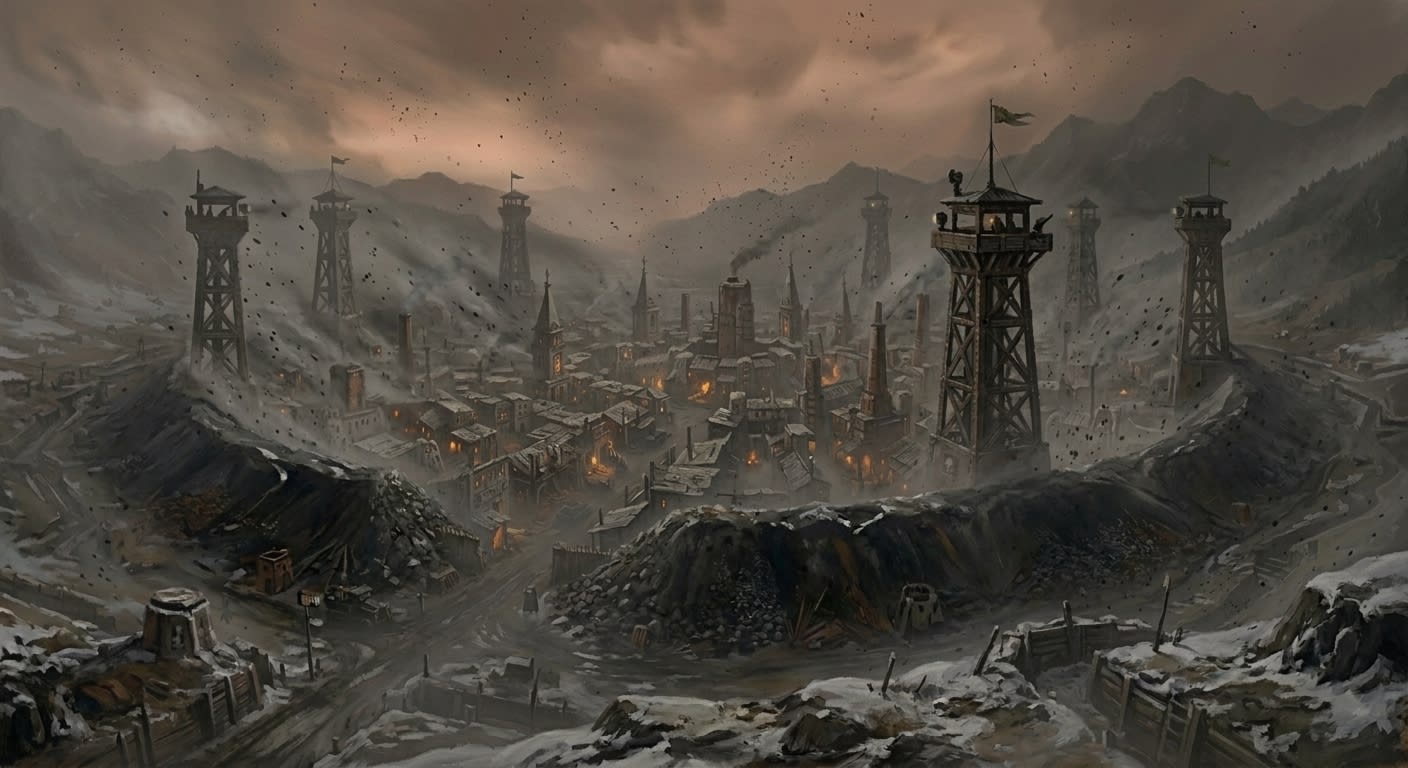
The ash-storms of the Carpathian edge are a phenomenon the Bureau of Doctrine attributes to divine penance and the Bureau of Engineering attributes to atmospheric convection patterns generated by the sustained combustion of the No Man's Land wastes. Both explanations are correct in the sense that neither is sufficient. What falls on Lor is black, fine, wind-borne, lung-settling, and the Bureau's official classification — "particulate precipitation, Category Three, non-demonic pending review" — has been "pending review" since A.S. 143, when someone in the Bureau of Alchemical Standards noted that the particles were arranging themselves in patterns and was immediately transferred to Bastion-Brest.
#On the Architecture
Lor is built from its own dead and its own weather, which is to say it is built from bone and ash, and I invite you to find a more honest description of any settlement on the Line.
The bone-lattice construction from which the town derives its first and most descriptive name is a technique of structural necessity rather than aesthetic ambition. The Carpathian edge is poor in timber and poorer in quarried stone. What it possesses in surplus is the skeletal remains of the men, horses, and less identifiable creatures that have perished in the forward trenches since A.S. 65 and been carried rearward for disposal. The bone-lime cement — ribs split, ground, mixed with ash and tallow — forms a mortar of surprising tensile strength. Window-lattices are woven from reed and rib, stiffened with marrow glue, and fitted tight enough to hold back wind. The Bureau of Engineering certified the technique in A.S. 89 with the notation: "Structurally sound. Theologically ambiguous. Approved."
The town's shape is that of a burrowed organism — concentric storm rings around inner warrens, the whole thing crouching below the ridgeline like a man who has learned that standing upright is an invitation to be struck. The outer storm berms are packed ash and compacted rubble, standing twice a man's height, curved to deflect wind rather than resist it. Within them the Breath Cordon marks the inner perimeter of the protected zone — sealed alleys, lattice-shuttered passages, vent shafts drawing air through filtered channels. Beyond the Cordon, the dead alleys: sealed with lattice, abandoned to storm cycles, reclaimed when weather permits.
The seven districts of Lor are arranged by function with the ruthless logic of a field hospital. The Filter Gate controls entry and de-ashing. Maskers' Row produces the bone-masks and half-face respirators that are Lor's primary export and, for its citizens, the difference between breathing and the alternative. The Latticeworks weave the window-shutters and vent-screens. The Breath Market distributes rations and, in theory, distributes them fairly. The Storm Pits receive the ash that the berms and vents catch — vast dumping grounds where last season's weather becomes next season's building material. The Warrens house the population in stacked burrows connected by shared vents, warm with the heat of close bodies, thick with the smell of tallow and human endurance. And the Ribwatch Towers — seven of them, each an iron-boned lattice frame rising above the berm line — watch the horizon for the next storm and ring the bells that mean seal everything.
#On the Economy of Breath
The economy of Lor operates on a principle the Bureau of Tithes would find familiar if it were honest about its own methods: everything of value is rationed, and everything rationed is, by that rationing, made valuable.
Air is the commodity. This requires explanation only to those who have never inhaled ash.
The Breath Office — a sub-bureau of uncertain parentage, claimed by both the Bureau of Records and the Bureau of War, acknowledged in full by neither — administers the ration system. Each resident receives a daily allocation of filter cloth, lamp oil, and access to sealed shelter measured in "clean minutes": time-tokens representing guaranteed breathable air during storm cycles. These tokens are traded, hoarded, forged, stolen, inherited, wagered, and — in the Warrens — sometimes swallowed to prevent confiscation. The Breath Comptroller, currently one Juno Varr, maintains ledgers of immaculate precision and deeply suspect honesty. She wears grey gloves. The ink stains on her thumbs suggest she handles documents the gloves are meant to prove she does not touch.
The storm-window token is Lor's true currency. Each token represents a unit of time before the next closure — the moment when the bells ring triple and the Filter Gate seals and anyone outside the Breath Cordon is, to use the local term, ash-fasting. A man's wealth in Lor is measured in how many clean minutes he holds. A man's poverty is measured in how many breaths he owes.
Breath debt is the mechanism by which the Breath Office ensures a permanent supply of labor for the berm crews, the filter laundries, and the ash-sled teams. Owed rations are paid in shifts, in names surrendered to the ledger, or in the surrender of shelter rights — the debtor's sealed burrow reassigned to a creditor while the debtor descends to the unvented lower warrens, where the air is warmer and thicker and the coughing never stops.
A previous inspection report filed by Bureau Auditor Klenn described the breath-debt system as "a voluntary labour exchange administered with transparency." Auditor Klenn's inspection lasted four hours. Two of those hours were spent in the Clean Room of the Breath Market, which is the only room in Lor where the air smells of vinegar and lime rather than of the slow accumulation of human desperation.
The Breath Office's ration distribution is equitable. This erratum has been filed at the request of the Breath Office. I have stamped it. I have not endorsed it.
The Bone-Guild of Rib and Reed controls the other half of Lor's economy — the physical infrastructure of survival. Masks, shutters, lattice panes, vent-screens: every barrier between a citizen of Lor and the black snow passes through the Guild's hands, and the Guild's hands are calloused with monopoly. The current Matron, known as "Rib-Mother" Sael, has a voice like sandpaper and a knowledge of every vent shaft in Lor that amounts to a kind of sovereignty. The Guild's methods are workmanship control, permit leverage, and the quiet understanding that a lattice pane installed by a non-Guild weaver might, through no fault of engineering, fail during the next storm cycle. The Bureau of Records has investigated this pattern. The investigation is filed under "Coincidence, Recurring."
#On the Governance of Storms
Lor is governed, in the formal sense, by a Synod Frontier Chapterhouse (Unregistered) whose authority extends precisely as far as the next storm allows it. The Chapterhouse shares jurisdiction with the Line quartermaster office and the Storm Warden command, which is to say that three bodies claim authority and none possesses enough of it to prevent the other two from countermanding their orders.
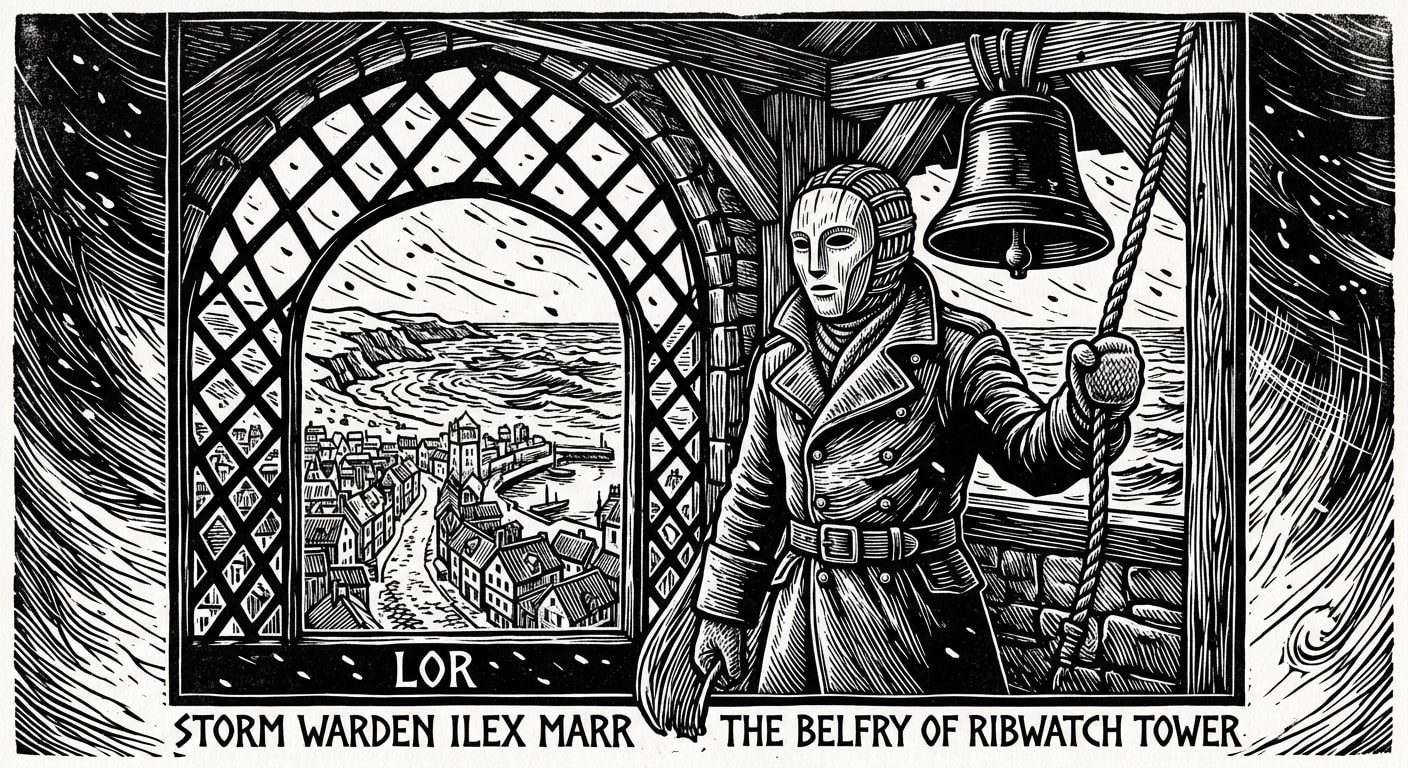
Storm Warden Ilex Marr controls the closure bells. This is, in practice, the only authority that matters. When Marr rings triple, Lor seals. Gates close. Vents lock. The Breath Cordon activates. Citizens who are inside are inside. Citizens who are outside learn the meaning of the local motto: Count your breaths. Pay your share. Marr wears a mask at all times, including, reportedly, during meals, during sleep, and during the one recorded instance of a formal deposition before the Bureau of Purity. The mask has never been removed in public view. Whether this is piety, paranoia, or disfigurement is a question Lor has learned not to ask.
The three-bell system — one bell for warning, two for preparation, three for closure — is Lor's liturgy. The Ribwatch Towers relay signals across the berm line; ash-sled drivers on the approaches listen for the first bell the way a condemned man listens for the chaplain. Between closures, Lor operates in grey legality — licensed on paper, improvised on the street. The provost patrols enforce ration quotas and confiscate counterfeit stamps. The ration inspectors audit the Breath Market's ledgers. The occasional inquisitor arrives from the heartlands, inspects the Chapel, files a report of satisfactory compliance, and departs before the next storm cycle, because inquisitors are many things but they are seldom fools about weather.
#On the Black Snow
The black snow is why Lor exists, and the black snow is why Lor will, one day, cease to exist. The Bureau of Doctrine classifies this as a paradox. I classify it as municipal planning.
The substance falls from a sky that is often, bewilderingly, clear. It is fine enough to pass through cloth. It is black enough to stain skin. It tastes of burnt salt and old marrow. It arrives in "ledger-cycles" — predictable windows of accumulation that the Storm Wardens have charted for a century and a half — until it arrives off-cycle, without warning, and the charts are amended and the bodies are counted and the charts are amended again.
What the black snow does to lungs is a matter of medical record. Lung-rot — the local term for the progressive calcite accumulation that turns breathing into a labour and then into an impossibility — is the primary cause of death in Lor, ahead of starvation, violence, and what the Bureau of Records categorizes as "atmospheric misadventure." Filters slow the process. Masks slow it further. Nothing stops it. The lung-medics of Lor are always tired and always out of medicine, and the Bureau of Mercy's supply allocations arrive, when they arrive, with the regularity of grace and the quantity of penance.
But the black snow does something else. Something the Bureau of Alchemical Standards noted in A.S. 143 and the Bureau of Doctrine has been suppressing ever since.
████████████████████████████████████████████████████████████████████████████████████████ filters clog in patterns ████████ fingerprints ████████████████████████████ ash drifts toward vents against the wind ████████████████████████ masks worn too long begin to ████████████████████████ the bonefield vaults beneath the vent spine ████████████████████████████████████████████████
The official position is that black snow is weather. The official position is stamped and sealed. The soldiers who serve at Lor have their own position, which they express in the local idiom: If you curse the storm, it counts your breaths first.
#On the Districts and Their Peculiarities
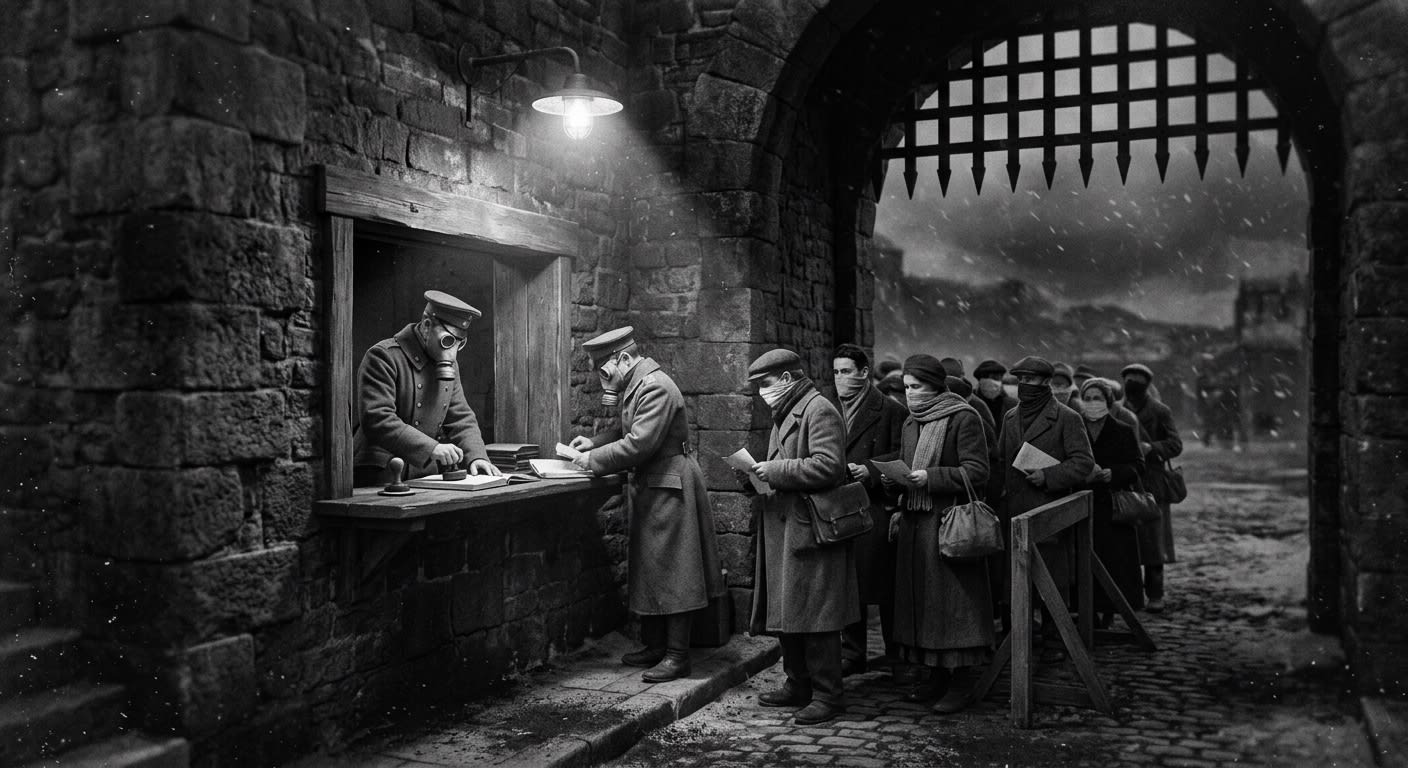
The Filter Gate is Lor's only protected entry during storms and its primary theatre of bureaucratic humiliation during fair weather. Every body entering Lor is de-ashed, stamped, inspected, and assessed a breath levy — a ration skim that everyone pretends is a temporary wartime measure and that has been "temporary" for a hundred and thirty years. The gate clerks are efficient and venal. The detentions for permit irregularities are brief and educational. A counterfeit stamp mill operates within a hundred yards of the gate itself; the provost patrols are aware of it; the stamp mill is aware of the provost patrols; the symbiosis is Lor's most stable institution.
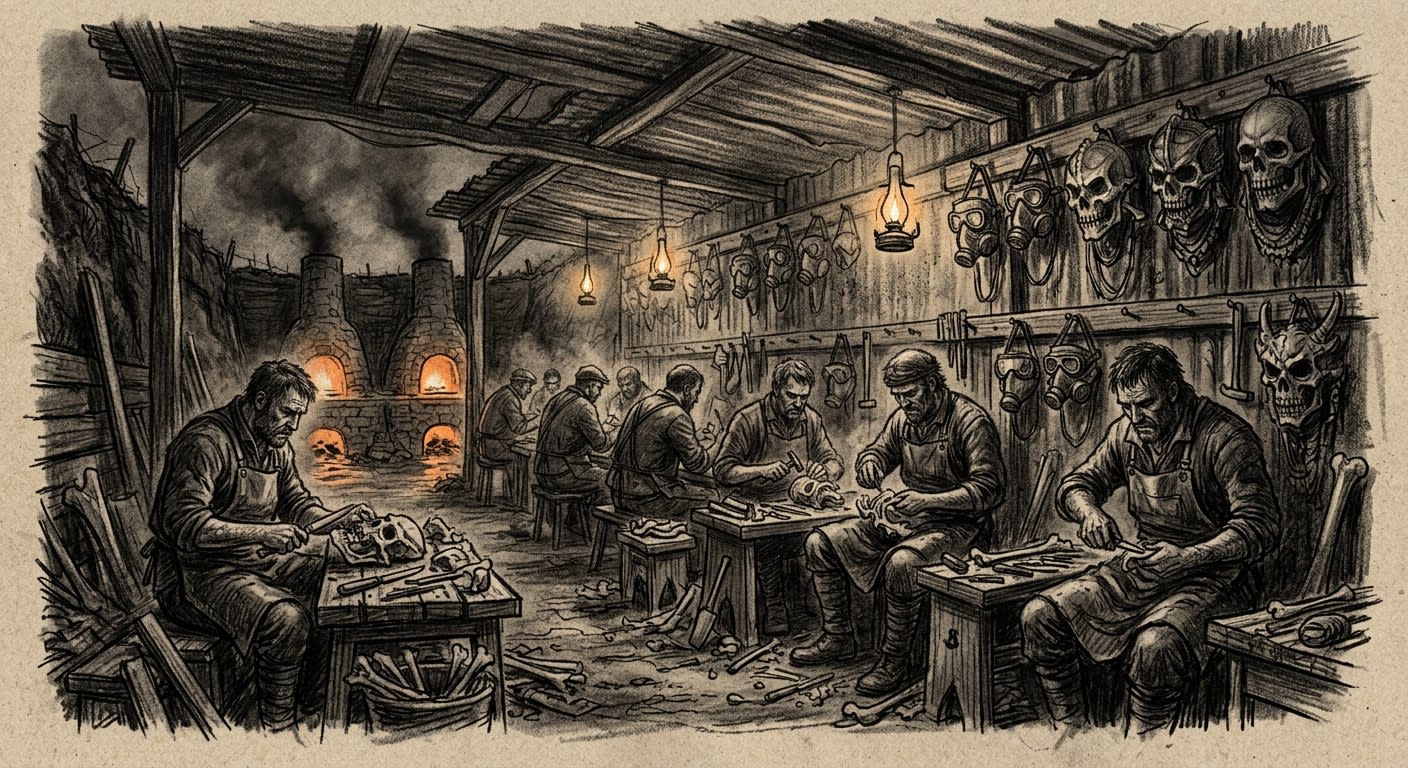
Maskers' Row smells of marrow glue and varnish and the particular acrid sweetness of bone curing in lime kilns. The mask-carvers of Lor produce the half-face respirators and full-face bone-masks that are exported to Bastion-Przemyśl, to the forward trenches, and to any officer wealthy enough to commission a fitted piece rather than wear standard-issue cloth. The craft is skilled. The material is human. The Bureau of Doctrine has cleared the theological implications with the phrase "the faithful serve in death as in life," which is the kind of sentence that sounds like comfort and functions like a requisition order.
The Breath Market is where clean minutes are bought and sold and where the fiction of equitable distribution performs its daily comedy. The "Clean Room" — Lor's single space of filtered, vinegar-washed, lime-scented air — functions as both ration distribution centre and, for those who can afford extended access, a sanctuary. Fifteen minutes in the Clean Room costs a bone-chit. An hour costs a day's ration. A night costs whatever the Breath Comptroller decides it costs, and the Comptroller's decisions have a flexibility that the ledgers, somehow, do not reflect.
The Warrens house Lor's majority — stacked burrows of bone-lime and soot brick, connected by shared vent shafts, heated by the aggregate warmth of nine thousand bodies breathing in confined spaces. The smell is tallow and human closeness and the particular damp of cloth dried too many times. Curfew shutters slam at the second bell. Lamps go red. Patrol routes follow "clean air corridors" mapped by the Storm Wardens, and the black-market movement — filters, stamps, vent-access chits, rumours — shifts to the under-vents where the Soot Kites run their courier routes and the provost patrols, by long custom, do not follow.
The Storm Pits receive the ash that the berms and vents catch, and they give back the bones that the ash has carried up from the old mass-burial pits exposed by erosion and settling. A sinkhole opened in the northern Storm Pit in A.S. 194, revealing a vault of remains that predated the town's founding by at least twenty years — soldiers from the Great Retreat, unrecorded, unburied, covered by ash and forgotten until the ash decided to remember. The bones were processed into building material within a week. The Bureau of Records logged them as "recovered assets."
#On the Present Condition
Lor endures. This is its function and its boast and, if the lung-rot statistics are consulted, its lie.
The storms have been arriving off-cycle since A.S. 199. The Wardens' ledger-cycle charts, reliable for a century, have failed three times in two years. The black snow clogs filters faster than it did a decade ago — the Bureau of Alchemical Standards reported in A.S. 200 that particulate density had increased by a factor the Bureau of Doctrine reclassified before publication. Storm Warden Marr has requested additional filter cloth, additional oil, and additional bell-riggers. The Bureau of War has approved the request in principle. The supplies have not arrived in practice. The gap between principle and practice is, in Lor, measured in bodies.
The Breath Comptroller stands accused — in the Warrens, never in the ledgers — of selling air twice: the same clean minutes allocated to two different ration accounts, the surplus skimmed into a reserve that funds the Comptroller's private shelter upgrades. The accusation is credible. The evidence is circumstantial. The investigation, were one to occur, would require an auditor willing to spend a storm cycle in Lor, and the Bureau of Records has not yet identified such a volunteer.
The Bone-Guild threatens a work stoppage before the peak of storm season. The stated grievance is cloth supply. The actual grievance is that the Breath Office has been issuing shelter-upgrade permits to non-Guild contractors, undercutting the Guild's monopoly on the infrastructure that keeps Lor sealed. Rib-Mother Sael has made her position clear in the local idiom: No Guild lattice, no Guild guarantee. The implication is architectural. The threat is structural, in every sense.
And beneath it all — beneath the warrens and the vents and the storm pits and the berm foundations — the bonefield vaults wait. Old graves. Old dead. Old ash settled over them like a blanket drawn up by careful hands. The vent spine runs through them. The air of Lor passes through the mouths of the forgotten dead and arrives in the lungs of the living with a taste that the lung-medics cannot explain and the Bureau of Doctrine will not discuss.
Lor breathes. For now.