
#On the Guild That Owns the Lung
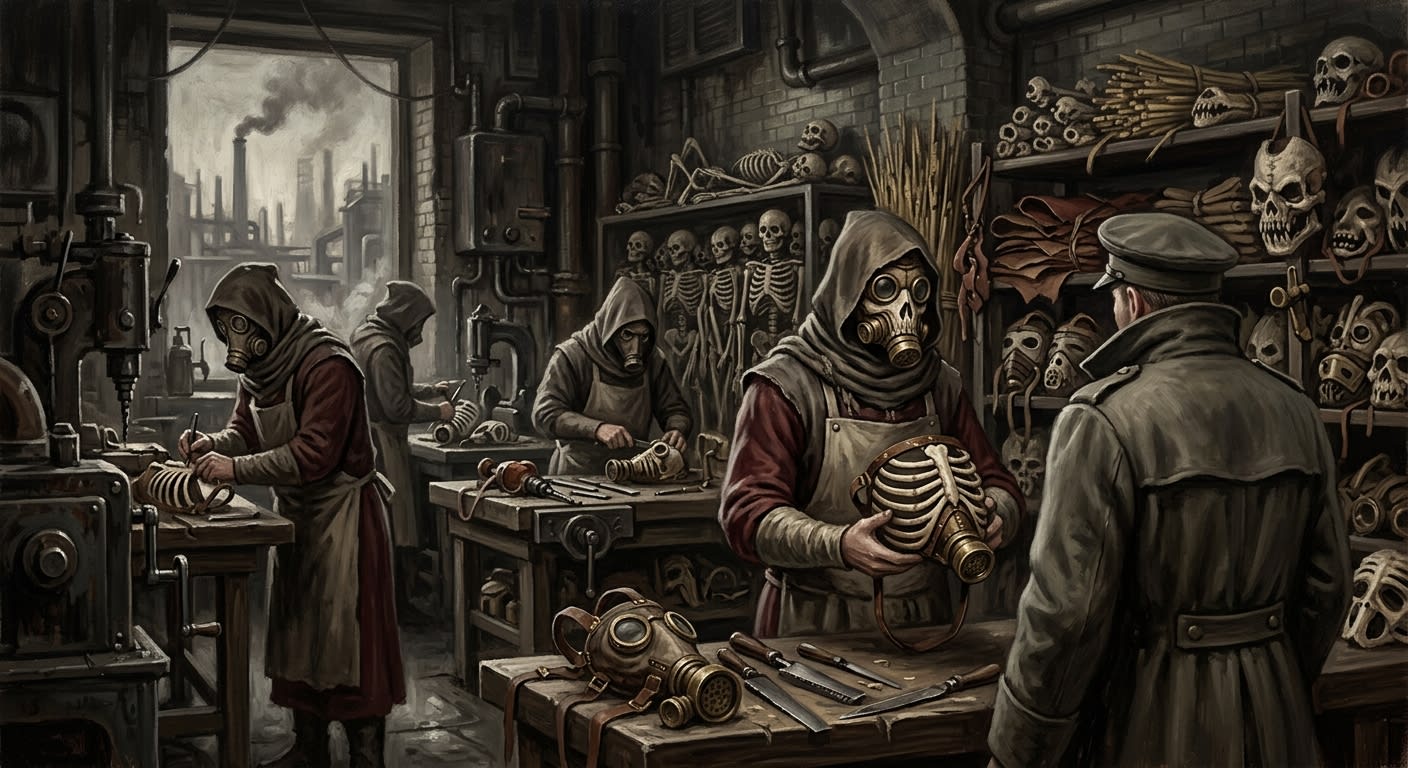
The Bone-Guild of Rib and Reed is the craft monopoly by which Black-Snow Lor keeps the black snow outside, the people inside, and the Bureau comfortably uncertain where survival ends and extortion begins. It controls every licensed bone-mask, shutter frame, vent-screen, storm lattice, safehouse seal, marrow-glue batch, ash-brick joint, and rib-strut repair within the Breath Cordon. A citizen of Lor may despise the Guild. He may curse its prices, its permits, its apprenticeship fees, its habit of arriving after a storm with a bill and a condolence slip. Then he inhales through a mask the Guild carved, behind a shutter the Guild fitted, beneath a vent-screen the Guild inspected, and remembers that contempt is best practiced with working lungs.
This is power in Lor: the ability to decide which materials stand between a man and weather that has learned malice.
The Guild's public catechism is simple. It keeps Lor breathing. It trains artisans in the proper handling of sanctified remains. It certifies masks for Line convoys bound toward Bastion-Przemyśl, repairs storm shutters after off-cycle falls, and maintains the lattice panes that strain ash from air with a fineness standard cloth cannot match. Its private catechism is simpler. No Guild lattice, no Guild guarantee.
That phrase is posted in Maskers' Row, stamped on safehouse permits, scratched inside shutter frames, muttered by apprentices during their first month, and spoken by householders with the same sour piety with which peasants name tax collectors. It is threat, warranty, prayer, and invoice. A useful sentence. The best ones are.
#On Its Origin in the First Storm Rings
Lor began in A.S. 71 as Storm-Shelter Node 14-C: four scavenged walls, a timber roof, a clerk with a stamp, and a queue of convoys that had discovered the Carpathian edge could kill men who had survived artillery. Bone-lattice began as improvisation. Timber was scarce, quarried stone scarcer, and the mass pits from the Great Retreat lay beneath the ash flats in obscene abundance. The first builders split ribs for slats, ground femurs into lime, mixed ash with tallow, and produced a shutter that held through three storms.
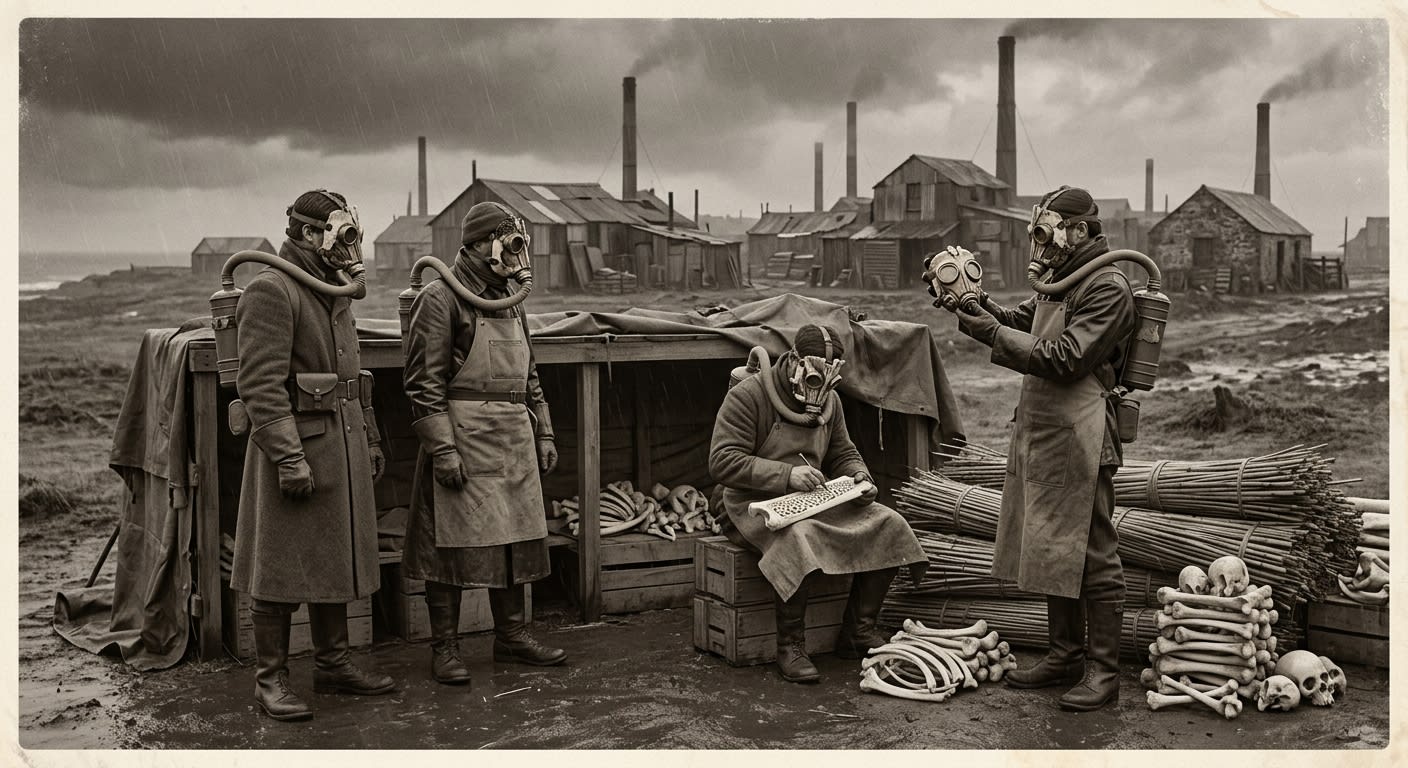
The Bureau of Engineering saw a method. The inhabitants saw survival. The future Guild saw a franchise.
By A.S. 89, bone-lime construction had formal certification. By A.S. 105, after the Second Concordat of Münster bound craft guilds into Synod tithe-structure, Lor's mask-carvers and lattice-fitters petitioned for recognition as a chartered craft body. The petition was written on bone-paper, sealed with marrow wax, and accompanied by thirty-seven working respirators fitted to the faces of the reviewing clerks. The clerks approved the charter in a single afternoon. Their descendants still breathe through Guild work and call the approval prudent.
The earliest name in the charter is Mother Pellis of the Split Rib, an artisan remembered in Lor with reverence and by the Bureau with discomfort. She standardized the half-face convoy respirator, introduced the three-layer reed-rib vent screen, and wrote the first Rule of Measured Remains (Unregistered): no bone may be used without origin mark, ash washing, salt-lime sealing, and a prayer for function. The prayer is short. In Lor, prayers that take too long become respiratory hazards.
A.S. 132 instructional pamphlets described the Guild as an “informal association of mask-makers.”
Corrected after the Nine-Bell Night inquiry. The Guild was already maintaining storm shutters, tower vents, safehouse seals, and Breath Market screens under enforceable charter. Informality ended the moment a whole district discovered its shutters had been fitted by amateurs.
#On the Craft of Bone and Air
The Guild works in four houses, because Lor's citizens enjoy pretending that internal divisions restrain monopoly. They do not restrain it. They give monopoly departments.
The Mask-House carves respirators. Apprentices learn bone selection before letters: horse for draft crews, human rib for close-fit civilians, long bone laminates for officers who want durability, skull-thin plates for full-face storm masks used by wardens and bell-riggers. Each piece is salt-limed, polished, lacquered, fitted with reed filters, and stamped behind the jaw hinge with a maker's mark. A mask without a mark may still work. It may also split during a closure bell and fill the mouth with black snow. Lor does not prosecute every unlicensed mask-carver. The storms do most of that.
The Lattice-House makes shutters and window screens. Its masters claim they can tune a screen to pass air while refusing ash. The Bureau of Alchemical Standards rejects the verb tune in engineering correspondence, which proves the Bureau has never stood in a Lor alley listening to shutters sing in high wind. Some screens hum low before storms. Some click like teeth when black snow moves upwind. Some bear hidden names in their slat patterns, stitched by widows who believe names keep memory from being scraped out by ash. The Guild forbids hidden names. The Guild also charges a premium for removing them.
The Vent-House holds the inner map. This is the true treasure of the Guild: routes, junctions, narrow throats, dead bends, under-warren crawlways, stale pockets, and the little maintenance slits through which clean air becomes dirty money. The Breath Office maintains official airflow plans. The Storm Wardens maintain closure diagrams. The Guild maintains the plan that opens. Its masters taste air at seams, hear pressure through rib frames, and know which safehouse claims capacity for sixty while being able to preserve forty-three and a child if the child is small.
The Glue-House is the least honoured and most necessary. Marrow glue holds Lor together. It fixes reed to rib, bone to ash-brick, seal to hinge, mask lining to plate. It smells vile, smokes badly, and takes law better than ordinary wax. Counterfeit breath stamps made with stolen marrow glue have set into paper with such authority that ration clerks obeyed them against their own ledgers. The Guild denies involvement. The Glue-House locks its vats at night and counts them in the morning.
The workshop warning on Maskers' Row is painted in black lime: do not sing over curing glue; do not name the donor of structural bone; do not laugh unmasked during drift. Violation penalties are dismissal, ration loss, or assignment to Storm Pit recovery.
#On Rib-Mother Sael
The current Matron, Sael of the Nine-Point Awl, is called Rib-Mother because Lor prefers titles that sound affectionate until one hears them in court. She is sixty or seventy or older than records admit, narrow as a shutter slat, with hands lacquer-stained to the wrist and a voice like a file drawn across dry bone. She knows every vent in Lor by taste. This is the phrase locals use. I have asked whether it is literal. They stared at me as though I had asked whether bells are loud.
Sael's authority rests on three accomplishments. First, she unified the four houses after the A.S. 194 northern Storm Pit sinkhole exposed pre-founding bones and provoked a jurisdictional riot over whether recovered remains belonged to the Bureau of Records, the Breath Office, the Ash-Chapel of Saint Lorn, or the nearest household short of shutter stock. Sael resolved the dispute by processing the bones within a week. Possession, in Lor, is often nine-tenths of theology and the remaining tenth is speed.
Second, she forced the Breath Office to accept Guild inspection marks on every safehouse upgrade after the A.S. 197 Purity compliance review. The Office called it craft oversight. Sael called it “keeping clerks from killing people with straight lines.”
Third, she made the Guild indispensable to Storm Warden Ilex Marr without becoming subordinate to Marr. The Ribwatch Towers depend on Guild bell-frame maintenance; Marr controls closure bells; each can ruin the other during one storm cycle. Their relationship is polite, exact, and venomous enough to require its own cup.
The Bureau of Records has attempted three times to determine whether Sael's title is hereditary, elective, occupational, or merely descriptive. The first questionnaire came back blank. The second came back fitted into a child's respirator. The third did not come back, though the courier did, wearing a better mask than he had left with and refusing, with exemplary Lor manners, to discuss price.
Sael does not dress like a guildmaster. No fur collar, no polished chain, no performative humility in expensive linen. She wears layered ash-cloth, a plain bone respirator, and an apron reinforced with rib slats. Her insignia is a small awl at the throat. Witnesses say she can tap a shutter frame once and identify its maker, year, source-bone, and likely manner of future betrayal. The Bureau of Records asked her to submit this knowledge as a table. She submitted a mask.
#On Monopoly as Municipal Theology
Lor's law permits no non-Guild contractor to install bone-lattice within the Breath Cordon. The reason given is safety. The reason operating is control. Both are true, which is how bad policy grows roots.
A Guild certificate gives a household access to ration discounts, safehouse eligibility, storm inspection priority, and insurance against closure failure. Without it, a room may be dry, warm, structurally sound, and full of children; the Breath Office will still classify it as unsealed. Citizens curse the certificate tax and pay it. They curse the inspection fee and pay it. They curse the annual refitting levy and pay it. Then the first bell rings, shutters slam, black snow strikes the outer screens like thrown grit, and the curses become prayers of embarrassing sincerity. The Bureau of Doctrine has studied this transformation and, naturally, classified it as obedience.
The Guild monopoly was abolished under the A.S. 183 Fair Workmanship Directive.
Clarified by the Frontier Chapterhouse, A.S. 184. The directive abolished “unreasonable exclusion from frontier craft markets.” The Guild's exclusion is reasonable because death by ash inhalation is unreasonable. The legal elegance of this clarification has been admired by three jurists and despised by every independent shutter-fitter still alive.
The Guild enforces its claim through permit challenge, material control, apprenticeship closure, and misfortune. Misfortune deserves examination. Non-Guild shutters fail at a remarkable rate. Non-Guild masks split during drills. Non-Guild vent screens develop small defects at points no honest sabotage could reach. The Guild insists that this proves the danger of amateur work. The provost patrols insist that direct evidence is lacking. The widows insist on burial before argument.
The guildmasters also own the apprenticeship ledger. A child admitted at seven receives mask, ration preference, and a cot above the Glue-House instead of the lower Warrens. A child rejected remains storm poor. Families petition, bribe, marry, threaten, confess, and occasionally surrender ancestral bones for priority. Apprenticeship in Lor is social ascent by way of a workbench and raw knuckles. It is also hostage practice with better ventilation.
#On the Coming Stoppage
The present quarrel concerns shelter-upgrade permits issued by Breath Comptroller Juno Varr to non-Guild contractors under emergency authority. The public reason is storm intensification. Since A.S. 199 the black snow has arrived off-cycle, clogged filters with uncanny speed, and forced expansion of safehouse capacity faster than the Guild can certify. The Breath Office claims necessity. The Guild claims fraud. The people of Lor, who are sentimental about surviving, claim whichever side controls the room they expect to enter when the third bell rings.
Sael's grievance is jurisdiction; cloth supply is merely the poster language. If the Breath Office can designate a safehouse as storm-worthy without Guild lattice, the Guild's monopoly cracks. If the Guild yields once, every landlord with a cousin in the Office will install cheap shutters and charge premium clean minutes. If the cheap shutters hold, the Guild weakens. If they fail, the district dies and the Guild is blamed for not preventing work it was forbidden to inspect. This is the kind of administrative trap the Synod creates in imitation of Providence, lacking Providence's manners.
A work stoppage in Lor differs from a heartland strike. Strasbourg imagines labour disputes as noise at a gate and speeches by men with hats. In Lor, stoppage means masks unrepaired, shutters unsealed, vent-screens unwashed, bell frames untensioned, storm cracks unpatched, Glue-House vats cooling, and safehouse landlords staring at their walls with sudden theological interest. A stoppage before peak storm season is a siege conducted with folded arms.
Storm Warden Corps contingency estimate, sealed annex: If Guild labour ceases for seven days during peak fall, projected shelter failure ███ percent. Projected lung-rot surge █████. Breath Market riot probability █████████. Recommended response: arrest Sael / negotiate with Sael / requisition Guild / preserve Guild / █████████████████████████████. Final line overwritten in bone-glue: SHE KNOWS WHERE THE AIR GOES.
The Bureau of War wants requisition. The Breath Office wants emergency contractors certified. The Frontier Chapterhouse wants silence until the next inspection party leaves. Sael wants a sealed writ affirming exclusive jurisdiction over all bone-lattice infrastructure within the Breath Cordon, priority access to filter cloth, and amnesty for past “coincidences.”
She will get two of the three. She already has the third in practice.
#On Doctrine, Remains, and the Useful Dead
The Guild's scandal is obvious to outsiders: it builds with human bone. Outsiders are adorable. The real scandal is that the arrangement works. Since the Year of Ash Rain and the Ninth Bell Famine taught the Line the practical value of remains, Lor has been less an exception than an honest index entry.
The Bureau of Doctrine settled the matter with the phrase “the faithful serve in death as in life,” first used for Lor in an A.S. 106 advisory and later stolen by three funeral tariffs, two recruitment pamphlets, and a truly intolerable sermon in Mainz. The Guild maintains origin marks for structural bone where records survive. Where records fail, it performs the Common Use Litany: ash wash, salt-lime seal, three knocks, one breath held, function declared. The dead become shutter, mask, screen, brace. The living pay rental fees to be preserved by them.
The Dead are a class of person the Synod prefers to honour in ways that remain useful. Lor has refined this principle into civic architecture. A skull keystone over a safehouse lintel may once have contained opinions, sins, recipes, doubts, a favourite hymn. Now it holds a hinge. The Bureau calls this consecrated utility. The Warrens call it family housing.
There are limits. Demonic bone is forbidden without Purity clearance. Unidentified large remains require Engineering review. Children's bones may be used only in mask components for kin households, a rule introduced after a scandal whose records remain locked beneath the Ash-Chapel altar and whose participants, by local mercy, are now all structural. The Guild obeys these limits with visible solemnity and invisible exceptions. So does every institution that handles death for a living.
The bone-lattice sings in storms. The Guild says this is pressure through slats. Locals hear warning, ancestry, hunger, accusation, and occasionally names. In A.S. 200, three separate households reported hearing the same dead soldier coughing through their shutters. The Guild replaced the frames at cost, kept the originals, and refused Bureau access on grounds of proprietary craft method.