

#On the Office That Closes the Town
Storm Warden Ilex Marr controls the closure bells of Black-Snow Lor, and by that control governs the only question that matters when the black snow begins to fall: who breathes inside the Breath Cordon, and who learns theology outdoors.
Lor possesses the usual ornaments of authority. It has a Synod Frontier Chapterhouse (Unregistered), a Line (Unregistered) quartermaster office, ration inspectors, provost patrols, a Breath Office with grey gloves and immaculate lies, and the Bone-Guild of Rib and Reed with its marrow-thread sashes and monopoly pieties. These offices issue orders, collect levies, seize contraband, threaten one another in memoranda, and call this governance. Marr rings triple. Gates close.
The title Storm Warden (Unregistered) predates Marr, though Lor speaks as if the office were invented to fit the mask. The first wardens were convoy lookouts posted to Storm-Shelter Node 14-C (Unregistered) after its founding in A.S. 71, men and women paid in filter cloth to climb rib-frame towers and distinguish ordinary bad weather from weather that intended murder. The office hardened by necessity. Warning became preparation. Preparation became closure. Closure became power. By A.S. 143, when the black snow began arranging itself in patterns at window seams and vent-screens after the Year of Ash Rain, the Storm Warden Corps had already become the town's practical priesthood of weather.
Marr is its current high functionary, though the term high is spatially comic in Lor, where any sensible person crouches. The Wardens maintain seven Ribwatch Towers (Unregistered), three-bell signal codes, closure diagrams, bell-line runners, ash-sled approach warnings, and the sealed ledger of storm cycles whose reliability failed three times between A.S. 199 and A.S. 201. They wear bell pins. Marr wears the mask.
#On the Mask
Marr wears a full-face bone-mask at all times.
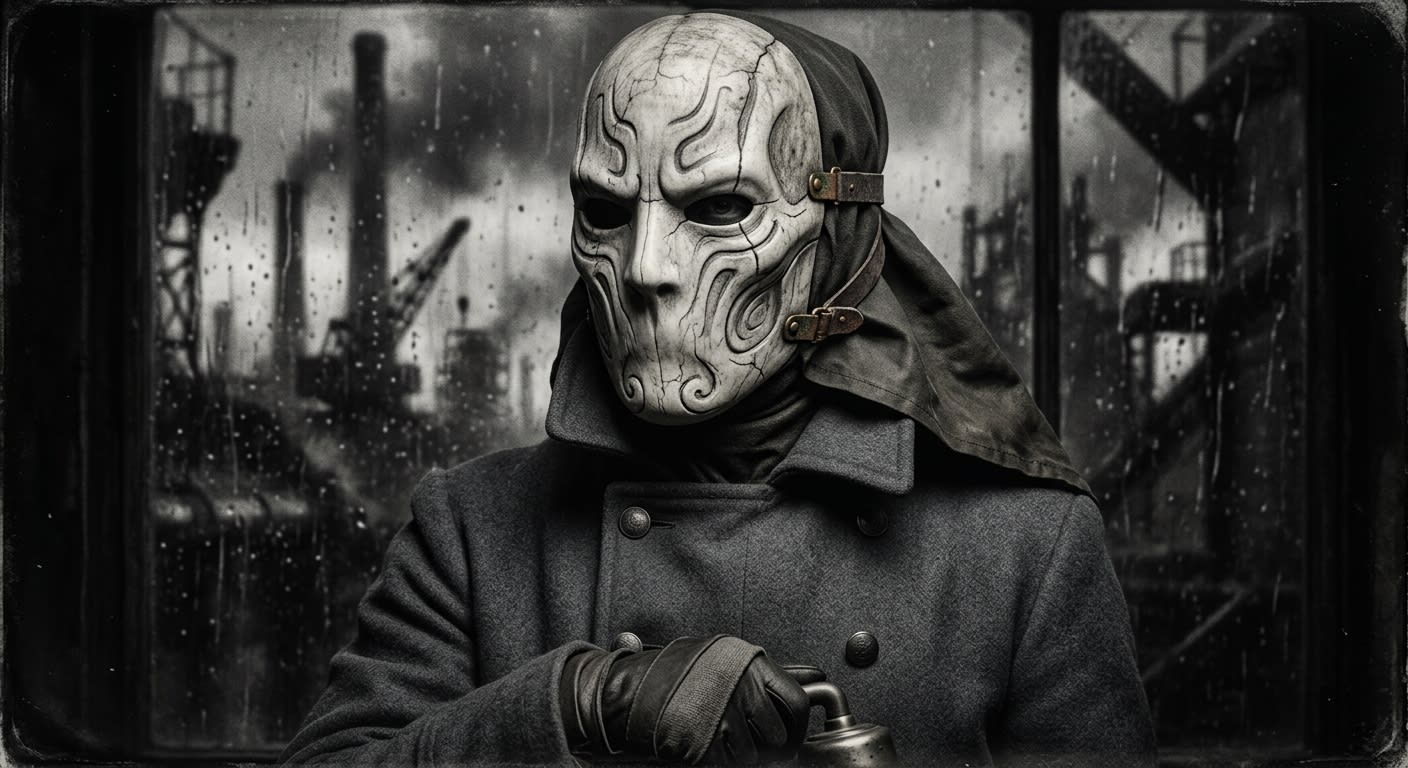
This statement has the serenity of a death certificate. No qualification improves it. The mask has never been removed in public view: not during storm watches, not during Chapterhouse audiences, not during the one recorded deposition before the Bureau of Purity, not — by report from a bell-rigger with more courage than sense — during sleep. It is a single fitted piece of pale bone and lacquered reed, smooth across the cheeks, narrow at the mouth, slitted at the eyes, sealed at the throat with black cord and ash-wax. It bears no maker's mark visible to inspection.
The absence of a maker's mark is obscene. In Lor even a pauper's half-mask carries its carver's stamp behind the jaw hinge. Guild craft records list no commission for Marr's piece. Rib-Mother Sael (Unregistered) of the Bone-Guild once stated, under oath and with evident pleasure, that the Guild did not make it. The Breath Office claims it cannot inspect the mask without Marr's consent. Marr has not consented.
Speculations breed in Maskers' Row like mildew. Some say the mask hides lung-rot calcification climbing the face. Some say Marr was disfigured in the A.S. 194 northern Storm Pit sinkhole, when pre-founding bones surfaced and the ash blew upward from below. Some say the mask is made from a single skull recovered from the bonefield vaults beneath the vent spine. Some say Marr died during an off-cycle storm and the office found it administratively simpler to keep ringing.
The Bureau of Doctrine recognizes none of these claims. The Bureau of Doctrine recognizes the usefulness of unanswered questions.
A circulated warren-sheet of A.S. 200 alleged that Storm Warden Marr's mask is demonic in origin.
Corrected. No sanctioned inspection has established demonic origin. No sanctioned inspection has established human origin either, which is an omission I record with the calm expected of my station and the irritation earned by everyone else's incompetence.
#On the Voice from the Wall
Marr's voice emerges as though spoken from inside a wall.
This is acoustic report. The mask flattens ordinary speech into a resonant, depthless pressure, neither loud nor soft, carrying through shutters and vent corridors with unpleasant authority. When Marr gives bell intervals, the numbers arrive like stones dropped into a sealed well: exact, cold, and already at the bottom.
I met Marr once in the lee of Ribwatch Tower Three during an inspection that the Frontier Chapterhouse had advertised as pastoral and Marr had treated as weather interference. The black snow was falling lightly, which in Lor means only that death was being polite. Marr stood beside the bell-frame, one gloved hand resting on the closure rope, mask turned toward the eastern flats. I asked about forecasting methods. Marr answered with cycle tables, particulate loads, pressure clicks in lattice screens, and the interval between ash-sled runner sightings. I asked whether the recent off-cycle storms invalidated the old ledger. Marr said: A ledger that fails three times remains a ledger. A bell that fails once becomes a funeral instrument.
I did not ask about the mask.
The voice serves the office. Lor must obey signals under conditions in which sight disappears, breath hurts, and panic spreads faster than any official proclamation. A command voice that seems to come from the wall itself has advantages. It carries through vents. It reduces argument. It makes disobedience feel architectural.
Children in the Warrens play a game called Marr Says. One child stands behind a shutter and calls closure orders in a hollow voice; the others must run to chalk circles before the third knock. The game is banned in the Ash-Chapel of Saint Lorn yard after three children refused to leave the circle for an hour, insisting the real Marr had not released them. The ban failed. Children understand power before clerks define it.
#On Closure and Mercy
Closure is the word Lor uses for salvation conducted with hinges.
At one bell, the towers warn. At two, shutters slam, market stalls vanish, vent-runners sprint, and the Breath Office begins lying faster than usual about capacity. At three bells, Marr closes Lor. The Filter Gate locks. The Breath Cordon seals. Safehouses accept those with tokens, writs, bribes, children, influence, knives, or sufficient desperation. The rest press against lattice and learn the arithmetic of air.
Marr's defenders call this discipline. Marr's enemies call it murder by schedule. Both are correct enough to be useless.
During an off-cycle storm in late A.S. 199, Marr rang closure eight minutes before the Breath Office had posted its official warning. Twenty-seven civilians, two ash-sled crews, and one convoy chaplain remained outside the Cordon. The chaplain was found fused to his own reliquary case. The Breath Office filed protest, citing lost clean-minute revenue and unauthorized panic. Marr filed one page in reply: The storm arrived nine minutes after first bell. Your notice would have buried three hundred.
Breath Office memorandum 199-B described Marr's early closure as “procedurally excessive and socially destabilizing.”
Amended after casualty review. The closure was procedurally excessive. It was also correct. The Bureau has long maintained that correctness excuses procedure when the correct party holds the stronger stamp.
The moral accounting is uglier in slower storms. Marr has kept gates open past second bell to admit late convoys carrying filter cloth. Marr has sealed the Cordon while petitioners remained within sight of the gate. Marr has ordered safehouses reopened for children and refused them to soldiers. Marr has accepted priority shelter lists from the quartermaster and then ignored half the names when the third bell struck. A Warden who closes too early kills the outside. A Warden who closes too late kills the inside. Lor, with the fairness of all cruel places, remembers only the deaths it can see.
Deposition fragment, storm-labor crew, A.S. ███: QUESTION: Did Storm Warden Marr hear the people at Gate Two? ANSWER: Everyone heard them. QUESTION: Did Marr answer? ANSWER: The mask turned. QUESTION: What did Marr say? ANSWER: ██████████████████████████████████████ QUESTION: Why was the gate not opened? ANSWER: Because the bell had already made them weather.
#On Rivals, Allies, and Those Who Need the Bell
Marr's principal rival is Breath Comptroller Juno Varr, whose grey gloves touch every ration ledger in Lor and whose clean-minute allocations depend upon storms arriving when scheduled, citizens queuing where assigned, and Wardens behaving like civil servants rather than weather prophets. Varr sells access. Marr cancels access by ringing. Their feud is exquisite because each requires the other to remain legitimate. A Breath Office without closure authority is a shop selling promises; a Storm Warden Corps without ration ledgers becomes militia with bells.
Rib-Mother Sael is the second axis. The Bone-Guild maintains bell frames, tower lattice, shutter seals, vent screens, and the ribbed rooms in which closure has any meaning. Sael can make Marr's orders harder to obey by slowing repairs. Marr can make Sael's monopoly irrelevant for one storm cycle by condemning a safehouse line. Their relationship is polite, exact, and venomous enough that the Frontier Chapterhouse schedules meetings between them only in rooms with two exits and recently inspected air.
The Frontier Chapterhouse fears Marr because theology cannot overrule suffocation at third bell. The Line quartermaster resents Marr because convoys do not move through sealed gates. The Soot Kites (Unregistered) — vent-runners, smugglers, and under-warren couriers — admire Marr in the practical manner of thieves who respect a lock. The Ash-Chapel of Saint Lorn prays for the Warden in public and recruits storm-orphans in private from the very families closure creates.
The Bureau of War has considered replacing Marr. The consideration appears in three requisition papers and one unsigned annex. Each paper dies at the same question: who rings next? There are bell-riggers. There are wardens. There are officers with clean boots and theories. There is one Marr.
JOINT FRONTIER ASSESSMENT — LOR, A.S. 201: replacement risk high; public confidence fear-based and stable; operational competence severe; mask inquiry deferred pending nonexistence of emergency.
#On the Unasked Question
The mask remains unexplained because every institution in Lor benefits from the explanation staying sealed.
If the mask hides disfigurement, Marr becomes pitiable, and pity weakens command. If it hides disease, the Breath Office must declare contamination protocols and lose its strongest closure instrument. If it is relic-work, the Bureau of Relics will descend with calipers, incense, and official appetite. If it is demonic, the Bureau of Purity must purge the one official whose timing keeps Lor alive. If it is merely theatre, Marr is more dangerous for it: a person who understands that authority sometimes needs a face precisely because it has none.
I prefer the last answer. It is the most human answer, and the most damning.
Since A.S. 199, the storms have arrived wrong. The black snow clogs filters from within. Particles gather at seams in little rows like script too cowardly to become letters. The vent spine runs through old bonefield vaults, and the air of Lor passes over the mouths of the forgotten dead before it reaches the living. Marr has requested bell-riggers, oil, cloth, and authority. The first three have not arrived. The fourth never left.
When the next off-cycle storm comes, Lor will look to the towers. The Chapterhouse will pray. Varr will count tokens. Sael will test shutters with one lacquered nail. The poor will run. The rich will discover whether purchased air retains value under pressure. Marr will stand at the rope, bone-mask blank, voice in the wall, counting intervals the rest of us pretend are weather.