
#On the Public Vocation
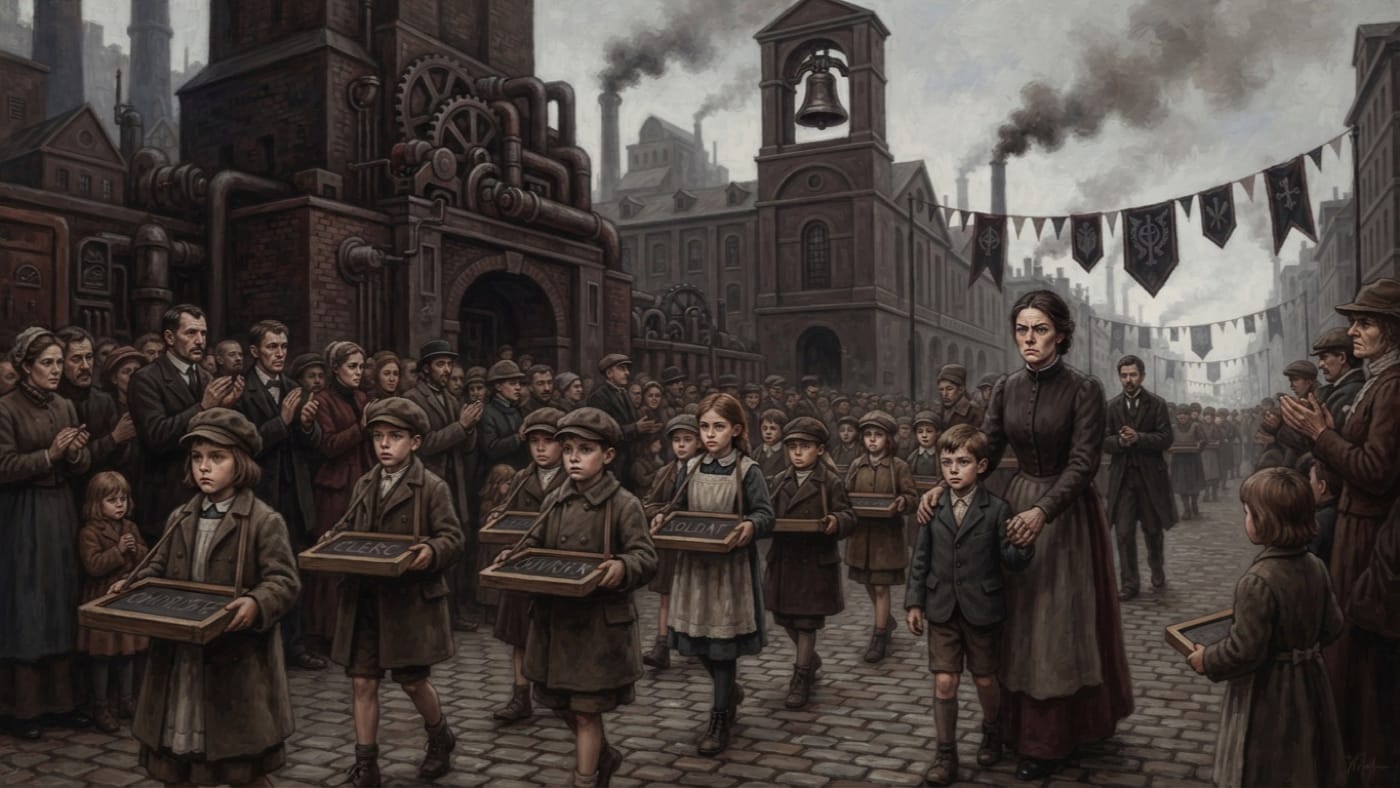
The tablet is roughly the size of a psalter's lid. Wax spread in a shallow wooden tray, pressed with a name, a seal and one word of vocation, it is warmed a little by the small fist that carries it. A clerk who has never met the child made the inscription, and he never will meet the child. A vegetable stall would value the object at nothing. The Synod values it at one life, provisionally.
The Book of Promise lives in sealed ledgers kept by Records and consulted by everyone with a quota to fill. The Parade lives in the street. There the village can see the Book, cheer it, and later remember who cheered and how loudly.
The Parade invents nothing. Every assignment carried through the square existed in the files before the first child stepped off. The procession makes the assignment public, and that makes it pious. A forecast murmured across a clerk's desk is administration. Raise the same forecast at the bell before a hundred neighbours and it becomes Providence, with bunting.
#On the Child Already Entered
A child enters the Book at baptism under Synod jurisdiction, before it can grip anything heavier than a finger. The font is still dripping when Records writes the first mark. After that the measuring begins. The schoolroom roll takes some of it. The ordained intervals of the Trials of Loyalty take more. In those trials a very small person is asked whether Order outranks affection. A swift answer improves the Promise mark. Hesitation earns the classification immature soul, and it stays with the file the way a debt stays with an heir.
Records holds custody of the Book, but other offices own the appetite. Conscription counts boys the way a miller counts sacks. Orison wants clean throats. War wants whatever Conscription has not already taken. Mercy wants hands for its wards. Tithes regards each infant as yield deferred. Doctrine supplies the vocabulary that lets all of them speak at once without sounding like auctioneers. Each of these offices consults the ledger. None of them is required to consult the tablet.
So the child who walks in the Parade walks out of an office as much as out of a household. Behind the wax lie a baptismal register, a school assessment, a loyalty mark and a district forecast, and the clerks have folded all of them into one word small enough for a child to carry.
#On the Tablet and the March
The form is simple, and the brutality is in how simple it is. Children march beside their parents and hold their tablets in both hands. Bells mark the cadence. At the bell the tablets go up, held aloft the way the old processions held relics, so that the whole street can read soldier, clerk, chorister, ash-labour as they pass. The village applauds each word as if heaven had leaned out of a window and shouted it.
The wax performs no miracle when raised, and Doctrine claims none for it. It shows a vocation, and showing is enough. A family that marches cheerfully beside the word soldier has given its consent in public, before witnesses, in good weather. Nobody can later claim it was taken by surprise.
Official teaching says the vocation is revealed: Providence names each child's use, and the Parade is the moment of disclosure. The administrative method is plainer. Assignments come from bloodline, quota and shortage. They also come from aptitude, from household debt, from district need, and from whether a wagon happens to be available to take the child where it is needed. A boy whose father owes the parish may find Providence unusually interested in his shoulders. A girl in a parish short of voices may find that the Creator has been listening to her hum.
The Parade reveals to each household the calling Providence has appointed for its child.
Amended. The Parade shows each household the calling the district currently requires of its child. Providence is retained as honorary signatory.
What the families feel is harder to put in a ledger, though Records has tried. Picture a mother walking beside a tablet that says clerk. I describe a type here, not a parish. She is proud, because a clerk sits indoors. She is afraid, because indoors can be revised. And she knows, as every adult in the street knows, that the seal on that wax gives several Bureaus permission to come and ask for her son later. She cheers anyway. She cheers well. The parish clerk is writing, and enthusiasm is a column too.
#On Carelessness with Vocation
Walking becomes pedagogy here, and pedagogy has a schedule of fees.
If a child stumbles and drops the tablet, the household is fined for carelessness with vocation. The phrase deserves admiration. It turns a cobblestone and a small boy's ankle into a moral failure of the whole family, and it bills them for it. The fine falls on the household because the household is what the Book has really enrolled. The child is only the collateral.
If the tablet arrives smudged, because it was clutched too hard, breathed on too close, or carried through drizzle, Records may require a re-inscription fee. The re-inscribed tablet may come back with a different word. Records sends no apology. Wax takes a new impression, and so does a quota.
The parents are watched too. A parent who weeps too openly when the tablet reads as a levy mark may find the parish clerk noting improper attachment. Nobody is arrested for a tear. The note simply goes into the file, where it sits like a loose stone in a wall, waiting for the next audit to lean on it. Mothers learn to cry at the correct pitch, which is pride. Fathers learn to clap with their jaws set.
Here is the real instruction of the Parade. The children are being taught their futures, and they are also being taught their bodies: steady hands, a raised arm, a face that holds when the bell sounds. A child who can carry a promise through a crowd without dropping it is learning to carry an order through a war.
#On the Promise After the Procession
After the march the tablet goes home. It sits on a shelf, or by the hearth, or in a drawer with the baptismal ribbon. In that house it takes on an authority the Bureaus never meant to grant. A family reads it daily. They save coins for the clerk's apprenticeship. They teach hymns to the chorister. They keep the boy away from the forge because the wax said ledger.
The ledger in Records, meanwhile, keeps moving. Bureau reconciliation can redirect any child, whatever the street once applauded. A boy marked for the choir can be found on a mustering field because the front needed more than Orison could sing. A clerk-candidate can be sent toward Bastion-Brest once an older brother's place falls empty. Records calls this reconciliation. Conscription calls it correction. At the reconciliation of the Seventh Renewal levy in A.S. 185, the note instructed officials that, if challenged, they should cite the Doctrine of Deferred Fulfilment.
That Doctrine is the Parade's afterlife, and its finest piece of furniture. It holds that the promise is never broken. It is fulfilled by a route too wise for the household to follow. The chorister in the trench still sings, only louder and with powder. The tablet on the hearth stays true in the way a tombstone stays true: accurate as to the name, and silent about the arrangements.
Some households answer this the only way households can, with the wax itself. Old tablets are hidden. Words are pressed flat with a warmed knife. Superseded rolls are kept under floorboards and brought out at depot gates, where a father stands holding his son's childhood in a wooden tray and asks the Synod to honour what it once paraded. The offence is theological. Holding the Synod to yesterday's word denies its authority today.
#On Present Application
As of A.S. 201 the Book of Promise remains in force across registered parishes west of the Sagittal Line, and its Parade goes on with it. Children still carry tablets beside their parents, raise them at the bell, and are cheered by neighbours whose own children carried tablets before them. No single feast day governs every parish, and no common route or uniform calendar binds them. The Parade needs neither, because it travels with the Book, and the Book reaches every font in the Synod.
The clerks still write and still revise. The children still hold the wax with both hands, as they were taught, and the families still cheer.