
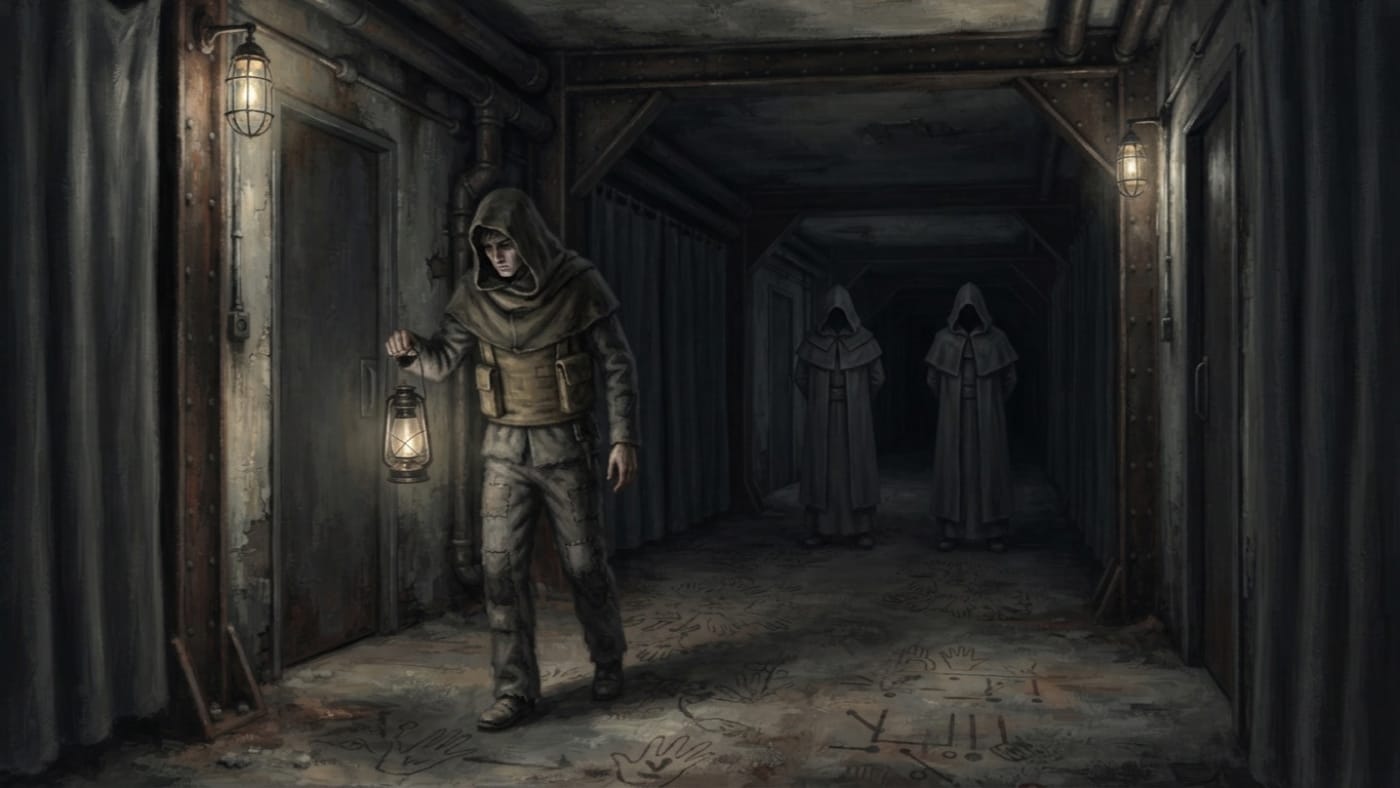
#On Silence-Order
The Circle of Mute Radiance admits its candidates by an oath in which nothing is said. The Breath Oath is the Circle's specialist initiation, a variant on the ordinary customs of the Lantern Brotherhood. It exists because the Circle works where sound has already failed.
In bell-dead alleys and dome-scar districts the Bellway signal goes flat against the masonry. Instruments of the Bureau of Bells register dead air. A Warden can shout a lawful order into such a street and watch the order die a yard from his teeth. Command there passes by hand-code and mirror shard, and a patrol that cannot hear itself has to be made of bodies that do not betray themselves. The Circle's teaching on this point is short enough to carve on a lintel: Sound is leakage. Leakage is invasion. Its charter adds a second line, sweeter and more dangerous: In silence, the Synod is closest.
I record both as Circle doctrine. The Bureau of Bells would dispute the second with considerable heat and a great many tuning forks, and the wider record of the Silence Domes gives Bells its reasons. Silence has drowned men as well as sheltered them. The Circle holds its view regardless, and the Breath Oath is where it first teaches that view to a candidate's lungs.
The name borrows from the vocabulary of witnessed speech and none of its furniture. The charter mentions no spoken vow, oath-token or registry line. The candidate takes the oath by walking.
#On the Corridor and the Count
The charter gives the rite in one sentence, and it is a good sentence: the initiate must stalk a corridor with a lit lantern without audible breath for a full count of one hundred.
Read the adjective. The candidate is not required to stop breathing. Nothing in any file I have examined demands a hundred seconds of held breath, and the files do not fix the length of the count, who keeps it, or whether the count-keeper uses fingers, beads or the pulse of a bored Lanternman. The requirement is narrower and harder to cheat. The candidate breathes, because the body insists, and does so in a way nobody in the corridor can hear. The lungs are permitted to work. They are forbidden to be heard working.
Then there is the lantern, lit, and carried while stalking. It gives off no sound of its own, and a frightened candidate will make one with it anyway: the hand trembles, the bail creaks, the glass ticks against the frame. A candidate must therefore keep sanctioned light and keep it quiet, through the whole count, while moving like a man looking for something he intends to detain.
What the rite trains is plain enough to someone who has watched a panic begin. A Brother in a hush corridor must move, carry light and keep his own fear from leaking into the street. The oath tests those three things together. That is my reading of the exercise. The charter offers none, because charters only give instructions.
#On Repetition and Removal
Failure, says the charter, means repetition, until lungs burn or discipline appears. The Circle's published accounts add a third result, collapse. In collapse the candidate lies on the boards in a shape from which instruction can be resumed. The rite has no fixed number of attempts. It ends when the body or the candidate gives way.
The finer rules survive in a training note of the Circle, undated, copied here as I have it:
Two remarks. The note says nothing about a breath at count thirty itself. Perhaps the Circle has never had a candidate considerate enough to fail at precisely that moment, or perhaps Revision D is still in committee. I will not draft it for them.
The hood clamp is described as fitted behind the jaw. Its mechanism appears nowhere in the files, and I am glad of it, because a codex is no place for a farrier's manual. Its purpose is legible from where it enters the sequence. A candidate who fails early is merely untrained and goes again. One who fails late has shown that composure gives out under strain, and from then on the strain is supplied by iron. The Circle calls this repetition. It is repetition in the way the second turn of the rack repeats the first.
Next, the dropped lantern. A candidate who lets the light fall is removed from candidacy, and here a careful reader must keep his hands off the obvious conclusion. Elsewhere the Circle performs removals of another sort, unsanctioned and unwritten, and the coincidence of vocabulary is the kind of thing that keeps Shadows employed. In the training note, removal means the candidate is no longer a candidate. Nothing in the note makes it a sentence of death. The Circle simply prefers to keep one word for both purposes, as it likes to keep its doors closed for both purposes.
The scream that follows a removal settles the matter. The candidate who screams is sent back to general Brotherhood stock as Circle unsuitable. That candidate is not condemned, cast out or even disgraced. The Brotherhood can use a man who shouts. Mute Radiance has no use for one.
#On the Hush Loft
The Circle trains and lives in the Hush Loft, an attic in Dome-Split Tenement 4B inside a bell-dead zone. Cloth hangs on every wall. Hand-code diagrams and mirror-flash drills are marked across the floor, so a Brother crossing the room walks through his own syllabus. A small shrine stands there with a candle kept barely lit, because, says the charter, too much flame makes noise in the glass.
Whether the corridor of the oath runs through this attic, beside it or across the city, the files do not say. I decline to supply a floor plan the Circle never filed.
What the Loft does document is the routine that the oath opens onto. At dusk come breath-discipline drills, a mirror-shard check and a test of the hood clamps. At curfew the patrol pairs deploy without a spoken word. The initiation is therefore the first entry in a daily ledger, and the candidate who survives the count will go back to breathing exercises every evening for as long as he wears the grey.
The oath confers no rank that I can certify. The Brotherhood keeps its own ladder of Wicker, Spark and Lanternman, and its general initiation, the Taking of the Wick, requires a skull-candle kept alight through a curfew cycle while the names of the local dead are recited. That rite is spoken. The Breath Oath is mute. The files leave it to the reader to decide whether the Circle's candidates undergo both, and in which order, and the reader will kindly leave that undecided too. Talent in the Circle shows itself in other ways. The Spark Jani Kest, a silent-code prodigy attached to Mute Radiance, is reported to see patterns in mirror-flashes that the manual does not contain, which is the sort of gift that commends a young man to the Circle and alarms the Bureau of Shadows.
#On the Body in Service
The candidate who mastered his own lungs is next set loose on other people's.
A bent finger means halt. A mirror-flash of one, two and one means the Circle converges. Three parallel chalk lines on a wall instruct the street to speak softly or not at all. These signals depend on Brothers who do not cough, gasp or swear when a flank collapses, and the Breath Oath is the first place the Circle checks for such Brothers.
The punishments carry the same lesson to people who never asked for instruction. The Mouth-Seal is a dab of wax at the centre of the offender's lips, symbolic and humiliating. The Hush Beating is methodical, non-lethal and conducted behind closed doors so that no story escapes. Neither belongs to the initiation. Each takes the discipline the candidate imposed on himself in the corridor and imposes it on a citizen against his will. The candidate earns his silence. The street has it applied.
The Wardens find all this useful. A crowd in a bell-dead district can go from one cough to a trampling before an officer has found his whistle, and the Circle can stop that crowd without a word. The Wardens also find it embarrassing, since the men doing their work hold no commissions, and authority without a commission can be denied by everyone at once. The Circle's charter boasts that its removals leave no sound, no record — unless we choose to write one. That boast is the reason the Circle is tolerated, and it is the reason the Circle can be abandoned the moment toleration becomes inconvenient.
The Tongue Cabinet I mention once and by attribution. It is a rumour of trophies kept from extrajudicial removals. Shadows has looked into it. The Breath Oath has no connection to it in any file, and I will not lend it one by standing the two side by side for longer than this sentence.
#On Quiet Meaning
The weakness in the Circle's doctrine came in on soft feet. A rebel Lantern Preacher who shouts can be sealed, cited and struck. A preacher who speaks softly in a hush-zone gathers listeners who make no sound, and they leave with the sermon. The Circle trained its people to treat inaudibility as obedience. The quiet sermon proved that a congregation can be inaudible and disobedient at once, and that meaning travels perfectly well at the volume of a Breath Oath.
The Bureau of Purity has recommended post-watch confession for every Brother assigned to preacher contact. The Brotherhood corrected its own manuals:
Mute Radiance patrols are to silence all unauthorised preaching.
Unauthorised preaching may already be silent. The proper instruction is: interrupt the congregation before meaning accumulates.
The correction says nothing about the Breath Oath, and the oath has not been amended to match. The Circle still tests its candidates for silence, a hundred counts at a time, while its most troublesome enemy has passed the same test without trying.