
#On the Nature of the Bellwarden, and Why He Is Chained
"The key is the vow."
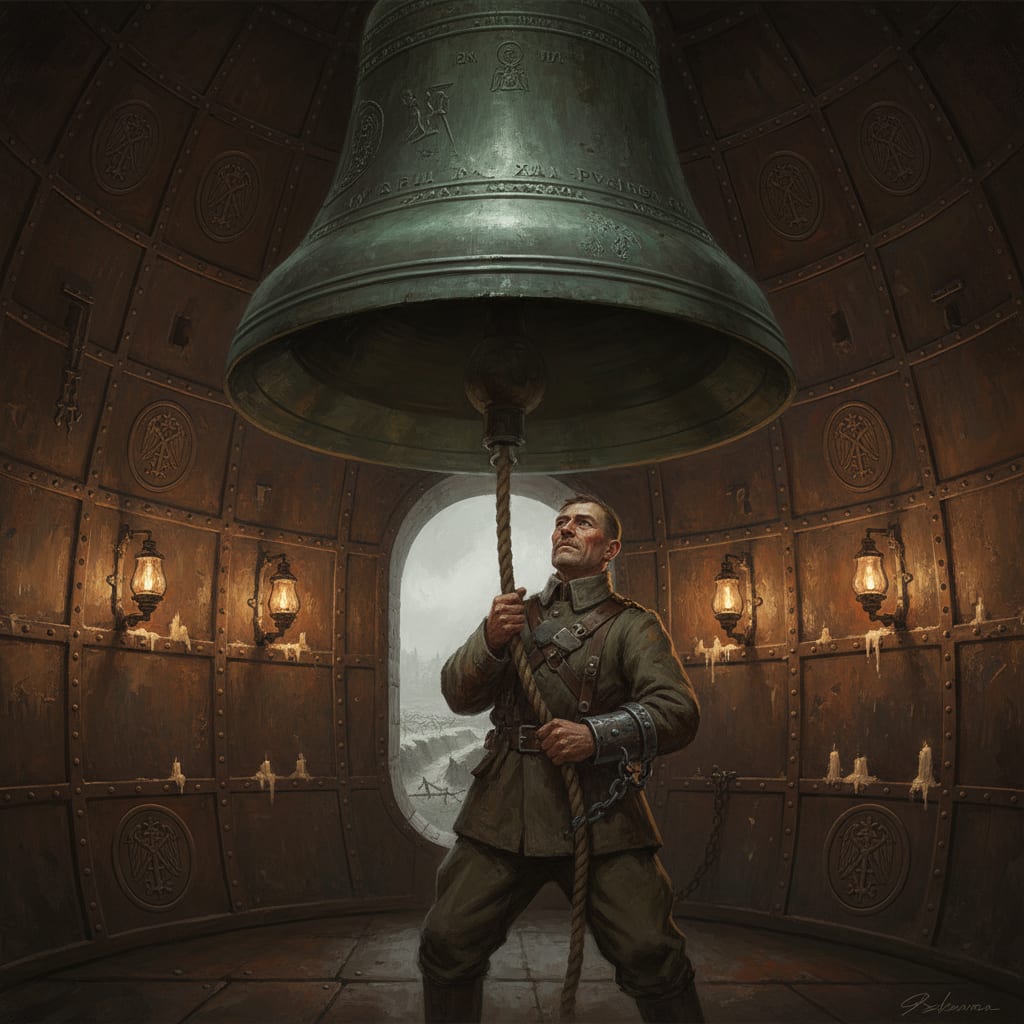
A Bellwarden is a man with a length of iron chain riveted through the flesh of his left forearm. The chain connects him to a toll-key, which connects him to a bell, which connects him to the schedule by which three hundred million souls eat, sleep, pray, march, and die. Remove the chain and you remove the schedule. Remove the schedule and you remove the Theocracy. The Bureau has therefore determined that the chain shall not be removed.
This is the profession in its entirety: a man stands in a tower or a tunnel or a fog-wreathed gantry above a harbour mouth, and he pulls a rope at the time prescribed on a chart he did not write, producing a sound whose doctrinal significance he was not consulted on, in service of a schedule whose rationale he will never be told. He does this until his hearing fails, his nerves fray, or the bells begin ringing when he has not pulled the rope — at which point the Bureau of Bells reassigns him, pensions him, or walls him into a ringing chamber until the phantom peals stop, which they do, because the man stops first.
The Bureau of Bells employs eleven thousand four hundred Bellwardens across the Dominion as of the latest census. Of these, approximately nine thousand are stationed along or adjacent to the Sagittal Line. The remainder serve in Strasbourg, in the cathedral cities of the Rhine corridor, in the harbour towers of Thessaloniki and Marseille, and in those bastion garrisons where the bell infrastructure has grown complex enough to require its own administrative class. At Bastion-Shipka, Bellwardens work eight-hour shifts. The bells never stop. The Bellwardens rotate every four months — the heaviest rotation on the Line — because longer tours produce men who can no longer count days, and a Bellwarden who cannot count days is a contradiction the Bureau finds aesthetically intolerable.
#On the Chain, and the Oath That Binds It
The toll-key is riveted to the Bellwarden's flesh at ordination. This is not ceremony. This is logistics.
A bell captured by the enemy is a catastrophe. A bell rung under enemy hand sends the wrong command along the bellway lattice, and wrong commands kill: troops rally when they ought to retreat, kitchens lock when garrisons starve, curfew lifts when the fog is thickest. The Lore of the Line records the Betrayal at Metz (Unregistered), where a single Bellwarden — captured, tortured, broken — yielded his toll-key to agents of Lust. The enemy rang the Fifth Peal, which commands repentance. Half the trench-line fell to their knees. Radiant Fusiliers were slaughtered mid-volley, shields splintered under perfume. The Bellwarden's family was erased from the Ledger. His parish was paved with salt.
The chain, then, is the Bureau's answer to its own terror. A toll-key that cannot be separated from the man who holds it cannot be surrendered without surrendering the man. And a man chained to his station is a man who will die there, which is the Bureau's preferred outcome. The Bureau of Oaths witnesses the riveting. The oath is short: I am the key. The key is the voice. The voice is the city. Then the iron goes in, and the Bellwarden belongs to his bell until one of them cracks.
The hierarchy runs from Bell Runner — an apprentice too young for the chain, assigned to carry messages and oil along the tower stairs — through Toll Keeper and Tunnel Listener to the full Bellwarden rank, which carries the chain, the key, and the right to ring. Above them sit the Resonance Marshals, who hold override authority across entire city sectors, and above the Marshals sit the Bell-masters — ordained officers of the Bureau itself, whose authority eclipses that of local clergy and who answer to the Archon of Bells in Strasbourg. Between the Bell Runner and the Archon stand nine ranks, each marked by a different callus pattern, a different grade of hearing loss, and a different calibre of nightmare.
#On the Bellways, and What They Guard
The bellways are the arteries of the Line. A lattice of overlapping peal-nets strung from Brest to the Aegean, each sector mapped less by cartography than by resonance — the timbre of its bells shaping the boundaries of obedience. Every peal carries command: the First for stand-to, the Third for push, the Fifth for repentance, the Ninth for curfew fog. Miss the noonday peal at Constantinople and the kitchens lock. The common litany of the ration queues says it plainly: sing or starve.
The Bellwarden does not make the schedule. The Bellwarden does not understand the schedule. The Bellwarden executes the schedule with the mechanical precision of a man whose chain pulls taut if he hesitates. The peal charts arrive from the Timing House (Unregistered) each morning — stamped, sealed, cross-referenced against the liturgical calendar by the Bureau of Rites, countersigned by the Bureau of Bells, and annotated in a cipher the Bellwarden is taught to read but forbidden to explain. He calibrates his bell to the chart's prescribed tolerance band — pitch, decay, resonance spread. He strikes at the prescribed second. The Bureau permits seven seconds of deviation. The Bureau enforces this with an enthusiasm that makes the Bureau of Purity look charitable.
When a bell sounds in alien cadence — seized by the enemy, corrupted by Pale Chanter broadcast, or rung by something the Bureau declines to name — the counter-toll protocol activates. Another bell must answer, louder and longer, overwriting the false note with sanctified truth. This is the Counter-Toll Operator's domain, but the Bellwarden is the first line: he hears the drift, he reports the anomaly, he holds the key while the Operator works. At Bastion-Irongate, where the Gasket Choir sings through sixty-three tunnel-mouths, the Bellwardens and Counter-Toll Operators maintain a relationship the Bureau describes as "operationally symbiotic" and the operators describe as "we do the thinking, they do the pulling."
#On Bell-Sickness, and the Cost of Listening
Bell-sickness is the profession's tithe. It begins with tinnitus — a persistent tone in the left ear, pitched to the Bellwarden's own bell. It progresses to phantom peals: hearing the curfew toll at noon, the dawn strike at midnight, the Silentium in one's sleep. The final stage is compulsive counting. A Bellwarden in late-stage bell-sickness counts everything — his steps, his breaths, the rivets in his chain, the cracks in the plaster of his quarters. He counts because the counting is the only rhythm he can trust. The bells in his skull have replaced the schedule, and the schedule in his skull does not match the schedule on the chart, and the discrepancy is a sound only he can hear, and the sound will not stop.
Earlier editions of this Codex described bell-sickness as "an occupational hazard, minor, non-doctrinal."
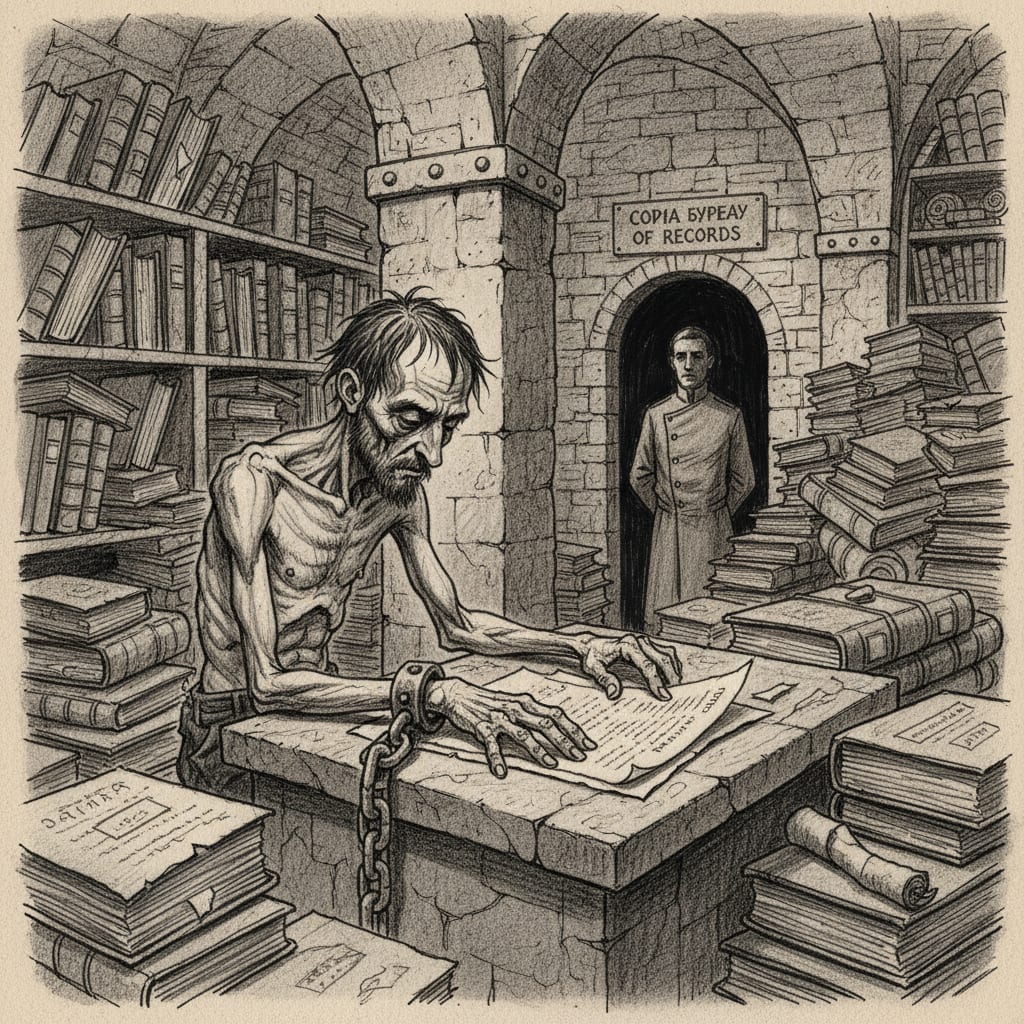
This classification has been revised. Bell-sickness is now classified as a Category Two Spiritual Contamination, following the incident at Bastion-Shipka in which a Bellwarden of eighteen years' service rang the Silentium without authorisation, triggering a garrison-wide breach alert. The Bellwarden stated afterward that the Silentium had been ringing "for months" and that he had merely answered it. The garrison's bell had not rung. His skull had. He was reassigned to the Bureau of Records' filing annex in Sofia, where his compulsive counting has proven, the Bureau admits, "unexpectedly useful."
The profession knows its own. "Brass ear" is a veteran; "soft ear" is an apprentice. "Ringhead" is a Bellwarden whose sickness has advanced past the point where the Bureau would normally retire him but whose experience makes him too valuable to lose — a man who hears bells that are not there but who can also hear bells that are there before anyone else can, which is the difference between a breach detected and a breach endured. Tower-wardens despise tunnel-wardens, who work in resonance corridors where every whisper lingers and every cough returns with harmonics. Tunnel-wardens despise tower-wardens, who work in wind and cold but never have to listen to the walls sing back.
The profession's superstitions are functional. Never strike a bell while speaking a name — a Bellwarden in Cologne did, and the bell repeated the name back through the night, and by morning the named man was dead. Never whisper in a resonance tunnel; the whisper stays. Never leave the key unattended, even to relieve oneself. The chain exists because the Bureau does not trust the Bellwarden. The Bellwarden accepts this because the Bellwarden does not trust himself. A man who spends his life pulling a rope connected to a bronze throat that can send ten thousand soldiers to their deaths with a single note should not be trusted. He should be chained.
#On the Sergeant of the Fourteenth, and Other Testimonies
A sergeant of the 14th Bellwarden Cohort emerged from a Drag Corridor near Shipka in A.S. 196, claiming to have entered it "this morning." He had entered it in A.S. 181. His wife had remarried. His daughter had enlisted, served, been wounded, and discharged. His kit was pristine. His rations were fresh. He asked why everyone was staring.
At Thessaloniki, Bell-Warden First Class Andros Pell climbed the Elder Tower on the fourteenth of Ashmonth, A.S. 198, pulled the rope, struck the clapper against the bronze, and produced nothing. The bell swallowed the sound. Bell-Warden Second Class Katerin Liss, in the Younger Tower — eleven years of service, six thousand pulls — experienced the same. The clappers hit. The bronze absorbed. Three nights of silence followed: the longest unbroken silence in the Towers' history. Pell's deposition runs to fourteen pages. Eleven describe the physical sensation. He compared the silence to "shouting into a pillow held by someone who is not there." The Bureau of Rites classified the metaphor as "unhelpful." I classify it as the most accurate thing anyone said.
On the morning of the fourth dawn, Pell climbed the tower again. He pulled the rope. The bell rang. No explanation was offered. No explanation existed. The Bureau filed the incident under "harmonic irregularity, atmospheric" and refused further comment. Pell still climbs the tower each dusk. His hands, I am told, shake. His chain does not.
#On the Present Condition, and the Bells That Ring Themselves
There are twenty-three bells at Constantinople, each with its own writ and its own ordained keeper. There are nine hundred and fourteen licensed bell-towers within the Dominion. There are eleven thousand four hundred Bellwardens chained to their posts. There are fourteen hundred Counter-Toll Operators in their sub-tower vaults. There are nine hundred and twelve active Bell Peal Licenses in the Rhine corridor alone. The Bureau of Bells keeps a ledger of every peal rung across the Dominion, every day, from the Ninefold Matins at dawn to the curfew at dusk. The ledger fills seven volumes per year. The ink budget exceeds the garrison budget at three minor bastions.
And there are, increasingly, bells that ring without being struck.
The Bureau classifies these as "atmospheric contractions of bronze." The Bellwardens call them "glass notes" — brittle, clear, pitched to frequencies the charts do not contain. When a glass note sounds, the protocol is simple: lock the district, seal the tower, send for the Resonance Marshal, do not answer the bell. The protocol is simple because the alternative — answering a bell that rang itself — is a question the Bureau of Doctrine has spent eighty-six years declining to address, and the Bureau of Bells has spent the same eighty-six years pretending it has not asked.
The Bellwarden's response to this instruction is, invariably, correct and immediate. He locks the district. He seals the tower. He sends for the Marshal. He does not answer the bell.
But he hears it. He hears it in his chain and in his bones and in the particular register that bell-sickness has carved into his auditory nerve over years of service. He hears it and he knows — with the certainty of a man who has pulled six thousand ropes and counted every peal — that the bell is not contracting. The bell is not malfunctioning. The bell is speaking. And the bell is saying something the Bureau has forbidden him to hear.
He does not answer. The chain holds. The schedule continues. The city breathes between the tolling, briefly, and with proper documentation.