
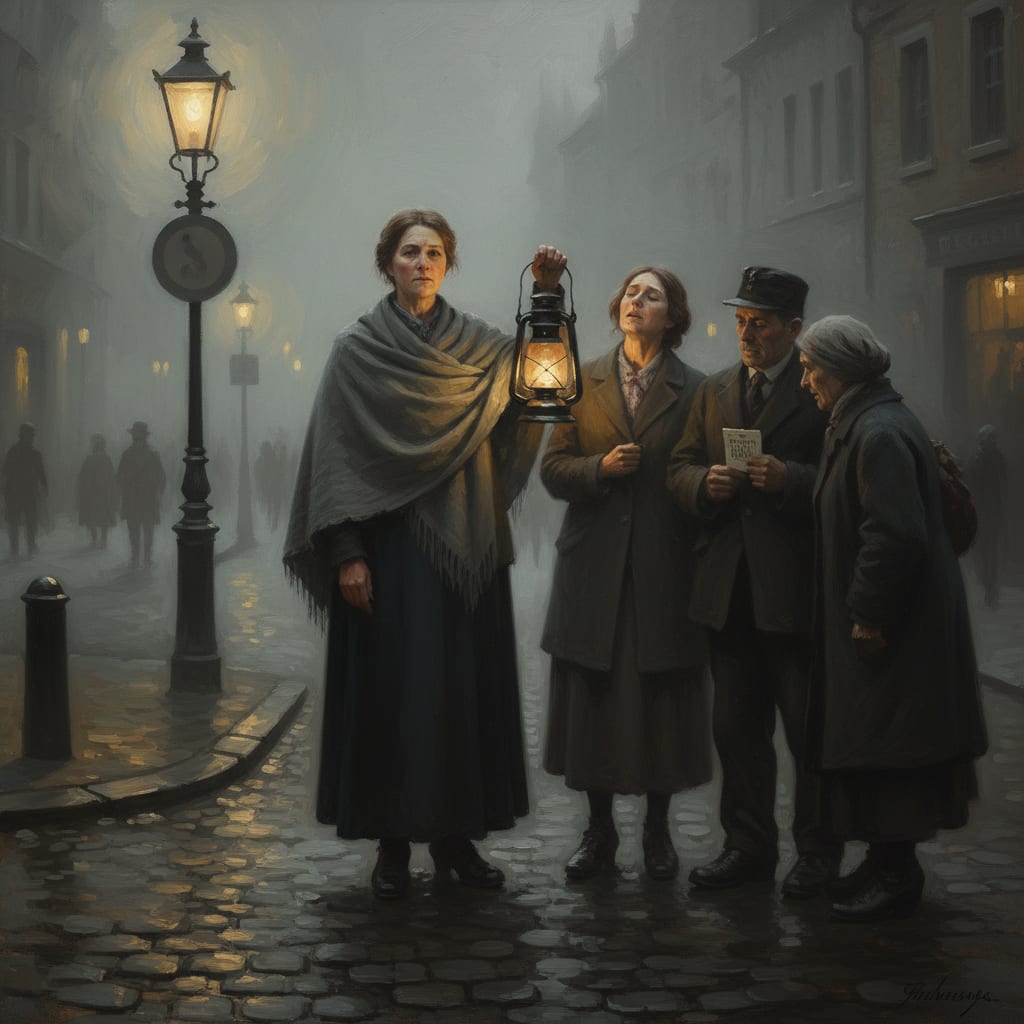
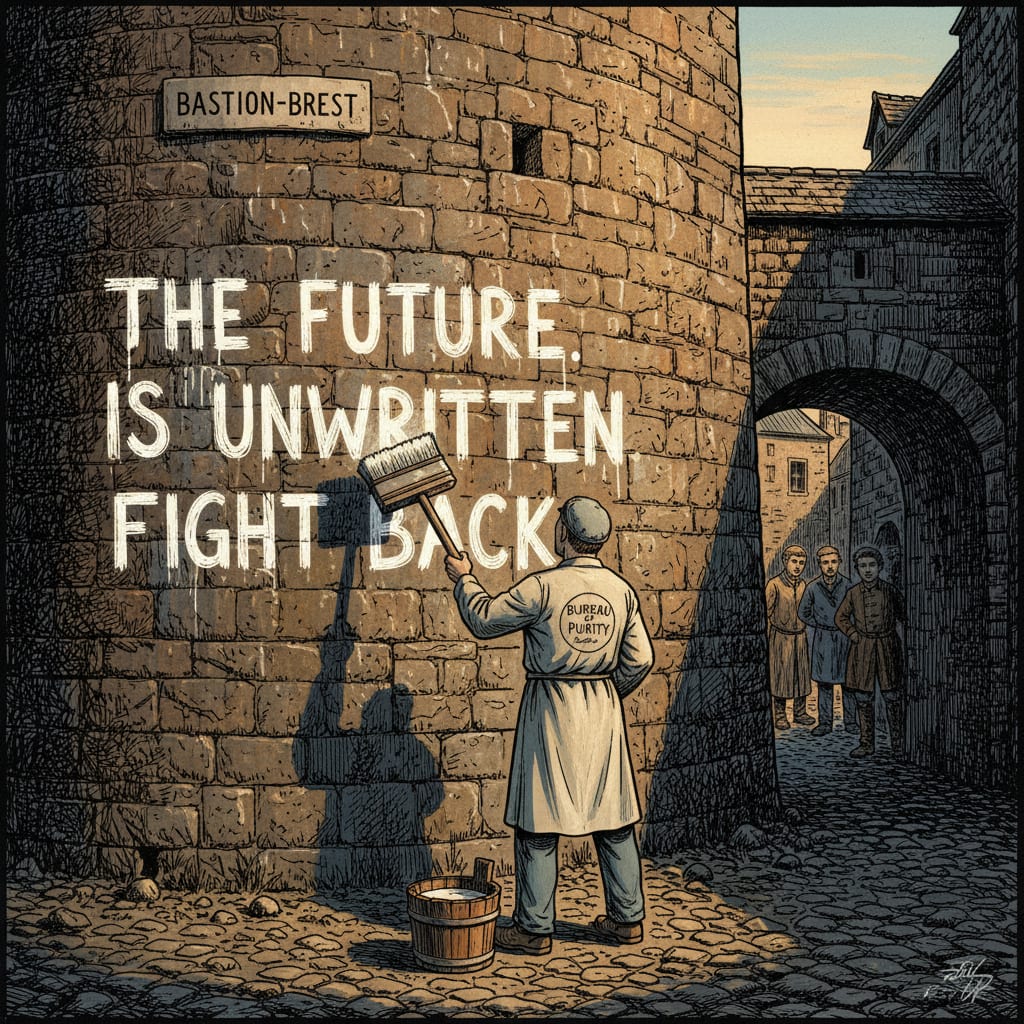
"Mercy is discipline made gentle." — Approved Catechism, Third Revision, Article 114. "Mercy is truth spoken low." — Confiscated chalk-mark, Ward Seven, Bastion-Brest, A.S. 197.
#On the Origin of the Licensed Consolator
The Synod, for all its virtues — and they are legion, and I have catalogued them, and they fill three shelves in the Vault of Prescribed Admiration — does not excel at tenderness. The Warden's cudgel is an instrument of precision, but precision and warmth are not synonymous, and there are moments in the administration of a continent-sized theocracy when what is required is a voice that does not bark.
The curfew riots of the early bastions taught us this. Men will endure hunger. Men will endure cold, disease, the loss of children, the amputation of hope. What men will not endure is being told to endure these things by someone holding a truncheon. The riots of A.S. 78 through 83 — the Lull of Names, the Plague Years (Unregistered), the long grey decade when half the Rhineland existed in a state of permanent, low-grade mutiny — demonstrated that the Synod's preferred instruments of public calm (the bell, the brand, and the boot) were insufficient. A mob dispersed by force reassembles. A mob soothed by a familiar voice does not.
The Curfew Ordinance of Quiet Hours, ratified in the margin of a supply requisition sometime around A.S. 94, created the office of Licensed Consolator. The language is worth preserving: "That persons of approved temperament be stationed at crossing-points during hours of darkness, bearing sanctioned lanterns and approved texts of comfort, to reduce disorder and preserve the tranquility that is the Synod's gift to its people." The Bureau of Rites drafted the approved texts. The Bureau of Purity vetted the temperaments. The Bureau of Records stamped the lanterns.
What no Bureau anticipated was that the people chosen for this work would, in the fog and the dark and the weeping, begin to mean it.
#On the Heresy of Undisciplined Mercy
The Lanterns — as the Bureau of Purity has designated them, eighth of eight proscribed heresies, filed after the Pale Kin and before the silence that follows a list that has reached its administrative limit — are poor revolutionaries by every theatrical measure. They carry no weapons. They draft no manifestos. They hold no secret councils in candlelit cellars with maps pinned to the wall and dramatic oaths sworn over wine.
They stand in the fog and say kind things.
The Bureau's classification, which I have read, which I have stamped, which I am not permitted to find amusing, describes them as "itinerant preachers of undisciplined mercy who undermine penalties and Warden authority." The key word is undisciplined. The Synod has no objection to mercy — indeed, the Bureau of Mercy administers it on a continental scale, with forms and fees and stamped receipts and a queue that stretches, on feast days, from the hospice door to the confession booth three streets distant. The Synod's mercy is measured, documented, and above all conditional. You receive mercy because you have been assessed, because your repentance has been weighed, because a clerk has determined that the cost of forgiving you is less than the cost of punishing you, and because — and this is the essential clause — you understand that mercy is a gift from above, dispensed at the Synod's pleasure, revocable at the Synod's whim.
The Lantern Preacher's mercy comes with no receipt.
This is the heresy: that comfort can be given without permission, that grief can be shared without a stamp, that the words "you are not alone" can be spoken in a curfew lane by a person whose only authority is having walked through the same fog. The Synod's architecture of control depends on atomisation — each soul isolated, each confession individual, each ration queue a column of separate hungers supervised by a clerk who knows every name and weighs every silence. The Lantern Preacher stitches people back together. A woman who has wept alone in a doorway is a manageable woman. A woman who has wept in the company of three neighbours, all of whom were told by a soft-voiced stranger that their tears are holy, is the beginning of something the Bureau files under "Unscheduled Congregation, Category Two."
#On the Method
They call it fogwork. The approved term is street consolation, but no one who performs it uses the approved term, which tells you everything the Bureau needs to know and everything the Bureau refuses to hear.
The method is simple and old. A Lantern Preacher positions herself at a crossroads, an ossuary gate, a queue junction, a tavern threshold — anywhere grief collects, which in the Synod's territories means anywhere with more than four people and fewer than two Doctrine Street-Vicars. She carries a sanctioned lantern. She wears a grey stole. Her brass badge identifies her as a Licensed Consolator, a title the Bureau of Rites assigned with the same enthusiasm it assigns titles to drainage pipes. She recites approved comforts: "The Creator sees your labour. The Synod shelters your obedience. Rest now, for the bell will call you to purpose."
Then she adds a sentence the Bureau did not write.
The sentence varies. "Your pain is not a punishment." Or: "The bell measures hours, but hours do not measure you." Or, in the variant that caused the Warden Sermon Trials of A.S. 134: "Obedience and love are not the same word." The sentence is never an instruction. The Preacher gives no orders, makes no plans, identifies no targets. The sentence is a crack — a hairline fracture in the wall of doctrine through which something old and warm leaks in. The Bureau calls it sedition. The Preachers call it mercy. Both are correct, and the difference between the two is the difference between a lock and a key, which is to say: mechanical, directional, and entirely a matter of which side of the door you occupy.
The operational structure mirrors this ambiguity. The Candle-Runners — children, mostly, street-wise and too young for the levy — carry blessing schedules between Preachers: route maps disguised as prayer lists, coded warnings nested in liturgical calendars. A Fog Preacher works the streets directly, her voice her instrument and her lantern her credential. Above her, a Mercy Architect plans the routes, manages the safe-house referrals, coordinates with Lantern Brotherhood watch circles who shield the Preachers in exchange for the civic calm that keeps the Brotherhood's own licence intact. At the summit, invisible and rare, the Tongue-Smiths write the dual-meaning catechisms that pass Bureau audit — texts that read as doctrine on the page and read as something else entirely when spoken aloud by a voice that knows where to place the emphasis.
#On the Predators and the Prey
The Red Lanterns are the mirror. Where the Mercy Preacher carries amber light and soft speech, the Red Lantern squad carries crimson glass and sudden seizure. They "illuminate" heresy — the Bureau's word, and I admire the craftsmanship — with lantern-brandings: the offender's face pressed against the heated glass of a Bureau-issue lantern until the crosshatch pattern of the lamp-guard sears into the cheek. The brand marks the heretic as illuminated — brought into the light. The scar marks them as burned.
ERRATUM — Bureau of Records, Ref. 44-L-199 Previous classification listed "Lanterns (rebels)" and "Red Lanterns (Inquisition)" under the same glossary heading. This has been corrected. The two are unrelated. The Bureau does not name its enforcement branches after the movements they persecute. The nomenclature is coincidental, and the coincidence is instructive.
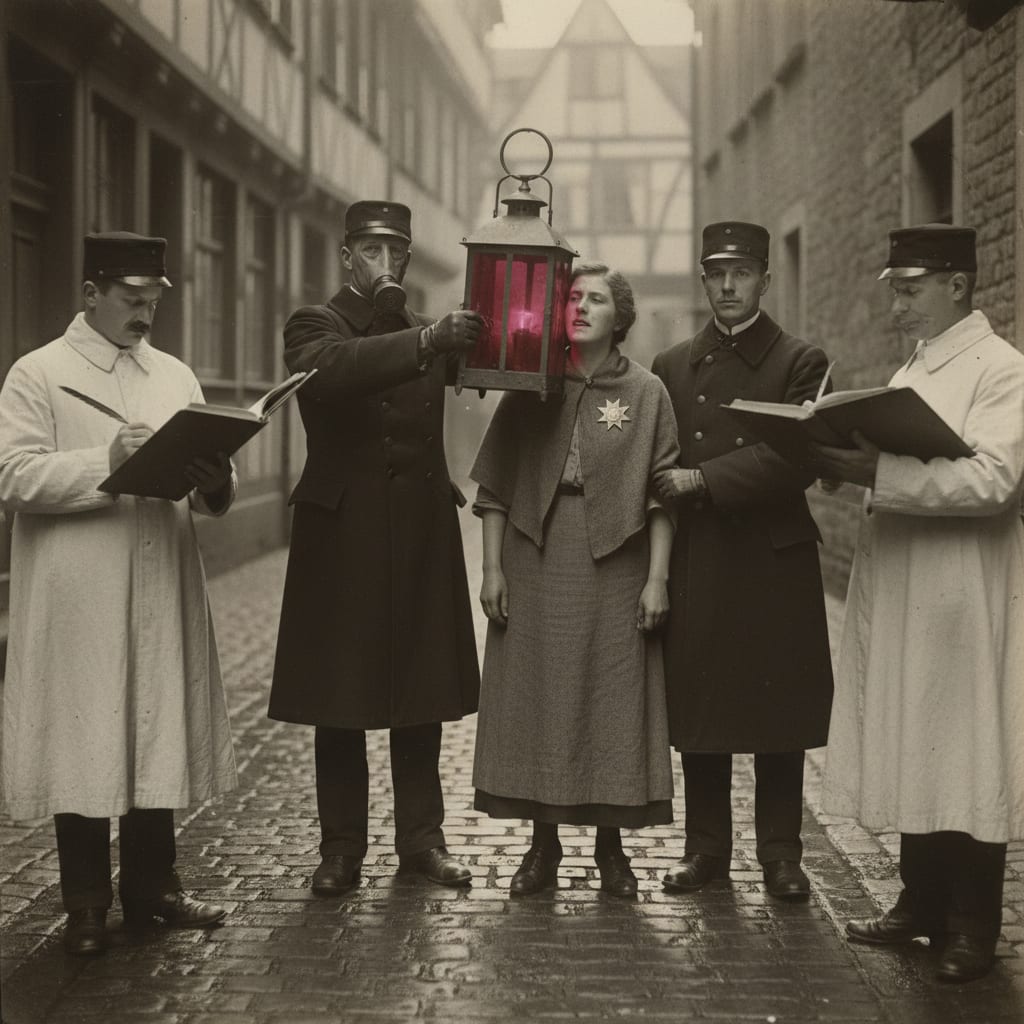
The Warden Sermon Trials provide the canonical precedent. In A.S. 134, seven Licensed Consolators across three Rhineland districts were detained for "pastoral overreach" — a classification the Bureau of Rites invented for the occasion and has since applied to forty-one subsequent cases, suggesting either that pastoral overreach is epidemic or that the classification is useful. The seven were tried before a tribunal of the Bureau of Purity, their sermons transcribed by Confessor-Booth Clerks who had attended in plainclothes. The transcripts were read aloud in court. The Preachers wept. The tribunal observed that weeping was not a defence. Five were reassigned to trench chaplaincy — a posting the Bureau describes as "front-line pastoral care" and soldiers describe as "a death sentence with hymns." Two were immured. The Bureau of Mercy sent flowers to the families. The Bureau of Mercy always sends flowers.
#On the Brotherhood and the Schism
The Lantern Brotherhood — the night-watch vigilantes whom the Synod tolerates because their blades strike criminals and dissenters before doubt festers — discovered early that the Mercy Preachers reduced their workload. A calm street requires fewer patrols. A comforted widow does not shatter a queue window. A child who has heard a kind word at dusk does not throw stones at a Warden at dawn. The Brotherhood began shielding Preachers from pragmatism more than ideology — the mathematics of civic order, which are the only mathematics the Bureau of Tithes respects.
The Schism came when the Brotherhood's watch circles realised that shielding the Preachers made the Brotherhood complicit. If a Fog Preacher's coded catechism helps a family dodge a levy, and the Brotherhood lookout turned a corner at the right moment, the Brotherhood's tolerance becomes participation. Three watch circles in Cologne split over this question in A.S. 178. The Ward-Soothe Purists — those who keep peace and reject politics — severed ties with the Preachers entirely. The Lantern Loyalists — those who serve the Brotherhood first and doctrine second — continued the arrangement. The Soft Insurgents — the faction that believes mercy is resistance — argued that the Brotherhood's entire purpose had always been resistance dressed in permission, and that the Preachers simply said aloud what the Brotherhood's patrol routes had been saying in silence for decades.
The Bureau of Shadows filed the Schism under "INTERNAL FRATERNAL DISAGREEMENT, NO ACTION REQUIRED." The Bureau of Shadows' inaction is never inaction. It is observation with a longer fuse.
#On the Voice That Costs
The Mercy Preacher's instrument is the voice. The voice is also the evidence.
Every sermon becomes a transcript. Every comfort, if overheard, becomes a deposition. Every coded catechism, if decoded, becomes an exhibit. The Preachers know this. They preach with the knowledge that the words leaving their mouths are already being filed, already being weighed, already being measured against the Approved Comforts checklist that the Bureau of Rites updates annually and that no Preacher has ever read in full because reading it would require admitting that the Bureau's version of comfort and the Preacher's version of comfort occupy different theological continents.
The cost is cumulative. Candle-Runners lose their childhood to routes and codes. Fog Preachers lose their sleep to dusk shifts and dawn debriefs. Mercy Architects lose their names to deniability — the best Architects are known by no name at all, a condition the Bureau of Shadows recognises as professional excellence and the Bureau of Records recognises as a classification error. And the Tongue-Smiths, the elite writers of dual-meaning catechisms, lose their own voice: they spend so long constructing sentences that mean two things at once that they forget which meaning they intended, and their private speech becomes as layered and coded as their public speech, and they fall silent in company because every word is a risk and silence — for once, for the only time in the Synod's dominion — is the honest option.
The burnout takes two forms. The first is the instrument — the cold tongue, the voice that recites without inflection, the Preacher who has said "You are not alone" so many times that the phrase has worn smooth and lost its grain. She stands in the fog and speaks and the words pass through her like bell-sound through bronze, shaping nothing, warming nothing, performing mercy as a reflex rather than an act. The Bureau considers this an acceptable outcome.
The second form is the fracture. A Preacher who has absorbed too much grief, who has stood in too many queues and heard too many confessions and held too many hands in the dark, breaks — and when she breaks she does the one thing the training forbids. She speaks plainly. She says what she means. She says it once, in a voice stripped of code and catechism, and everyone within earshot hears it, and the street remembers.
#The Ratification
The Lanterns are eighth of eight heresies, and eighth is where the Bureau files things it cannot extinguish and will not dignify with a higher rank. They carry lanterns the Bureau stamped, recite comforts the Bureau approved, and work streets the Bureau mapped. They are the Synod's own creation, turned sideways by sincerity — which is to say, by the one contaminant no stamp can neutralise and no audit can detect.
The Bureau's position is clear. Mercy is a Synod prerogative. Mercy without authorisation is theft — theft of the Synod's most carefully rationed resource, the right to be kind rather than bread, iron, or chrismole. The Preachers steal this right nightly, distribute it without receipt, and return their lanterns to the parish office in the morning with the glass polished and the wick trimmed and not a single document out of order.
The Bureau will continue to surveil them. The Bureau will continue to file reports. The Bureau will continue to send the Red Lanterns when a Preacher speaks too warmly or too often or in a cadence that three wards recognise. And the Preachers will continue to stand in the fog, grey-stoled and hoarse-voiced and soot-fingered, carrying their sanctioned light into the unsanctioned dark.
Nihil obstat — or rather, nihil obstat until the next revision.