

#On the Fever in the Present Register
Brine-fever is the illness of Saffron Bastion. This survey was compiled for the Bureau of Doctrine in A.S. 201 / 1911 CE, and it records the fever as the port knows it this year: a sickness of the breath that has never left the harbour, an office that governs it, and a population living between the two. All of the evidence comes from Saffron. The fever logs, the intake sequence on the Quarantine Causeway, the published accounts of the Quarantine Prefecture and the testimony of the under-quays all belong to one headland near Ragusa. Other harbours of the Adriatic Coast keep their own fevers under their own names. I do not lend them this one.
Three things share the word, and they must be filed apart. The disease is a condition of bodies. The Brine Fever Winter was one catastrophic season, in A.S. 112. The restrictions surveyed as the Brine Fever closures are a recurring practice of waiting, holding and release. A clerk who files the fever as a date has misfiled it, and so has a clerk who files it as a gate. It lives in the lungs.
#On Brine-Breath and the Salt-Chest Reports
The first recorded sign is brine-breath, a sour, tidal smell on a mouth that should smell of onion mash and cheap spirits. With it, or soon after, the sufferer reports a taste of salt in the mouth that no rinse removes. In Low Nets, wives lean over sleeping husbands and sniff. At the Third Quay, foremen watch which ropehand spits too often. The household usually diagnoses the fever before the Prefecture does, and often knows more.
Saffron's published account describes what follows as a progressive inflammation of the lungs. Over the decades the fatal reports use the same few phrases: salt in the chest, salt in the lungs, a man drowning on dry boards. These phrases record what nurses and families saw and heard at the bedside. They are observations, and they explain nothing about how the fever kills. The reports also do not say that every case ends this way. The logs that record the drowned also record people who coughed, were held, and walked out again.
Local knowledge names two routes of infection: the mist and the fish. Brine-mist rolls off the water thick enough to crust iron overnight and soak wool through by the second bell. Contaminated catch carries the fever into kitchens. Dockhands, gutting-women and salvage divers work in both, and they fall in numbers the port has learned to expect. These routes are suspected, put together by people who watched who fell sick. No physician of the Church has named an agent, measured how long it hides in the body, or certified how it passes from one body to another. The salt on the metal is a fact about the weather. Nobody has shown it to be a fact about the disease.
#On the Winter of A.S. 112
The disease was in Saffron before anyone wrote its season into the Ledger. Nobody knows when the fever first appeared, who first called it brine-fever, or where it came from. Ragusan custom already shut sick sailors in clifftop rooms and made suspect arrivals wait offshore. The coast was afraid of its harbour long before the Synod came to share the fear.
A.S. 112 / 1822 CE is the year the fear became a census. The local account of the Winter records that one in five died with salt in the chest. That proportion belongs to that season in that town. It is not a rate for brine-fever in general, it is not an estimate for this year, and it should not be multiplied against a population table to produce a total.
The Quarantine Prefecture was constituted in response to the Winter. The sources disagree about whether that happened during the season or after it. No charter day is on file, and the first officers left no names. The formal Synod was twenty-two years old, and both founders had been dead for longer than that.
Official rites were said above the harbour, and the families of the dead went down beneath the Causeway. The earliest reliable mentions of the Brine Choir come from that mourning. Reports of humming in the pilings are dock testimony. None of them claims the singing cleared a single lung.
The same year sits in the indices beside the Breach Plagues. The Bureau of Oaths blames the violence of those years on rotted vows. It has never shown that Saffron's fever was part of it. Sharing an index year does not make two events share a cause.
The Brine Fever Winter killed three thousand in six weeks.
Withdrawn. The sentence appeared in earlier published entries on Saffron Bastion and the Quarantine Prefecture. The dedicated account of the Winter records mortality only as one in five, with no absolute total and no duration, and the closures survey has already struck the figure. It is struck here too, because if a withdrawn number stayed standing in a condition survey, readers would take it for a clinical one.
#On Inspection, Holds and the Dry-Pass
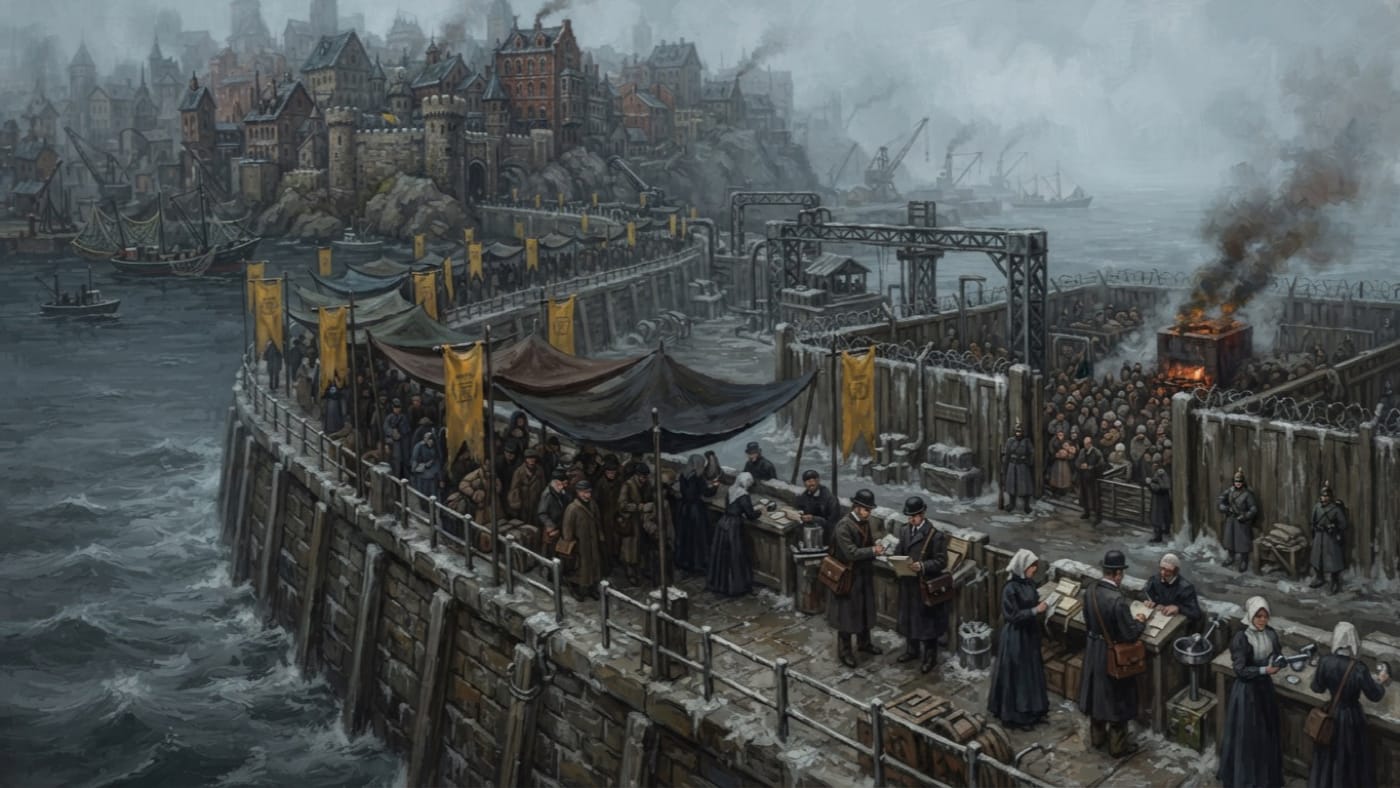
Intake at Saffron follows a fixed sequence. It is the same whether four hundred pilgrims cross the Causeway in a slack week or two thousand in the height of the season. Arrivals walk in single file along the stone-and-timber pier under the saffron flags. A clerk rubs salt on each tongue and asks a confession question while the applicant can still taste it. A nurse listens to the lungs. A stamp records the result.
The salt rub is attested procedure, but nobody has shown what it detects. It reliably produces confessions from mouths too busy to embroider. I record it as a ritual with a clinical alibi and leave the alibi unproven. The verdict belongs to the nurse's ear.
An applicant who is cleared receives a dry-pass. One who is not is saffroned and sent to the holding yards behind the Causeway. The pass's public handling rule states its terms: the bearer is cleared of current sign, authorised for limited movement through a stated district, and subject to recall if their exposure category changes. The pass certifies the state of the bearer's lungs that morning. It says nothing about next week and grants no immunity. A clerk can recall it by reclassifying the street where the bearer sleeps.
The care in the yards and fever sheds is real. Mercy's nurses wash and feed the held. Bedding is burned, yards are scrubbed and piers are scraped. The Prefecture's own account credits Prefect Halden Greaves's fever logs and nurse rotations with reducing true brine-fever mortality along the Causeway. It gives no percentage, and I will not supply one. Burn crews stop outbreaks that would otherwise ride inland in pilgrims' sleeves.
The same authority also holds people for reasons their lungs have not given. "Exposure proximity" can saffron a household where nobody coughs. Greaves once held an entire pilgrim convoy for nine days over a single genuine cough. The cough was medical. The nine days were administrative, and that one episode sets no standard period for anyone else. The nurse who sits with a fevered dockhand and the clerk who holds his clear-lunged brother sign the same register.
#On the Households Under Hold
A hold suspends the held person's legal identity for as long as it lasts. The held cannot trade, petition, testify, sell property or travel. Their belongings pass into the Prefecture's trust custody, which keeps excellent inventories and returns things whenever it pleases. Their wages stop unless they are reassigned to sanitary labour. That labour is requisitioned from people already exposed, because exposure has made them cheap.
For a household in Low Nets, this arithmetic is the whole of the fever. The district sits behind sea walls and over tide culverts. It lives among mildew, fish guts and a grey silt that dries into salt rash on bedding and on infants. It is damp, crowded and close to the fish sheds, so it stands near both suspected routes. The sweeps come down before dawn with burn crews and nurses. A cough can cost a week's wages. A held leaseholder can cost the family its room, because nobody else may petition to keep it.
Pilgrims do no better, though their losses differ. Their berth chits run out while they wait, and they buy food from Prefecture kitchens at emergency rates. A clean pass at the end of the wait lets them move again, but nobody refunds the week.
Forged dry-passes are sold in Low Nets every fever season. A forgery may get its bearer through a gate, but it cannot clear a lung. The burn crews treat a bearer caught with one as both a fever risk and a criminal.
Then there are the booths. Whatever is said in the Prefecture's quarantine confession booths is written down as cleaning notes, and those notes may be passed to the Bureau of Records for later use. A dockhand who answers the confession question with salt on his tongue may meet that answer again in a debt hearing or a writ dispute, years after his lungs were cleared.
#On the Continuing Condition
In A.S. 201, brine-fever is endemic at Saffron. People still read fever season off the flags, the sweeps and the length of the queue on the Causeway. In Low Nets, "Wetmouth" is still an insult worth a knife. The dry-pass still decides who may climb the Duesstairs. The nurses still listen to lungs the clerks have already priced.
The register is still incomplete where it matters most. No agent has been named and no cure is recorded. Nobody has settled whether the mist carries the fever or only travels with it, or whether the fish cause it or only arrive with it. Whatever answered the mourners under the Causeway belongs to the Choir's testimony and Purity's file, and none of it counts as evidence in this survey. The Prefecture goes on holding, washing, stamping and burning. The fever keeps coming in with the mist.