
I've read the continuity, voice and Saffron sources. Writing the article now.
#On the Winter and the Count
The Brine Fever Winter is the Ledger's name for the season of A.S. 112 in which Saffron Bastion lost one in five of its people to a fever that ended with salt in the lungs. The figure is a proportion. It went into the record as a proportion and has stayed one. No clerk of the period turned it into a total, and I will not turn it into one now to flatter a reader who prefers round numbers.
Two things outlived the dead. The first is the Quarantine Prefecture. It was constituted after the catastrophe and still flies its saffron cloth over every berth on the headland. The second is the Brine Choir. Its earliest reliable mentions come from the same aftermath, beneath the same piers, among the families the Prefecture was built to count. One inheritance holds a charter. The other holds a note no licensed throat can reach.
#On Exposure and the Dead
Saffron was already a wet city before the winter made it a sick one. Dockhands worked in brine-mist that crusted iron overnight and soaked wool through by the second bell. Gutting-women stood ankle-deep in fish waste. Ropehands handled salt lines with split knuckles. Salvage divers came up from the breakwater teeth with harbor water in their ears, in their sleeves and, by their own complaint, in their teeth.
The port knew two roads into the fever and named them plainly: the mist and the fish. Bad catch brought it into the kitchens, and the mist brought it everywhere else. This is local exposure knowledge, gathered by people who watched who fell. The Bureau of Mercy has improved on it only with longer words. No physician of the Church has named the agent, measured how long it lay hidden in the body, or found a cure to end it. I decline to supply what my colleagues could not.
The first sign, then as now, was brine-breath. It was a sour, tidal smell on breath that should have smelled of onions and cheap wine. Wives learned to lean over a sleeping husband and sniff. The end was salt in the lungs, a man drowning on dry boards.
In present Saffron the fever-marked dead are burned under Quarantine bells, and the clean dead get weighted shrouds dropped beyond the breakwater. No surviving order tells me how many of the winter's dead went to fire, how many to water, and how many to whatever trench the season could spare. I have looked. The burn warrant belongs to later years. Of the winter's disposals, the testimony keeps the smoke and the record keeps the proportion.
#On the Office the Winter Left
Quarantine did not arrive at Saffron with the Synod. Around A.S. 68 the surveyors came to the headland near Ragusa. They found seven hundred souls, a tide shrine, and a Ragusan quarantine tradition older than anyone's complaint about it. Ships waited offshore. Suspect cargo waited longer. The custom was sound and local and, in the Synod's view, unforgivably unsupervised.
By A.S. 90 the headland had been terraced, the cliff batteries armed and the breakwaters extended, and the town held twelve thousand. A harbor custom does not stretch to twelve thousand people living in fog. The winter of A.S. 112 proved it in the only language a city government reads without being asked twice.
The Prefecture was constituted afterward. By then the formal Synod was twenty-two years old and both founders were long buried. Its first officers left no names that have reached my desk. I will not invent a founding prefect to decorate a paragraph. In principle, the new office received the power the Ragusan custom had never held. It could detain a body at the Causeway, keep a log against it, and decide whether it passed.
Every instrument a visitor meets in modern Saffron descends from that grant. There are dry-passes, fever holds, intake nurses at the Quarantine Causeway (Unregistered), burn crews and sanitary militias. There are also fever logs that the confession booths now keep as sin ledgers. These came over decades. A historian who presents the whole apparatus as the emergency kit of one winter has filed ninety years of accretion under a single seal. I have returned such folios unread.
#On the Rites Above and the Voices Below
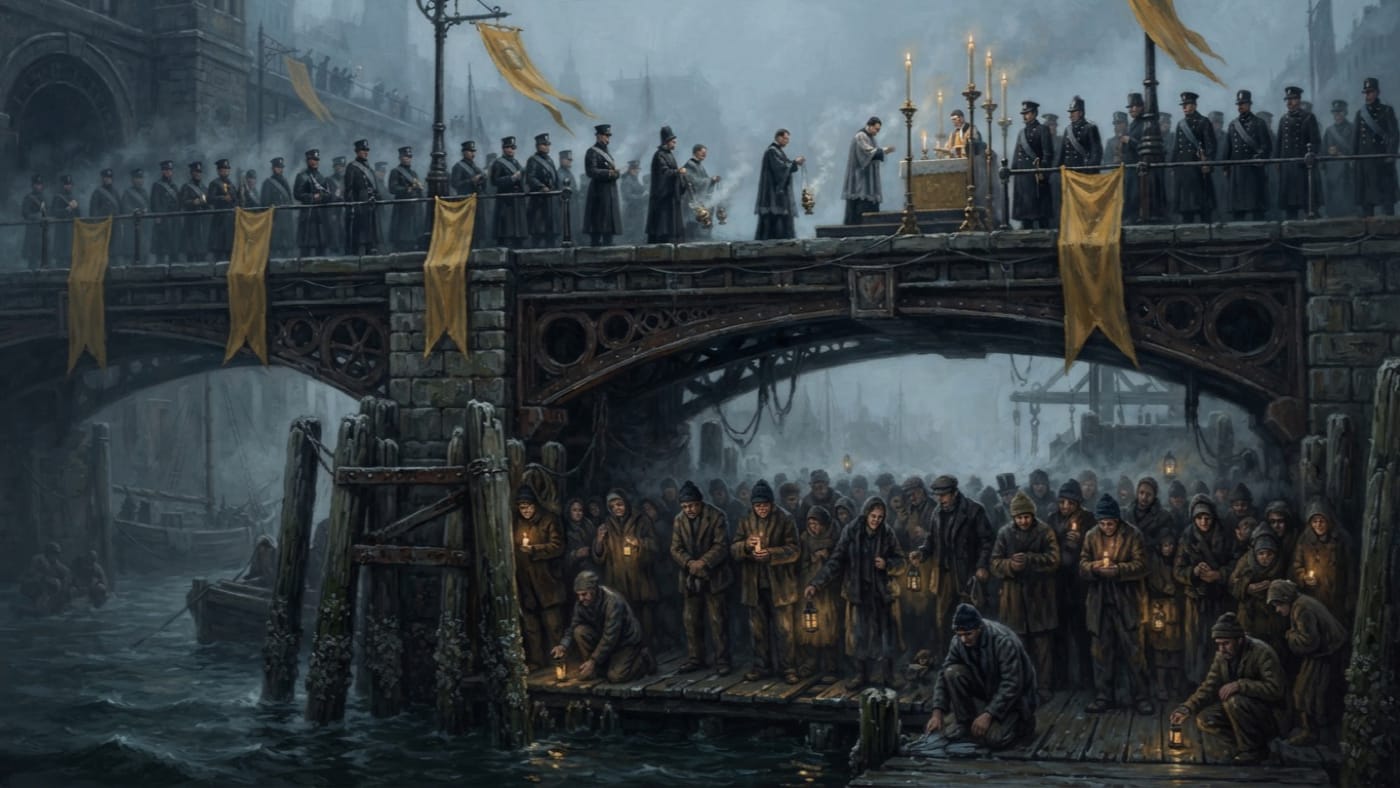
The official memorial rites were held above the harbor, on stone high enough that the smell of the holding yards reached it only on an unkind wind. The Bureau of Rites brought candles, vestments, and a proper elevation. These are the correct tools for grief on a large scale. I have used them myself at other catastrophes. The sightlines were excellent.
The families went below.
They gathered under the Quarantine Causeway, among the pilings, on boards that flooded twice a day. That was where the dead had worked and where the boats had come in. Many of the mourners had nowhere else to stand. Dockwomen do not attend memorials that require clean shoes. They brought what they had: wet boots, the names of the dead, and words older than any the Church had given them.
Those words matter. The Choir's oldest antiphons carry Ragusan sea prayers from before the Synod's arrival. The winter did not compose them. It gave them a congregation.
What follows is dock testimony, and I record it as such. Widows reported humming in the pilings. Divers working the Causeway footings heard syllables through their helmets. Ropehands laying salt lines noticed that the water answered some work-songs differently from others. None of these accounts claims that the fever dead came back. None claims that the singing cleared a single lung. The listeners say only that something below the boards made sound, and that they kept listening.
That is the whole of the Choir's origin. It has no charter, no first cantor and no roll of founding faithful. Its five mature practices belong to later decades. In A.S. 112 there was a crowd of mourners standing in the tide under a causeway, and a rumour of noise.
#On the Aftermath and Its Later Owners
Low Nets changed status rather than shape. Dockhands had lived in the under-quays, behind the sea walls and beside the tide culverts, long before the winter. Afterward the Prefecture needed somewhere to point when it drew a cordon. The slang name Low Nets hardened into registered geography. A quarter becomes official on the day an office needs to sweep it.
Twenty-two years later, in A.S. 134, the Insurance Courts opened and began turning storms into assets. By then the under-pier singers had become a recognizable faction. The Courts had no hand in the winter. They arrived in time to price the disasters that followed it, with compensation writs, exception claims, and the long arithmetic of bodies never found. The Choir sang at the funerals those writs paid for, and later at the claims that failed. The Choir's quarrel with the Lanternline Chandlers' Lodge and its Demon-Lures came later still. At the south-pier incident of A.S. 199, the singers proved more useful than anyone holding a seal could admit.
The Breach Plagues entry of the A.S. 112 inventory records Quarantine Prefectures established at Saffron Bastion (Brine Fever Winter) and at Grain-Gray Wexel (Dust Fire).
Corrected. Wexel's Dust Fire was a silo explosion, and the office installed after it is a Ration Prefecture. The two catastrophes share a year in the inventory and nothing else that has been shown. The Bureau of Oaths attributes the Breach Plagues to broken oaths, but that attribution has never been proven for Saffron's fever, whatever its merits on other dockets.
#On the Continuing Fever
The Prefecture did not end the brine-fever. Present Saffron still marks fever season by flags, by sweeps, and by the length of the queue at the Causeway. In Low Nets, "Wetmouth" is still an insult worth a knife. Brine-breath still sends a household to the window to see whether the saffron cloth has gone up on their street. The Bureau of Purity watches the Choir. The Prefecture watches everyone. The mist arrives on schedule and watches nothing at all.
On calm nights the Choir still sings under the Causeway, at deaths and at fever clearances. Low Nets holds that some of the names it hums are old enough to belong to the winter. Rites has never asked which. Records would require a form.