

#On the Causeway and Its Queue
"A city that smells of soap is either very clean or very afraid." — Prefect Halden Greaves, attributed; classified apocryphal by the Bureau of Records
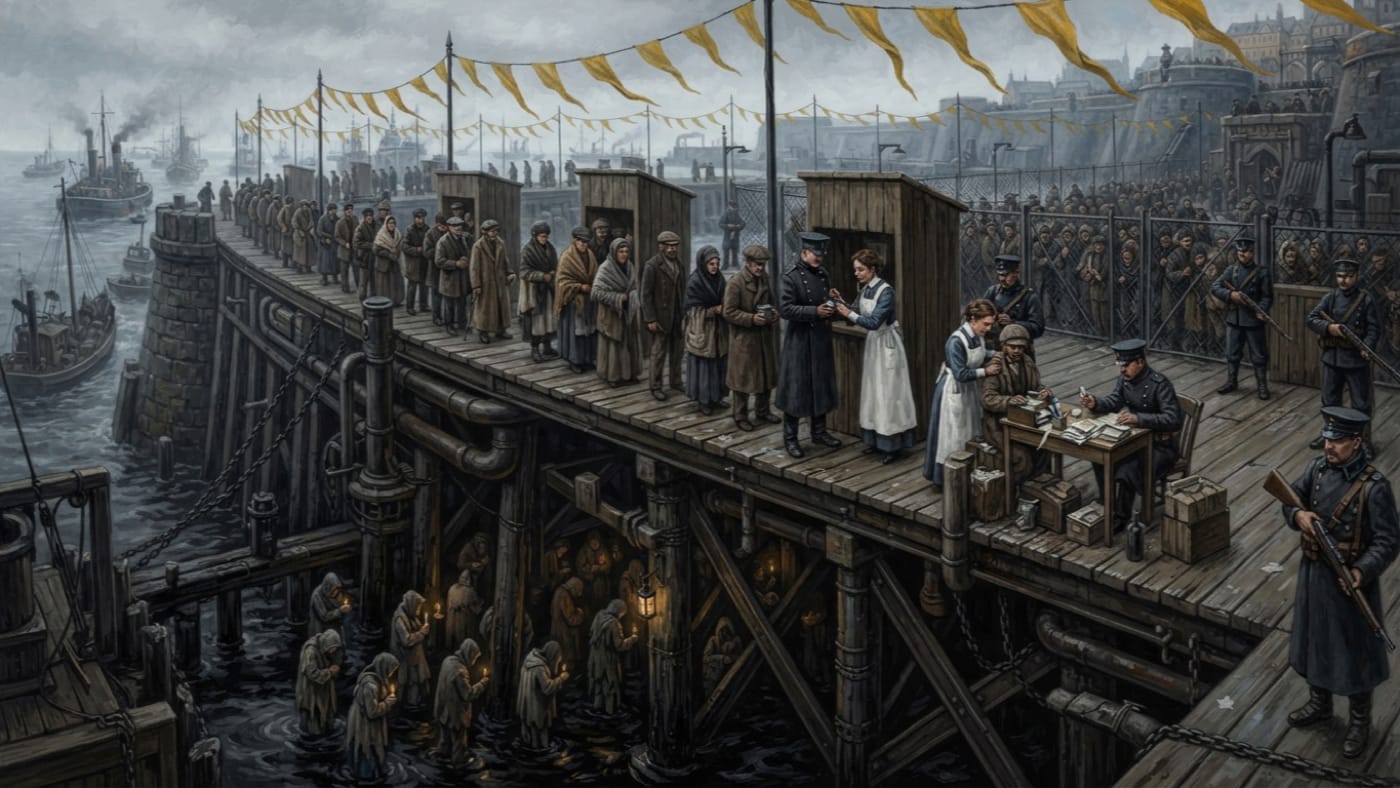
The Quarantine Causeway is a long stone-and-timber pier that runs out from the harbor mouth of Saffron Bastion. Every pilgrim who comes by sea for the southern bastions walks it in single file beneath saffron flags. The flags crack overhead in every season. The pilgrims under them keep their eyes on the boards, because that is where the line runs. Leaving the line is a choice, and the Quarantine Prefecture writes it down.
The holding yards stand behind the inspection. The whole Causeway is arranged around them, and the pilgrims usually work this out somewhat later than the clerks would like.
Jurisdiction on the Causeway has been carved up with the care of surgeons dividing a cadaver among students. The Prefecture, which the town calls the Saffron Flags, holds the pier and the yards, and Prefect Greaves holds clearance and detention. Canon-Marshal Veyra Sable's Harbor Marshal Command holds the berths, the guns and the security of the water approach. The Quay Chapterhouse holds seals and dues. Writ-Lector Odrin Vale's Insurance Courts hold the civil writs that follow a detention as dependably as gulls follow the gutting knife. No office answers for the pilgrim. Each answers for one portion of the pilgrim, and keeps receipts.
There are two Causeways, laid one on top of the other. The upper one is scrubbed with lye, salt-stained, inspected and stamped. The lower one is tarred piling, chain, black water and a congregation. The Prefecture runs the first and has trained itself not to look at the second.
#On Tongues, Lungs, and the Stamp
On any given day the boards carry between four hundred and two thousand pilgrims, depending on the season. Each one goes through the same sequence. A clerk rubs salt on the tongue, then asks a confession question while the pilgrim is still tasting it. The lungs are assessed. The intake nurses, known for kind eyes and brutal checklists, weigh what they have seen and heard against the likelihood of brine-fever. After that comes the stamp.
The stamp costs one salt-token, payable at the Duesstairs. The salt-token costs whatever the Quay Chapterhouse needs it to cost that morning. A pilgrim who pays has bought an inspection and nothing more. The verdict still belongs to the nurse, and the token cannot buy it.
The Causeway's critics are numerous and mostly drunk, and they call the inspection theatre. It is a theatre where people die when the players miss a cue. Brine-fever is real. It comes in on the brine-mist and in bad fish. It starts as a taste of salt in the mouth, and through progressive inflammation of the lungs it ends by drowning its patient on a dry floor. The Winter of A.S. 112 killed one in five. The Prefecture's fever logs are meticulous and its protocols are effective. The nurses who bend close to a stranger's open mouth all day long have nothing to protect them but soap and habit, and they do the work anyway. I have met prelates with less courage and better upholstery.
#On the Dry-Pass and the Held
Those who pass are given a dry-pass, the clean release slip, and they step off the Causeway with their legal personhood intact. Officially the paper says only that its bearer was inspected and found clean. In practice it does far more. Dry-passes circulate through all nine districts as a second currency. Lodging-keepers, hiring benches and ration counters accept them, as does anyone who values a clean bearer above a doubtful one. Forgeries trade in Low Nets at prices that rise with fever season. Every so often the Prefecture's burn crews sweep the undercity, confiscate the counterfeits and conscript the people holding them into quarantine labor, which is the one trade in Saffron that always has openings. A bought paper describes the lungs of the person it was issued to. The buyer's lungs stay exactly as they were.
Those who fail are saffroned and walked across the boundary into the yards.
From this point the Causeway stops being a clinic. A quarantine hold suspends the legal identity of the held for as long as it lasts. The saffroned cannot trade, cannot petition, cannot own, cannot testify and cannot leave. The Prefecture administers their goods in trust and may conscript their labor for sanitary purposes. The Prefecture also decides how long a hold lasts, and I have been shown no schedule.
Then there are the booths. Whatever is said in the Prefecture's quarantine confession booths goes down as cleaning notes, so the fever log and the sin ledger are one book with two titles. The notes go to the Bureau of Records under a classification that lets them be used in any later proceeding. A pilgrim can leave the yards with clean lungs and meet that confession again in a debt hearing, a writ dispute or a heresy inquiry.
The Bureau's coastal survey records disappearances from the Causeway yards. It also records something quieter: held pilgrims sold into labor. No ledger I have seen names a buyer. The yards are washed with lye, and lye does its work thoroughly.
Wealth has its own way in. The toll-tunnel at Saffron Gate lets those who can pay skip the boards entirely, and quarantine falls on the bastion about as evenly as rain falls on a roof with one sound corner. Still, the corruption has a limit. During a fever spike, even money cannot reliably buy a genuine clean release. The nurses have seen what a spike does to a ward, and the Prefect's logs are at their most honest exactly when honesty is fatal to the unclean.
#On the Congregation Beneath
The mourning of A.S. 112 split into two congregations. The official memorial rites were held above the harbor, a respectable distance from the smell. The families went down instead, under the Causeway, among the pilings where the water slaps the timber and the flags overhead can be heard but not seen. Over the next twenty years they became the Brine Choir.
All the testimony from those years is dock testimony, which is reliable mainly about its own fear. Widows reported humming in the pilings. Divers heard syllables through their helmets. Ropehands noticed that some work-songs bent lantern flames away from the water and that others drew the sea up the posts. None of it shows that any identifiable dead person came back. Not one entry in the Prefecture's logs credits singing with curing a case of fever. What the testimony does show is that the bereaved found a better church under the Causeway than the one they had been given. Their antiphons kept older Ragusan sea prayers alive beneath the Synodal words. By A.S. 134 the singers were a recognizable faction. Their mature disciplines came later, and I will not backdate them to suit the Bureau of Purity, which would like the heresy to have been fully formed on its first wet night.
At chain-drop the Causeway comes under the same harbor discipline as every exposed pier. The curfew chains go up. Registry numbers replace names. Salt lines are laid across the boards, the Lanternline Chandlers' Lodge runs its approved lantern patterns, and the watch puts in waxed earplugs. Above the boards the watch speaks in numbers. Below them the Choir hums the shapes of names and sings counter-patterns timed to the gaps in the lanterns. Nobody has settled whether the singing calms the waterline entities or feeds them enough that they leave other prey alone. Rites has been asked to decide and has requested an extension.
The Prefecture puts up with what it condemns, and it does so in the only way a Bureau can do something it cannot admit to: by denying it. Consultation has been refused in writing. Patrols under the boards run thin. Nothing records any exchange.
Earlier coastal notices described the Brine Choir, its gatherings beneath the Causeway included, as "a recreational tide-hymn fellowship of no operational significance."
Withdrawn under Seal Amber after the south-pier incident of A.S. 199. That incident did not happen on the Causeway, and nothing in this entry should be taken as a Causeway finding. The correction spread along the waterfront faster than news of the incident, which is the usual speed at which a Bureau learns it was wrong in writing.
#On the Present Condition
"Quarantine is mercy." — Canon-Marshal Veyra Sable, A.S. 199, addressing the Dock Union
In A.S. 201 brine-fever is endemic and the Causeway works without stopping. The saffron flags snap over grey water. The line moves forward one pilgrim at a time. Clerks salt tongues and put their question. Nurses listen to lungs and tick their brutal lists. The Duesstairs reprice the salt-token to the Chapterhouse's taste. The yards hold whoever they hold, the booths take down whatever is said, and Records files the notes in a hand far neater than the confessions themselves.
On calm nights, under the boards, the Choir stands with the tide at its boots and hums names the watch above is forbidden to say. The Prefecture owes it the quiet of those nights and acknowledges no debt.
Canon-Inquisitor Silex Marrow's audit is still expected. He has not arrived, and I will not predict what he finds. I have advised him to bring his own salt-token.