

#On the Wash Authority
The personnel notice posted inside Coastal Annex 71-P is a small document, and like most small documents in Calais it has teeth. It names the Chief Warden. It counts the clerks by day and by fog night. It assigns the bell observer and says when Doctrine must be present. Between those lines sits a single entry that no inspector has yet managed to expand: Wash authority: Brine Sisters Compact.
That is the whole of the Compact's appearance in the annex record. Everything below is built on that line, on my own account of the Undertide Pens, and on what can be seen from a doorway without getting wet.
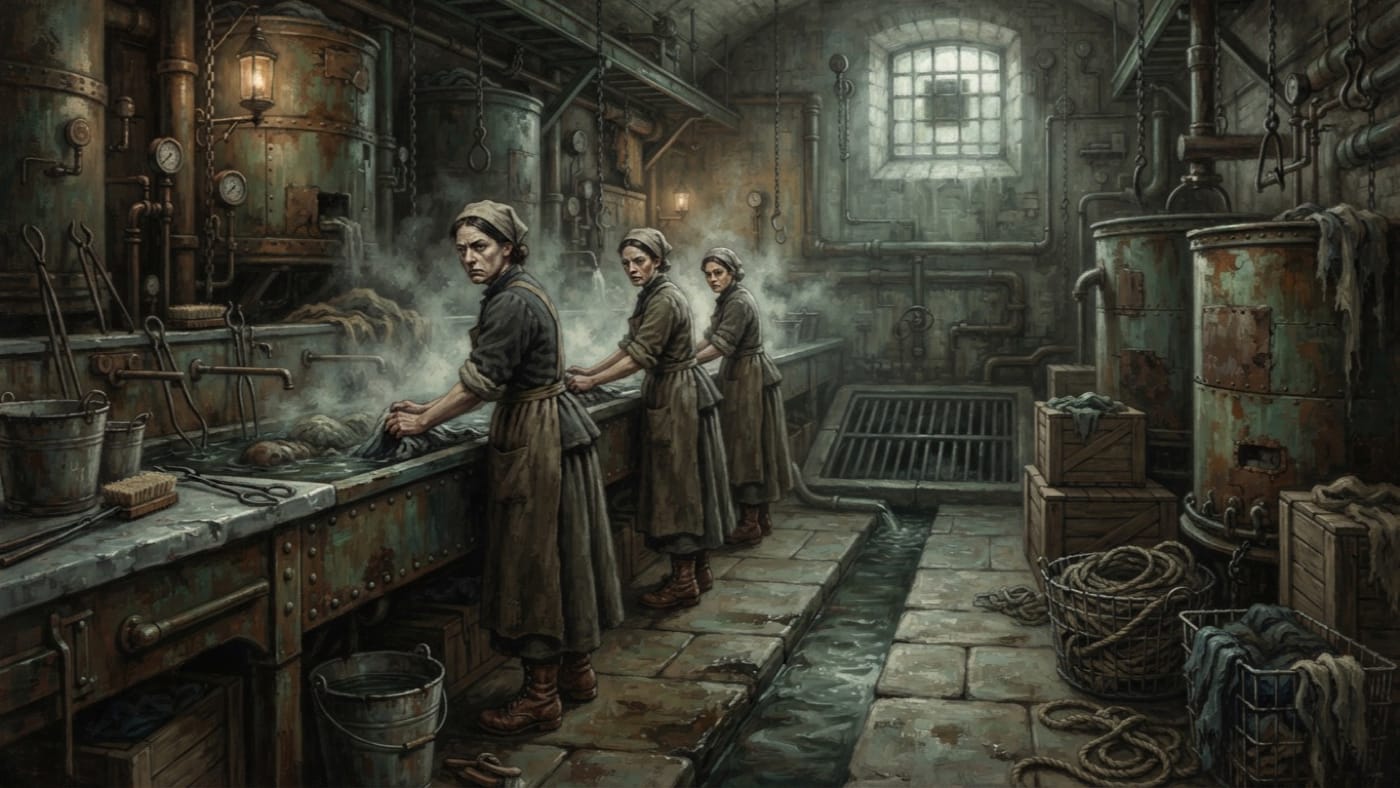
The Pens lie under the Net Quays, where the fishing boats, salvage crews and diver launches work. Into the Pens comes whatever the sea returns and Calais will not yet name: bodies from failed descents, objects from the sea caves, clothing, rope, and the living who came back from the Undertide in a condition the clerks prefer to watch before they classify. All of it must be washed at some point. Washing it is the Sisters' work. The wardens hold the hooks and the clerks hold the pens, but the Sisters hold the water.
#On the Warrens Lineage
The Brine Sisters are a hereditary work-guild of women from the Chalk Warrens. Visiting pilgrims say otherwise. Pilgrims arrive at Calais wanting the Sisters to be a mystery order with a vow and a relic and a tidy sacred origin, and they go away disappointed or else invent one. The record shows a trade. It says nothing of a cloister.
The Warrens are the worker city cut into the cliff below the Chalk Redoubt. They began as quarry cuts and were enlarged into housing, and they smell of damp wool and lime dust. The Sisters come out of those tunnels, and my Pens account traces their work back through three generations: grandmothers who washed the quarry dead, mothers who washed nets, daughters whose current contracts send them to wash what comes up from the Pens.
That is a descent of trade, and I set it down as one. It shows that the work passes downward through the women of the Warrens. It does not show when the Compact was formed or under what charter it was formed, if it had one. Nor does it show that every Sister is kin to every other, how a girl is admitted, who presides, or how many of them there are. The Bureau would like to have these things. The Bureau may go on wanting.
The sequence itself requires no help from me. The quarry killed men, and someone washed them. The sea fouled nets, and someone washed those too. Then the sea began returning things that were neither quarry dead nor fishing gear, and the same families sent their daughters down the stair with the same buckets. Calais did not train a new profession for the Pens. It hired the one it already had.
#On the Contract and the Fee
The Sisters work under contract. Of the terms, exactly one is known to me. The daughters' current contracts require them to wash what comes from the Pens without asking whether the thing was ever human.
I have read worse clauses in sealed treaties. I have read very few that were more exact. The clause prohibits a question. It does not supply the answer, and it does not oblige anyone else to supply it. A Sister washes, and the matter of what she washed remains with whatever office keeps such answers, if any office does.
I do not know the clause's age or the contract's duration. I do not know who signs for the Compact, who signs against it, what the penalty is for asking anyway, or which other clauses the contract contains. I state this plainly so that no later copyist mistakes my silence for a summary.
The caution above belongs to this survey and to no posted rule, since I have found no posted rule that says it. It needs saying because Calais is a city of tired clerks, and a tired clerk will treat clean as cleared. The Pens wash first because nothing can be examined properly under silt and brine. Clean flesh can still ring the bell over its slab. A clean boot can still leak seawater that was never in it. The Sisters remove the dirt and leave the doctrine where it lies.
Their fee is high. The record allows me that adjective and nothing more. I cannot give the amount, the payer, the schedule, the method of bargaining or the division among the women. The Pens take their own money through expedition fees, handling charges, witness deposits, urgency wax and the other honest-sounding names under which Calais collects what it is owed. The Sisters' fee is a separate thing and should be kept separate in any ledger that wishes to stay accurate. Lumping the washerwomen's price in with the Pens' handling charges is how an auditor learns the hard way that the two have different masters.
The Sisters' patron is unnamed. I say unnamed, and I do not say unknown to all men, since I cannot speak for all men. It does not appear in the notice, in my account or in any record I have seen. Chief Warden Mavet Rusk commands the annex, and nothing I have shows that he employs the Compact or protects it. Whoever stands behind the Sisters' fee stands out of sight. In Calais that is either very cheap or very expensive.
#On What the Hands Learn
The clerks of the Pens develop the Pens Hand: small letters, pressed down hard, no flourishes, as if each sentence had to be pinned before it crawled off. The Sisters do not. In my own account I recorded what they develop instead: shoulders, silence, and a way of laughing with the mouth closed.
The shoulders come from the work. The silence suits the cellars, where noise is rationed. The laugh I cannot explain and will not try.
What they know comes in by the hands. I record these as my observations of what the Sisters can read, and I claim no theory of how they read it:
They know which bodies were loved, from how the clothing was mended. A mother's darn is unlike a quartermaster's patch, and a wife's patch is unlike either. Pens clothing comes down wet, torn and salt-stiff, and a woman who has washed nets all her life sees each repair as a signature.
They know which of the divers expected to die, from what was tucked inside the suit. Men who go under the chalk take small private things down with them. Some of those things are carried for luck. Others are carried for the people who will open the suit afterward.
They know which officials fear the Pens, because fear smells different on wool. The Warrens are a district of damp wool, and the Sisters were raised in that smell. An inspector comes down the stair in a good coat and believes his face is under command. His collar reports him anyway.
All this adds up to gossip, and the gossip is guarded. My Pens account says it is better protected than the Gunline Choir master chart, which the Calais account lists among the few things in that city never offered for sale. The comparison measures how securely the gossip is kept. It does not mean the Compact and the Choir share a custody, a vault or a habit. I wrote that sentence and I stand behind its size. Its mechanism I cannot supply. The record does not show a Compact intelligence office, a blackmail register, an oath, a cipher, or any protection beyond the plain one: the women do not say.
The Bureau has tried twice to audit their wash logs. Both auditors came out clean, pale and unwilling to continue. That is my report, and its whole content. I do not know what year either attempt was made in, who sent the auditors, what they saw, or why they stopped. I make no accusation against the Sisters, and I do not suggest a curse, a threat or a trick of the cellars. Two men went down to count, came up washed, and did not go back. Readers who want a cause may supply their own, at their own risk and under their own seal.
I once wrote that I would promote the Sisters if promotion did not require paperwork, and that paperwork would only make them easier to damage. I see no reason to amend it. A woman who knows from a darned cuff that a dead man was loved is carrying the most useful and least filed knowledge in the annex. Putting her in a column would put her within reach.
#On Present Conditions
At the date of this survey the Pens are active, under Amber, and overfull. Two Body Rooms share bell observers. Object trays are stacked against the spacing rules. During convoy weeks the Living Rooms turn over faster than is safe. More intake means more washing, and the wash-water runs down sloped floors into sealed cisterns because nothing from the Pens is permitted to reach the harbour directly. The Sisters work wherever those runnels begin.
In A.S. 201 several parties have made demands of the Pens. The diver-captain wants more discretion over recovery. The Salt Tribunal wants evidence released sooner. The Script Wall readers want transfers stopped during fog. Doctrine wants clearer reports. The Brine Sisters have demanded gloves that do not split.
Theirs is the smallest of the demands and the easiest to understand. It is also the only one that concerns the protection of a body still alive. I have no record of whether the gloves were supplied, who would pay for them, or whether the request has gone the way of the Lower Pens' iron, from office to office and back again.
The notice still reads Wash authority: Brine Sisters Compact. The patron is still unnamed. The fee is still high, and the clause still forbids the question. Down at the cisterns, the daughters of the Warrens go on washing what the sea sends back. They wash it thoroughly, and they do not ask.