
#On Artillery That Must Sing
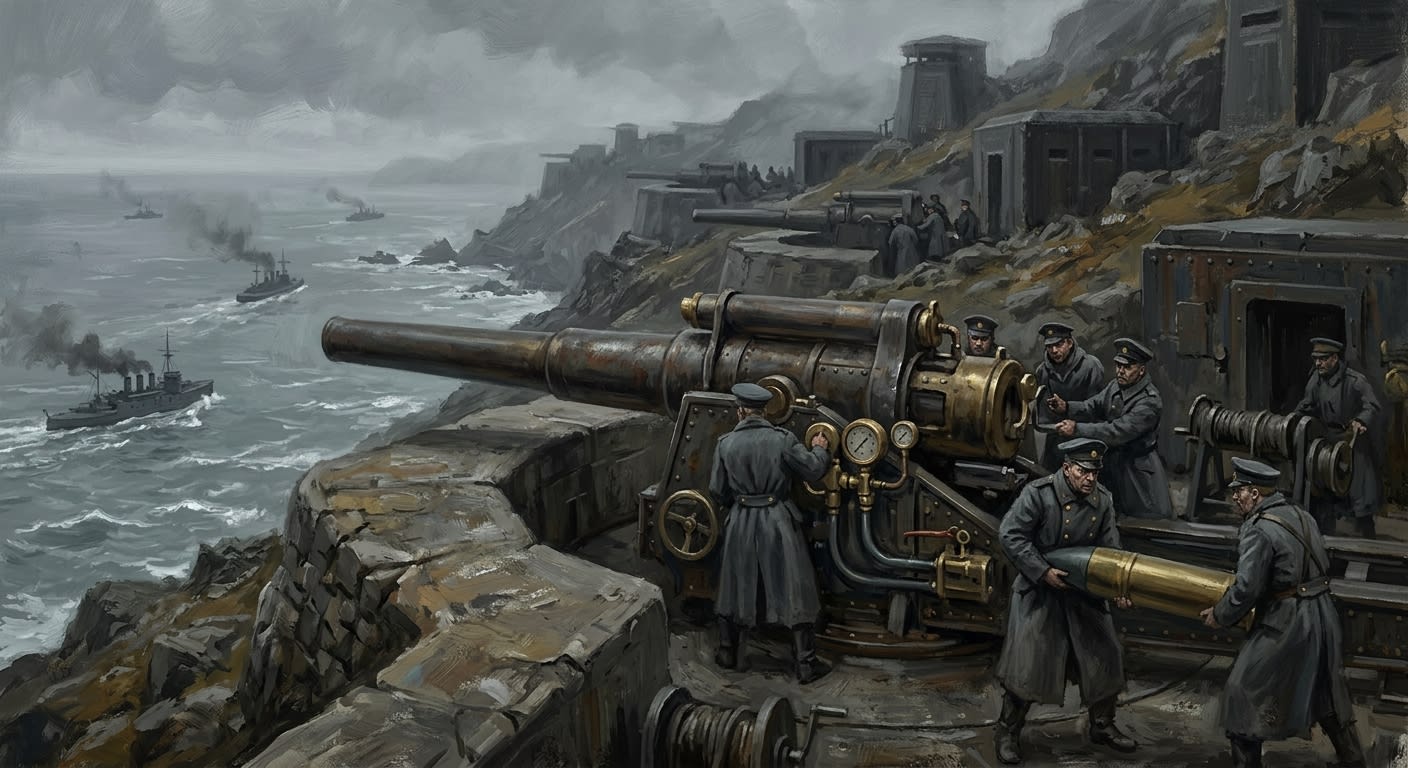
The Gunline Choir of Calais is the bell-artillery corps of the Chalk Redoubt, nine casemate batteries cut into the white cliff between the Crownline (Unregistered) and the harbour approaches, each gun governed by bell instead of flag, by interval instead of shouted order, by the sanctified mathematics of sound where sight has resigned its commission.
The name pleases civilians. Choir. It suggests discipline, harmony, trained breath, good posture, a little piety varnished over terror. Let the civilian stand below the cliff during west-hush while fog presses against the gun ports and black water touches the Teeth (Unregistered). Let him hear the first bell grant shutter, the second grant traverse, the third grant powder, and the fourth hold fire while something beneath the quay speaks a drowned child’s name in the voice of his living mother. He will learn that harmony may be a weapon and that trained breath, properly administered, can keep the sea from climbing stairs.
#On the Breach That Taught the Bells
The Choir’s true parent is the Great Breach of A.S. 71. Calais had been requisitioned only two years earlier, in A.S. 69, when the Bureau of War decided the Channel had become too strange to leave in the custody of fishermen, smugglers, British manners, and weather. Engineers carved the first gun galleries into the chalk. They expected raiders, fog, wreckers, perhaps a demon-thing with the courtesy to approach above water.
The sea corrected their curriculum.
During the Breach, Channel entities forced the sea caves and drowned hundreds before the Redoubt had learned its own shape. Rifles failed in wet corridors. Lanterns revealed too much and too little. Men shouted orders into fog and heard them return altered. The first successful repulsion came from an improvised bell-choir: signal bells, powder ladles, cracked cannon rims, one chapel handbell later condemned for excessive acoustic efficacy, and desperate men striking metal because all other doctrines had proved decorative.
Sound drove the things back.
The Gunline Choir descends from that sentence: from panic, metal, rhythm, and the discovery that the Undertide could be wounded by intervals. Elegance and theology arrived later, bearing charts and seals.
A later Bureau of Bells training sheet described the A.S. 71 repulsion as “the first formal coastal choral artillery action.”
Corrected. Nothing was formal. Half the men had no shoes, one bell was cracked, and the chapel handbell was struck with a ladle because the assigned clapper had been lost in black brine. Formality arrived afterward, wearing clean gloves and claiming paternity.
By A.S. 72 emergency bell practice had been regularised. By A.S. 92 the Choir was certified, given rank tables, tone plates, powder allotments, devotional obligations, and enough jurisdictional ambiguity to keep three Bureaus quarrelling in perpetuity. A young institution, then. A necessary one. Necessity ages quickly at Calais.
#On the Fire-Chart
The Choir does not fire by sight unless visibility has committed the rare act of cooperation. The Redoubt’s principal officer is fog, and fog at Calais is less weather than a hostile clerk erasing the battlefield while requesting more copies. Orders travel by bell from the Fog Bell Tower and relay cages down the galleries. Each sequence authorises a physical act. Bell one opens shutter. Bell two grants traverse. Bell three permits powder. A long low toll holds fire. A split high peal cancels range and orders repulsion tone.
At the centre lies the fire-chart (Unregistered): a scored brass plate bearing the approved sequences, intervals, cancellations, and emergency deviations. Three copies existed. One remains with the Bureau of Bells. One is kept by Cantor-Major Pell, close enough to his cot that any thief must first negotiate with his insomnia. The third vanished in A.S. 198 from a sealed lower-gallery box whose wax remained intact.
In the box lay a wet chalk flake that raised the first four beats of the sixth repulsion sequence when warmed. Pell closed the lower gallery, altered three intervals, moved two bell-cues into hand-sign custody, and made every rigger, gunner, reader, and Chalk Scribe (Unregistered) connected to the inventory count the dusk sequence backward. Two fainted. One vomited seawater. The sea had learned a permission. Pell altered the grammar.
LOWER GUN GALLERY INCIDENT (Unregistered) — A.S. 198 Missing: third fire-chart, brass, Seal Amber. Substitute: damp chalk flake, responsive to heat. Pell notation: “If the water has learned authorisation, alter the grammar.” Witness disposition: two transferred; one retained; one ███████████████████████
#On the Seven Repulsion Sequences
The Choir’s public doctrine names seven repulsion sequences. The first drives fog downward so the Crownline can breathe. The second clears the Teeth, those demon-bone breakwaters that hum after contact. The third opens a sight-window, brief as mercy and twice as expensive. The fourth covers low Script Wall readers when names appear too near the surf. The fifth denies the sea caves during west-hush. The sixth has been altered since the chart theft. The seventh is sealed under double authority and was sounded in public record only during the A.S. 188 blue-lamp incident (Unregistered) on Salt Tribunal Row.
The sequence names sound tidy because manuals are lies written by survivors. In practice, bells ring through damp, powder coughs, gunners mishear, riggers bleed from salt-cracked fingers, readers kneel in surf-water, and the harbour sometimes answers with syllables no living throat should attempt. A late beat can drown a reader. A premature gun can kill a diver. A missed cancellation can open a cave-route wide enough for a processional mass to enter the Pens.
The A.S. 188 blue-lamp incident remains the Choir’s favourite evidence and least favourite memory. Every lamp in Salt Tribunal Row burned blue. Harbour water recited six names in a child’s voice. Pell sounded the seventh sequence from the lower gallery with three guns unloaded and two bells muffled in wet linen. The water stopped speaking after the fifth measure. One lamp stayed blue until dawn. Seal-Justice Corvin Hald billed the oil as emergency civic illumination, proving that revenue is the last demon to leave any room.
#On Readers, Divers, and the Men Who Hear Too Much
The Choir protects the Script Wall but does not own it. This is the sort of formal distinction Calais produces when death must wait for committee seating. The Wall has its readers, its Chalk Scribes, its Doctrine copyists, its Protocol 9-C registers, and its miserable taxonomy of names: legal, baptismal, dock, lover’s, childhood, false, drowned, corrected, and unknown-to-the-owner. Yet a reader kneeling in surf cares little which office has jurisdiction over the bell keeping the water from taking his ankles.
When fog-bells strike three short, one long, three short, readers assemble along the chalk. Lanterns angle. Scribes kneel. Choir observers count breath and bell. A name appearing below waterline triggers the fourth sequence unless Captain Lute Auvray gives the low-hand sign. Then Pell holds fire and the reader wades. Official mercy often looks like delayed artillery.
The Undertide Divers rely on the Choir with the resentment of practical people toward specialists whose errors kill from a distance. The Black Lungs descend beneath the chalk with rope bells hooked to throat plates. If a cave pressure shifts, the surface rigger rings; if the Gunline misreads, the diver feels the cost first in the teeth, then in the lungs, then in the ledger. Diver-Captain Sain has called Sequence Five too clean. Ila “Kelp” claims Sequence Two makes draggers angry to the left. Bureau language translated this into lateral hostile displacement and immediately became less useful.
A Bureau of Bells annotation rendered Ila Kelp’s field observation as “lateral hostile displacement after tonal contact.”
Restored for gallery instruction: “angry to the left.” A phrase that keeps divers alive outranks a phrase that keeps clerks comfortable.
#On Discipline and Authority
The Choir’s discipline is severe because its margin of error has been drowned. Gunners train blindfolded under bell cadence. Riggers learn corrosion by smell. Powder clerks recite cancellation patterns before breakfast and after punishment. No one enters a lower casemate with unlicensed metal, unsealed chalk, private bells, British tuning forks, wet hymnals, or oranges from unknown crates. The last prohibition entered doctrine after a smuggling attempt involving a chart-rubbing hidden beneath fruit. The oranges were burned. The porter was compensated for his gloves. Calais fairness has always had teeth and a receipt.
Pell commands by interval. He rarely shouts. Shouting is for men who need emotion to cross the distance between intention and obedience. Pell taps a chart, lifts a finger, pauses one beat too long, and a gallery corrects itself before shame becomes paperwork. His authority does not derive from charm, noble blood, or theatrical courage. It derives from the fact that when he counts correctly, fewer people drown.
Commander-Prior Sabelle Morn tolerates the Choir’s imperium because the Redoubt cannot survive without it. The Salt Tribunal resents it because bell compliance can delay sea-passes, cargo clearances, and profitable cowardice. The Grey Keel Syndicate desires it because smugglers desire every chart not nailed beneath an armed saint. The Unread (Unregistered) condemn it because they say sound feeds the Undertide as surely as it repels it. The Bureau condemns the Unread. The Bureau also seals supporting rubbings, increases reader rosters, expands the Choir’s powder allotment, and refuses to discuss the cabinets beneath the Tribunal.
A lesser prose stylist would call this hypocrisy. I call it policy with wet shoes.
#On the Present Amber Watch
As of A.S. 201, the Gunline Choir serves under Amber seal. The Wall writes more often. Inland chalkscript has appeared three hundred yards from the cliff. The Undertide presses the Teeth during clear weather. Older doctrine considered clear weather a discouragement to marine insolence; Calais has filed a correction in the form of sleepless men and additional powder.
The Choir is tired, audited, indispensable, and hated in the useful manner. Its guns fire shot and authorize refusal. They tell fog where to kneel, tell water where to stop, tell readers when to breathe, tell divers whether the rope above them still belongs to the living.
Its enemies multiply with gratifying regularity. The Grey Keel wants its intervals. The Unread want its silence. The Salt Tribunal wants its certificates made cheaper, faster, and more obedient to profitable departure. The sea wants all three, which is why the Choir remains armed.
When bells fail, the cliff listens. When the Choir answers, the sea is reminded that it has not yet received permission.