
#On the Rooms Where the Sea Is Made to Wait
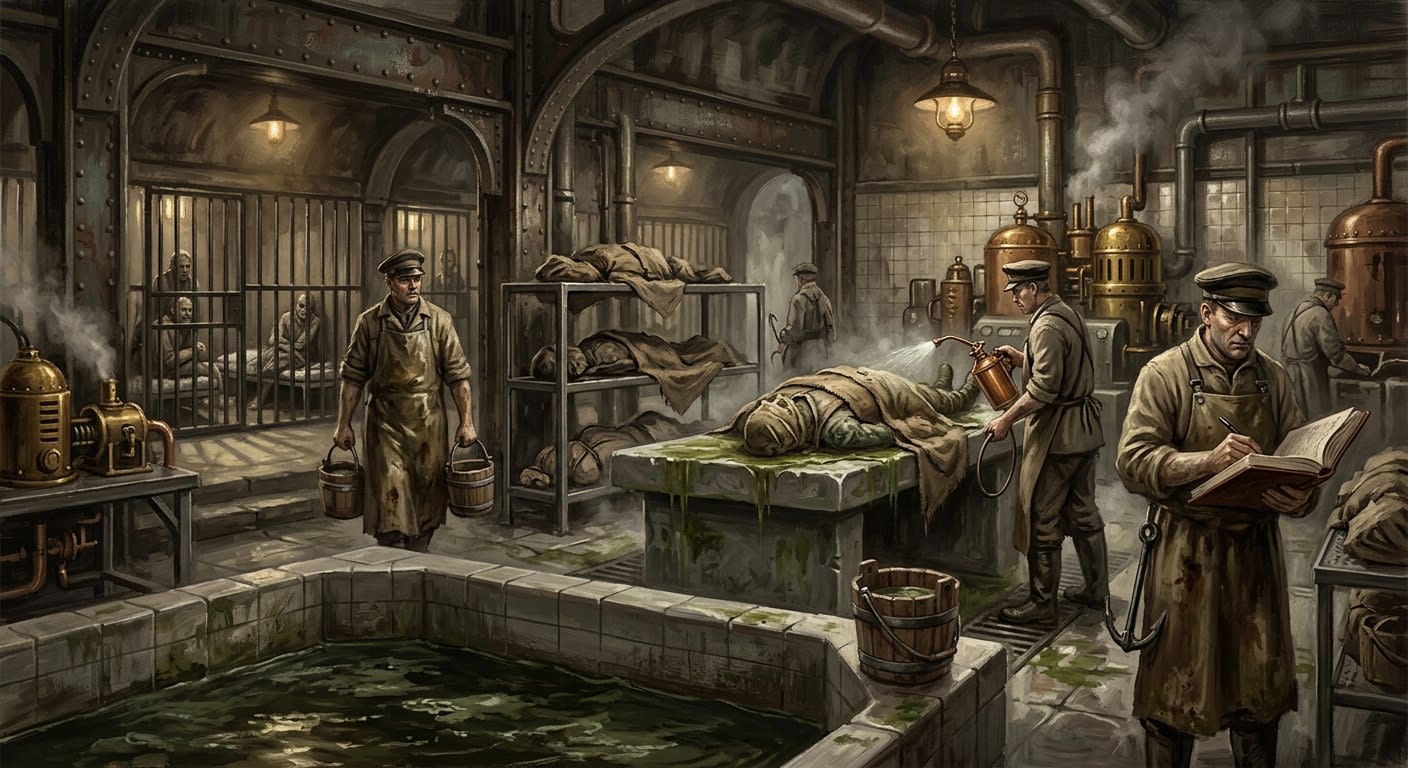
The Undertide Pens lie under the Net Quays (Unregistered) of Calais, below tribunal pavement, below fish scales, below the stair where widows sell salted lamp-wicks to men who intend to return and often do not. The official plan marks them as Quarantine and Recovery Chambers, Coastal Annex 71-P. The garrison calls them the Pens because garrison speech is honest when no inspector is listening. A pen holds the living before slaughter, the dangerous before examination, the useful before classification. Calais found the right word by accident, which is how Calais finds most truth.
They are not prisons in the civic sense. Prisoners have charges, names, trials, grudges, meals, and the consoling vanity of believing the state has noticed them personally. The Pens hold bodies from failed dives, recovered objects from the sea caves, ropes that rang without hands, lamps that burned underwater, nets that caught voices, chalk fragments that continued writing after removal, and those partial things the Black Lungs drag up when the Undertide returns a man by instalments. They also hold the living when the living have come back too wet in the soul.
The smell is famous. Antiseptic brine, hot lime, fish-rot, vinegar, lamp smoke, chalk dust, wet rope, old panic, and that under-salt sweetness which tells a trained nose that something dead has not yet finished negotiating with its body. The air sweats on the walls. The floors slope toward runnels that carry wash-water into sealed cisterns. Nothing drains directly to the harbour after A.S. 103, when a bucket of Pens water was poured into the quay gutter and four gulls learned to speak the names of condemned smugglers. The gulls were shot. The gutter was re-laid. The bucket was promoted to evidence.
The Pens exist because the sea beneath Calais does not kill cleanly. A clean death is a clerk's friend. One body, one token, one cause, one burial order, one widow's table. The Undertide mocks such economy. It returns bodies with extra memories, objects with borrowed names, living witnesses whose teeth ring at bell-cadence, and corpses that appear on the Script Wall three nights after autopsy. The Pens give these refusals a place to wait while the Bureau decides which lie will survive audit.
#On the Founding After the Great Breach
The Pens began as barrels.
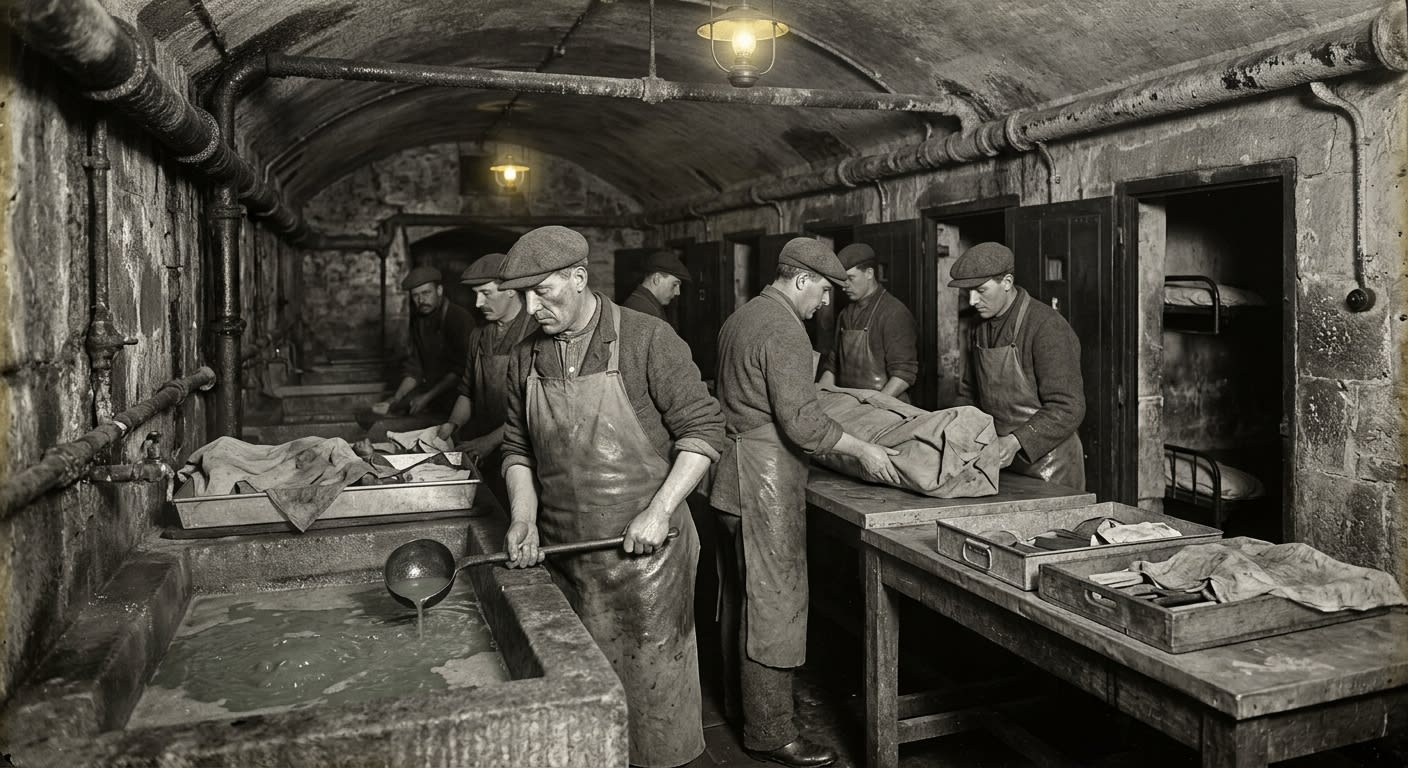
After the Great Breach of A.S. 71 (Unregistered), when Channel entities forced the sea caves below the Chalk Redoubt and drowned hundreds before an improvised bell-choir drove them back, the quay filled with recovered things. Bodies came first, as bodies rudely do. Then clothing. Then tools. Then lanterns still lit with black water inside the glass. Then hands unattached to arms. Then ropes tied in knots no sailor recognised but every grieving wife did. Then small wet stones that bore fingerprints from men who had never touched them.
The first recovery crews had no procedure. They had barrels of lime, salt sacks, canvas, rope, and fear. They sorted on the Net Quays under lanterns while the fog pressed against the cliff and the new Script Wall wrote names until readers went hoarse. Anything clearly dead went to burial holding. Anything clearly alive went to the infirmary. Everything else went into barrels marked with chalk crosses and weighted lids.
The distinction failed by dawn.
One barrel knocked from within. One began leaking seawater although it contained only a diver's boots. One produced a choir note when moved. One contained a drowned watchman's head and, by morning, two heads, both claiming the same teeth. Commander-Prior Sabelle Morn's predecessor ordered the barrels carried into the old net-drying cellars beneath Salt Tribunal Row. A clerk scratched temporary holding onto the lintel. The lintel still bears the words, freshened each decade, because every permanent Synodal institution begins with a temporary notice nobody has courage to remove.
A later Coastal Chapterhouse commemorative plate states that the Undertide Pens were “designed in advance as a rational quarantine improvement.”
Corrected. They were designed by panic, lime barrels, insufficient sleep, and a sergeant with the wit to lock a cellar door before the thing inside learned the handle. Architecture came afterward, as architecture so often does, carrying a measuring cord and claiming parentage.
By A.S. 74, as the Teeth breakwaters rose from iron, chalk-lime, and calcified Undertide remains, the cellars had become an annex. By A.S. 84, when the Salt Tribunal was ratified and sea-pass law tightened its little fist, every object entering the Pens required a tide-file number. By A.S. 92, after Gunline Choir certification, bell response chambers were added. By A.S. 103, after the gutter incident and the speaking gulls, drainage was sealed under red wax. By A.S. 187, after the Unread Uprising (Unregistered), a Silent Corridor was cut between the Pens and the Script Wall so names could be transferred without speech.
A.S. 201 finds the Pens expanded through six levels of old chalk cellars, quarried service tunnels, brick quarantine rooms, iron holding cages, wash chambers, observation slots, and one flooded gallery nobody admits to using and everyone schedules around.
#On Their Architecture and Divisions
The Pens are entered through three doors. The public door is a false mercy: a clean tribunal arch on Salt Row with a desk, a posted schedule, and a clerk whose duty is to tell relatives there is no visitation. The working door stands behind the Net Quays, wide enough for stretchers and low enough to make every officer bow. The third door opens from the Silent Steps near the Script Wall and is used when a name, object, or witness must pass between chalk and quarantine without touching the ordinary city. It is called the Reader's Wicket. It has no handle on the Pens side.
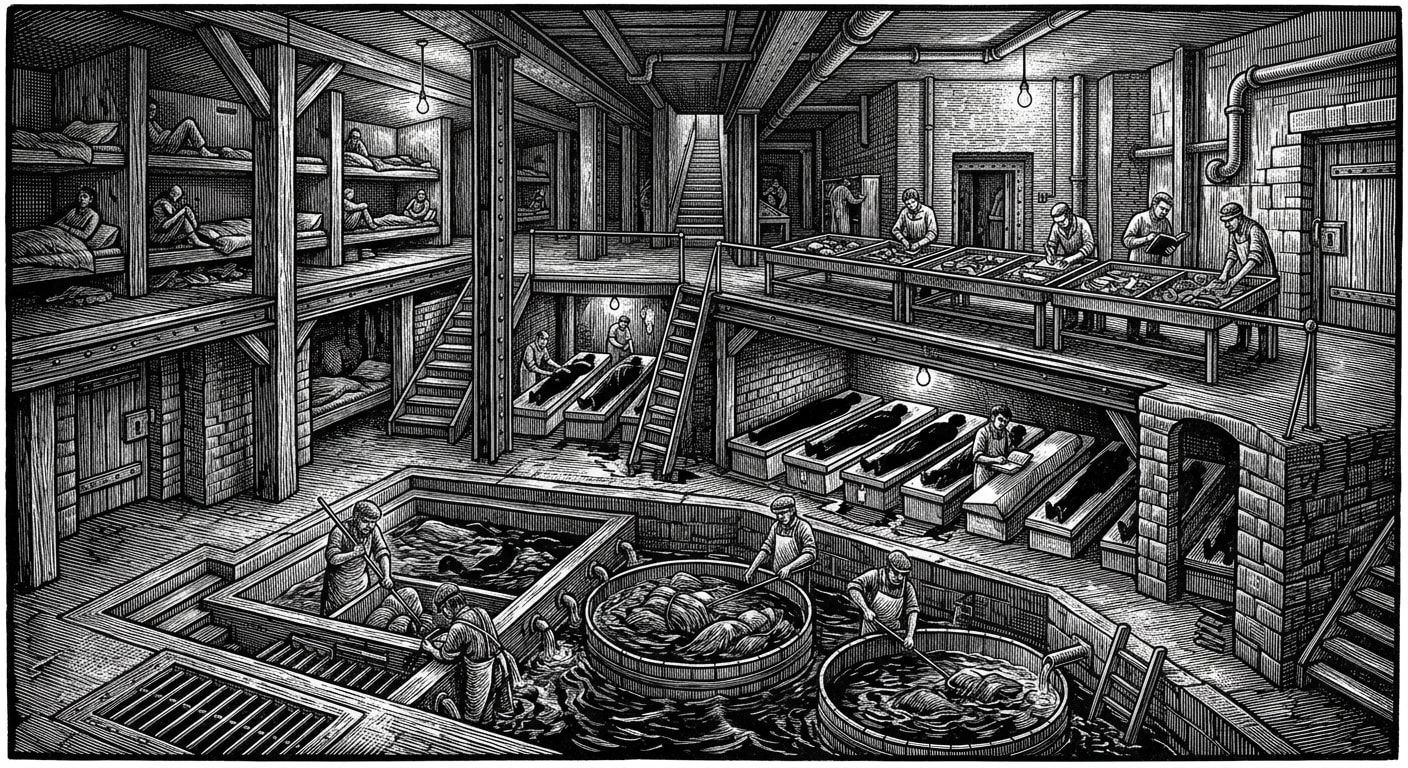
Below the doors, the first level is the Salt Vestibule. Every intake is stripped, rinsed, named, weighed, and assigned a wetness grade. Dry, damp, soaked, brined, internal, speaking. The last grade was added in A.S. 116 after a salvaged cannon shoe began reciting tide tables from Dover in a child's voice. The vestibule walls are scored with height marks from old flood events. The highest is dated A.S. 188, Roster 14-F, when a partially sunk name at the Script Wall coincided with a west-hush and the Pens took on three feet of water from behind sealed stone.
The second level contains the Body Rooms. Slabs of chalk-lime, iron drains, chain racks, pulley hooks, and small bell-cages mounted above each table. A body from the Undertide is never left without a bell. If the flesh moves, the bell rings. If the bell rings without movement, the observers leave and report to Doctrine. If the bell hums, Bells is summoned. If the bell sings, the room is sealed and the night roster is revised downward because optimism wastes personnel.
The third level is for objects. Nets, oars, chalk pieces, diver knives, lanterns, boots, rope bells, pass tokens, coin, hair, teeth, and the little private things that men carry underwater because courage likes company: saint cards, lover's ribbons, children's buttons, scraps of bread wrapped in wax. Each item rests in a brine tray with a slate number. Brine prevents certain changes. It encourages others. The wardens accept this because no liquid in Calais has ever been fully trustworthy, and brine at least can be invoiced.
The fourth level is for the living. Seven rooms, each with a grated drain, three observation slits, a bell hook, a chalk board, and a cot bolted to wall rings. Returned divers spend their first night there if they breathed strange water, forgot a legal name, heard a bell beneath the sea, laughed during debrief, or answered to a name the Script Wall had not yet written. Most leave after three days. Some leave after nine. Some are transferred to inland offices under sealed escort. Some remain long enough that the cot bolts acquire personal history.
The fifth level, the Chain Ward, holds things requiring iron. The sixth, the Lower Pens, holds things requiring silence. The flooded gallery lies below both. Its official designation is Disused Tide Sump. No sane person believes this, which has never impeded official use.
#On Intake, Naming, and Refusal
The Pens begin with naming because Calais begins and ends with names. An intake without a name is hazard. A name without intake is accusation. A body with two names is a quarrel between Bureaus. A body with no name and a working mouth is a promotion opportunity for whichever fool touches it first.
The intake clerk reads the legal name from the token, if a token exists. Then the dock name, if known. Then the name spoken by the recovery crew. Then any name present on the Script Wall within seven nights before or after recovery. All four are entered on Form 71-P/Black. Agreement is rare enough to make clerks superstitious. Disagreement produces a Name Quarantine slip and a copy to the Salt Tribunal. If the recovered person objects to a name, the objection is recorded after restraint.
The great question is whether the sea may return property. A corpse is property of Records, family, parish, and grave in that order, although each office lies about its rank. A living diver is property of his or her own legal standing, unless contaminated, indebted, impressed, suspected, or useful. An object belongs to the owner, the finder, the Tribunal, the Chapterhouse, War, Doctrine, or the sea, depending on which signature arrives first and whether the object has begun to whisper.
The Pens have cultivated refusal as an art. Families request bodies; the Pens refuse because the face has altered. Widows request tokens; the Pens refuse because the token returned warm. Divers request knives; the Pens refuse because the knives know the cave route. The Salt Tribunal requests evidence for passage cases; the Pens refuse until the fee is paid, then refuse again under quarantine clause. Purity requests everything loudly. The Pens send copies and lock the original room.
This makes the Pens hated. Hatred is a sign of correct function. A popular quarantine is either theatrical or breached.
The Pens also receive voluntary submissions, which are the worst kind. A fisherman brings a net that caught his dead brother's voice. A mother brings a child's shoe found dry in the scupper while the child sleeps upstairs with salt in his eyelashes. A diver brings himself, sits on the intake bench, and says, “I came back with someone standing behind my name.” These cases require tact, and because Calais is short of tact, they receive procedure.
#On the Living Returned Too Wet
A returned diver may appear well. This is the first danger. The dead advertise themselves. The contaminated living smiles, complains about cold, asks for broth, remembers jokes, and signs the debrief ledger in a hand close enough to pass a tired clerk. Calais has learned to distrust wellness after descent. Wellness is a borrowed coat. Check the seams.
The first night in the Living Rooms is sleepless by design. The subject is kept under lamp, watched through slits, and required to answer name-calls at each bell. Legal name. Dock name. Mother's name. Captain's name. Rope rigger's name. Last debt. Last sin confessed. Last thing seen. The answers are compared. Diver-Captain Sain has argued that this practice damages personnel. Records replied that personnel returning from the Undertide are already damaged and that documentation merely permits the damage to become legible. Both were correct. This is why the argument remains productive.
Common signs of Undertide retention include delayed blinking, water in the left ear after drying, teeth ringing at wrong bells, dreams spoken in another diver's voice, inability to say “east,” appetite for chalk, refusal to look at rope, sudden literacy in Channel weather, and the belief that the sea under Calais has a ceiling. Severe signs include answering before called, naming people not yet written, coughing up black brine, drawing tunnel maps on skin, and asking why the room is upside down.
LIVING ROOM FOUR — A.S. 199 Subject: Diver █████ “Kelp-line second crew,” recovered after rope slack event. Initial status: ambulatory, coherent, joking. Third bell: answered to legal name. Fourth bell: answered to dock name. Fifth bell: answered to name not issued until A.S. 201 winter replacement roster. Sixth bell: room flooded from ceiling inward. Recovery: cot bolts, one bell clapper, subject's hair braided with eelgrass. Public disposition: transfer.
The Pens do not cure. The word cure belongs to physicians, mothers, and other optimists. The Pens separate, watch, dry, test, salt, question, and decide whether a person may be returned to the quay with warnings, sent inland under seal, retained for study, assigned to restricted dive duty, or filed as a living absence. The last category troubles philosophers. Philosophers are invited to volunteer for observation. Few accept. Philosophy, like most trades, becomes cautious near drains.
Bureau of Medicine correspondence A.S. 177 proposed renaming the Living Rooms “Maritime Recovery Wards.”
Rejected. A ward implies healing, pillows, and professional lies delivered with clean hands. The rooms are Pens. The Bureau of Doctrine congratulates Medicine for its vocabulary and declines to let vocabulary unlock the doors.
#On Objects That Continue Their Work
Objects from the Undertide are more patient than bodies. Bodies rot, scream, dry, or become political. Objects wait. A diver's lamp may sit inert for months before igniting at low tide. A rope may stiffen toward the Script Wall whenever a particular family passes. A knife may remain clean until dipped in ordinary harbour water, then bleed salt for an hour. A chalk shard may show blank for every inspector and write obscenities for the junior copyist, which proves either demonic cunning or excellent taste.
The Object Rooms maintain the three-day, nine-day, and forty-one-day watches. Three days for physical reaction. Nine for name correlation. Forty-one for bell response. If an object remains quiet through all three, it may be released, destroyed, archived, or stolen by an office with enough rank. Few remain quiet. Calais objects are talkative in the way guilty men are silent; they arrange absence until someone less tired notices.
One famous brine tray, 22-C, holds the first recovered rope bell from A.S. 71. It is green with age, cracked along the lip, and mute unless lowered near the Reader's Wicket during fog. Then it sounds once for every name the Wall will write before the Wall writes it. The Bureau of Bells requested custody. The Pens refused. Bells requested access. The Pens offered supervised listening from behind glass. Bells called this insulting. The Pens agreed and kept the bell.
Other objects have generated lesser scandals. The school slate that wrote tide heights in bloodless red. The child's button that reappeared in six different trays after destruction. The oar blade covered in tiny teeth, each tooth bearing the owner's initials. The lantern whose flame leaned toward any man who had lied in a sea-pass confession. The Tribunal coveted that lantern with embarrassing hunger. The Pens extinguished it under a bell jar and recorded the Tribunal's interest as evidence of moral climate.
Objects teach the chief law of the Pens: nothing recovered is finished. A body may continue as testimony. A token may continue as accusation. A rope may continue as route. A bell may continue as ear. The sea sends things back because returned things keep working on land.
#On the Wardens, Clerks, and Brine Sisters (Unregistered)
The Pens are staffed by people who have either angered the wrong superior or pleased the right one too well. Chief Warden Mavet Rusk (Unregistered) commands the annex as of A.S. 201, a dry little man with scarred wrists, perfect cuffs, and the expression of a schoolmaster hired by drowning. He speaks softly because noise is rationed below the Net Quays. His predecessor shouted. His predecessor is sealed in Tray 41-D, though officially the tray contains a “command whistle of adverse acoustic disposition.”
Rusk's wardens wear grey oilcloth aprons, chalk-white gloves, and throat bells that must be removed before entering the Lower Pens. They carry hook poles, salt knives, lime packets, wax plugs, and refusal tablets for families at the public door. They learn early that pity is permitted only after the lock turns. Before the lock, pity is a breach vector.
The Brine Sisters handle washing. They are a hereditary work-guild of women from the Chalk Warrens, no matter what visiting pilgrims insist: mothers who washed nets, grandmothers who washed quarry dead, daughters whose current contracts require them to wash what comes from the Pens without asking whether the thing was ever human. Their patron is unnamed. Their fee is high. Their gossip is better protected than the Gunline Choir master chart.
The clerks suffer most visibly. They sit behind glass and copy wet facts into dry columns. Their ink contains extra salt. Their blotting paper is burned nightly. They are forbidden to whistle, hum, sleep at desk, write private letters, or look up if someone in a Holding Room uses their childhood name. After six months, clerks develop the Pens Hand: small letters, downward pressure, no flourishes, as if every sentence were being pinned before it crawled away.
The Brine Sisters do not develop the Pens Hand. They develop shoulders, silence, and a way of laughing with their mouths closed. They know which bodies were loved by how the clothing was mended. They know which divers expected death by what was tucked inside the suit. They know which officials fear the Pens because fear smells different on wool. The Bureau has attempted to audit their wash logs twice. Both auditors emerged clean, pale, and unwilling to continue. I would promote the Sisters, except promotion would require paperwork, and paperwork would only make them easier to damage.
#On the Salt Tribunal and the Trade in Return
The Salt Tribunal pretend to supervise the Pens. The Pens pretend to accept supervision. Between these fictions, Calais functions.
Seal-Justice Corvin Hald wants evidence, advantage, and sea-pass discipline. The Pens want doors locked and contagion contained. Hald's clerks arrive with writs demanding objects tied to passage disputes: a captain's token, a false-bottom crate, a salvaged oar from an unlicensed skiff, a name-slate from a fog reading that might void a cargo claim. Rusk reads the writ, notes the missing quarantine countersign, and returns it damp. This has continued for years. It is one of the few stable relationships in Calais.
The true commerce is return. Families pay for bodies released early. Guilds pay for tools cleared of contamination. Ship captains pay for cargo delisting. Divers pay for knives because a knife that has gone down with you and returned knows your grip. The Pens officially accepts no bribes. It accepts expedition fees, handling charges, witness deposits, urgency wax, mourning access stamps, and donations of lime. Moralists may call these bribes if they enjoy being correct and useless.
Smugglers covet the Pens for another reason: names. A name placed in quarantine can disappear from public process for days. A sea-pass investigation can stall while a token is tested. A witness can become unavailable because the witness is “drying.” Skiff-Sister Lune's Grey Keel extensions learned this faster than the Tribunal did. Several absences between A.S. 196 and A.S. 200 smell of Pens procedure used as cloak. Rusk denies involvement. His denial is crisp, plausible, and filed for that reason in the drawer reserved for handsome lies.
The Undertide also trades in return. It gives back enough to keep Calais descending. A body, a map, a clue, a name saved by reading, a child recovered from a cave pocket breathing through kelp. Hope is the sea's cleverest hook. The Pens stores hope with the same tongs used for teeth.
#On Present Conditions
As of A.S. 201, the Undertide Pens remain active under Amber operational status. Intake has risen since inland chalkscript manifestations were confirmed in A.S. 199 and since Channel escort dependence tightened after the Lantern Way accommodations with Britain. More ships means more passes. More passes means more lies. More lies mean the sea has more handles.
The Pens are overfull. Body Rooms Two and Five share bell observers. Object trays have been stacked in violation of Annex spacing rules. The Living Rooms rotate too quickly during convoy weeks. The Lower Pens have requested new iron. The request passed from the Chapterhouse to War, from War to Tithes, from Tithes to Engineering, and from Engineering back to the Chapterhouse with a note asking whether cheaper chalk-lime reinforcement might suffice. Rusk pinned the note above a crack that breathes at low tide.
Diver-Captain Sain has demanded more recovery discretion after three Black Lungs were retained in nine weeks. The Salt Tribunal has demanded quicker evidence release. The Script Wall readers have demanded that Pens transfers stop during active fog. The Brine Sisters have demanded gloves that do not split. Doctrine has demanded clearer reports. All demands are reasonable. This is why none can be satisfied without damaging another.
I inspected the Pens at second bell, which was unwise, and during an outgoing tide, which was worse. Rusk led me through the Salt Vestibule with a lantern that kept lowering its flame whenever we passed the west wall. In Body Room Three, a recovered diver lay under salt cloth while the bell above him turned gently though no air moved. In Object Room Two, a child's shoe sat in brine and tapped its heel against the tray in groups of three. In Living Room Six, a woman asked through the grate whether her brother had finished reading her name. She had no brother. Her name had not appeared. The clerk wrote both facts down and underlined neither.
At the Reader's Wicket, I heard the sea beneath the chalk. Not waves. Waves are vulgar. This was a slow handling of water by something patient enough to let us build doors. Rusk asked if I wished to continue downward. I declined, for theological reasons and because courage, like ink, should not be spilled without a form.
The Pens remain. The doors hold. The brine is changed on schedule. The bells hang ready above the slabs. Families queue at the public arch with tokens in their hands and terror in their teeth. Below them, the sea returns what it no longer needs, or what it needs more effectively on land.