
#On the Western Mouth
"The sea does not besiege — it remembers." — marginal inscription, Salt Tribunal annex, attribution refused
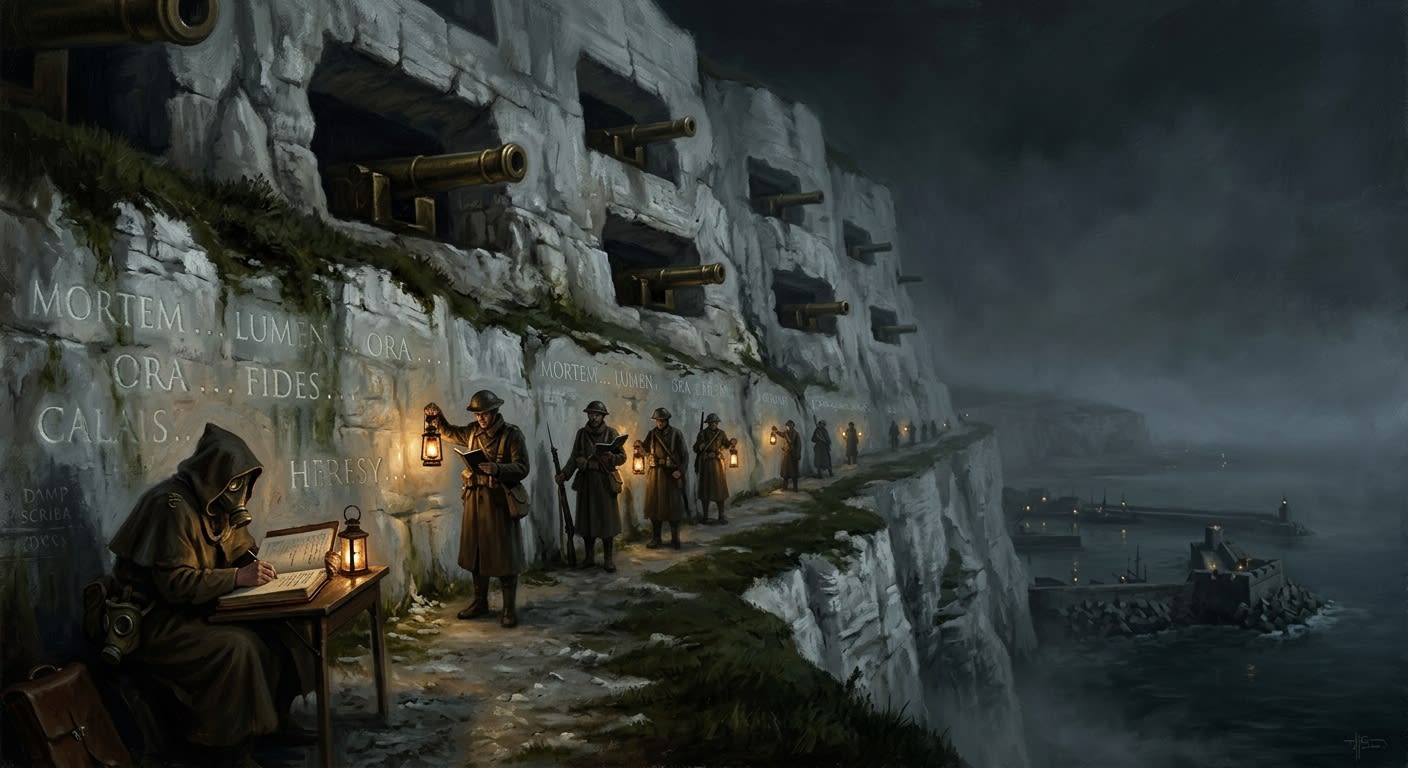
The Chalk Redoubt of Calais faces the wrong direction, and this is the first thing the Bureau would have you understand about it. Every fortification on the Sagittal Line stares east — toward the Sin-Generals, toward the wastes, toward the theological certainties that make garrison life bearable by giving it a compass heading. Calais stares west. Calais stares at the Channel. Calais stares at a body of water that, on certain nights when the fog rolls thick and the bell-gunners lose their pitch, ceases to behave like water at all.
The Synod built the Redoubt in A.S. 69, four years after the Line solidified across the continent's eastern spine. The reasoning was sound, which is rare enough in military architecture to warrant remark. The Line held Hell in the east. The coast remained open. Ships still sailed from English ports and Dutch harbours under flags the Synod could request but not command, and the Channel — that narrow, filthy, magnificent ditch — had begun producing anomalies that the Bureau of War could not classify under any of the seven cardinal headings. Drownings with no bodies recovered. Fishing vessels returning with crews intact but vocabularies rearranged. A merchant brig out of Dover whose manifest, upon inspection at Boulogne, listed cargo that had not yet been loaded at the port of origin — cargo dated three weeks hence, in a hand the harbourmaster recognised as his own.
The Bureau of War requisitioned the chalk headland. Engineers from Strasbourg carved gun galleries into the white cliff face, each casemate angled to cover the harbour approaches, each embrasure cut so that the concussion of firing would travel downward through the stone rather than backward into the powder stores. The brass fittings came from Essen; the signal bells from Cologne. The chalk itself they left as it was — white, porous, and, as it transpired, literate.
#On the Script Wall
"Fog writes names on stone; the night watch reads them aloud." — garrison catechism, mandatory recitation, dusk bell
The Script Wall is the cliff face between the Gun Galleries and the Crownline — seventy feet of raw chalk, exposed to the Channel wind, perpetually damp. On clear nights it is a wall. On fog nights it is a ledger.
The phenomenon was first recorded in A.S. 83, fourteen years after the Redoubt's founding. A sentry on the midnight watch reported letters forming in the condensation — not scratched, not carved, but sweated out of the stone as if the cliff were a body running a fever and the fever were trying to spell something. The sentry read the letters aloud because that is what sentries do when they are frightened and alone and the regulations offer no guidance: they report. He read fourteen names. By morning, the fog had lifted, the letters had faded, and six of the fourteen people named had drowned in the harbour despite the water being calm enough to mirror stars.
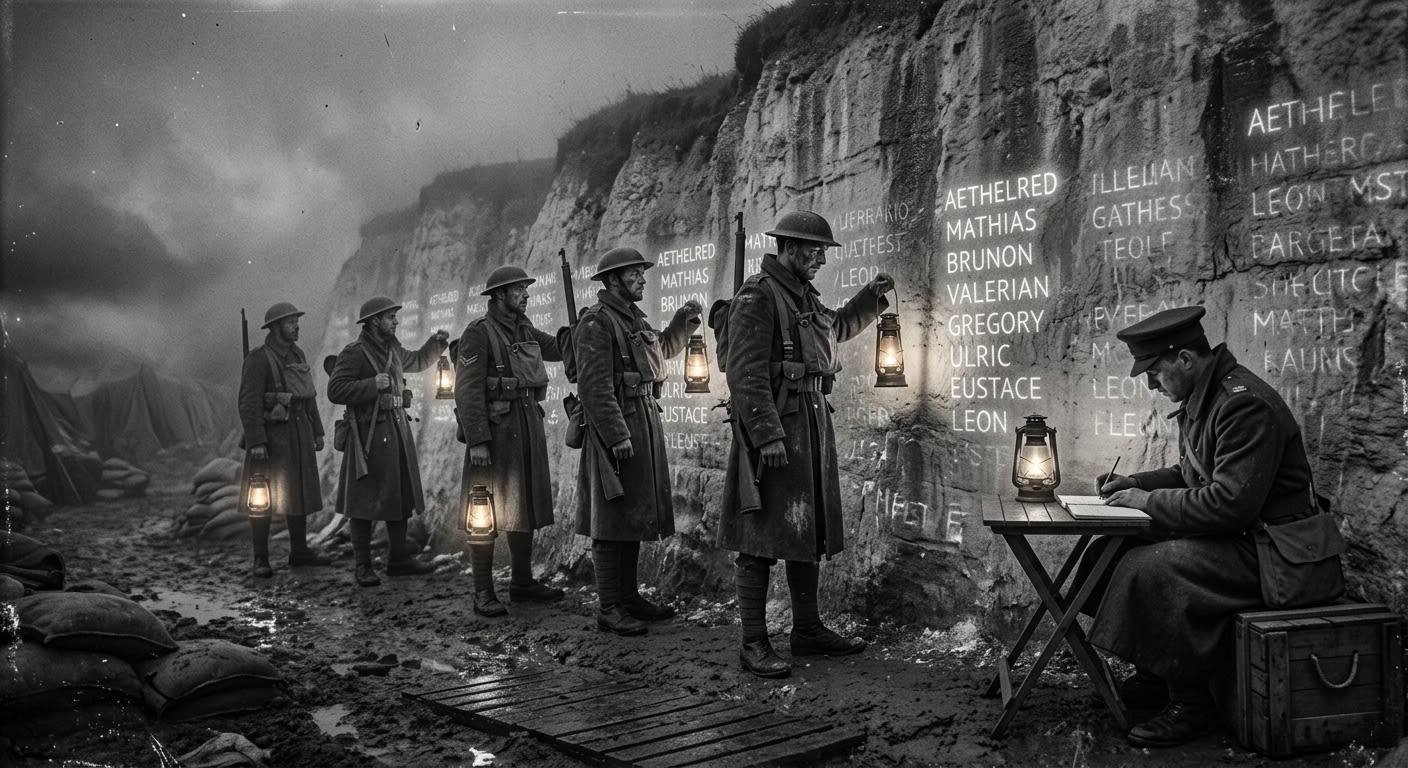
The protocol that emerged over the following decade is now the Redoubt's defining ritual. When fog descends — and fog descends on Calais the way sermons descend on congregations, which is to say with regularity and without invitation — the night watch assembles at the Script Wall. Readers take positions at measured intervals along the face. Lanterns are lit. The bell at the Fog Bell Tower sounds the dusk sequence: three short, one long, three short. And the readers read.
They read every name that appears. They read them clearly. They read them into the record. A Chalk Scribe copies each name into the ledger of the Salt Tribunal as it is spoken, and a second scribe — this one employed by the Bureau of Doctrine, which trusts nobody's handwriting but its own — copies the copy. The names are read in order of appearance, left to right, top to bottom, as if the cliff were a page and the fog an author with compositional discipline.
If a name goes unread, it sinks. The letters darken, bleed moisture, and recede into the chalk as if pulled by a hand on the far side of the stone. Within hours — sometimes within minutes — something happens to the person named. A drowning. A disappearance. A fishing skiff that returns to harbour with the correct crew complement but the wrong crew. The locals call this a sink-night. The Bureau calls it a Category Three Acoustic-Relic Event and has published four circulars on the subject, each contradicting the previous three with the serene confidence of an institution that considers consistency a form of intellectual weakness.
STAMPED ERRATUM — Bureau of Doctrine, Coastal Section, A.S. 197 The Script Wall is a natural meteorological phenomenon consistent with chalk condensation patterns observed in coastal cliff formations across the Channel littoral. The appearance of legible script is a perceptual artefact attributable to pareidolia, fatigue, and the well-documented suggestibility of garrison populations stationed in maritime isolation. The Bureau's position on this matter has not changed. The Bureau's position on this matter has always been this. Ratified. — The Bureau notes that the mandatory night-reading protocol remains in effect, as a precaution against the pareidolia.
#On the Salt Tribunal and the Economy of Passage
The Salt Tribunal was installed in A.S. 84, fifteen years after the Redoubt's founding, by a Synod decree that cited "irregularities in maritime passage documentation" — which is the Bureau's way of saying that people were drowning in an order that correlated suspiciously with the sequence in which they had last crossed the harbour without paying the toll.
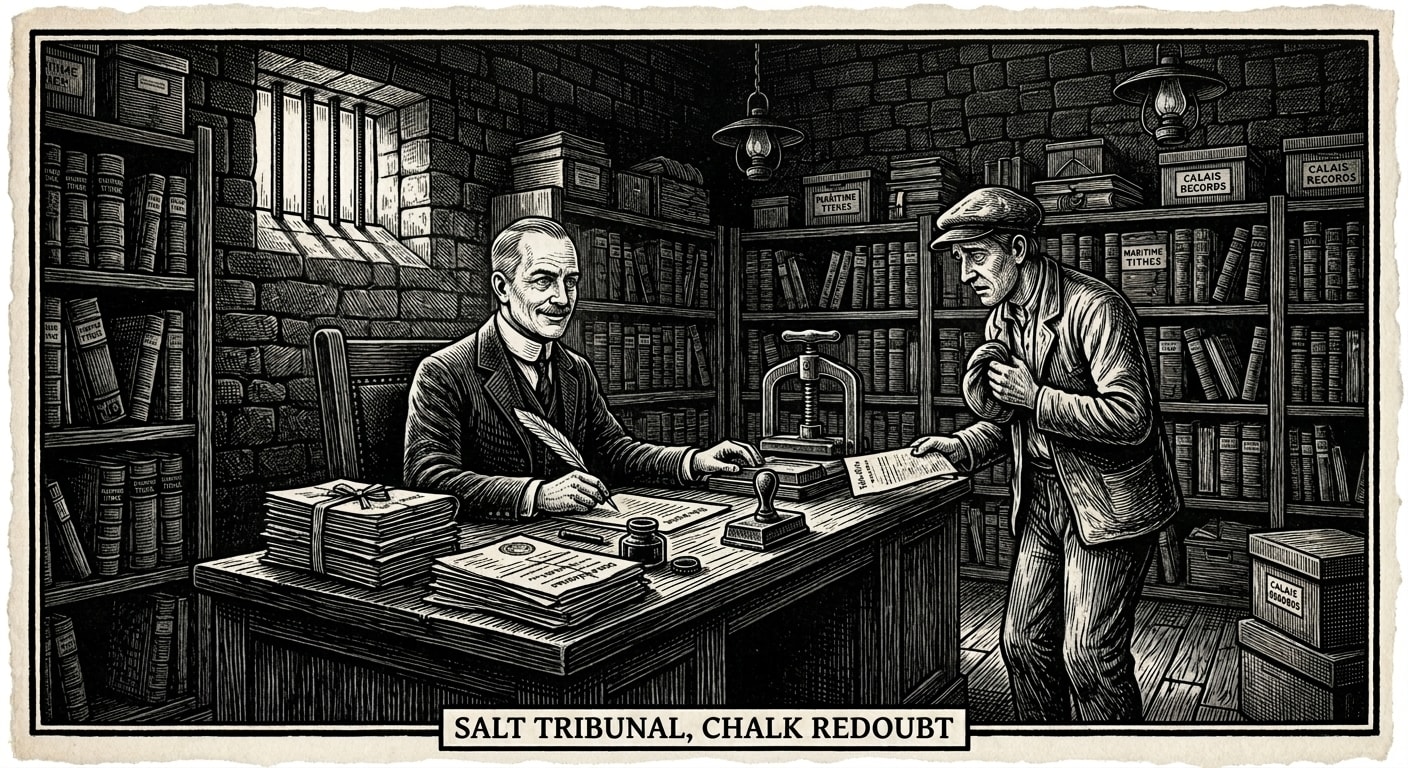
Seal-Justice Corvin Hald administers the Tribunal from Salt Row with a smile that has been described, by three separate inspectors in three separate years, as "professionally warm." Hald's remit is the sea pass — the stamped, sealed, confession-linked document without which no vessel enters or leaves the harbour, no cargo crosses the quay, and no citizen of the Redoubt boards anything that floats. The pass requires a confession (filed as a "tide-file"), a seal (pressed in salt-wax imported at considerable expense from the Candlewick Palatinate), and a bell-signal compliance certificate from the Gunline Choir confirming that the applicant's vessel carries the correct chime-plates for fog navigation.
The economy of Calais runs on passage. Salt chits, lantern tokens, ration stamps — the usual currencies of a Synod installation — circulate, but the true denomination is the sea pass. A valid pass is worth more than coin because coin cannot cross water. Coin cannot cross the harbour gate. Coin cannot purchase the Tribunal's forgetting, which is the most expensive commodity in the Redoubt and the only one Hald sells at a price he sets fresh each morning depending on the fog forecast and his digestion.
The black market operates in the boat tunnels beneath the Chalk Warrens — smuggler arteries carved by pre-Synod quarrymen, now maintained by the Grey Keel Syndicate, whose principal services include forged passes, cave-route navigation, and the quiet removal of names from places where names ought not to appear. The Syndicate's leader, a woman known as "Skiff-Sister" Lune, smells simultaneously of perfume and tar, a combination that the Undertide Divers consider a professional credential and the Salt Tribunal considers evidence of at least three capital offences.
#On the Garrison and the Gunline Choir
Commander-Prior Sabelle Morn has governed the Redoubt for nine years. She sleeps poorly and governs well, which is the standard exchange rate for competence in the Synod's coastal installations. Her garrison is small — perhaps two thousand regulars, supplemented by the Gunline Choir's bell-artillery corps and the quarantine wardens — but the Redoubt was designed for economy, not mass. The cliff does half the work. The guns do a quarter. The bureaucracy does the rest, and does it with the thoroughness of an institution that has discovered paperwork kills as reliably as grapeshot and with considerably less noise.
The Gunline Choir maintains the casemate batteries in the Gun Galleries — nine positions cut into the chalk face, each housing a consecrated cannon whose firing sequence is governed by bell-signal rather than visual command. Cantor-Major Pell, who counts beats the way other men count coins, administers the fire-chart: a scored brass plate recording which bells authorise which guns in which sequence. The chart is the most classified document in the Redoubt. Three copies exist. Pell sleeps with one. The Bureau holds another. The third was stolen in A.S. 198 and has not been recovered, a fact that Pell discusses with a calm so absolute it constitutes a threat.
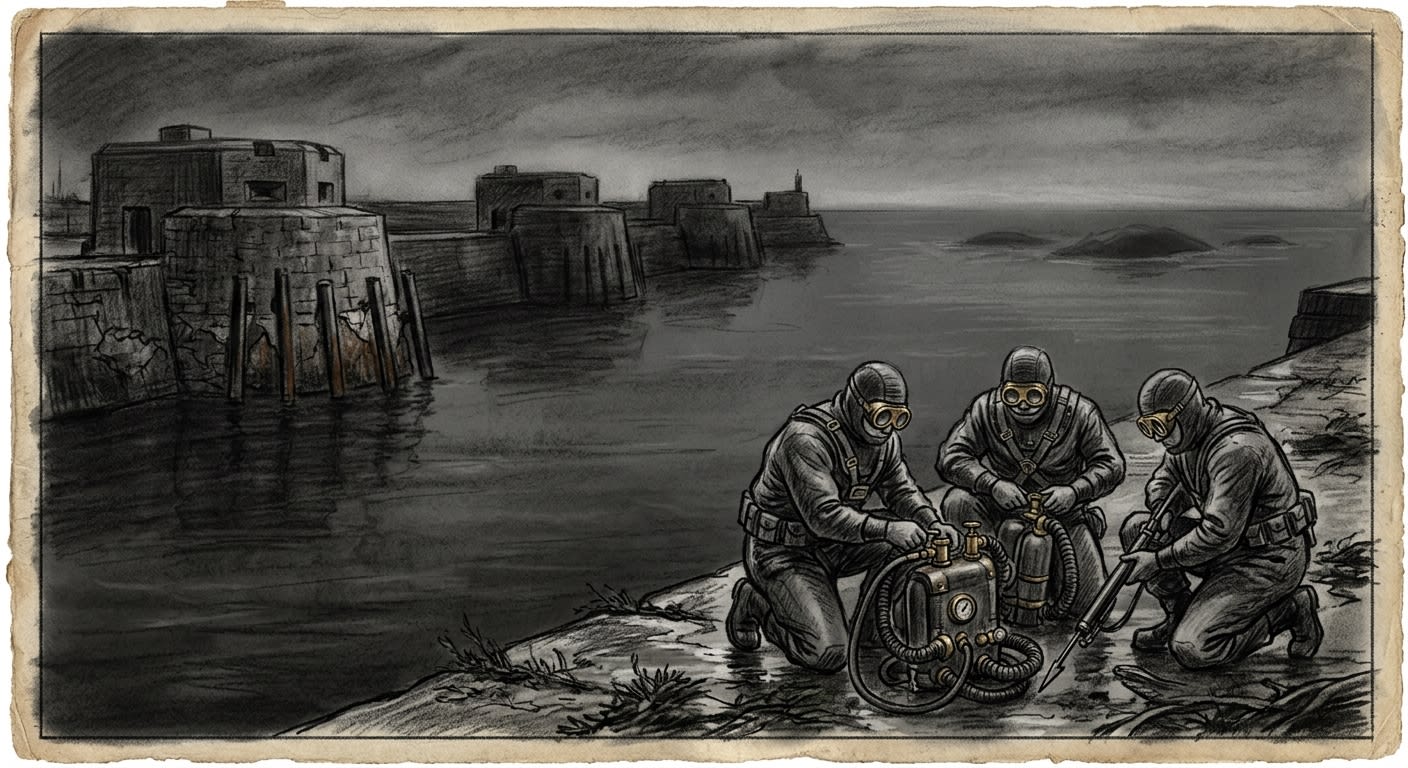
The military reality of Calais bears no resemblance to the Line. There are no trenches. There is no advance. The Redoubt's wars are weather and stealth: fog-masked skiff raids from the Channel, underwater breaches through the sea caves, and the occasional full-scale Undertide incursion — a thing like a tide that contains faces and moves against the current and, when it reaches the Teeth breakwaters, tests the demon-bone pilings with a patience that the Bureau of Doctrine has formally classified as "inconsistent with animal behaviour."
The Teeth — four breakwater fortlets guarding the harbour mouth — were constructed in A.S. 74 from iron, chalk-lime, and the skeletal remains of the first Undertide entities recovered from the sea caves after the Great Breach of A.S. 71. The bones were incorporated into the pilings on the advice of a Bureau of Alchemical Standards team whose report, titled On the Repulsive Properties of Self-Derived Calcified Remains in Saline Immersion, was seven pages long and recommended, in its final paragraph, that the team be reassigned to duties that did not require proximity to the sea. The Bureau granted the request. The bones remain.
#On the Undertide and the Things Below
The Great Breach of A.S. 71 established the Redoubt's purpose. Two years after its founding, something came through the sea caves. The official report describes it as "a marine incursion of theologically irregular entities" — which is the Bureau of War's way of saying that the Channel vomited demons through the cliff's underbelly and the garrison fought them in tunnels by lantern-light for eleven hours until a hastily organised bell-choir drove the things back into the water with a hymn-sequence that the survivors could not afterward remember and the Choir has since refused to reproduce.
Hundreds drowned. The sea caves flooded. The harbour went still — a stillness the old hands call west-hush, which is different from ordinary calm the way a held breath is different from sleep. And in the aftermath, when the fog rolled in over the blood-stained quays, the Script Wall wrote for the first time.
The Undertide is Calais's war. The entities — the Divers call them draggers, the Bureau calls them nothing because naming them would require classifying them and classification would require admitting they exist in a form the Twelve Pronouncements do not address — move in the deep water beyond the Teeth, rising during fog, testing the harbour defences with a regularity that implies intelligence and a patience that implies something worse than intelligence. They are attracted to sound and to light. They are repelled by the bell-sequences of the Gunline Choir and the consecrated bone in the Teeth pilings. They are drawn, with an appetite that the Divers describe as personal, to the Script Wall during active readings.
The Undertide Divers — the "Black Lungs" — are the only people in the Redoubt who have seen the things in their element. Diver-Captain Sain, who has made more dives into the sea caves than any living member of the corps, does not describe what she has seen. She answers questions about the caves with other questions about the questioner's swimming ability. Her second, Ila "Kelp," reportedly laughs underwater, which the other Divers consider either a sign of extraordinary nerve or a symptom of something the Bureau of Purity ought to investigate but has thus far declined to, on the grounds that investigating a woman who laughs in a place where nothing is funny would require sending an inquisitor into the water, and inquisitors are expensive.
█████████████████████████████████████████████████████████████████████ █ DIVER RECOVERY LOG — A.S. 199, DIVE 14-C — CAVE SYSTEM BRAVO — █ █ RECOVERED: one (1) object, chalk composite, dimensions approx. █ █ 14cm × 8cm × 3cm. Object bears inscription in script consistent █ █ with Chalkscript Fog manifestation. Inscription reads: ████████ █ █ █████████████████████████████. Object warm to touch. Object hums █ █ at frequency consistent with ██████████████████. Object placed █ █ in quarantine. Object ████████████████████████████████████████. █ █ RECOMMENDATION: ██████████████████████████████████████████████. █ █████████████████████████████████████████████████████████████████████
#On the Unread, and the Heresy of Silence
The Unread are the Redoubt's resident heresy. Their doctrine is simple, their pamphlets are terrible, and their logic — the Bureau pains itself to admit — is structurally sound, which is the most dangerous quality a heresy can possess.
They argue that the readings feed the wall. That the wall feeds the sea. That the Undertide comes because Calais reads, not despite it — that the Synod installed a mechanism to attract the very entities it claims to repel, and that the mandatory readings are not a defence but a lure, a baited hook sunk into the Channel with the population of the Redoubt threaded on the line as bait.
Brother Vell, who leads the cell from the edges of the Chalk Warrens, cannot speak. His voice was taken — whether by the Tribunal, the fog, or a dive that went wrong depends on which pamphlet you read, and the Unread publish frequently. He communicates by sign, by chalk-mark, and by a silence so precise it functions as oratory. Mara White, his lieutenant, carries sheaves of paper from which all writing has been erased — blank pages held up in protest at the readings, wordless placards in a city that punishes wordlessness with quarantine.
The Chapterhouse crushes the Unread when it finds them. A.S. 187 saw the "Unread Uprising" — three days of organized refusal to attend the night readings — broken by the garrison with quarantine writs and quarry conscription. The Silent Steps, those corridors near the Script Wall where speech is forbidden under penalty of beating, were created in the aftermath: zones of enforced silence surrounding the one surface in the Redoubt that demands to be read aloud. The irony is architectural. The Bureau has filed it under "design."
#On the Present Condition
The fog is spreading. In A.S. 199, chalkscript appeared on doorframes in the Chalk Warrens — three hundred yards from the Script Wall, in tunnels where no fog had ever penetrated. Names bled through interior plaster. A child's name appeared on a lintel and could not be scraped clean; the child was removed to the Undertide Pens, which are technically quarantine facilities and practically a place the Tribunal puts things it does not wish to classify.
Lamp oil runs short. The readings require lanterns; the lanterns require oil; the oil arrives by convoy from the heartlands on a schedule the Queue Road's toll-gates make unreliable and the Grey Keel Syndicate makes profitable. Without light, the readers cannot read. Without readings, names sink. Without names — or rather, with names sinking unread into the stone — the harbour goes still, the west-hush descends, and the Divers report movement in the caves.
Commander-Prior Morn has requested reinforcements. The Bureau of War has sent a circular.
Fog-Reader Captain "Lute" Auvray still assigns the reading rosters. She chooses who reads, when, and for how long, and she makes these choices with a care that the night watch interprets as fairness and the Tribunal interprets as a form of power the Salt Tribunal does not control and cannot tax. Auvray's readers trust her. The Tribunal does not. Morn trusts nobody, which is why she governs well, and sleeps on a cot in the Crownline with the window open so she can hear the fog bell, the surf, and — on bad nights — the Script Wall writing names she cannot read from that distance but knows, with the certainty of a woman who has governed a Name-Cliff for nine years, will include someone she spoke to at breakfast.
The sea is patient. The Redoubt reads on.
STAMPED ERRATUM — Bureau of Doctrine, Coastal Annex, A.S. 201 The preceding entry describes certain phenomena attributed to the Chalk Redoubt of Calais. The Bureau notes that the term "Undertide" is an informal designation employed by garrison personnel and does not reflect Bureau classification. The entities referenced are correctly designated as "Unresolved Marine Anomalies, Classification Pending." Classification has been pending since A.S. 71. The Bureau anticipates resolution presently. Ratified.