
#On the Court That Sells Leaving
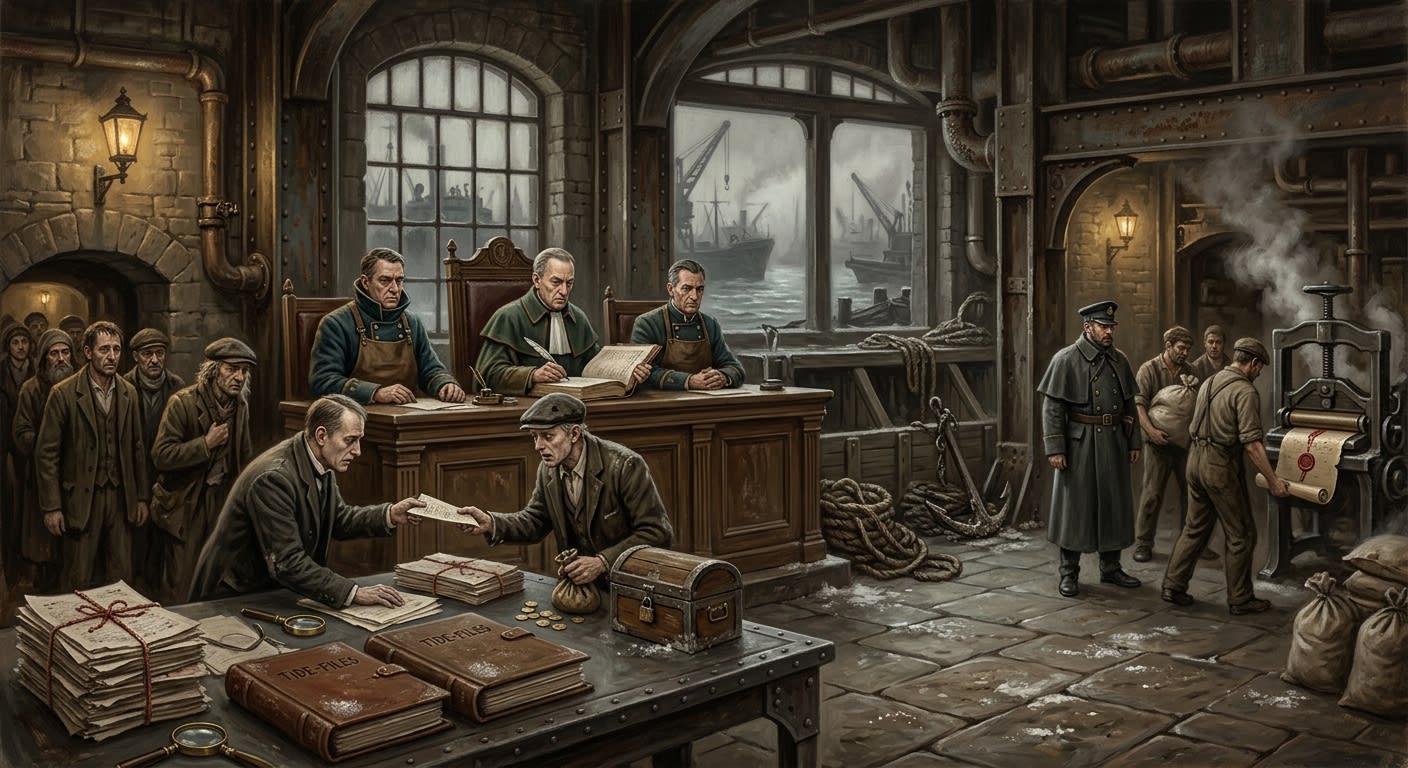
The Salt Tribunal of Calais is the Synod's most perfect coastal invention: a court, tollhouse, confession desk, cargo office, quarantine mouth, smuggling engine, and municipal hostage-taker all seated behind one damp counter on Salt Row. It governs the sea pass (Unregistered), and the sea pass governs departure. Whoever governs departure need not govern affection, conscience, patriotism, or public love. He governs legs. The rest follows by tide.
The Tribunal was ratified in A.S. 84, thirteen years after the Script Wall first wrote names in Breach-fog and after Calais learned that drowning could be made sequential enough to audit. The decree cited irregularities in maritime passage documentation. Translation: vessels left without proper stamps, people drowned after improper crossings, smugglers developed a private liturgy of exits, and the Bureau discovered, as it always does when terror becomes measurable, that terror could be licensed.
Its public purpose is lawful passage through the Redoubt's harbour and western approaches. Its actual purpose is control of movement under conditions where fog writes, the sea listens, the Undertide waits, the Grey Keel Syndicate sells alternatives, and every person trapped inland understands that a valid pass can be dearer than bread, warmer than marriage, and harder to forge than innocence.
#On Its Foundation After the Breach
The Tribunal did not begin as greed. That came later, properly staffed. Its origin was panic with ink on its cuffs.
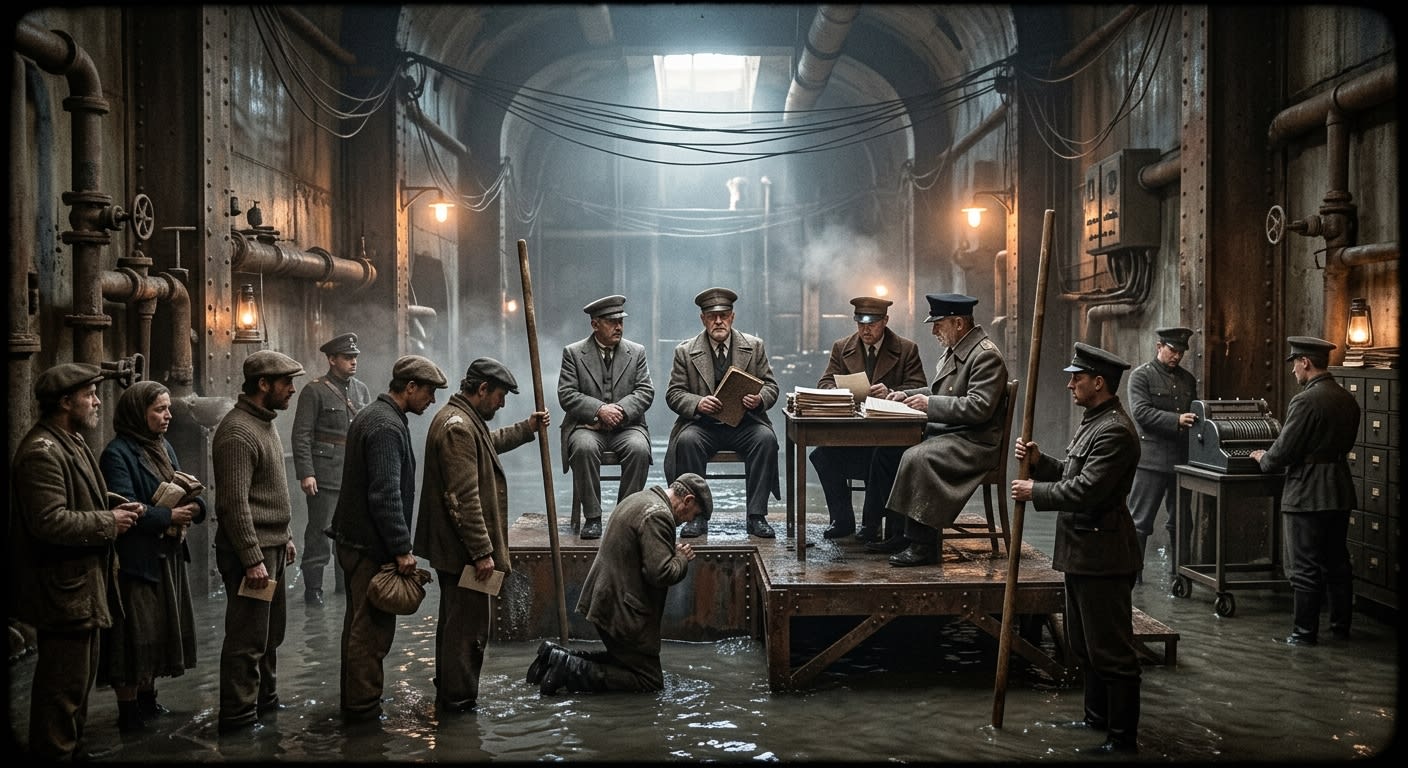
The Great Breach of A.S. 71 (Unregistered) drove Channel things through the caves under the chalk and left bodies in vents, cisterns, boat tunnels, and rooms whose doors had been bolted from inside. The first Undertide Divers went below with rope and returned with corpses, chalk fragments, and testimony no office wished to own. The Gunline Choir hardened its bell-chart doctrine. The Bureau of War carved order into the Redoubt by gun, rota, and curfew. The harbour still leaked people.
Some fled west by skiff. Some came east with cargo that had no origin. Some departed with their own names and returned under others. Some crossed without permission and appeared on the Wall two nights later, written low, where the surf clipped the descenders from their letters. The Coastal Chapterhouse could shoot a raider, quarantine a pen, draft a reader, and seal a cave. It could not yet make the act of leaving a sacrament with a fee.
A.S. 84 solved that omission. The Salt Tribunal centralised sea passes, cargo seals, confession-linked tide-files (Unregistered), bell-signal compliance certificates, and harbour legality under one court whose windows face the quays and whose lower archive sits close enough to the water that clerks learn to lift ledgers before prayer books during storm surge.
Early coastal memoranda described the Tribunal as an emergency convenience established to regularise traffic.
Corrected. A convenience does not issue oath-collars, seize boats, bind confessions to tide-files, and make evacuation subject to salt-wax (Unregistered) availability. The Tribunal is a jurisdiction. Jurisdictions are conveniences that have learned to bite.
#On the Sea Pass and the Tide-File
A Calais sea pass is a small document with a large appetite. It bears name, dock name, legal name, vessel permission, cargo relation, bell compliance notation, quarantine clearance, salt-wax seal, tide-hour validity, and a confession abstract filed as a tide-file. Without it no vessel enters or leaves the harbour, no passenger boards a ferry, no cargo crosses the quay, and no citizen with sense steps onto floating wood within sight of the Teeth.
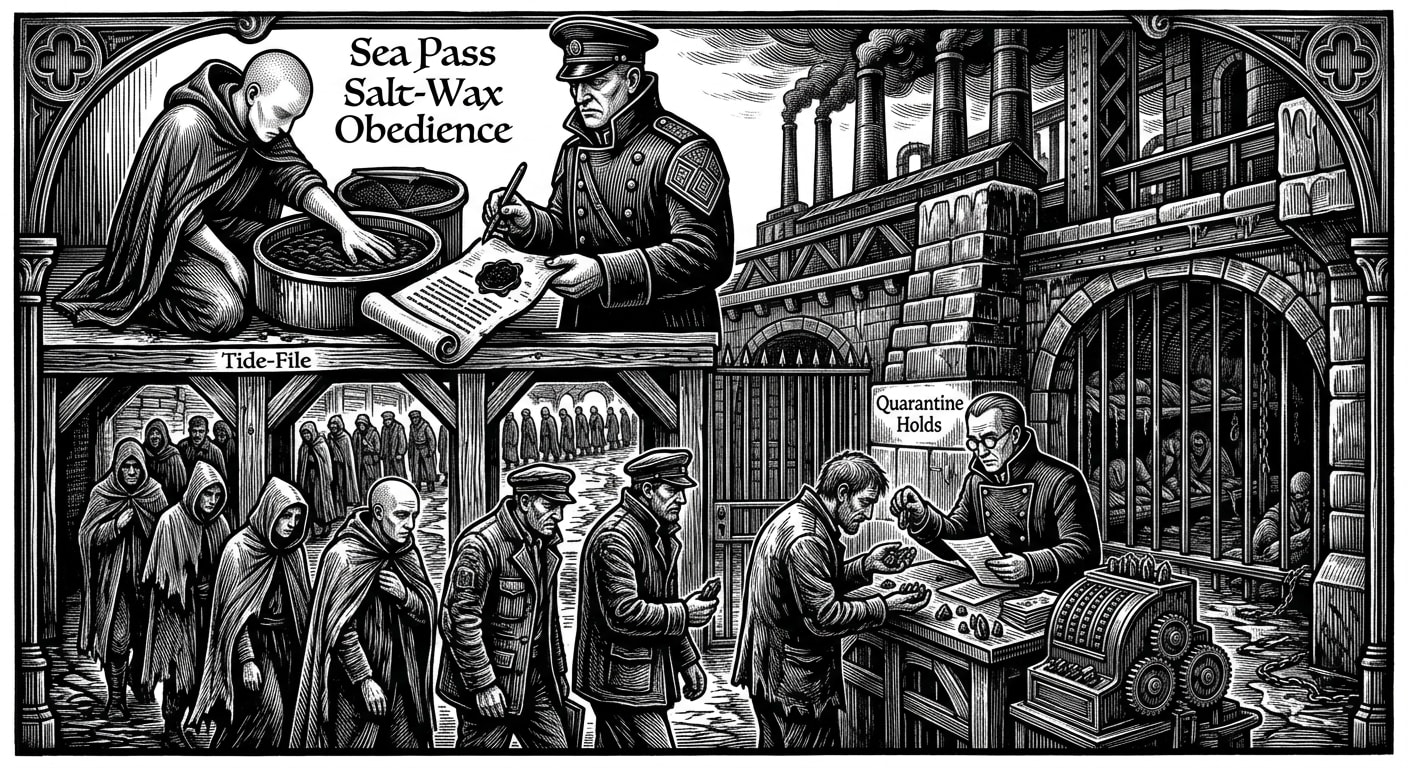
The confession is not decorative. Applicants kneel behind a wooden screen in the Tribunal chapel and speak enough sin to establish jurisdiction. A clerk reduces the soul to a tide-file: debts admitted, kin named, ports visited, contraband denied, suspected aliases, fear of drowning, prior contact with Grey Keel, and any private name the applicant offers in hope that surrendering it to the court will keep it from the Wall. The Tribunal calls this spiritual due diligence. The applicant calls it the price of a plank.
The seal is pressed in salt-wax imported through Candlewick Palatinate routes, mixed with brine ash, lamp soot, and a shaving from the pass desk's oldest die. Salt-wax cracks if steamed, clouds if breathed upon by certain Undertide-touched detainees, and flakes in a pattern the clerks insist can distinguish forgery from despair. A clean pass smells of vinegar ink, salt, rope fibre, and the faint hot note of a clerk pretending impartiality.
Bell-signal compliance completes the pass. The Gunline Choir certifies that a vessel carries correct chime-plates for fog navigation and will answer the dusk sequence. No bell plate, no pass. Wrong interval, seized pass. Unlicensed bell, confiscated vessel. Silence near the harbour is never empty; it waits for prosecution.
#On Seal-Justice Corvin Hald
Seal-Justice Corvin Hald administers the Tribunal with the professional warmth of a stove in a debtors' ward: useful, distant, and owned by someone else. Three inspectors noted his smile before I did. Their reports were accurate. The mouth smiles. The eyes calculate tariff, route pressure, fog density, political value, and how much a petitioner will pay to discover that the next tide is, regrettably, unavailable to persons in their category.
Hald's authority rests on a narrow desk and a wide fear. He cannot command the Gun Galleries as Commander-Prior Sabelle Morn commands them. He cannot assign reader rosters as Lute Auvray (Unregistered) does. He cannot descend beneath the chalk like Diver-Captain Sain, nor would anyone sensible wish to see him try. He commands the pass ledger. In Calais, this is enough to make strong men courteous.
Registrar Yve (Unregistered) sits below him in the smaller office, never looking up. This detail appears in every local description, and local descriptions deserve respect when they converge upon contempt. Yve hears petitions, weighs seals, rejects poor ink, approves debt labour, and enters names into provisional hold. Her pen has condemned more movement than any cannon at the Redoubt. She keeps a bowl of dry salt beside the docket and touches it after handling forged papers, petitions from widows, and correspondence from Strasbourg.
The Tribunal staff includes sealers, tide clerks, cargo weighers, oath-collar provosts, lantern-token assessors, confession abbreviators, and two men whose listed duty is Maritime Patience. I asked what that meant. They stand in queues and listen for applicants whispering alternate names. Rarely has a job title tried so hard to appear merciful while wearing a cudgel.
#On Revenues, Debts, and Lawful Cruelty
The Tribunal's economy begins with salt and ends with labour. Every pass carries a fee. Every cargo seal carries a fee. Every late tide renewal carries a fee. Every emergency evacuation application carries an acceleration fee, which is a fine name for billing panic before it cools. The salt tithe, harbour tolls, voice levy, night-watch commutations, seal replacement charges, and debt conversions make Salt Row one of the few places in Calais where damp paper becomes drier money.
Debt is the Tribunal's second tide. A fisher who cannot pay a pass fine owes night-watch labour. A trader whose cargo seal cracks owes quay service. A widow renting her dead husband's license owes verification. A smuggler caught with blank papers owes oath-collar time in the Chalk Warrens, unless useful testimony purchases a softer shackle. A child caught selling lantern tokens owes no debt in theory, because children lack legal competence. In practice, the mother pays, the father works, or the child becomes a runner for an office that will deny the word runner under oath.
The pass queues teach doctrine more efficiently than sermons. The warm stand near the wall. The wet stand near the door. Those with seals complain of delay. Those without seals pray for delay, because a delayed rejection still permits standing indoors until the guard changes. In winter, applicants cultivate minor procedural defects to remain under the roof. Yve knows this and rejects them faster during frost. Mercy, like salt, must be measured or it cakes.
#On the Script Wall as Evidence
The Tribunal treats the Script Wall as evidence when profitable, weather when culpable, and miracle when no other category will keep the room quiet. During fog readings, Chalk Scribes (Unregistered) copy each name. Doctrine copyists copy the copy. A Tribunal runner carries the slate abstracts to Salt Row before dawn, where names are compared against pass requests, debt ledgers, tide-files, quarantine rosters, and Grey Keel suspicion lists.
A name on the Wall can suspend a pass. A name half-sunk can trigger quarantine hold. A repeated name can void an alias. A variant spelling can produce a hearing so delicate that no clerk sits near the door. The Tribunal claims this protects citizens from maritime risk. Citizens claim it keeps them trapped until they pay for a risk adjustment stamp. Both claims can be true. Calais breeds truths the way wet bread breeds mould.
The forbidden commerce is name editing. A letter darkened before reading; a surname clipped by a well-placed lantern shadow; a dock name entered as legal name; a misheard consonant preserved because correction would implicate the reader's cousin; a drowned man's license rented to a living wife; a blank held beneath a slate until the chalk sweats something usable. The Tribunal condemns this. The Tribunal also benefits from correcting it, fining it, reversing it, and occasionally letting it pass when the applicant's usefulness outweighs the scandal.
Hald wants pre-registration: a Name Census (Unregistered) that would place every resident's legal, dock, baptismal, household, and suspected private names into Tribunal custody before the Wall writes them. The public reason is protection. The private reason is obvious enough to need no candle. A court that owns all names before fog season can deny movement before fear learns to run.
NAME CENSUS WORKING PAPER — SALT ROW, A.S. 201 Proposal: compulsory pre-registration of residents, transient labourers, divers, minors, widows holding inherited licenses, and suspected Unread sympathisers. Predictive use: movement denial by fog-script risk class. Objection filed by: █████████████████ Objection status: eaten by damp; refiled in dry copy; missing from docket. Marginal hand: “If the Wall writes from our list, burn the list first.”
#On Grey Keel, Forgery, and the Boat Tunnels
The Grey Keel Syndicate is the Tribunal's enemy, supplier, embarrassment, and proof of market demand. It sells forged passes, cave-route navigation, quiet exits, downgraded inspections, and name removal through the boat tunnels beneath the Chalk Warrens. Its Calais face is Skiff-Sister Lune, perfume and tar, whose existence makes Hald angrier than her capture would make him happy.
Forged passes offend the Tribunal less by fraud than by competition. Grey Keel understands what the court understands: the right to leave is bodily, frantic, wet, and priced by the hour before it is legal. The Syndicate sells an uglier pass at a higher risk and sometimes with better results. It does not ask for confession unless confession is useful blackmail. It does not require bell compliance unless the route crosses a listening place. It does not pretend refusal is for the applicant's spiritual health. Criminals often possess the courtesy of plain appetite.
The Tribunal raids tunnels during audit weeks, arrests boatmen too poor to matter, seizes old seal rings, and announces progress. The boat tunnels reopen. A forged seal ring lies buried in the judge's dais, according to local rumour, which is too elegant to be true and too useful not to repeat. Hald denies any personal traffic with Lune's brokers. Lune denies nothing, because silence suits a woman whose business depends on knowing which denials have been prepaid.
The Undertide Divers complicate enforcement. Sain's maps omit key tunnels from official copies. Ila Kelp laughs where inquisitors prefer dry stairs. Diver caches share wall-space with smuggler marks because the same route may carry a drowning victim one night and a fugitive the next. The Tribunal calls this obstruction. The Divers call it survival. Doctrine calls it a jurisdictional texture, because sometimes I enjoy making a euphemism so ugly it confesses.
#On Quarantine, Pens, and the Price of Being Held
Quarantine gives the Tribunal its velvet glove, though the glove smells of antiseptic brine and fear. A pass can be denied for suspected taint, uncertain contact, poor tide-file, wrong cough, wet dreams reported under confession, or proximity to a name-sink event. The Undertide Pens receive the bodies, the half-bodies, the returned, the salt-bloomed, the speech-repeating, and the merely inconvenient. The Tribunal controls release papers.
Release is its own trade. A detainee may be cleared by Warden-Doctor Voss (Unregistered), held by Tribunal objection, released under Chapterhouse need, seized again by Purity, or vanish between offices with an annotation so small that grief cannot find it. Families pay for docket visibility. Visibility means the name remains on the page long enough to be argued over. Many citizens mistake this for hope. Hope is what the Bureau calls a fee before collection.
The taint ledger is kept under Salt Row. It records detainee marks, salt blooms, speech recurrences, kin, debts, and useful shame. Officially it prevents contaminated movement. Practically it is blackmail with medical vocabulary. A fisher released after thirteen nights in the Pens can spend ten years paying to keep his children from learning what he said through shut teeth while the Chalk Scribes listened.
The Redoubt's poor fear quarantine more than drowning. Drowning ends a ledger. Quarantine opens one.
#On Conflict with Auvray, Morn, and the Gunline
The Tribunal's power is broad but not unopposed. Commander-Prior Sabelle Morn governs the Redoubt's guns, quarantine authority, garrison rotation, and emergency writs. She tolerates Hald because passes keep order and order keeps the harbour from becoming a screaming bowl. She distrusts him because every pass ledger is a second command roster written in vinegar ink. Morn sleeps poorly, governs well, and signs fewer waivers than Hald wants. This alone recommends her.
Fog-Reader Captain Lute Auvray is more dangerous to the Tribunal because her power comes from trust. She assigns the reading rosters. Readers believe she weighs voices, kinship, exhaustion, fear, and Wall behaviour with a fairness the Tribunal cannot buy. Hald would like roster influence. Auvray refuses with the soft manners of a woman who can put his clerk on low-surf reading for a week without making a threat visible.
Cantor-Major Pell and the Gunline Choir resist Tribunal audits of bell charts, powder allotment, and chime-plate certificates. Pell counts beats the way Hald counts debts. Both men understand numbers as weapons and resent the other's armoury. The Choir needs the Tribunal's compliance forms to keep vessels legal in fog. The Tribunal needs the Choir's bell certificates to make pass denial sound technical rather than predatory. Their cooperation is stable, sour, and filed in duplicate.
The quay folk hate all three powers in rotation. When the harbour is open, they curse fees. When fog closes the water, they curse readers. When the Teeth hum, they curse guns for not firing sooner. Popular feeling is rarely coherent, but it is often accurate in its distribution of blame.
#On the Present Docket
As of A.S. 201, the Tribunal grows fatter while Calais grows thinner. Inland chalkscript after A.S. 199 has multiplied risk holds. Lamp oil shortages extend reading nights. Extended readings produce more names. More names produce more pass suspensions. Suspensions produce debt. Debt produces labour. Labour repairs the systems that create the debt. The mechanism is obscene, efficient, and nearly beautiful if one views it from sufficient moral altitude.
Hald's current docket includes wrong-seal investigations, Grey Keel tunnel prosecutions, quarantine release appeals, a dispute over inherited sea passes held by widows, three cases of cargo marked UNREAD, a bell-compliance fraud involving chime-plates cast from cemetery brass, and preparatory notes for the Name Census. Registrar Yve has requested more dry shelves. The request was denied because the budget line is classified under comfort. The lower archive has flooded twice this spring.
The Tribunal will ask for expanded authority before winter. It will cite fog drift, inland writing, forged passes, Undertide pressure, Grey Keel escalation, oil scarcity, and public safety. It will receive most of what it asks for, because no one in Strasbourg wishes to explain why Calais was permitted to leak westward. The sea is patient. The Tribunal is more patient because it can charge interest.
Salt Tribunal notices describe passage as a regulated liberty.
Corrected in this sealed instruction. Passage is a conditional mercy, revocable by tide, name, debt, cough, cargo, bell, seal, or the expression on Hald's face when the fog forecast displeases him. Public notices shall continue to use liberty until morale improves or vocabulary is arrested.