
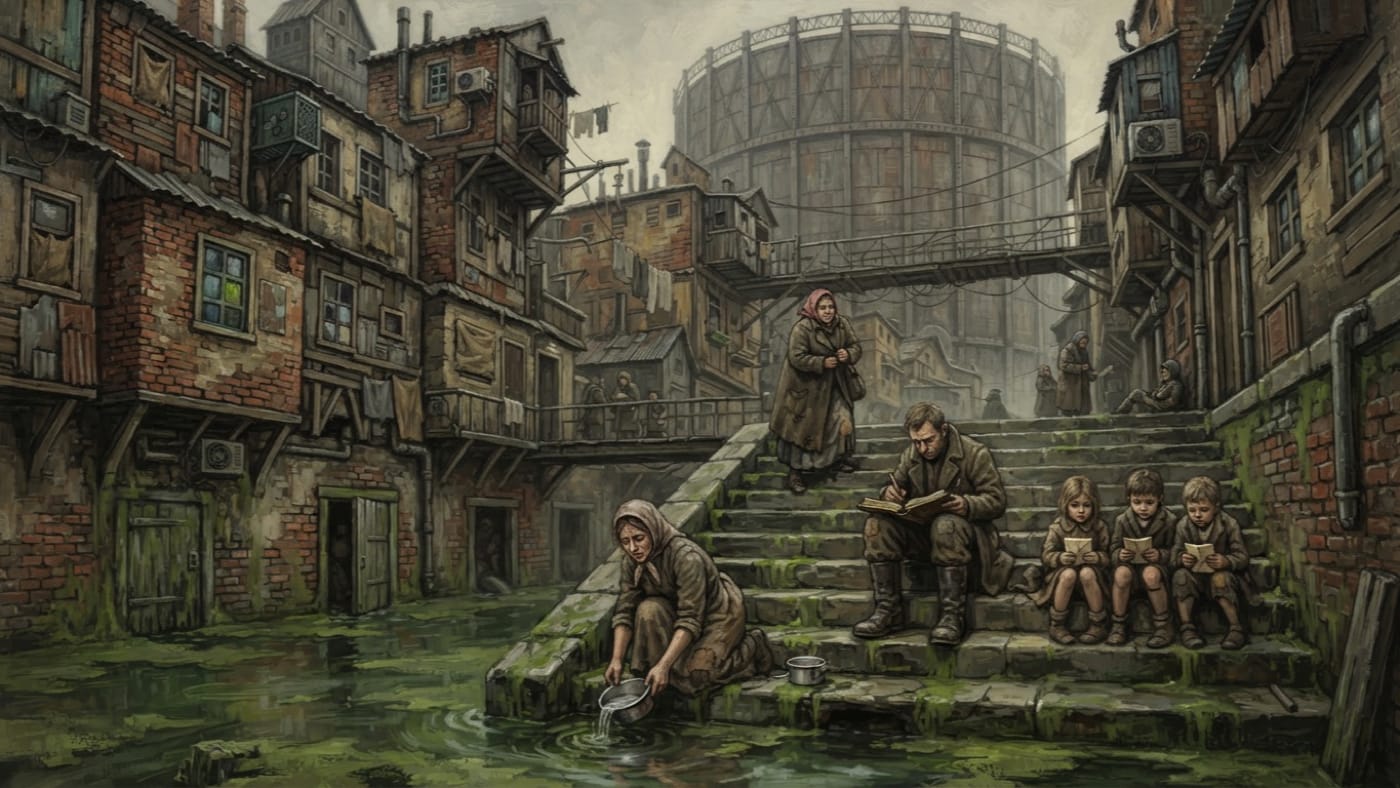
#On the Canal Steps
"Hunger hears everything." — Wexel proverb
Canalback is the part of the Grain-Gray Ration Parliament of Wexel that the Parliament counts most carefully and visits least. The Shacks crowd an irrigation canal in the town's flat grain basin. Their roofs lean against each other, their window frames are glazed with salvaged glass where there is any and stopped with burlap where there is not, and their pale brick came from buildings that no longer need it. From the canal steps a resident can see the steel silo ring standing over everything. It is full of grain that is legally nobody's breakfast.
The steps are the quarter's only public room. Women rinse porridge pots there. Day labourers wait there for the muster bell. Children sit there with sealed slips in their laps until someone pays them to run. The stone is green with algae to the ankle and darker above, where the floods have reached. Behind some of those flood-stains, at about the height where a tired hand might rest, there are cellar doors. The Mirth Office knows the doors exist. It does not know which stains hide them. Its inspectors wear grey sashes and dislike mildew, and they have shown no eagerness to run their palms along the whole canal to find out.
Wexel was founded in A.S. 98 to count food, and it counts Canalback's food to the ounce. The Parliament's ledgers record the silos by the ton. Canalback's household books record them by the bowl: porridge, coarse bread, onion broth. Honey is something one hears about. Butter is something one gets cited for describing too warmly. Prefect Marwen Kile's Ration Prefecture manages the distance between the silo and the bowl, and it manages it superbly. Nothing is lost on the way. A great deal is retained.
#On Work and Household Accounts
"Count the grain, don't count the grief." — Wexel proverb
The Canalback Poor are the fourth of Wexel's six layers of persons. They rank below the clerks, the grain holders and the chit traders, and above the Ash-Fined and the Erased-but-Used. Fourth is a dangerous rank. It has enough to lose and nowhere safe to keep it.
They live by day labour. The canal wants dredging, the mills want hands, the burlap wants weaving, the ration wagons want pushing, and the Parliament's labour drafts take whoever is left. Wages arrive as labour-hours logged against the household ledger, which is a Canalback family's true dwelling. The book records chits received, hours owed, gratitudes declared at Mirth Rollcall and marks entered. A shack can flood and be rebuilt. A ledger with a mirth mark on it cannot be dried out.
The bells run the day. At dawn the Scale Gate weighline opens, and the quarter goes up to present its chits two-handed with lowered eyes while the Scale Gate Authority weighs the sack and the face together. At midday the Parliament votes the quotas, and a family learns in chalk whether this week's porridge will be thick or theological. In the afternoon the Mirth Office walks the markets. After curfew the lantern patrols walk their loops, and Canalback keeps its mouth in its pocket.
Debt arrives by three roads. The first is the ration reduction, which Canalback treats as weather. The second belongs to the Ash-Fine Marshals, who carry writs, torches and carts and treat a debtor's roof as a line item. The third is the one the quarter whispers about. A household marked for audit may clear its book by offering another name for review. Speaker Huld Bex keeps such names in a drawer beneath the dais of the Parliament Hall of Measures, and the drawer has never refused a deposit. In Canalback the price of a clean ledger is usually a neighbour, and sometimes a cousin. Families have sat on the canal steps sharing one pot of onion broth while each privately calculated what the other would fetch at review.
"No one in Wexel is punished for emotion — only for fraud."
Withdrawn. The sentence appears in Heartlands summaries of the Wexel model, and it has been repeated in good faith by readers who have never opened a Canalback household ledger. In those ledgers, marks for laughter, ingratitude and "suspect abundance" sit beside the ration figures and are collected in the same labour-hours. The only fraud on the page is the sentence itself.
#On the Quiet Mirth
"A joke can burn a house." — Wexel proverb
The Quiet Mirth meets in the cellars beneath the shacks. The Cellar Circles have no public face, no registered officer and no name the Bureau of Records can write on a writ. In a ration town, that is the only kind of anonymity that has ever worked. The Circles keep safe cellars. They keep runners, most of them children who carry sealed slips by day and see no reason every slip must be official. They also keep jokes.
After curfew there is a laugh-tap at the door and a proverb said slightly wrong, the way the code requires. Then a stair that smells of algae and onion, and a lamp the size of a thumb. Below, people do what Wexel forbids most thoroughly. They eat without recording it. They say what they think of the Prefect's dusty hands. They laugh with their mouths open. Someone reads from a joke sheet folded so many times it has gone soft as cloth. Someone plays the Sister-Lector, holding a bent spoon to a neighbour's lips to measure the smile. Someone who has not eaten since the last weighline is handed half a bread heel, and nobody writes it down.
Canalback should not be sentimentalised. The cellars that keep jokes also keep commerce. Hidden grain passes through them. So do forged chits that smell convincingly of honest bread, mirth scripts sold by the sheet, and arson insurance, a product bought by households that have received an ash bill and want to feel they have done something. The cellars cannot sell a clean audit. Nobody in Wexel can, though plenty have taken payment for one. A Circle can hide a family's grain. It cannot hide the family from the ledger.
The informants come down the same stairs as everyone else. The Mirth Office pays per name, and the man laughing loudest at the cellar jester may be laughing under contract. Every Circle knows this, and every Circle lets the stranger in anyway. A cellar that turns away strangers stops being a refuge and becomes a household, and the Ration Prefecture already owns the households. So the Quiet Mirth keeps joy alive in Canalback by trusting people it should not trust. The terms above ground are worse.
#On Laughter Carried Beyond the Quarter
"If the wind laughs first, don't answer with yours." — Wexel superstition
A cellar is a closed room, and the Chaff-Winds of Wexel do not respect closed rooms. The Bureau of Rites classifies them as a Category One Localized Atmospheric-Acoustic Disturbance. In Canalback they are the reason people laugh into their sleeves.
Genuine amusement carries farther than sound should. A joke told in a Canalback cellar has reached Parliament Square whole, in the middle of a quota vote, with no mouth to attach it to. A sermon on contentment came back from the Shacks with one syllable changed, until it sounded very close to "contempt." By such routes, a folded sheet that never leaves the quarter seems to be read everywhere. The sheet itself does nothing. The smiling loops that bend Mirth Office ledgers belong to the wind and to the citation ink. They have nothing to do with these pages, which do not rewrite themselves as Hungry Ink does. Canalback's paper is only paper. It tears along the creases.
Every countermeasure has failed. The canal damp turns salt lines at the cellar doors into brine within the week. Wax plugs in the keyholes stop nothing. Joy masks hide the face and leave the shoulders free to shake.
What the wind does to Canalback is stranger than punishment. It takes a laugh out of a cellar and sets it down in public with no speaker attached. The Mirth Office cannot fine the air, so it fines the direction. Sweeps follow loud weeks. Citations fall on whichever households stand nearest the inspectors' guess. Canalback is not the wind's only source. It is only the source the Office prefers to blame, because the poor live closest to the canal and farthest from appeal. The wind is no ally to the quarter. It is a gossip with superior range.
#On the Present Condition
As of A.S. 201, Canalback is inhabited, feverish, indebted and still capable of laughing.
Canal fever takes its share each summer, when the water drops and the algae thickens. The wet season floods take shacks and leave fresh stains for fresh doors. The poor are buried in pits along the canalbank with a handful of grain on the tongue and a final chit reconciliation in the ledger. It is the only time a Canalback account is closed in the household's favour. Ration cuts arrive under the heading of waste mitigation and labour drafts under the heading of civic opportunity. The Marshals' carts arrive at night under no heading at all, and the Bureau of Tithes receives the assessment in the morning.
The joy discipline imposed after the Dust Fire of A.S. 112 has now been temporary for eighty-nine years. Canalback has never known anything else. Its grandparents were cited, and its children practise the measured smile in the same broken mirrors. The quarter has endured the way its steps have endured the canal: worn into the shape the water demands, with a door kept behind the stain.
Wexel exports its quota manuals to other towns as proof that discipline needs no chains. The manuals have no chapter on Canalback. Such a chapter would have to cover the cellars after curfew, and the Ration Parliament has not yet voted a quota for those.