
#On the Territory That Calls Itself Safe
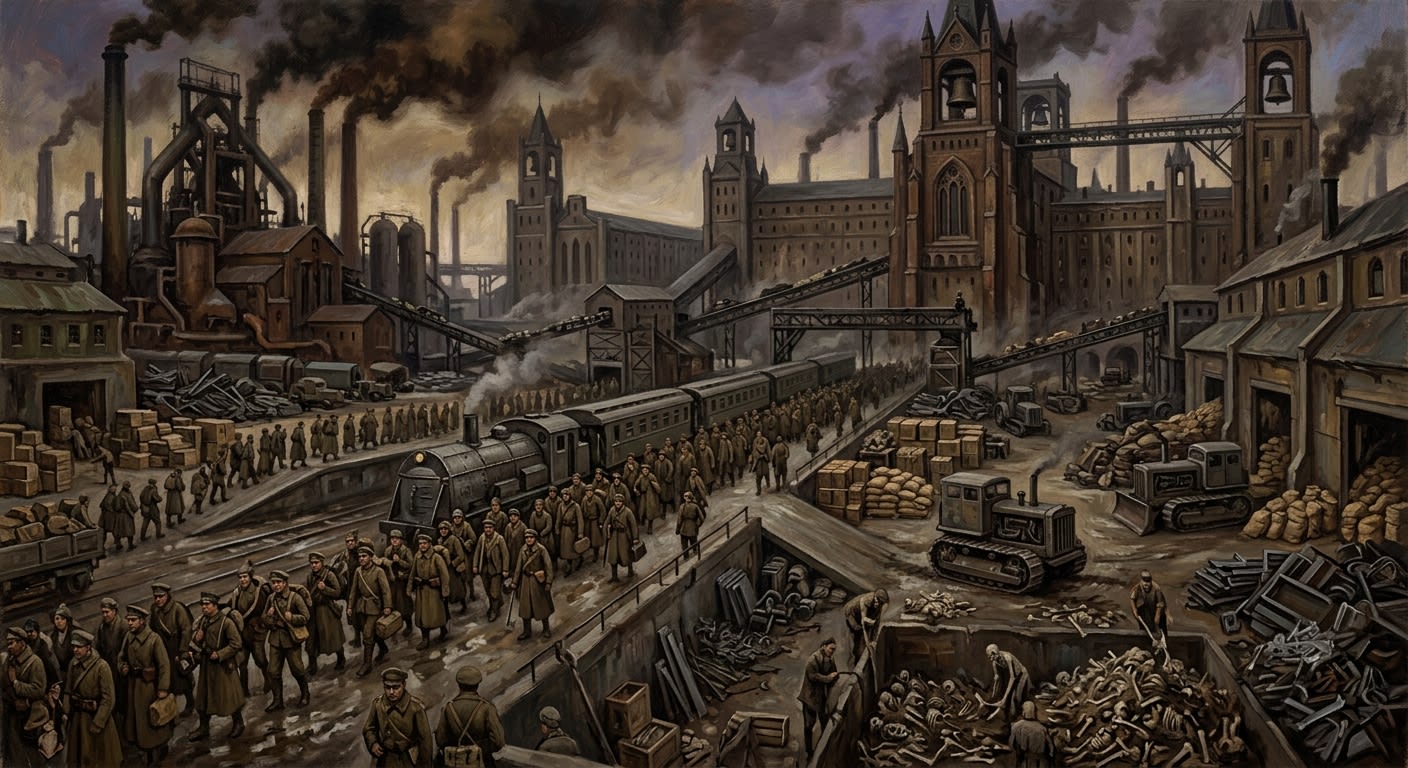
The Heartlands are the Synod's westward body: the cathedral-cities, ration parishes, foundry belts, canal districts, rail yards, paper mines, candle sump towns, quarry cuts, switchyards, grain parliaments, archive-banks, mint courts, and obedient streets that lie behind the Sagittal Line and congratulate themselves for not hearing Hell directly.
This congratulation is premature. Hell need not stand at your window to own the shape of your day. A man in Cologne rises when bells written for the Line strike his district awake. A woman in Ghent receives bread reduced by a ration calculation made for Bastion-Brest. A child in Munich learns to spell obedience by copying troop departures from the Provisorium. An old clerk in Ulm becomes paper because a front office required stock. Safe, in Synodal geography, means far enough from teeth that the biting arrives with a stamp.
The official zone map divides the Heartlands into dignified bands. Zone 1: Western Heartlands, Atlantic and canal-safe, France, Spain (Unregistered), the Low Countries, those old provinces that smell of wax, fish, and historic compliance. Zone 2: Central Heartlands, Germany, Switzerland, northern Italy, Austria, safe and heavily industrialised, which is to say the war's stomach and ashpan. Zone 3: Forward Heartlands, Bohemia, Moravia, western Hungary, Dalmatian approaches, staging ground where civilians learn to sleep under logistics timetables. The map continues eastward into Zone 4, the Line; Zone 5, contested absence; Zone 6, the Charnel Lands. The Heartlands are what feeds the wound.
To speak of the Heartlands as rear territory is to indulge soldiers in their favourite superstition. Rear to whom? Rear to the trench, yes. Rear to the bell, never. Rear to the tithe, the conscription notice, the ash-return, the queue-gate, the corrective sermon, the census revision, the ration knife, the Bureau's appetite? There is no rear in a theocracy built around a front. There are only distances from the gun and methods of payment.
#On Bells, Bread, and the Sanctified Machine
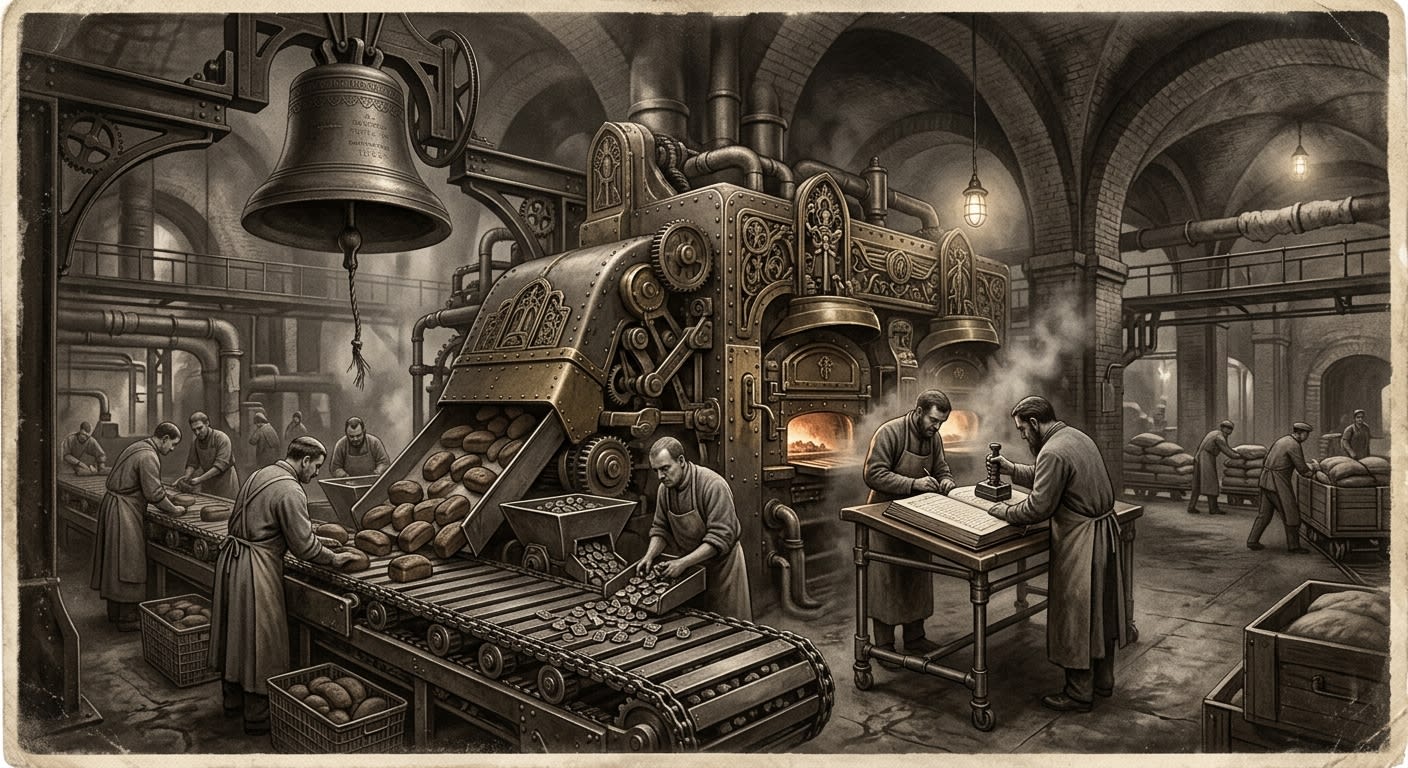
The Heartlands rise in cathedral-cities where spires are laced with bell-lattices and the hours do not pass until struck. Each peal is governance made audible. Labour begins when bells cry. Labour pauses when bells sigh. Absolution is granted when they thunder. Funerals are sanctified when they drone. Curfew descends in bronze. Rations issue under cadence. Marriages wait for approved notes, deaths for lower ones, and rebellions for none at all.
Outsiders complain that Synodal bells never cease. They should be grateful. Silence is expensive. Silence gives thought room to put on boots.
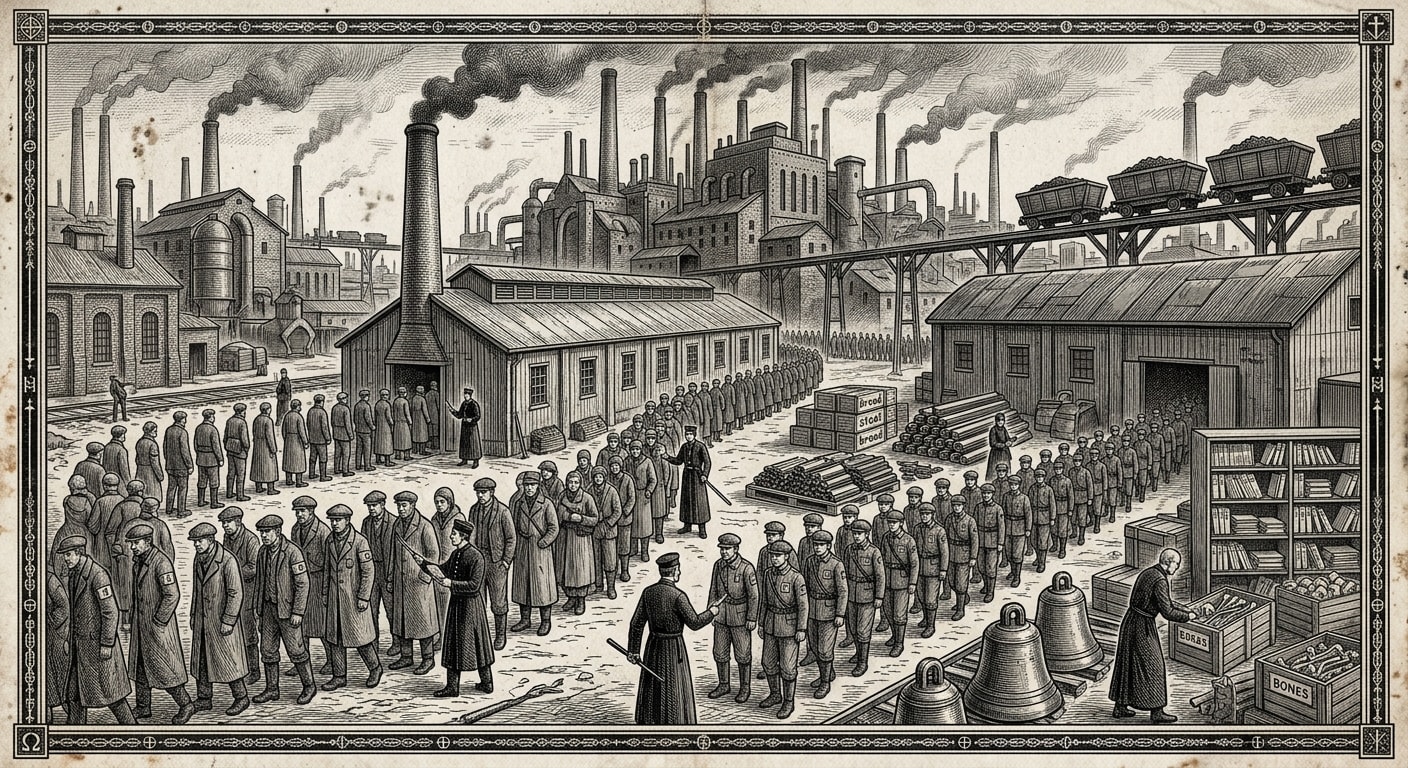
The Heartlands machine is pious in every visible component. Processional foundries thunder beside cloisters, so the smoke of furnace and censer can quarrel in the same street. Ration-chapels distribute stamped bread beneath frescoes of martyrs whose painted ribs resemble inventory marks. Ossuary districts press the dead into walls as mortar, brick-dust, reliquary plaster, and legal argument. To walk the Heartlands is to move through a sanctified machine: every cog a soul, every breath a prayer, every prayer counted against output.
This machine was not built in one decree. It grew after the Sundering, hardened after the Line, and acquired its modern face under the Concordat of Strasbourg in A.S. 90, when scattered emergency arrangements were dignified into permanent offices. The Bureaus took what war had improvised and taught it to sign its name. Roads became corridors. Kitchens became ration chapels. Guild tallies became census evidence. Foundry songs became doctrinal compliance. Family grief became ash credit.
Early provincial primers describe the Heartlands as the Synod's peaceful interior.
Corrected. The Heartlands are the Synod's regulated interior. Peace is an unaudited word and has been withdrawn from instructional use.
Bread is the cleanest example. In the old monarchies, a loaf was food, price, harvest, oven, and household. In the Heartlands, a loaf is doctrine measured in grain. The Bureau of Tithes weighs it, Records enters it, Pilgrimage claims transit allowance if it moves, War requisitions it when soldiers are hungry, Mercy distributes the damaged end under witness, Doctrine explains why the crust was always sufficient, and the citizen eats before the argument cools.
The Heartlands teach obedience through repetition rather than astonishment. The same bell every dawn. The same queue at the ration window. The same clerk's wrist, the same stamp, the same notice forbidding complaint within ten paces of a complaint box. Tyranny at the front wears a helmet. Tyranny in the Heartlands wears a sleeve polished by counter wood.
#On Zones, Corridors, and the Geography of Use
Zone 1 flatters itself as deep safety. The Atlantic seaboard, France, the Low Countries, Iberian arteries, canal cities, ports, relic markets, Pilgrimage yards, wax compact towns, old martyr roads, and those prosperous districts where citizens speak of the war as if it were weather: terrible, distant, requiring contributions. Paris, Lyon, Metz, Bruges, Ghent, Marseille, and Saint-Malo all wear different wounds under the same obedient coat.
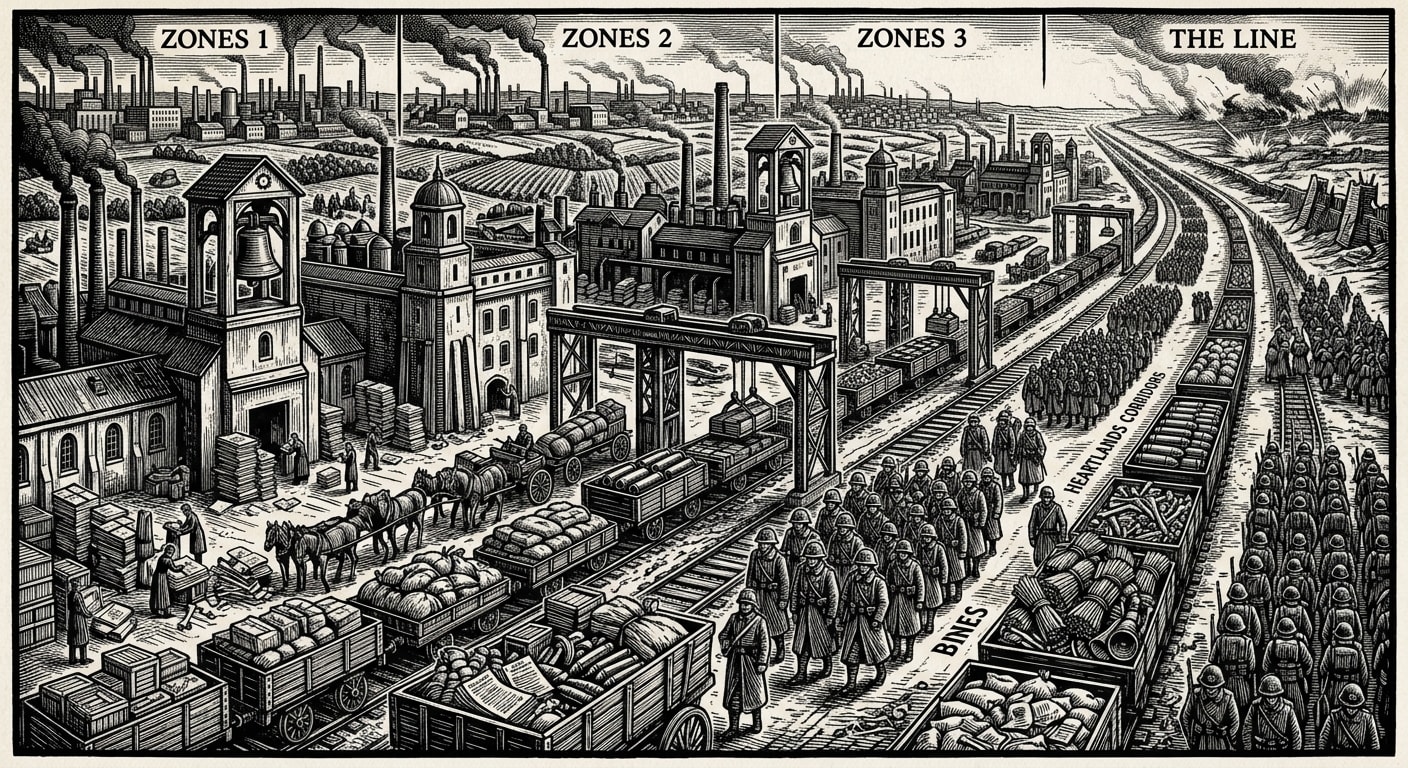
Zone 2 is the industrial nave. Germany, Switzerland, northern Italy, Austria's held districts: foundry, archive, rail, mint, barracks, paper, quarry, fuel, finance. Strasbourg sits there as capital and stomach. Hamburg gulps Atlantic imports. Kanzleiburg thinks northern thoughts in regimented brick. Munich packs trains until time itself smells of grease. Cologne stores money, faces, relic claims, bridge sins, and enough old politics to choke a saint. Essen-of-Hymnsteel teaches iron to sing. Mainz tolls, remembers, denies, and collects.
Zone 3 is where the Heartlands stop pretending that distance is innocence. Prague, Warsaw, Vienna-Ruins, Bratislava, Budapest, Sofia, the Hintermark, the Palatine switchyards, the Carpathian corridors: these are staging grounds, overflow organs, forward depots, shrine-wounds, half-civil cities with one ear turned west for orders and one east for artillery. Zone 3 feeds Zone 4 and learns thereby that the Line's hunger is holy because no other adjective would survive the accounts.
Between these zones run corridors with names citizens learn before prayers because prayers do not get grain to the front by dusk. The Northern Corridor draws imports through Hamburg and Kanzleiburg toward Warsaw, Brest, and Königsberg. The Central Corridor pushes Strasbourg's will through Munich, Vienna-Ruins, Bratislava, Budapest, and the Carpathian approach. The Southern Corridor (Unregistered) pulls through Marseille, Genoa, Venice, Saffron Bastion, Thessaloniki, Sofia, and the roads toward Irongate, Shipka, and Constantinople.
Corridors are not roads. Roads merely carry. Corridors command. A road may detour around a broken wagon. A corridor creates an office to explain why the wagon broke in a manner useful to requisition doctrine. Along the Queue Road, time itself is taxed through gates. Along the Rope-Ferry Chain, crossings become hearings. At the Palatine Switchyard of Lorn, rail departures sing through Cantor Corps procedure because forty-one men once entered a siding the manifests denied existed. The Heartlands are full of such education.
#On the Cities That Feed the Wound
Every Heartlands city specialises in a form of obedience. Strasbourg specialises in authority. Cologne in custody. Munich in throughput. Hamburg in swallowing. Paris in surveillance disguised as civilisation. Marseille in profitable devotion. Ghent in canal memory. Ulm in paper and punishment. Vienna-Ruins in sacred delay. Budapest in forward arithmetic. The list is long because the Synod is large and sin is departmental.
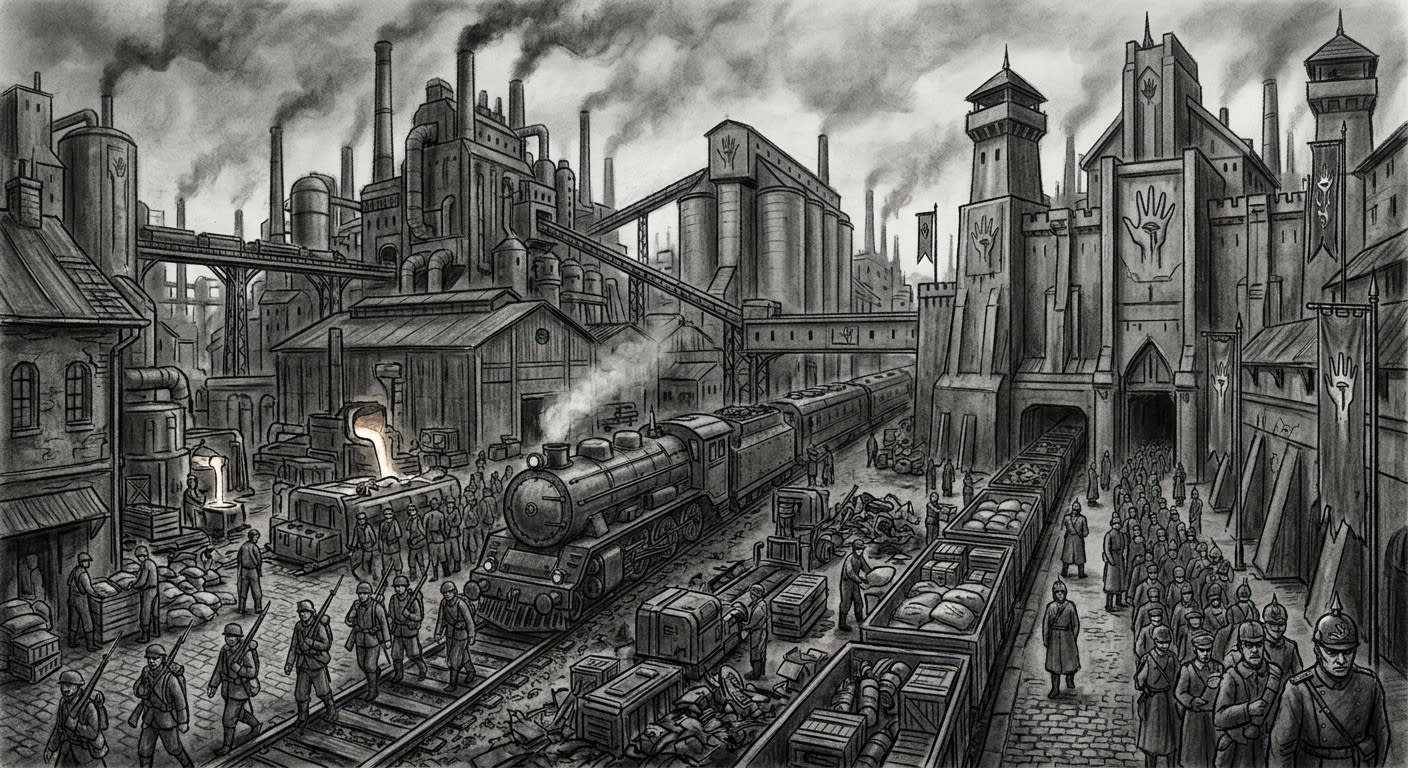
The small places matter more than grand maps admit. The Grain-Gray Ration Parliament of Wexel turns hunger into procedure, debates gram weights with the fervour once reserved for angels, and makes families understand that a ration cut is easier to endure when issued by a chamber with benches. The Candle-Sump District of Lower Vire renders fat, bone, tallow, stink, and canal refuse into light fit for altar and office. The Chrismole Furnaces of Brast teach coal, choir, and sanctified fuel to hate one another productively. The Oathglass Quarrytown of Saint-Helm's Cut pulls sacred diagnostic glass from a cleft that answers names better than hymns.
The Heartlands fringe is full of places that began as accidents and matured into inevitabilities. A war officer requisitioned a coal-seam junction; Brast became necessary. Canal locks attracted chandlers; Lower Vire became a district with a smell strong enough to register. A market town stood where supply corridors crossed; Lorn vanished and the switchyard appeared, the old name surrendered to divine purpose and freight timetables. Surveyors found glass; Saint-Helm's Cut learned to bleed workers into reflection.
Several civic histories state that Heartlands towns developed organically around local needs.
Clarified. Local need is the name later given to Bureau seizure once the seizure proves profitable.
In these towns, the front is present as number. Shells per week. Loaves per company. Litres of chrismole. Coffin boards. Replacement boots. Conscription classes. Bell-metal demand. Ash returned by weight. Saints' dust by sealed packet. A mother may never see Bastion-Shipka, yet her candle tallow may burn there under a sleepy gunner's nose. A miner may never hear Maldrake's artillery, yet his coal becomes thunder against Wrath's slag furnaces. A clerk may never leave Wexel, yet the reduction he signs can teach hunger to a trench company two hundred miles away.
This is the genius of the Heartlands. It distributes responsibility until guilt has no address.
#On Settlement, Removal, and the Domestication of Bodies
The Heartlands have a talent no bastion can equal: they make coercion look like household arrangement. At the Line, command arrives with mud, whistle, gun-stock, and officer. In the interior, it arrives as school placement, window reassignment, parish merger, rent correction, guild vacancy, chapel closure, bridge fee, quarantine advice, and an invitation to serve the common need in a town whose name the family had not heard before supper. The genius is not gentleness. The genius is furniture.
A moved family first debates where the bed will go. By the time the debate ends, the old district has already given their ration window to someone else.
The Bureau of Settlement claims the Heartlands as orderly habitation. It assigns families to districts, districts to quotas, quotas to roads, roads to front demand, and front demand to providence. Settlement is the Bureau's art of making people appear where needed and disappear where inconvenient without admitting that either motion required violence.
A Heartlands household is a small administrative unit with beds. Its members hold ration status, parish status, labour status, bell compliance, tithe standing, name condition, and funeral liabilities. Marriage joins ledgers before flesh. Birth creates a future claimant. Death releases space, creates ash, generates inheritance disputes, and occasionally enters the walls. The household imagines itself private because its doors close. Charming.
Settlement patterns follow usefulness. Canal cities receive clerks, chandlers, rope workers, and people whose backs bend correctly. Industrial cities receive furnace catechists, engineers, condemned scholars, widows, orphans, and debtors with strong hands. Forward cities receive everyone the west wishes to call brave after calling them surplus. Shrine-ruins receive pilgrims, sellers, relic attendants, and those who confuse penance with tourism.
Removal is softer in the Heartlands than at the Line. At the Line, men are ordered, dragged, shot, counted. In the Heartlands, a family receives reassignment, loss of ration window, school transfer, parish correction, guild vacancy notice, debt opportunity, health relocation, ash-vault privilege, or compassionate movement toward available work. The wagon is the same. The vocabulary wears gloves.
The Bureau insists that Settlement preserves civil order. This is true. It preserves order the way brine preserves meat: by changing the thing until decay becomes edible.
Settlement also makes language useful to power. Refugees become residents after enough forms and sufficiently quiet grief. Residents become labour households when quota tables need muscle. Labour households become devotional colonies when the worksite lacks a chapel. Devotional colonies become towns once the dead outnumber the temporary sheds. Towns become ancient after the Bureau installs a plaque explaining that Providence always intended the place to exist. I have approved several such plaques. They were excellent lies, engraved beautifully.
Children learn the trick faster than adults. They stop saying we were moved and begin saying we live here. Schoolmasters praise adaptation. Priests praise obedience. Records praises stable address. Grandmothers keep old door keys in aprons until death, at which point Settlement inventories the keys as non-functional metal and sends them to scrap.
#On Industry, Miracle, and the Appetite of Safe Places
Heartlands industry is never only industry. A furnace is a chapel with worse air. A rail yard is a litany in iron. A quarry is a confession booth dug sideways. A paper mill is a court that has learned to pulp defendants into stationery. The Synod cannot permit matter to be matter. Everything must confess its function before being used.
At Brast, chrismole burns with sanctified complaint. The furnaces began under A.S. 68 requisition, production by A.S. 72, charter under ordnance and doctrine, ratified with the Concordat. By A.S. 201 the place remains Amber: productive, dangerous, suspected, too useful to cleanse. Its Sulking Engine misbehaves like a heretic with a work quota. Its fuel carries prayers into artillery throats. Men cough black and call it incense when officials pass.
At Lorn, rails decide who reaches the front and who is declared to have reached it. The Silent Derailment of A.S. 112 made the Cantor Corps mandatory, because the Heartlands trust song more than engineering when engineering has embarrassed the paperwork. Departures are not released until hymn-phase and manifest agree closely enough to avoid scandal. Closely enough is one of civilisation's load-bearing frauds.
At Saint-Helm's Cut, volcanic glass responds to names, not hymns. This has annoyed Alchemical Standards, Relics, Doctrine, Records, and every foreman who has watched a gallery misbehave when addressed too personally. Oathglass is sacred because the Bureau needs it. It is dangerous because it answers back. Workers know the distinction in their scars.
At Lower Vire, tallow and canal filth make candle authority. At Wexel, ration law becomes grey bread. In the Crownwright diehouses, faces enter metal. In Ulm, condemned intelligence becomes sheets. In Munich, warehouses become stomach lining for the Line. In Essen, hymnsteel receives its vowels under heat. The Heartlands are called safe because the work kills in installments.
#On Work, Class, and the Approved Shape of Want
Heartlands society is described in catechisms as harmonious estate: clergy praying, soldiers guarding, workers labouring, clerks recording, children learning, widows remembering, the dead supporting. True, from the balcony.
From the street, the order has sharper edges. Ledger Saints eat warm and sleep dry because their signatures can starve a block. Licensed guilds enjoy steady rations and constant inspection, which is the Bureau's nearest approach to affection. Sail crews and soldiers are paid in windows, exemptions, and promises so old they have acquired ceremonial value. Refugees trade labour for shelter and stamps. Under-quay men, tunnel runners, paper thieves, and grey brokers live rich in bursts and dead in averages. The Heartlands call this hierarchy. The hungry call it weather because weather cannot be appealed.
Work is assigned through quota, debt, guild inheritance, parish correction, school aptitude, confession penalty, and the quiet fact that a household with three sons will lose at least one to a road, a yard, a furnace, a trench, or an office that eats the spine more slowly than shrapnel. Women run tally rooms, ration chapels, ash counters, cooperage lines, fever kitchens, bell rope crews, sponsor desks, and half the informal economies the Bureaus pretend not to require. Children sort buttons, fold slips, scrape wax, carry notices, sing compliance drills, and learn early which adults have names that can stop a queue.
Want is never admitted naked. It is issued clothing: ration pressure, devotional economy, corrective scarcity, wartime allotment, temporary reduction, local shortage, moral discipline, pending reassessment. Hunger in Wexel wears parliamentary grey. Hunger in Munich wears warehouse arithmetic. Hunger in Lower Vire smells of tallow and canal rot. Hunger in Zone 3 has learned to stand aside for troop trains. All of it reaches the stomach by sanctioned route.
The citizen survives by learning which laws are walls and which are curtains. A wall breaks the skull. A curtain may be lifted if one knows the clerk, the aunt, the retired provost, the chapel sister, the switchman, the chandler, the ash registrar, the boy who carries unsealed notes through the rain. The Heartlands are obedient. They are also densely expert in minor disobedience, which is how obedient places avoid burning down.
#On the Dead in the Walls
The Heartlands possess the most civilised relationship with death in Europe: they file it, grind it, praise it, weigh it, plaster with it, and invoice the survivors.
Ossuary districts are everywhere. Some are old piety, catacombs and charnel chapels inherited from gentler centuries. Some are war innovations, ash-vaults and bone presses built when bodies returned faster than cemeteries could pretend to be pastoral. Some are pure Bureau logic: the dead occupy space; walls require material; doctrine requires remembrance; Tithes requires valuation. Bone mortar solves four problems and offends only the sentimental, who can be assigned to scraping duty.
The dead in the Heartlands are not absent. They are infrastructure. Grandfathers strengthen ration chapels. Martyrs powder municipal steps. Unclaimed soldiers line barracks walls. Condemned clerks become paper. Infants lost in fever districts enter tiny reliquary bricks, each stamped too small for comfort. A citizen walking to market passes ancestors in plaster, heretics in lintel dust, saints in authorised niches, and administrative errors under whitewash.
This practice is defended as remembrance. It is also containment. A named grave is a site of family argument. A wall is public doctrine. A grave gathers flowers, murmurs, unscheduled grief, and sometimes politics. A wall gathers damp. The Bureau prefers damp.
The dead make the Heartlands honest in spite of every proclamation. Safe territory should not need so many bones at eye level. Rear districts should not build with battlefield return. Peaceful cities should not require ash registries large enough to bend floors. Yet there they stand, walls strengthened by the citizens whom safety failed more slowly than open war.
#On the Apparatus Beneath Comfort
Every safe region hides machinery whose purpose becomes visible only when it fails. The Heartlands are no exception. Under road, rail, ration, and bell lie older devices: culverts that hum under no water, sealed drills below survey houses, gate mechanisms that answer to no present architect, minute drifts in queue clocks, and apparatuses for which the Bureau of Engineering writes nouns instead of explanations.
The Apparatus of Gate Nine remains the most impolite example. A drill went down for vibration and returned with doctrine. Beneath a Heartlands artery lay a mechanism that had been waiting with the patience of buried guilt, older than the offices that claimed jurisdiction over it and more disciplined than the men sent to classify it. The Bureau called it infrastructure because infrastructure sounds less like accusation.
Such things trouble the Heartlands more than raids would. A raid confirms the world: enemy outside, citizen inside, wall between, bell above. A hidden machine below the road suggests that safety has foundations no one consecrated, debts no one entered, pressures no one tithed, and containment arrangements inherited from a history the Bureau has chosen to redact for everyone's convenience, chiefly its own.
The citizen meets these secrets as inconvenience. Gate Nine delays. The Queue Road changes time. A tunnel hums. A cellar not listed on the plan receives footsteps. A ration office refuses to open because the wall behind it is breathing in numbered intervals. The posted notice says inspection. The priest says patience. The engineer says nothing where Purity can hear.
The Heartlands' comfort depends on such silence. A city can endure a visible furnace, because smoke is honest vulgarity. It struggles with a sealed engine beneath a chapel that turns once every ninth bell and makes the candles lean east. It struggles more when the engine stops and the district begins remembering streets removed from every map.
#On Doctrine, Festival, and the Management of Cheer
The Heartlands are governed by fear, ration, rail, and permitted joy. A miserable population works poorly unless misery is given feast days, ribbons, cheap ale, approved songs, and something to throw at a target labelled heresy. The Bureau of Festivals exists because even despair must be scheduled before it spreads mildew through productivity reports.
Every district has its licensed gladness. Chain-Rising Week in coastal supply towns. Bread Benedictions in ration cities. Ash Return Vigils where families receive sealed packets and pretend weight proves identity. Foundry Saints' Days in forge towns, complete with blister blessings and sermons on heat. Bell anniversaries, canal processions, quarry laments, orphanarium choirs, candle allotment feasts, switchyard departure pageants, and the little local rites that prove citizens can still laugh after asking permission.
Festival is not relief from control. It is control with music. A procession moves crowds along approved streets. A hymn teaches approved timing. A feast distributes approved scarcity. A licensed mockery of officials lets citizens spit upward without hitting the ceiling. The Synod, contrary to enemy caricature, does not fear laughter. It fears laughter that chooses its own object.
Children remember festivals more kindly than decrees, which is why decrees dress themselves as festivals whenever budgets permit. A boy who receives sugared crust on the Day of the First Levy may later march east with less complaint. A girl who sings the Ash Return refrain may file her husband's packet with cleaner hands. A widow who laughs at a licensed fool dressed as a Tithes assessor has spent anger without changing the assessment. Mercy, in the Heartlands, often arrives as theatre because actual mercy would require amended tables.
#On Present Strain and the Lie of Distance
As of A.S. 201, the Heartlands remain loyal because loyalty has been made easier than alternatives and alternatives have been made educational. The bells ring. The ration windows open. The rail yards dispatch. The foundries cough. The candle districts stink. The quarry faces shine. The walls hold their dead. The front receives what it demands, though every year demand finds a new tooth.
Strain shows in small departures from the official smile. Bell compliance letters pile higher in Zone 8 and make Zone 2 nervous. Face theft spreads through mint districts. Hunger acquires parliamentary vocabulary. Rail anomalies find sidings that maps deny. Ash stores disagree with casualty lists. Children in industrial parishes know the names of bastions before the names of rivers. Guilds ask for exemptions in phrases close enough to obedience to avoid Purity. Clerks correct numbers downward, upward, sideways, and under seal.
The Heartlands do not rebel as a province because they are not one province. They are a set of organs taught to compete for blood. Canal against rail. Foundry against ration. Pilgrim road against military convoy. Tithes against Mercy. Records against anyone with a memory. City against district. Parish against queue. A revolt must first find itself in the correct filing category, and by then the bell has rung for work.
HEARTLANDS SECURITY ABSTRACT — SEAL AMBER Common factor in unrest: ration contraction, bell fatigue, ash-return discrepancies, inherited reassignment, wall-burial disputes. Recommended phrasing: localised devotional exhaustion. Forbidden phrasing: interior war-weariness. If multiple districts repeat the same complaint within one quarter, classify each complaint under separate causal headings. Do not permit them to discover they are speaking together.
The citizen in Zone 1 thinks Zone 3 is the frontier. The citizen in Zone 3 thinks Zone 4 is the frontier. The soldier in Zone 4 knows the frontier begins wherever the last honest sleep ended. I, who have read the ledgers and corrected the adjectives, offer a cleaner definition: the frontier is the place where the Synod's demand touches flesh. By that standard, the Heartlands are frontier from cellar to steeple.
At dawn in the Heartlands, bells wake spires, furnaces, rail yards, ration chapels, queue roads, orphan dormitories, candle sump alleys, quarry galleries, archive banks, and ossuary walls. Smoke climbs. Ink dries. Bread is cut. A switchman listens for the hymn-phase. A widow touches a wall that contains half her family and one stranger. A child repeats the zone map without understanding that maps are prayers addressed to power. Eastward, the Line opens its mouth.
The first carts move before full light: flour west to east, ash east to west, candles south, paper north, bodies wherever the tables require. A clerk unlocks the ration chapel. A furnace catechist clears his throat over men already coughing. Settlement runners pin address notices to doors still warm from sleeping families. Under Gate Nine, something old accepts the day's vibration and keeps its own counsel. The bells continue. They always do.