
#On Unlicensed Mirth
"A joke can burn a house." — Wexel proverb
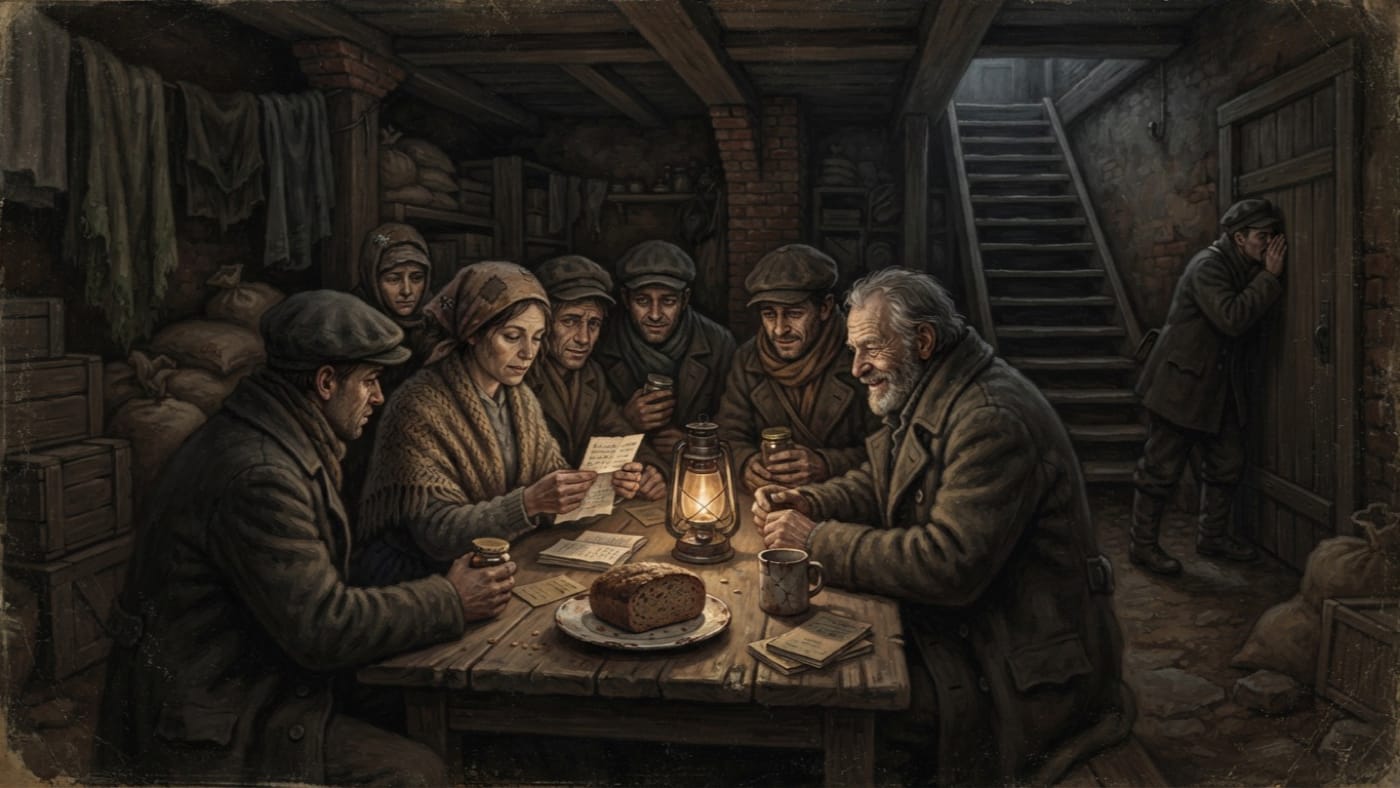
The Cellar Circles of Wexel, whose own people call them the Quiet Mirth, are a heresy network without a public face, a registered address or a single line in any ledger the Bureau of Records admits to keeping. Their purpose is to preserve human joy in a town that has made joy a taxable substance. Their instruments are the smuggled joke, the coded proverb and the shared loaf. Their territory lies under the floorboards.
The town above them needs little introduction. The Ration Parliament of Wexel was raised in A.S. 98 to count grain. After the Dust Fire of A.S. 112 killed three hundred and forty souls, it began counting faces as well. The Ration Prefecture and the Mirth Office followed, and with them the formal discipline of joy: a smile measured by brass gauge, a laugh licensed by permit, contentment owed to the Parliament as reliably as the tithe. Whatever a citizen of Wexel feels in public belongs, for practical purposes, to the Parliament.
The Circles maintain that some small portion of it still belongs to the citizen. The Church has a word for that position. So does the Mirth Office, and its word carries a fine.
No founder is recorded and no charter has been recovered. Nobody has produced a membership roll, a council or a creed that any two cellars would recite alike. I have seen inspectors' reports describe a "leadership." They describe it differently each time.
#On the Cellars and Their Carriers
The Circles convene after curfew. Lanterns are fixed to the ration posts, the patrols walk their smile loops, and Wexel's markets, as the clerks put it, "move into the cellars." In a town this quiet, laughter becomes a detectable sound. So the laughing goes underground, where the soil can absorb it.
The cellars are ordinary ones. They are dug under ordinary houses, smell of turnip and damp lime, and have stairs that a provost could descend in four strides. Many lie in Canalback, the poor quarter on the irrigation canal, where the air smells of algae, rot and cheap stew. On the Canalback Steps, cellar entrances are hidden behind flood-stains on the masonry. The Mirth Office's inspectors dislike walking in algae. I have found no other doctrine in Wexel that is applied so consistently. Other cellars lie under houses elsewhere in town, and no cellar is known to serve as a headquarters. A network with no centre gives the Ash-Fine Marshals nothing to burn first.
Runners carry the trade between them. They move folded paper sheets called mirth scripts, which hold a joke, a mimic-play cue or a scrap of verse, small enough to fit inside a ration book. A proverb said at the right doorway works as a passport: the ledger eats last, hunger hears everything. Cellar doors are answered with laugh-tap knocks. The Bureau has no reliable record of the pattern, and I will not publish an unreliable one. The surviving forms of unsanctioned amusement are joke circles, mimic plays and hidden feast nights. In the reclaimed houses of Ash Fines Row, contraband feasts have been held among the cinders, and some tables there are reported to have carried honey. In Wexel honey is classified, quite rightly, as dangerously joyful.
The poverty of the material does not matter. Owning a joke sheet proves an appetite for amusement the Parliament has not regulated, and the Mirth Office prosecutes that appetite. A bad joke folded inside a ration book is enough to fine a household.
The town's archetype of the trade is the Cellar Jester. Nobody has named one. The Mirth Office hunts the figure the way the Bureau of Purity hunts relic thieves. Signals sometimes come down from the silo catwalks, where a lamp may be shaded or a hymn line dropped at the right moment. Those catwalks also belong to the Silo Catwalk Choir, which sings over the grain on the bell schedule and reports what it sees to the Parliament. A lookout on a catwalk may serve a cellar. The Choir as a body serves the Parliament.
#On What Passes Beneath the Ledger
The Quiet Mirth trades in jokes, and people who come for the jokes are fed while they are there. The cellar market around the Circles moves hidden grain, forged ration chits and lamp oil. In Wexel oil is a currency of its own, because the night trade stops when the lamps go out. The Circles' own records list mutual aid as a method, and in practice that means a family whose allotment Prefect Marwen Kile has reclassified from provision to clemency can still eat in the week the clemency fails to arrive. How much bread is shared, with whom and on what terms is known only to the people who share it.
A distinction is owed here, and the Mirth Office never makes it. The Circles are part of Wexel's underground. They do not own all of it. The counterfeit-chit ring that has run for eleven years behind a bread stall in the Chit Market answers to its proprietor and to the informants' register. No affiliation with the Circles is established. The stall survives because its proprietor supplies names.
The same cellar market sells a product it calls arson insurance. I have found no record of what it pays out or whether it has ever paid at all. One thing cannot be bought below ground at any price, and that is true immunity from audit. The name drawer beneath the Parliament dais is kept above ground, and its key hangs on the Speaker's chain.
#On Names Offered in Payment
"Names are currency. Pay in people." — Canalback saying
Sister-Lector Neme Varr directs the Mirth Office. It works through citations, public shaming, confession leverage and informants. Its most productive instrument is the name payment: a citizen with citations against them can clear the debt by offering someone else's name. The name then goes to Speaker Huld Bex's drawer, where audit names are kept. From there it may come out with a clearance stamp or a foreclosure writ, or it may pass to the Ash-Fine Marshals. Prefect Kile, meanwhile, decides how much grain each household receives. Each of the three officials holds a different lever, and every household in Wexel lives under all three.
"No one is punished for emotion — only for fraud."
The Mirth Office cites citizens for unearned joy when a smile is too wide and for ingratitude when it is too narrow. Its holding cell is called the Laugh Box. The Office treats the earlier phrasing as a public courtesy. The Hieromnemon treats it as an error, and has corrected it.
This is the condition every cellar works under. Consider a mother with three citations against her household and a cellar address in her head. Her neighbours have fed her children through a lean month. The Mirth Office will clear her account if she gives up a single street and stair. She knows that a Marshal's ash bill allows three days to pay, and that on the fourth day the house is purified. Wexel expects her to weigh the hearth against the cellar every day. Some households have chosen the hearth. The Circles go on meeting knowing that someone on the stairs has had the same offer and may already have taken it.
The fines go to the Bureau of Tithes and the land assessments follow them. The names feed a surplus ledger that the public accounts never mention. Grain recorded there as diverted goes somewhere. I am not cleared to say where, and I will not guess.
#On Laughter Returned by the Wind
"If the wind laughs first, don't answer with yours." — Wexel superstition
The chaff-winds cross Wexel all year and repeat what they hear. A laugh made after curfew may come back half a second later from the wrong side of the street. By the parent assessment's account, genuine amusement is amplified most of all. Grain shifts audibly in sealed bins. Ink in the Mirth Office's citation ledgers dries into loops that look like smiles.
This makes the cellar a doubtful refuge. A cellar can keep laughter out of an inspector's hearing, but the wind may still carry it up to the street. The town's countermeasures are salt lines at cellar doors, wax plugs in keyholes and blank joy masks worn during audits. By the Bureau's own admission they fail. The wind is no ally of the Quiet Mirth, and nobody has learned to aim it. Locals test a stranger by asking, Did the wind clap? Only someone who has lived through a crackdown knows how to answer.
#On Counting Week
Counting Week is the post-harvest audit, when every household account in Wexel is weighed at once and riots break out more often than in any other week of the year. The Circles have grown recently. Their growth followed a scandal in which the Speaker's own family was exempted from fines. In a town that measures faces to the millimetre, that exemption was hard to read with a straight face.
Reports reaching the Bureau say the Circles intend a mass joy strike in Counting Week. The reports do not say whether that means refusing to measure, smiling all at once or simply laughing at the scales. They are reports of a plan. No strike has been confirmed, and no date or outcome is recorded. Nobody has shown that a network with no centre could coordinate one.
The cellars stay open in the meantime. Lamps are shielded, scripts are folded, bread is broken, and someone on the stairs listens for the patrols overhead.