
#On the Discipline
"Measured mouths, measured hearts." — Inscription above the Scale Gate, paint renewed quarterly by civic mandate
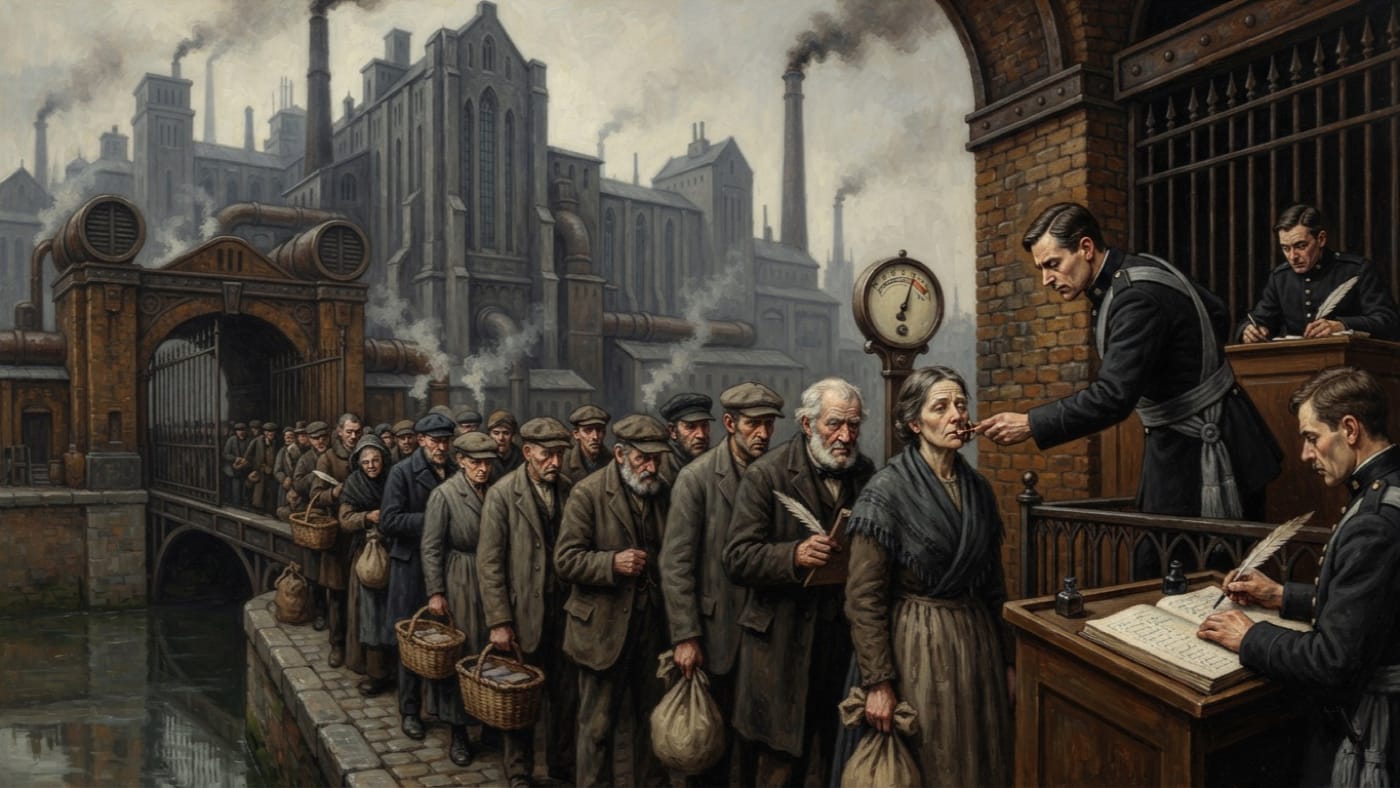
The instrument is a small curved piece of brass, hinged at one end, and it fits in a lector's palm like a communion spoon. An inspector of the Mirth Office lays it against the corners of a citizen's mouth and reads what the face has done. This happens at the Scale Gate, in the Chit Market, and on the doorstep of any household under review. That reading is Joy Discipline. It is the formal regulation of emotional display in the Ration Parliament of Wexel, and the only statute in the Heartlands enforced in millimetres.
The demand is simple to state and impossible to rest inside. A citizen of Wexel must appear grateful, and gratitude has a visible width. A citizen who smiles too much is cited for "unearned joy." One who smiles too little is cited by the same pen for "ingratitude." Between the two lies a band of approved contentment so narrow that the townspeople practise it in mirrors before dawn, the way other towns practise their prayers. When one Wexeler asks another, "How's your mouth today?", the correct answer is a number.
Laughter is permitted in the way fire is permitted in a granary: by licence, according to context, and in the quantity written on the form. On my first inspection, in A.S. 194, the Parliament issued me a laughter permit valid for one controlled exhalation. I did not use it. A Hieromnemon does not spend a document he may later need to cite.
#On the Safety Measure
"Hunger teaches holiness." — Ration Prefecture broadsheet, distributed at every Scale Gate checkpoint
Wexel was founded in A.S. 98, eight years after the Concordat of Strasbourg. A famine had killed eleven thousand across three provinces, and the Bureau of Records resolved to build a town whose whole purpose was counting food. Emotion was taxed there early. The record shows levies on mood well before any charter dignified them. It does not agree with itself on how many years the clerks needed to get from the grain sack to the grin, and I decline to referee a dispute between two of my own margin notes.
Formal discipline arrived with the dead. In A.S. 112 the Dust Fire tore through the original wooden silos and burned three hundred and forty people in a column of grain-dust flame. Records counted them. The Bureau of Doctrine explained them. Doctrine held that the catastrophe came from "reckless behaviour," and within weeks that phrase had come to cover singing and running near the bins. No surviving finding establishes that a song ever lit a single mote of flour. Doctrine did not need one.
The Ration Prefecture was constituted within the month, and the Mirth Office followed within the year. The charter declared the new regime temporary. In Article IX it also took care to declare what the regime was not.
Wexel will tell a visitor that it invented the regulation of joy. The Bureau of Festivals was licensing celebration and metering the response of crowds long before any Hessian clerk owned a gauge, and the Church's calendar of observance has never left pleasure unsupervised. Wexel's contribution was to move the measure out of the festival and onto the face, and to take it every day at the weighline. That is a refinement. The town is welcome to the boast, and I have recorded it as a boast.
#On the Measured Mouth
"A smile is a receipt." — Wexel proverb
Sister-Lector Neme Varr directs the Mirth Office. Its formal style is the Doctrine Office of Emotional Compliance, and its street name is shorter for reasons any clerk with a stopwatch will appreciate. The inspectors wear grey sashes. They learn the trade at the Mirth Office Schoolhouse, a building that smells of incense and of the sour tea they drink in quantity. There they are taught to calibrate the gauge and to read a mouth in the half-second before its owner corrects it. They are also taught to turn "a woman smiled at bread" into a citation an auditor can file.
The gauge decides. The Office gives the lawful range as approximately three millimetres. I measured it and found two. Nobody has told me which figure is wrong, and I have not asked, because in Wexel a question of that kind counts as a reading of the face that asks it.
The face is examined in public and confessed in private. Every week each household stands for Mirth Rollcall and reports its gratitudes aloud. The Office marks an absence, and it also marks a gratitude delivered too flatly. Gratitude declarations go onto forms. Mood confessions are attached to the household ledger, so a family's spiritual temper travels in the same wax-sealed book as its grain account. Before each meal comes the Silence Minute, when the family sits over its porridge and listens for unlawful laughter, including its own. A host must offer each portion measured, and a guest must praise it.
In A.S. 197 the Parliament showed me two hundred citizens smiling on command in Parliament Square while a clerk went down the rows with a gauge. I have reviewed processions in Strasbourg with less discipline in the ranks. Once the clerk had passed a mouth, I did not see it move.
#On the Citation and Its Collection
"The ledger eats last." — Canalback proverb
A citation in Wexel is never merely a rebuke. It is paper, and in Wexel paper is food.
Three offices share the citizen between them:
- Varr's inspectors write the mirth mark.
- Prefect Marwen Kile's Ration Prefecture holds the household allotment. Kile decides whether a family's grain goes into the books as provision, which the town owes the family, or as clemency, which the family owes back.
- Speaker Huld Bex holds the audit lists and the name drawer beneath the Parliament dais, and opens it when he sees fit.
None of the three needs the others' consent. A face that fails at the Scale Gate can therefore reach the allotment and the audit list in the same week, by three separate and lawful roads.
The punishments are material. Rations are cut under the heading "waste mitigation." Fines are paid in chits, in coin where there is coin, and in labour-hours worked off as "mood restitution." Unpaid fines become debt, and debt becomes a foreclosure writ. When a household falls far enough behind, an ash bill arrives under a flame seal and the family has three days. On the fourth the Ash-Fine Marshals arrive with torches and carts, and the house goes into the books as purified.
There is one way out, and it costs a neighbour. A citizen may clear his own citations by offering someone else's name "for review." The Wexelers call this a name payment. It buys no immunity, which nothing in Wexel can buy, as even the black market admits. It buys relief, and another household's ledger pays for it.
The reason the temporary measure lasts was given to me by the Bureau of Records in A.S. 199, as a figure: mirth-compliance fees make up eleven percent of Wexel's municipal revenue. The accounting is the Bureau's own, and it was presented to me with pride. I have not audited it. I note only that if Wexel gave up eleven parts in a hundred of its revenue for the sake of public happiness, the Bureau of Tithes would not find the shortfall amusing. Where the rest of Wexel's surplus goes is under seal, and I leave it there.
Earlier compliance reports classified the Mirth Office as "an advisory body with no enforcement capacity."
This classification has been revised. Later reports record forty-three inspectors, a citation archive of more than twelve thousand entries, and a holding cell called the Laugh Box. The Office's advice can no longer be told apart from its enforcement, and the Bureau of Doctrine has declined to tell them apart.
#On Unlicensed Mirth
"A joke can burn a house." — Wexel proverb
Forbid a thing by the millimetre and the millimetre acquires a price. The Cellar Circles, who call themselves the Quiet Mirth, meet in the undercellars and the Canalback shacks. They trade what the Mirth Office has made scarce: joke sheets folded small, proverbs in code, bread shared off the books, and the private laughter of a room with the door shut. Runners carry the sheets, and visitors knock with a laugh-tap to be let in. Those who confiscate the jokes inform me that most of them are bad. Possessing them is the offence, and the circles seem to understand that possessing them is also the point.
The Quiet Mirth keeps no public face and has no charter that anyone has recovered. It survives on mutual aid, cellar walls, and the inspectors' reluctance to walk through canal algae.
The cellars are not entirely private. Wexel has its Chaff-Winds, which the Bureau of Rites classifies as a Category One Localized Atmospheric-Acoustic Disturbance. The wind repeats laughter, sometimes laughter that nobody in the street produced. Grain shifts in sealed bins. Ink in the citation ledgers dries into loops that look like smiles. A joke told under a floor may come back across Parliament Square half a second later on a gust, from the wrong direction. The town has tried salt lines at cellar doors, wax plugs in keyholes and blank joy masks at audits, and the record calls all of them ineffective. The Bureau has not determined what the wind is, or whether it answers to permitted laughter or the other kind. Neither have I.
#On the Measure Still in Force
Eighty-nine years have passed since A.S. 112. In that time the temporary public safety instrument has not been rescinded or amended in substance, and I found no vote on it anywhere in the Parliament's chalk. Steel silos now stand where the wooden ones burned, with the dust of Wexel still hanging over them. Every dawn the gauge still goes to the mouth at the weighline. Article IX still states that the measure is no doctrinal innovation. After eighty-nine years the Prefecture is correct: nothing about it has been new for a very long time.