
#On the Crossing in the Record
Châlons owns one paragraph in the Ledger, and that paragraph is about its bridge.
A town ought to have more. It ought to have a charter, a parish register, a tithe dispute, a bishop who drank, a flood year, a plague year, a market cross and a lawsuit about the market cross. In my keeping Châlons has a crossing over a river the record never names, a central arch nobody measured, a column of Rationalist infantry halfway across, and a woman underneath. I did not choose these proportions. The archive chose them, and I sign what the archive holds.
I opened this survey in A.S. 201. That year belongs to my desk. The fall of the bridge has no year in the file, and no clerk who dislikes blank fields will be allowed to give it one.
Readers will want to know which Châlons. So would I. The name is spelled here as the account spells it, circumflex intact. I attach it to no municipality on a modern survey, no river in an atlas and no bank of any river. A name on a page fixes a name on a page. It fixes no coordinate.
#On the Bridge War
During the Atheist Wars the faithful were short of powder, short of guns and short of bishops willing to stand anywhere hot. The Rationalists marched by road and crossed by bridge. A column that loses its bridge becomes a crowd on a riverbank, quarrelling with its maps.
The women came out of the grief that followed the Massacre at Saint-Malo in A.S. 10. In A.S. 14 an ecclesiastical tribunal recognised Sister Margaux, long before any Bureau existed to seal its verdict. The Sisters of the Martyrdom are first confirmed at the Pont des Tanneurs in the approaches to Montreval in A.S. 15. They are attested through A.S. 25, and their record is thickest in A.S. 15–18.
Châlons appears in the order's list of crossings, between Saint-Riquier and the lower Meuse. A list records names in sequence. Any reader who dates Châlons by its neighbours on the page should be prepared to date a corpse by the coffin beside it.
Keep Tanneurs apart. Its record has three women on the deck, a column that halted because it expected a parley, six hours of delay, two spring guns lost and a relic convoy saved. None of those figures belongs to Châlons. The Montreval story also belongs to Cardinal-Marshal Severin of Avignon and to Lucien Artois. No line I hold places either man at Châlons. The column there has no commander in the file. It is the only mercy the archive has shown a Rationalist officer.
#On the Central Arch
The account comes from the order's file, and I give it whole because it is short.
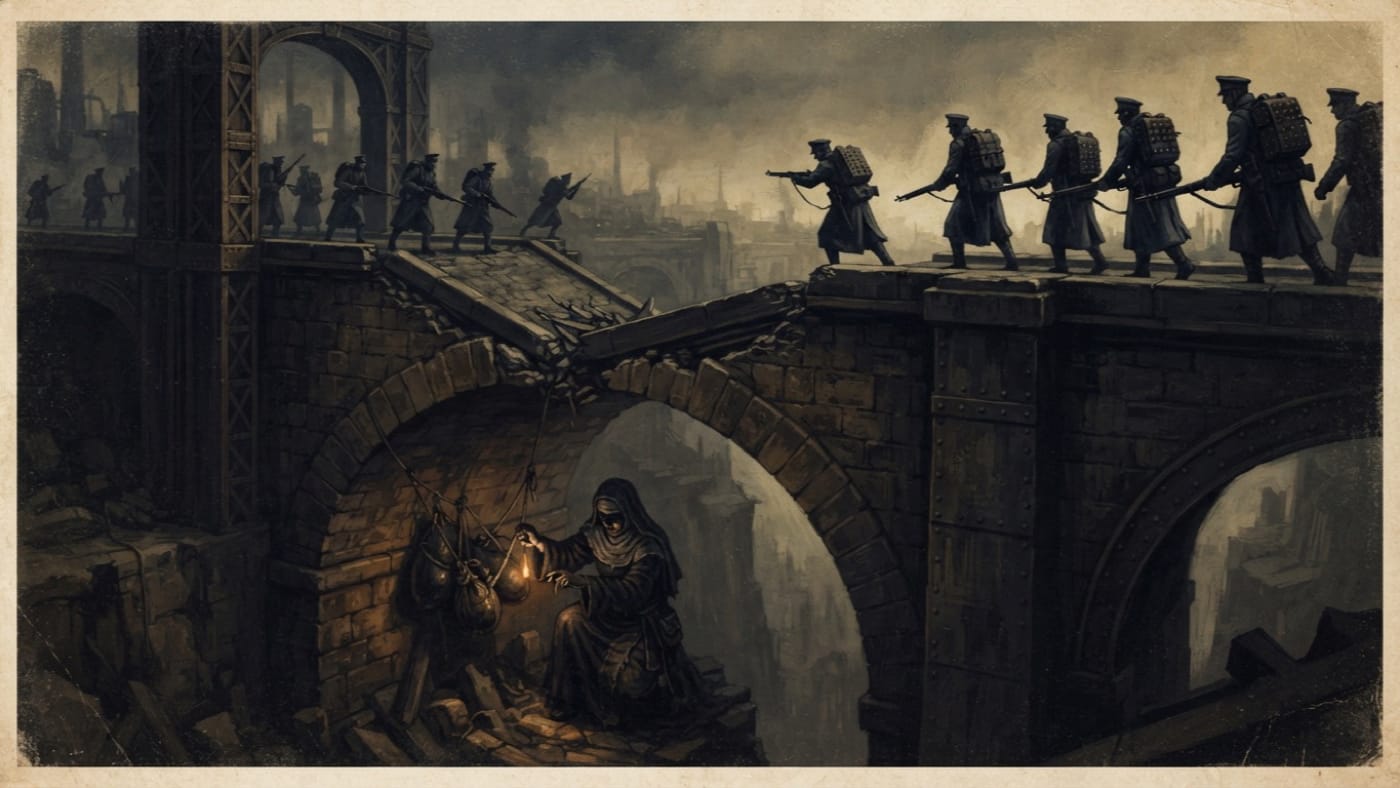
A Sister called Bérénice waited beneath the central arch instead of standing on the deck. When the column reached midspan she cut the oil bladders tied under the crossing and lit a taper with her teeth. Fire rose from below. The deck collapsed inward.
That is the whole incident. Everything else written about Châlons comments on those sentences.
Look at where she was, because place is my business in this entry. Her Sisters at other crossings took the deck, where the enemy could see them. Visibility was their method, and the column halted for the woman before it saw the fire. At Châlons the woman is out of sight beneath the arch, and the column is allowed to reach the middle. The account records the position. It does not record who chose it.
The bladders were already in place when the column arrived. They had been tied beneath the crossing before the column came. The paragraph does not say who tied them, how long it took, or how anyone reached the underside of a central arch carrying oil and cord. It names no accomplice. I will not invent one to make the arithmetic of hands come out even.
The teeth have been sung about so often that they have nearly become a relic. I keep them in the file as written: a taper, her mouth, a flame. The account gives no flint, no burn, no wound and no wonder. The Creator may have attended. The paragraph does not say so, and I file the paragraph.
Then there is what the account leaves out. It does not say she set herself alight. It does not say she died. It says the bridge burned from below and the deck went in. Devotion assumes she went down with it, because her Sisters went down with theirs. Devotion is entitled to that grief. The Ledger is entitled only to the paragraph.
#On the Masonry Dispute
The Rationalists blamed the masonry.
Their reasoning was obvious. If bad mortar destroyed a column, the matter went to procurement: a contractor was condemned on paper and the advance went on. If a nun under an arch destroyed it, the matter became doctrine, with sweeps beneath every span, inspections at every crossing and a new fear of the underside of the world. An army that has just lost men on a bridge prefers to file the loss with procurement.
The masons would not accept it. The account says they had built the span in their fathers' time. That phrase gives no construction year and identifies no generation, and I will not convert it into either. According to the account, they resented secular criticism more than death. They later testified that the masonry had performed admirably once it was asked to become a furnace.
I record the retort as reported testimony. It reaches me through the order's file and the memory behind it. I hold no sealed deposition, no roll of the masons' names and no dated transcript. A good retort survives better than any document, because people repeat it, and every repetition wears away the name of whoever first said it.
Three parties wanted three different causes. Rationalist command needed the stone to be bad so that its columns could stay invincible. The masons needed the fire to be enormous so that their stone could stay honest. The devotional writers needed the woman, because a crumbling bridge makes a poor hymn. Each explanation flatters the party that offers it, which proves nothing either way.
I am Warden of the Sacred Ledger. I do not certify mortar. Whether fire beneath a stone span can bring its deck down, whether the mortar was bad, or whether both were true together, the file cannot say. It records a sequence of events: column, bladders, taper, fire, collapse. The cause stays contested.
#On the Custody of the Memory
The Bureaus that now argue over Châlons did not exist when it burned. The formal Synod was constituted in A.S. 90. The women of the bridge war answered to whatever priest, captain or conscience stood nearest. When War calls the deed transit denial, or the Bureau of Doctrine calls it zeal, a later office is filing papers it did not write.
The order remains unratified. In Strasbourg, Doctrine keeps its drawer on the Sisters locked until Shadows clears it, and Shadows has never cleared it. Present policy lets the faithful commemorate individual Sisters locally as Witnesses of Transit Denial. It allows veneration of ash attributed to the order under provisional status, case by case, so long as no one claims to know whether the woman consented.
My file contains no shrine, feast, burial or ash under Bérénice's name. That describes my file. It does not prove that no chapel near the water ever lit a candle for her. If an urn appears, the provisional rule will apply. I will also want to know how ash got from under a fallen arch into a gilt box.
Consent is harder. The Bureau of Shadows keeps a later summary under Seal Obsidian that credits the order's early organisation and funding to Cardinal Kratz. By his assigned birth year he was a boy of seven when the Tanneurs Sisters knelt, and boys of seven do not fund demolition cells. His later political use of the order's memory is a separate matter. It does not put his hand on the taper at Châlons. Shadows' file mentions a coerced woman who was later given the oil. She is not Bérénice, and nothing in the file says she is.
No evidence establishes that Bérénice volunteered. None establishes that she was forced.
A.S. 92 instructional materials stated that "all Sisters of the Martyrdom were free volunteers, moved solely by divine inspiration."
Corrected for internal editions only. Public editions keep the sentence pending pastoral review. For Châlons, the correction withdraws the universal claim and puts no finding in its place.
#On the Present File
The finding is short because the evidence is short.
Châlons is a named locality, preserved in the Ledger because of a single crossing. The bridge's action is credited to Bérénice and has no date. The river is unnamed and the bridge is unnamed. The central arch is the only part of the structure the record describes. The cause of the collapse is disputed among the Rationalists, the masons and the devotional writers, and the file settles nothing among them. No surviving record describes the town as it stands, the bridge as it stands, a ruin, a rebuilding or a road.