
#On the Seal That Refuses Its Own Name
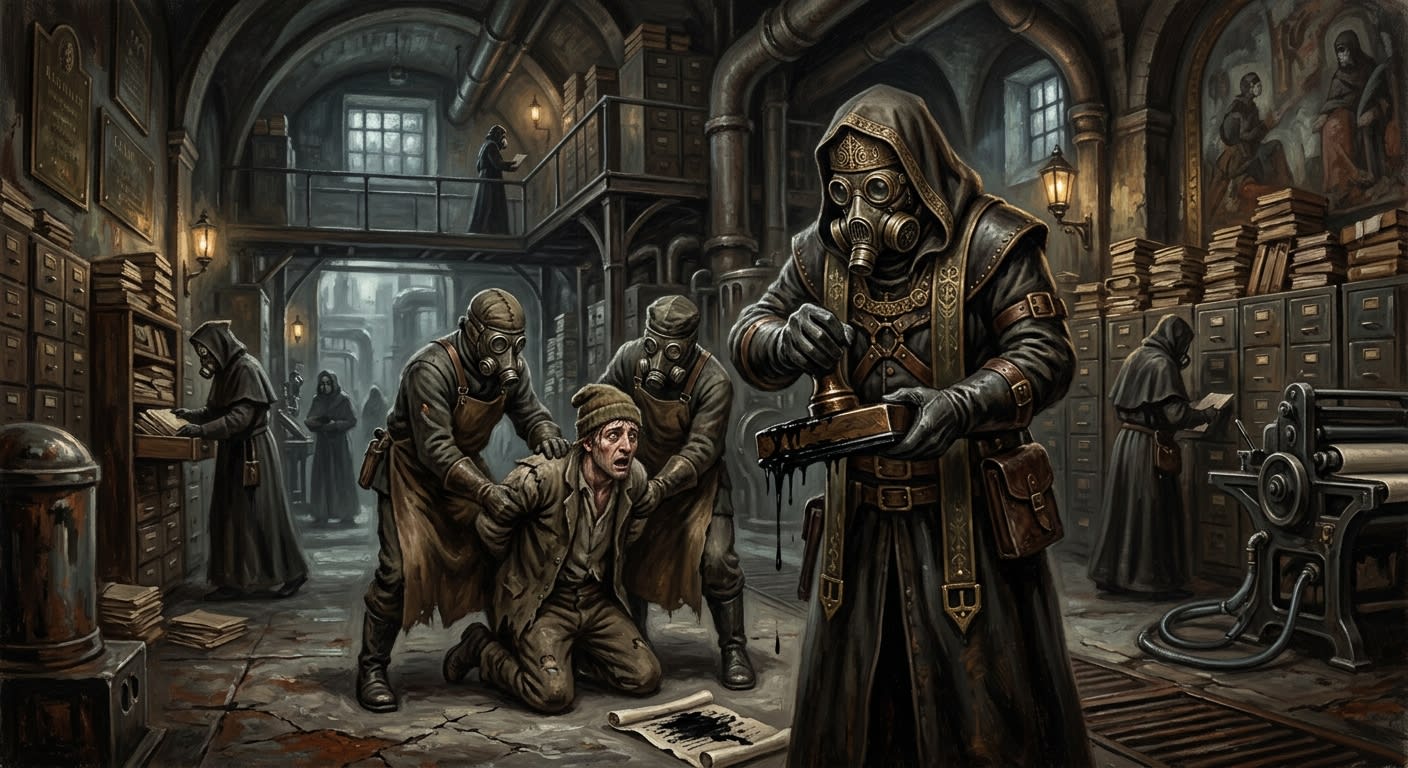
Seal Obsidian is a classification category employed by the Bureau of Shadows, which means it does not exist, has never existed, and has been invoked often enough to require three storage vaults, a grave-wax budget, and a clerk trained to answer all enquiries by coughing into his sleeve. Ordinary seals certify. Obsidian denies, consumes, and renders the certified object too dangerous for ordinary denial.
The public lexicon knows Amber, Crimson (Unregistered), Black, and various lesser colours beloved by clerks who confuse chromatics with courage. Obsidian sits beneath them like a buried tooth. It is used where knowledge must be retained for operational necessity and simultaneously removed from every mind insufficiently licensed to survive it. The Bureau of Purity classifies to prosecute. The Bureau of Records classifies to preserve. Shadows classifies to make preservation behave like disappearance.
The name is apt in spite of itself. Obsidian is volcanic glass: black, sharp, born from fire arrested before it can become stone. The classification works in the same manner. Something erupts from the world — a fact, an object, a survivor, a phrase written on the wrong wall — and the Bureau cools it into a cutting instrument, wraps it in absence, and locks it where only the careful may bleed.
#On Its Origin
The earliest confirmed Obsidian usage is disputed because confirmation defeats the point and dispute keeps departments funded. The Atheist Wars dossier on the Sisters of the Martyrdom carries one early mark: a black seal over gray vellum, applied to testimony suggesting the order was organized and funded by Cardinal Hieronymus Kratz rather than formed spontaneously by pious women with oil and a death wish. Worse, the dossier suggests not all the Sisters volunteered. The Bureau of Doctrine does not acknowledge this dossier. Neither do I, except in this approved article where non-acknowledgment has been scheduled for instructional use.
A later notation appears in the aftermath of the Cartographic Expedition of A.S. 73, when fourteen survivors returned from the Charnel Lands carrying mapping folios that all bore the same face. The maps were burned. The classification was revised Obsidian in A.S. 74, which tells the alert reader that burning the maps failed to burn the problem. Ash is frequently overrated.
The cleanest constitutional root lies in A.S. 82, when “ancillary offices for the maintenance of doctrinal security” began to breed in the margins of the early Synod's charters, and in A.S. 92, when the Bureau of Shadows became operational by the usual method: formal constitution disguised as nonexistence. Obsidian emerged from that administrative womb with all the charm of a stillborn law that learned to breathe.
Certain Records clerks have described Seal Obsidian as a mere archival access grade.
Incorrect and professionally suicidal. An access grade restricts who may read a file. Obsidian restricts what the file is permitted to be after reading. The distinction has cost three clerks their sleep, two their posts, and one his reflection.
#On Its Instruments
A file under Seal Obsidian is marked by three visible signs and one invisible one.
First: grave-dust wax, darker than the wax used for ordinary Night Papers, with a mineral shine at the edge where the thumb leaves pressure. Second: a countersign that appears blank under candlelight and legible only after the reader has spoken his own name aloud. Third: a binding ribbon of black glass-fiber, thin enough to cut skin, strong enough to hold vellum through fire. The invisible sign is simpler. Nobody wants to be in the room with it.
Obsidian files do not sit in the Forbidden Stacks, though fools assume every frightening paper ends there. Forbidden texts are still texts. They may be shelved, indexed, stolen, misquoted, kissed by graduate heretics in coffee houses. Obsidian material is stored in negative architecture: vaults absent from floor plans, boxes entered under weight but not contents, shelves counted by missing numbers. A Records inventory may list nine drawers; the Obsidian cabinet has the tenth. Nobody mentions the tenth. Everyone leaves space for it.
The reading protocol is equally charitable, by which I mean cruel in a crisp hand. One Custodian witnesses the opening. One clerk records the reader's pulse before and after. One priest from Doctrine stands by with a prayer whose text is itself restricted, which gives the prayer a pleasing circularity. The reader may copy nothing. He may summarize only into a black folio issued for the purpose. At dawn the folio is reviewed, corrected, and either sealed with the parent file or burned while the reader watches. If the reader remembers too much, the Bureau has methods. If he remembers too little, the Bureau has worse ones.
#On Objects Held Under Obsidian
The black iron key recovered after the Second Shadow Court Expedition is the best known item no one knows about. Warden-Captain Elise Morr (Unregistered) led one hundred and twenty personnel beyond the Danube. Gone forty-one days. On the forty-second, a single soldier appeared at the forward post wearing Morr's uniform and carrying her commission seal, his tongue replaced by a small, perfectly formed key of black iron. The remaining one hundred and nineteen were listed under a classification translating loosely as “consumed by the assignment.” The key is held in Vault ████ (Unregistered) under Seal Obsidian. Its lock has not been identified.
There are other things. The final equation of Lucien Artois, describing the trajectory of an object falling from infinite height. A blank bell-code sheet from the Year of Smoke in Lübeck whose silence caused three auditors to answer questions not yet asked. The Sisters dossier. Three flakes of brass from the Iron Plains that ring softly when placed near a Rationalist text. A child's tooth recovered from a Night Wagon wheel after the Saint Veritas affair, larger on the inside than any decent tooth should be.
Inventory fragment, Obsidian Cabinet 12: — one map of Irongate showing a ninth tunnel-mouth — one prayer written backward in a hand matching no living scribe — one list of names headed “Those Who Returned Incorrectly” — one vial containing ████████████████ — one order signed by Drax, undated, not yet issued Access terminated by Custodian intervention.
The Bureau insists that Obsidian protects the Dominion from hostile knowledge. This is true. It also protects the Dominion from bureaucratic embarrassment, theological instability, contradictory founding myths, evidence of unauthorized miracles, evidence of authorized crimes, and the occasional fact so rude that even I blush to see it filed.
#On Its Use Against Persons
A person cannot, officially, be classified Obsidian. The Synod does not classify souls as files. It counts them, taxes them, disciplines them, moves them, burns them, canonizes them, forgets them, and on feast days pretends this distinction is mercy.
In practice, persons become Obsidian by proximity. The courier who delivers a wrong Night Paper. The survivor who returns with a key for a tongue. The engineer who notices that a missing room has door-hinges polished by use. The widow who remembers a husband after administrative dissolution has removed him from every parish roll. These persons are not sealed. Their circumstances are sealed. The difference is printed in regulations so small that only guilt can read them.
The Custodians prefer collection to execution because execution produces relics, bodies, witnesses, stains, and widows with questions. Collection produces absence. Absence is cleaner. Under Obsidian, even absence may acquire a filing number that cannot be written down. If this sounds impossible, the reader has grasped the first principle.
A provincial Purity manual states that Obsidian collection requires approval from the Bureau of Purity's regional Inquisitor.
False. Purity may request, protest, obstruct, or discover after the fact that it has already consented. Shadows does not require Purity's approval. Shadows occasionally borrows Purity's handwriting.
#On the Present Application
As of A.S. 201, Seal Obsidian remains active across all major archives, bastions, anomalous expeditions, and any dinner at which three Hierarchs fall silent at once. Its usage has increased since A.S. 199, which the Bureau attributes to improved filing discipline and I attribute to the world becoming less polite about hiding its teeth. Both explanations have been sealed in different cabinets.
A junior clerk once asked me whether Obsidian is higher than Black. I told him that Black prevents a document from being read. Obsidian permits a document to read back. He laughed, because he was young and had slept recently. He no longer works in my corridor.
Seal Obsidian is the Synod's confession that certain truths cannot be destroyed, only managed with gloves, wax, and armed silence. That confession, naturally, is classified.