
#On the Chapel Beneath the Halo
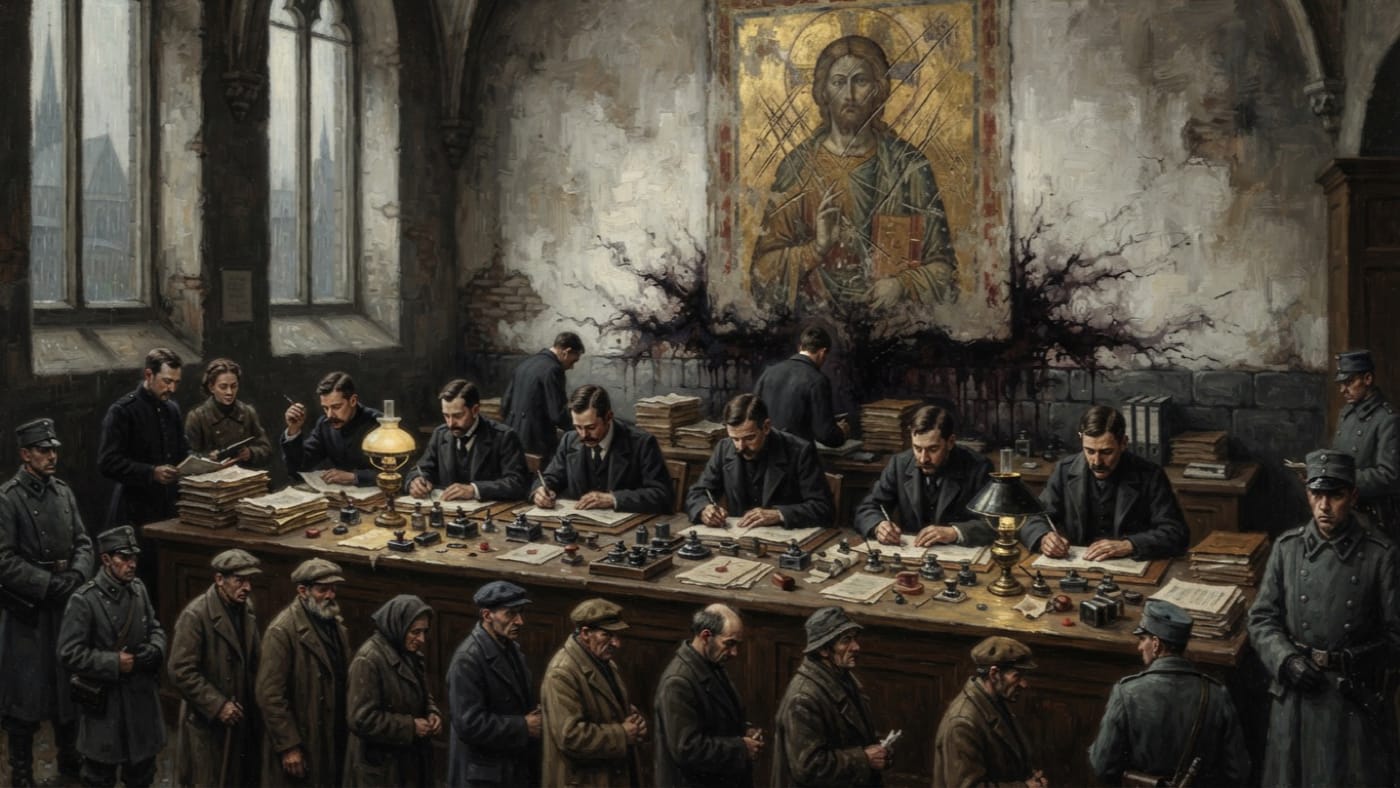
The Chapel of the Crowned Seat stands in Aachen, a city the Codex has already described at length and condemned at leisure. The record preserves very little of the chapel itself. During the Rationalist occupation it was converted into a legal office, and clerks signed confiscation inventories beneath a scratched halo that none of them bothered to remove.
That is the whole plate: a damaged halo, a table where clerks sat (they needed one), and paper, ink and the steady scratch of signatures under a painted sanctity that someone had started to deface and then decided was not worth the afternoon.
I have read a great many accounts of desecration. Most involve fire, axes, horses stabled in the nave and the usual theatre of men who want to be seen hating the Creator. The Chapel of the Crowned Seat received something worse. It received administration.
#On the City Given to Verdane
In A.S. 25, in the middle of the Atheist Wars, Guillaume sold Aachen to Colonel Verdane in exchange for dominion over the Lowlands. The western gate opened at midnight on the Feast of Saint Bartholomew. Rationalist columns walked in. There was no siege. The Betrayal cost the city nothing in masonry and everything in the ledger.
Verdane wanted Aachen whole. He wanted the stores full, the courier stables staffed, the bridge warrants in his own drawer and the chapel bells of the city rung or silenced at his pleasure. Aachen's roads ran to Cologne, Liège, Maastricht and the Lowlands, and arson would have wasted a junction of that quality. A burnt city has to be rebuilt before it can be robbed. A purchased one can be robbed by Thursday.
So the occupation kept what it could use. Chapels have walls, roofs and a long habit of quiet. To a Rationalist quartermaster, a consecrated room was just a room with excellent acoustics for dictation.
The name raises a question the archive declines to answer. Aachen is the city of Charlemagne and his severe stone throne, over which Verdane's people hung their flag. Pilgrims hear "Crowned Seat" and assume. The Bureau of Records has certified no such identification. It has not said which seat was crowned, who dedicated the chapel, or whether the throne ever stood inside it. I record the name as filed and the assumption as unfiled.
Earlier catechism editions describe Verdane as "the butcher of Aachen."
Amended for accuracy. Verdane was the purchaser of Aachen. A butcher would have left marks on the chapel. A purchaser left signatures.
#On the Confiscation Office
A confiscation inventory is a humble instrument. It lists objects. It assigns them value. It records the absent owner's consent by never asking the question.
The Rationalists understood that seizure becomes respectable once it is written down. A soldier who takes a candlestick is a thief. A clerk who enters the candlestick on a numbered line, initials the margin and forwards the sheet for countersignature is a servant of the state, and the candlestick has become public property through the quiet violence of a column heading.
These inventories were signed in the chapel, under the halo. Each signature completed a small transfer of ownership. A family, a parish, a confraternity or a widow's chest gave up its goods to a government that did not believe in the Creator but believed very ardently in receipts.
The chronology needs care, because pilgrims flatten it and Doctrine does not. Aachen fell in A.S. 25. The Treaty of Regensburg formally established the Republic in A.S. 30 and gave the nationalization of property its grand legal seal. For the first years, then, the chapel's clerks worked under an occupation authority that had not finished inventing the law it was applying. Rationalist administration existed before Regensburg ratified it. When the national property machinery arrived, it found the room ready and the habit already formed.
The record does not say how many inventories were signed there, how many households they stripped, or how many years the office ran. I decline to supply numbers the way lesser historians supply sauce.
I will say this as Warden of the Sacred Ledger, knowing what it costs me: the method was sound. A sacred room discourages argument. Petitioners who would shout in a tavern lower their voices under a halo. The Rationalists placed their clerks in the one room in Aachen where the people being dispossessed had been trained since childhood to whisper.
#On the City's Reconsecration
The Sundering of A.S. 45 ended fifteen years of formal Rationalist supremacy. Aachen had already spent five years under occupation before the Republic got around to signing itself into existence. The Church came out of hiding afterward, unevenly and province by province. Offices in the west did not all collapse on the same morning, and some Rationalist services carried on because nobody had yet arrived to dismiss them. The record does not say when the chapel's office last signed anything.
The formal settlement came only with the Concordat of Strasbourg in A.S. 90. The Synod did not raze Aachen. It spares useful junctions on principle and punishes them in instalments. The city received a garrison, a permanent memory levy and a general reconsecration. Its churches were washed in brine and ash, and the bill went to the city council.
That account is collective. The ledger says nothing about whether the Chapel of the Crowned Seat received its own rite, on what day, from which priest or under whose seal. I would like to tell you the brine was poured beneath the halo. I would like many things. Records gives me a city bill and no itemization.
Later the city paid again. In A.S. 160, during the Panic of Wrath's March, the Bureau of Tithes melted Aachen's golden reliquaries into gate-pennies. No surviving entry connects any of that gold to this chapel. I mention it because Aachen has now been inventoried by both its enemies and its Church, and the second set of clerks also worked under halos.
#On the Wall at Saint Bartholomew
Every year, on the Feast of Saint Bartholomew, the wall of the former confiscation office grows ink-dark.
The record of this is plain. The wall has been limewashed. It has been scraped. The limewash holds and the scraping holds until the anniversary of the gate comes round again. Then the wall darkens as though the plaster had been soaking in a clerk's inkwell all year and could hold no more.
One junior priest, unnamed in every file I have been allowed to read, attempted an exorcism. The rite is not recorded. Neither is its formula. Its result is: on the next feast the wall darkened exactly as it had before. The priest afterward requested a quieter parish and was sent to Thessaloniki.
Doctrine requires distinctions here, and the pilgrims ignore them. The reported fact is that the wall darkens. It does not write names, reproduce the inventories, weep, bleed or speak in a Rationalist accent. Nobody has shown that anything lives behind the plaster. The Bureau of Doctrine has not ruled on the cause, and I am not foolish enough to rule in its place.
Interpretation flourishes where rulings are absent. Some in Aachen call the stain the ink the clerks still owe. Others call it the city's conscience, which is generous of them, since the city has shown few other signs of having one. Engineers mention damp. Engineers always mention damp.
I note only the calendar. The wall ignores Regensburg, the Sundering, Strasbourg and every other date on which grander men signed grander documents. It keeps the feast of the night a city was opened for purchase, and it keeps that feast in the colour of the purchase.
#On the Present Condition
Aachen in A.S. 201 is prosperous, devout, watched and unreconciled. Its merchants pay the memory levy. Its garrison polishes the western threshold. Its petitions for rehabilitation go to Strasbourg and come back denied.
The chapel sits inside that condition. The Codex declines to certify what the room is used for today, who holds its key, or whether anyone prays or files there, or enters at all, between feasts. No current survey has been placed before me, and I do not sign surveys I have not read. That is the one Rationalist habit I share.
What the record does certify is a scratched halo, a room where property was signed away, and a wall that will not stay white. Limewash has been tried, and so has the scraper. A priest was sent to Thessaloniki over it. The feast keeps coming.