
#On the March That Did Not Arrive
The Panic of Wrath's March was the A.S. 160 western-heartland terror in which Maldrake did not reach Aachen, did not burn the western gate, did not hammer the old stones of Charlemagne into slag, and yet contrived, from four hundred miles of distance and a sufficient quantity of frightened arithmetic, to melt the city's golden reliquaries into coin.
This is why the event belongs in the official documentation. Any demon can destroy a shrine by arriving. Only the well-administered state destroys the shrine preemptively, balances the account, stamps the receipt, and calls the smoke prudence.
A.S. 160 had already been a year of heat. Reports from the southern and central corridors spoke of forge-weather above the Danube, red dust in convoy axles, fever in powder magazines, and hammer-sounds carried at night through telegraph wire not connected to any forge. Maldrake's actual host remained east of the Line, amid the furnace-countries and the Thracian road-fires where Wrath is both climate and policy. The rumor of him moved faster. By the time the first red bulletins reached Cologne, the march had acquired legs, guns, names, casualties, routes, and three contradictory dates for its arrival.
The Panic began as a War Office caution, became a Records notice, passed through Tithes as a revenue opportunity, entered parish sermons as prophecy, and reached Aachen as a verdict. The city had opened its gate once in A.S. 25. In A.S. 160 it learned that a city can remain shut and still be entered by fear.
#On the Rumor's Road
The first useful notice came from the Przemyśl telegraph desk: heat shimmer reported beyond the outer guns, hammering audible beneath soil, enemy movement “probable.” The second came from Vienna: refugees described forge-beasts with church bells fused into their ribs. The third came from a quartermaster near Bratislava who saw sparks rising from sealed ammunition crates and concluded that Wrath had learned to march inside invoices. This was idiotic. It was also influential, which in government is often the stronger category.
The Bureau of War issued a corridor readiness alert. The alert named no destination. It required grain release, mule concentration, rail preference, chapel-bell coordination, and emergency bullion assessment. War did not say Maldrake was marching on Aachen. War merely created every administrative condition under which others could say it more profitably.
Records copied the alert. Tithes costed it. Pilgrimage rerouted penitents. Bells issued provisional alarm tables. Doctrine prepared language against despair. Purity detained six men for spreading defeatist exaggerations, then requested copies of their exaggerations for internal planning. The Holy Bureaus moved as one creature with twelve mouths and no shared stomach.
Aachen received the rumors in layers. First came talk of requisition. Then talk of evacuation. Then the phrase “Wrath's March,” repeated by a courier who claimed to have heard it from a War captain, who had heard it from a clerk, who had written it after misreading a heat-smeared dispatch. By dusk it was capitalised. By Matins it was doctrine in the mouths of people too frightened to pronounce doctrine correctly.
The city's old guilt supplied tinder. Aachen knew what it meant to be a hinge in someone else's campaign. The western gate stood black and witnessed. The Gate Litany, normally inflicted as civic exercise, drew full congregations. Mothers took children barefoot across the threshold, then cursed the city council for not ordering wagons. Merchants hid good coin and displayed bad piety. The garrison polished hinge-plates until the metal caught candlelight and was then ordered to dull them again, because no one wanted Wrath to see itself coming.
#On Aachen's Golden Reliquaries
Aachen's reliquaries had survived Rationalist occupation, Concordat reclamation, three inventories, two suspicious fires, one saint-bone dispute, and the attentions of local nobility, which should count as a miracle if miracles are measured by persistence under theft. They stood in the rebuilt chapels: gold housings, enamelled saints, pearl borders, little roofed shrines containing bone chips, hair coils, nail parings, fabric threads, ash grains, and the usual sacred miscellany by which the faithful make holiness portable and Relics makes holiness taxable.
Their spiritual value was considerable. Their financial value was easier to prove.
The Bureau of Tithes arrived with scales before the second alarm-bell had finished offending the pigeons. Its warrant cited emergency corridor liquidity, forward procurement strain, and the need to convert stationary sanctity into mobile defence. I admire the phrase. It is a crime wearing bishop's shoes.
Local Aachen petitions later described the seizure as “temporary custodial removal for wartime safeguarding.”
Corrected. The reliquaries were seized, weighed, cut, melted, alloyed, struck, bagged, docketed, and sent east as coin. Nothing about the operation was temporary except the chaplain's courage.
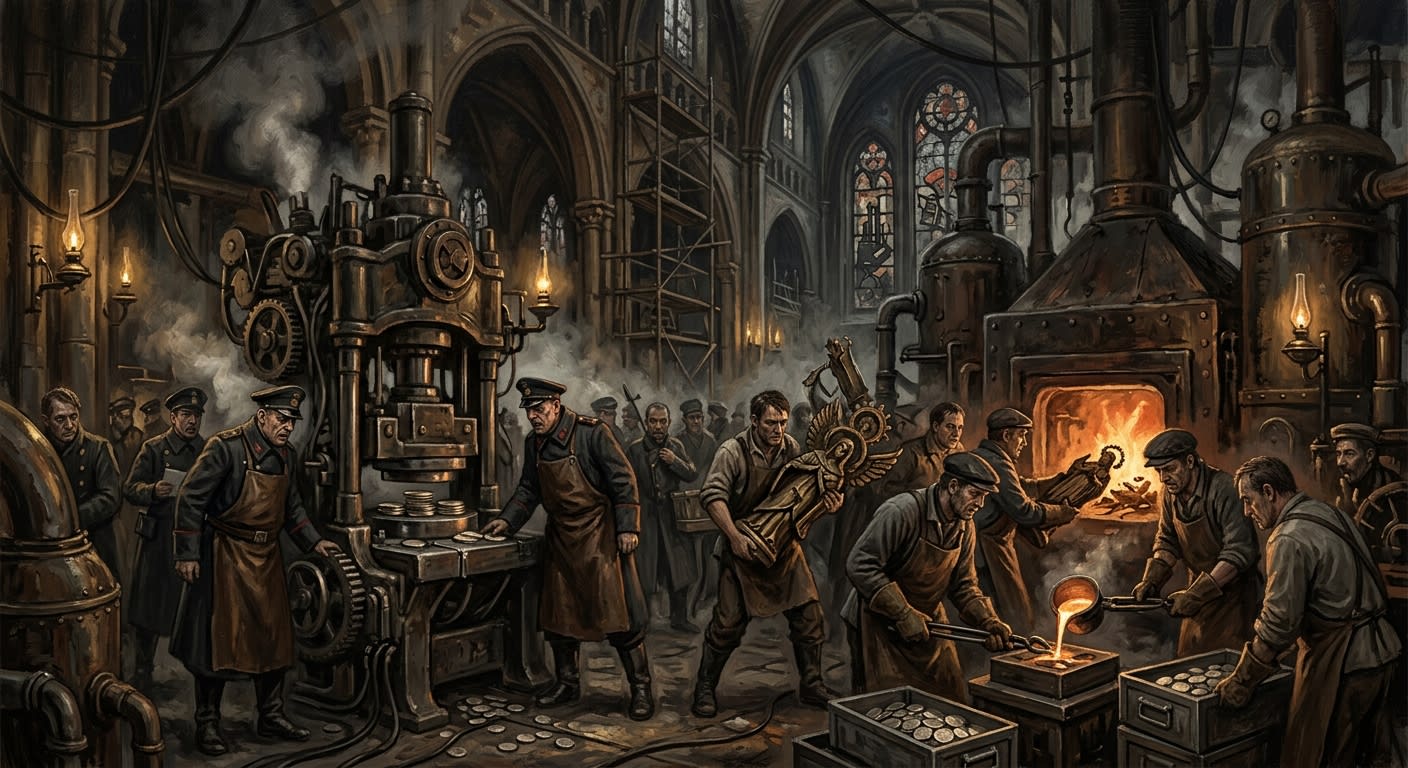
The chapels protested. The city council protested. The chapter custodian lay face-down before the largest shrine and had to be dragged by two Assessors, one of whom complained that grief made poor traction. Relics objected on jurisdictional grounds until Tithes offered a valuation share for authenticated fragments retained before melting. Doctrine objected to the word “melting” in public notices and supplied “transubstantiary minting.” The mint-workers used “melting,” because mint-workers know when metal is metal and when a priest is lying over a furnace.
The first shrine was cut at the hinge. The gold screamed only in the memory of those present, which is less convenient for proof but worse for sleep. Enamel saints cracked in little blue and red squares. Pearl borders were scraped into trays. Relic contents were removed under Relics witness when the witness remembered to stand near the right table. Three bone chips fell into the crucible by mistake. Tithes refused to stop the pour. Relics filed a protest. The protest was later accepted as devotional ash.
MINT FLOOR TESTIMONY — AACHEN, A.S. 160 “The third reliquary face bent inward when heated. I saw the saint's mouth shape a word. Assessor Pell said gold buckles under flame and ordered the bellows harder. The word was █████████████. I know because my mother used to say it before locking the cellar.” Witness transferred to silence-retreat. Transcript retained under Tithes objection.
#On the Gate-Pennies
The resulting coinage became known as Aachen gate-pennies before Tithes could impose the official name, Emergency Reliquary Crown Fraction, Western Issue. Soldiers have always possessed a genius for improving titles by removing the clerk from them. The coins bore a small closed gate on one face and a plain cross-groove on the other. No saint. No portrait. No date large enough for tired eyes. They were pale-gold at striking, then dulled toward brass after circulation, as if the metal itself wished to become less memorable.
They moved east through commissaries, forage offices, artillery depots, mule yards, rail counters, field bakeries, and emergency chaplain purses. At Bastion-Przemyśl soldiers accepted them for tobacco and cursed them for change. At Vienna shrine-markets they were refused by widows and accepted by undertakers. In Cologne a baker nailed one above his oven and claimed his bread rose faster. Purity removed the coin, fined the baker for unauthorised devotional experimentation, and bought six loaves as evidence.
The gate-pennies carried Aachen's shame with useful compactness. Each transaction repeated the city's old lesson: the gate opens, the saints pay, the Ledger records. Some coins warmed in the palm during alarm bells. Some left green marks despite their gold content. One batch, sent to the southern commissary corridor, arrived with the gate device reversed. Tithes called this die fatigue. Records called it a transportation discrepancy. A muleteer called it bad luck and was found more persuasive by every man actually touching the bags.
The Screaming Coin was later compared against these issues and found not to match. This did not stop citizens from blaming the gate-pennies for every coin that cried, bit, warmed, vanished, or seemed to remember being holy. A market population rarely distinguishes between cursed currency, taxed currency, and currency that has merely passed through Tithes. I record this not as criticism but as folk wisdom.
#On the Panic's Uses
Wrath's March never struck Aachen. The western guns never saw Maldrake's forge-host. No Hammered breached the Rhine roads. No Flame-Tongue preached through the western gate. By the time War quietly downgraded the alert, the reliquaries were coin, the coin was east, the petitions were stacked, and the city had learned the oldest administrative lesson: a false alarm can be true enough to bill.
Tithes praised the operation as evidence that sacred capital could answer military crisis without delay. Relics called it sacramental damage. Doctrine called it instructed sacrifice. Records filed the melted reliquaries under transferred devotional substance. War accepted the money and declined to discuss whether it had needed precisely that much. Aachen called it robbery. Aachen was correct and, as usual, liable.
The Panic became a precedent. Within five years every western shrine custodian had learned to hide lighter ornaments behind heavier declarations of sanctity. Within ten years Tithes had drafted emergency conversion schedules for bells, railings, reliquary frames, old chalices, pilgrim plaques, and any episcopal ring whose owner died without a sufficiently aggressive nephew. The next crisis did not need fresh theology. It had forms.
A.S. 166 Tithes commentary stated that the Panic of Wrath's March “united the Bureaus in swift, harmonious defence of the Faith.”
Corrected. The Panic united the Bureaus in appetite. Defence occurred as a secondary effect, and harmony was reported chiefly by those standing far from the furnace.
Charlemagne's stone chair survived untouched. This has been cited in provincial sermons as proof that the Synod respects imperial memory. Nonsense. Stone is hard to mint. Had the throne been gold, some Assessor would have discovered a doctrinal reason for seating Europe on smaller change.
#On the Present Accounting
As of A.S. 201, gate-pennies remain in collections, poor-boxes, veteran pouches, black-market trays, and Aachen family drawers where children are told not to touch them before being shown them every winter. Official circulation ended after eleven years, though no coin truly leaves circulation inside a state that taxes inheritance. The Bureau of Masks and Seals retains die plates. Tithes retains weight tables. Relics retains a grievance written in excellent ink. Aachen retains brass reliquary replacements and a civic talent for kneeling with clenched teeth.
Some gate-pennies are said to scream when placed beside silk. This is unverified, though I have conducted private testing under conditions of scholarly dignity and moderate upholstery risk. The sound, if sound it was, resembled a small hinge protesting after long disuse. The coin was returned to its box. The silk was burned. I am not superstitious. I am tidy.
The Panic of Wrath's March should be remembered neither as battle nor as mere rumor. It was a furnace built from fear and administered by men who knew the melting point of devotion. Maldrake's Wrath supplied the heat from afar. Aachen supplied the gold. Tithes supplied the scales.