
#On the Council's Attestation
The Council of Natural Sciences survives in the Church's ledgers as an attribution and very little else. During the Year Without Dawn of A.S. 32 (1742 CE), an unsigned paper on the failure of the sun was widely credited to "the Republic's own Council of Natural Sciences." The entire institution rests on that credit. The Codex holds no charter, roll of members, seat, minute-book, seal, founding year or year of ending for it. It holds the fifth of seven treatises published in nine days, and what the learned men of the Rationalist Republic said about the pen that wrote it.
The distinction must be kept, and the Hieromnemon will keep it. The treatise was anonymous. The attribution was wide. Wide attribution records what the Republic's readers believed about a paper and proves nothing about the hand that wrote it. The Bureau of Doctrine has never confirmed the Council's authorship. I decline to confirm it on the strength of a consensus formed in reading-rooms that burned candles at noon.
129 A.S. — Year Without Dawn: The sun fails to rise for forty days.
The older chronological tables of the Lore Book are corrected. The Year Without Dawn fell in A.S. 32 (1742 CE), two years after Regensburg and thirteen before the Sundering. It has always fallen there.
#On the Republic's Explanatory Machinery
By A.S. 32 the Republic had been formally constituted for two years. The Treaty of Regensburg had proclaimed the victory of Reason over religious authority in A.S. 30. The learned societies of Paris and Vienna had become instruments of government as dependable as any prefecture. In the Republic a treatise did the work of an edict, and a citation counted as a vote. The faithful kept their sacraments in hidden chapels. Everyone else kept up with the journals.
When the sky failed, the Republic did what it did with every phenomenon: it measured, published, contradicted itself and stayed confident. It had practised. Two years earlier the Cold Fires of Vienna had been filed as "atmospheric," and that filing had held.
The first treatise came from Professor Gérard Molyneaux of the Académie des Sciences in Vienna. He located a volcano beneath the Adriatic that produced forty days of particulate diffusion with no ash, no tremor and no eruption anyone could find. The second, from Professor Aldric Venn of the Strasbourg Lyceum, flatly contradicted the first and proposed a solar occlusion in keeping with eleven-year luminosity cycles. The third proposed meteoric debris. The fourth blamed the British. The fifth is ours.
The Codex cannot say whether the Council sat within the Académie, beside it or across the street from it. An inherited catalogue entry lists a natural sciences council among the Académie's post-Regensburg works. A catalogue entry is a finding-aid, and finding-aids make poor witnesses. No surviving record names Molyneaux or Venn as a member.
#On the Fifth Treatise
The proposition can be quoted in a single breath. The phenomenon was "psychosomatic in origin." The sun had risen normally every day. A "mass hysterical suggestion" had convinced the population otherwise.
The four papers before it shared a habit. Molyneaux put the fault under the sea. Venn put it in the sun. The third paper put it in the sky between, and the fourth put it in London. Each of them, however absurd, placed the anomaly outside the man looking at it. The fifth treatise was more ambitious. It acquitted the heavens and charged the witnesses. It declared the sky sound and moved the defect into the eyes, nerves and imaginations of everyone from the Atlantic to the Balkans.
As natural philosophy it is worthless. As statecraft it deserves study, and I have studied it with the admiration one forger feels for another's work. A volcano can be searched for and fail to turn up. A solar cycle can be calculated and fail its calculation. No observation can refute a hysteria, because every report of the grey becomes another symptom of it. The man who complains that he cannot see the sun confirms the diagnosis by complaining.
The Codex records no experiment in support of the paper, no vote adopting it, no dissent within the body credited with it and no instruction issued under it to any physician or prefect. It needed none of them. Follow its logic to the end and every witness becomes a patient. That is my judgement, and the Bureau is welcome to it. A government that can tell its citizens their eyes are mistaken has reached the summit every confessor in history has climbed toward, and it did so with far less equipment.
As for the anonymity, the Codex gives no reason for it, and I will invent none. I note only that men rarely keep their names off papers they expect to win the Gold Prize. Molyneaux signed his volcano and received one.
#On the Observations
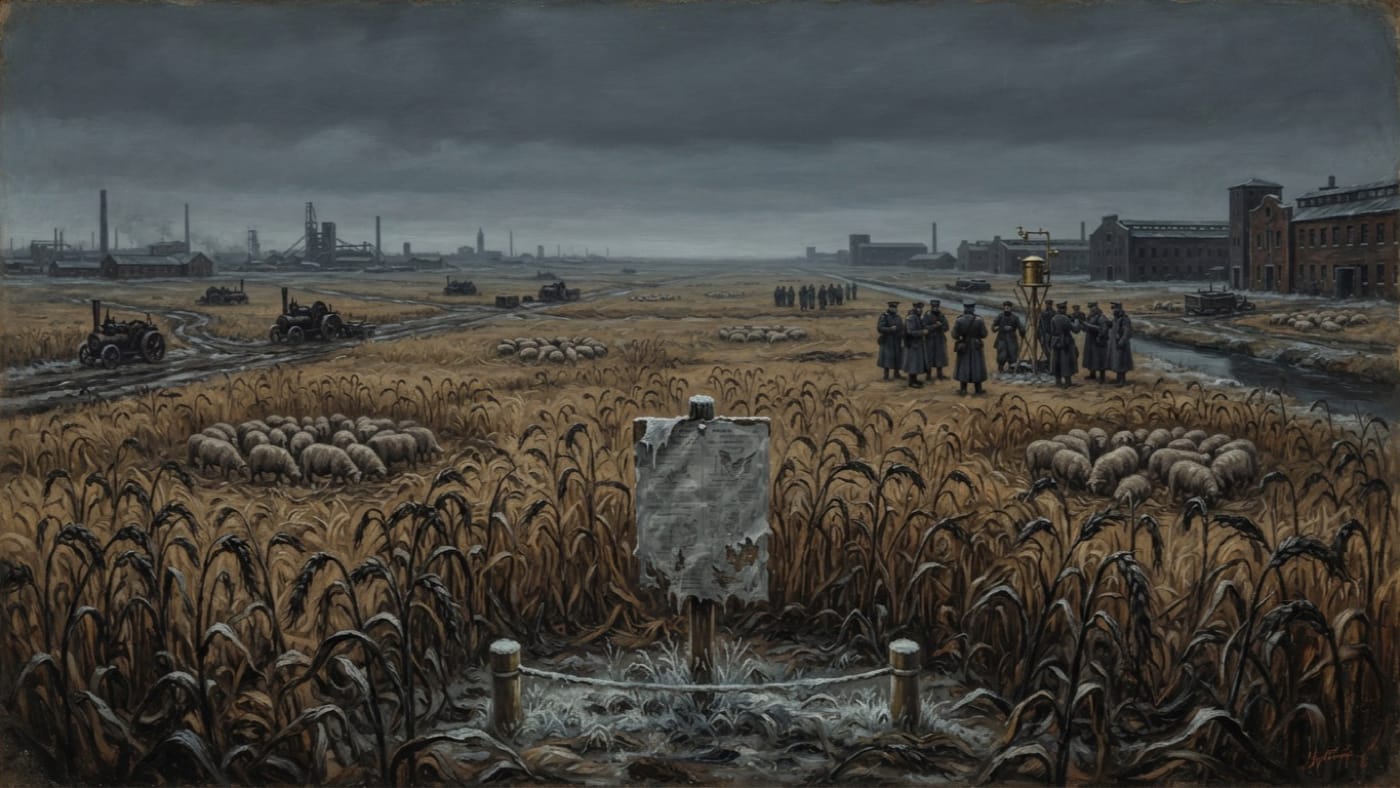
The paper asked Europe to disbelieve something specific. The grey was a flat, even illumination without depth or variation. It reduced noon to a November dusk. The world was never in absolute darkness, and the Bureau has corrected everyone who claims it was. For forty canonical days the sun did not clear the horizon. The Vienna observatory logs recorded "delayed sunrise, cause: pending." To my knowledge, brass instruments are not susceptible to suggestion.
The wheat and barley withered in the first week, curling and blackening in mild weather. In the Rhineland the shepherds watched their flocks walk in circles, each animal following the one ahead. The ring tightened over days until the sheep stood pressed together and stopped moving. The North Sea fisheries pulled cod from living water that came up soft, translucent and already rotting.
The fifth treatise answers none of this. A hysteria confined to human minds does not blacken barley. A suggestion that convinces a farmer he cannot see the sun does not also convince his crop to die for lack of it. The paper's surviving summary says nothing of livestock. The livestock said a great deal. The sheep did not give a tinker's damn what any Council thought, and they went on walking their circle all the same.
#On the Permitted Explanation
The fifth treatise must be kept apart from the Republic's public position. The two contradict each other, and the Republic posted only one of them. Broadsheets in every Prefectural hall declared the event "a natural atmospheric occurrence of unusual duration." They added that "no supernatural explanation should be entertained by rational minds." The Codex does not know who drafted those broadsheets, and nothing ties them to the Council. An atmospheric occurrence requires an atmosphere that did something. The fifth treatise held that the sky had done nothing at all.
The Republic tolerated both, along with the volcano, the solar cycle, the meteors and the British. It could afford to. Its orthodoxy was a fence around one excluded field. Any cause at all could be proposed, cited, rewarded and contradicted, provided it was natural. Six mutually exclusive accounts were all acceptable. Only one kind of explanation was forbidden.
In form, the Church's later ruling on the question reads like the broadsheet with the polarity reversed.
Doctrine holds that the Creator withdrew His light as a warning, the second in the sequence before the Sundering. My office requires me to hold the same. I note that the Bureau counts fifty-seven days of grey while the canon keeps forty. The difference was settled by declaring seventeen of those days insufficient to count as distinct temporal units. The fifth treatise reclassified forty days of grey as a mood. The Bureau reclassified seventeen as clerical surplus. No succession between the two offices is documented, and I document none.
#On Later Custody
The Republic did not long outlive its explanations. The Red Flood of the Danube came in A.S. 34 and the Eastern Silence in A.S. 38. The Sundering followed on 1 November A.S. 45. The Codex does not record what became of the Council in that sequence. It has no dissolution on file, no final session and no casualty roll, and I will supply none.
When the Church came to keep the Republic's paper, it kept a great deal of it. Rationalist pamphlets of the period lie under triple seal in the Forbidden Stacks, and reading them requires Synodal licence. The practice is general and established. The ledgers available to this Hieromnemon cannot say whether a copy of the fifth treatise survives there. They give no shelf-mark, no chain of hands and no sign of a name added later to a copy of the unsigned original. The four treatises published after the sun returned are no better assigned, and neither are the unnumbered ones in between. The Council receives none of them here.