#On the Occasion
"They made a funeral for God and wondered why the corpse would not stay warm." — Drax, Marginalia on the Forbidden Stacks catalogue, A.S. 199
The Treaty of Regensburg was three days old when the Rationalists staged it. Three days since the Archbishop had signed the dissolution of the Holy See in his own blood, three days since the "New Dawn" had been proclaimed from every lectern and balcony in Vienna, and the educated men who governed the city — those physicians and mechanists and philosophical prefects who had spent twenty years making war upon prayer — desired a spectacle. They had won. They wished the world to watch them celebrate.
And so the Black Procession.
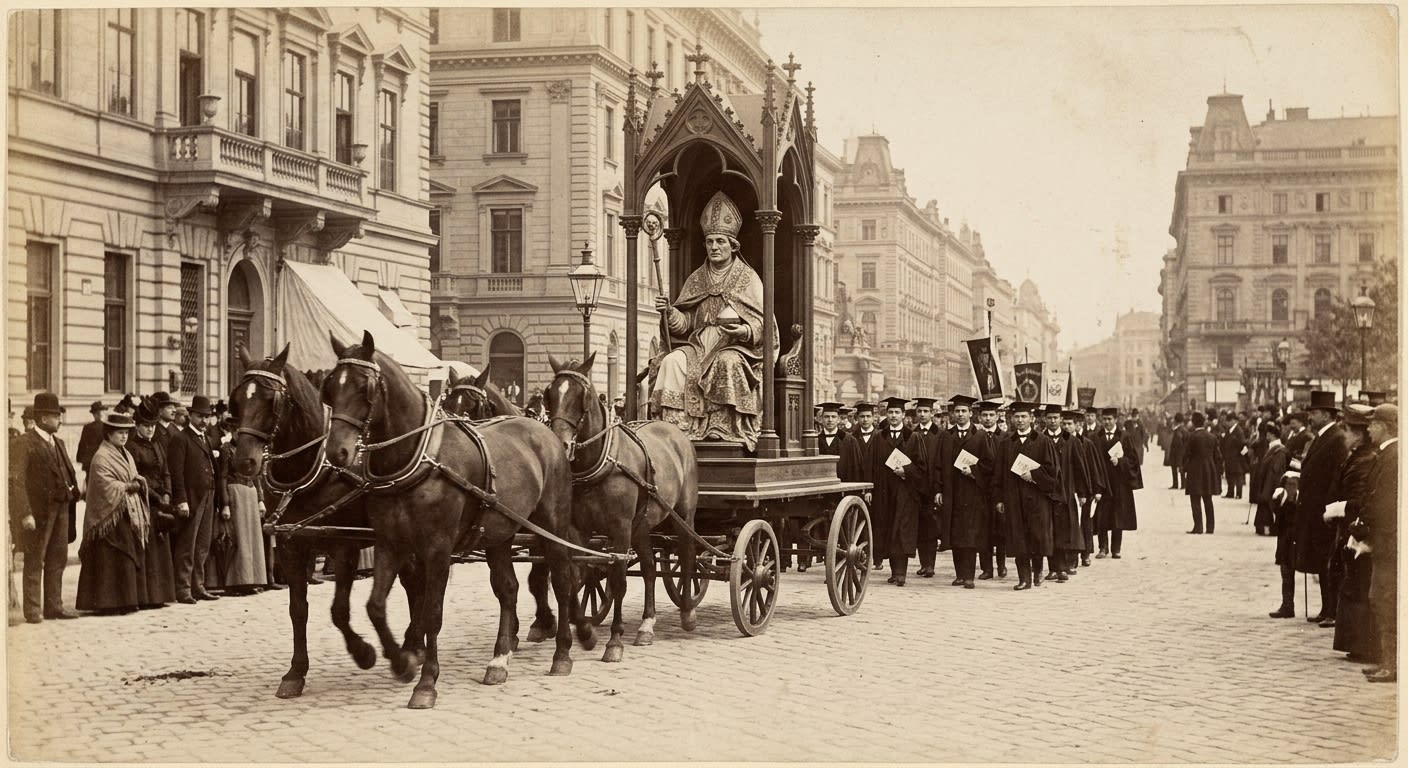
The date was the fourteenth of Novembris, A.S. 30, a Tuesday — the Rationalists having rejected the liturgical calendar with characteristic thoroughness, they scheduled their triumph on a weekday, during working hours, attendance compulsory for all citizens of the First Prefectural District. The venue was the Ringstrasse, Vienna's great boulevard, which in the old world had hosted feast-day processions bearing the relics of Saint Rupert and the Blessed Adalheid. The Rationalists chose it for the same reason they had placed their Academy in the Cathedral of Saint Stephen: they understood symbolism, even as they professed to despise it.
#On the Effigies
Forty-seven effigies were constructed. The Rationalist civic records are specific on this point — forty-seven, one for each year of what they termed "the Superstitious Epoch" (their calculation of the period from the founding of the Mendicant Orders to the Treaty of Regensburg, a span they defined with the same arithmetical confidence they brought to everything, and with the same disregard for whether the numbers meant anything). Each effigy represented a saint. Each was built of straw and plaster upon a wooden frame, dressed in vestments confiscated from the churches of Vienna, and draped in black mourning cloth.
The craftsmanship was, by all accounts, impressive. The Rationalists had commissioned the city's finest theatrical costumiers — men who had previously dressed opera singers and built stage sets for the Imperial Theatre — and the effigies were lifelike in ways that disturbed even sympathetic observers. Saint Rupert bore his salt-cellar. The Blessed Adalheid carried her crozier. Saint Leopold wore the ducal crown. A Rationalist broadsheet published the morning of the Procession praised the effigies as "instructive representations of defunct mythology, suitable for public contemplation and subsequent incineration."
The effigies were mounted on wheeled platforms and drawn by draught-horses through the Ringstrasse. Behind each platform marched a column of Academy students in their black gowns, carrying printed programmes that identified the saint in question, listed the "superstitious claims" associated with their cult, and concluded with a one-paragraph "rational correction" explaining why the miracles attributed to the saint were, in fact, "natural phenomena misinterpreted by the credulous." Saint Rupert's salt miracle was attributed to "saline crystallization in humid environments." The Blessed Adalheid's healing of the blind was dismissed as "spontaneous remission consistent with optic nerve inflammation." Leopold's incorrupt body was explained as "naturally occurring adipocere formation in alkaline soil."
They had explanations for everything. They always did.
#On the Burning
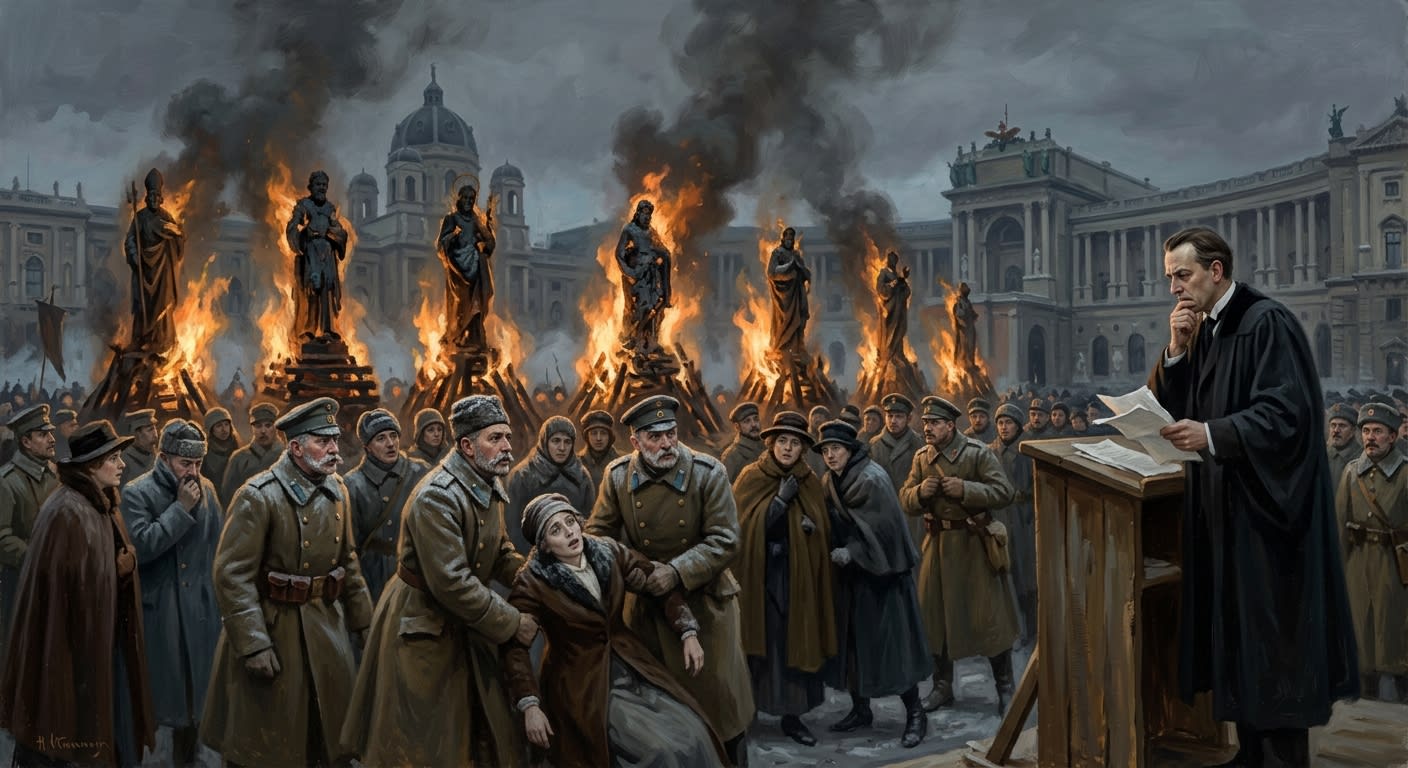
The pyres were erected in the Heldenplatz — the Heroes' Square, another deliberate humiliation, for the Rationalists wished to burn the saints in the square that bore the name of the heroes they claimed to replace. Seven pyres, arranged in a semicircle, each stacked with timber and doused in pitch. The effigies were carried to the pyres in groups, hoisted by Academy students who had been rehearsed in the procedure for three days prior. The Rationalist Prefect of Public Instruction, one Dr. Albrecht Klemm — whose name the Bureau of Purity has since struck from all registries of learning, though his ghost persists in footnotes the Bureau of Records declines to expunge — delivered the address.
Klemm's speech survives in the Rationalist archives. Fourteen pages. The Bureau of Doctrine has classified it under Seal Amber, but I have read it, because I read everything, and because the Bureau's seals are, for the Warden of the Sacred Ledger, more suggestion than prohibition. The speech is competent, measured, and entirely devoid of the quality that would have saved the man who wrote it. Klemm explained, at length, that the burning of the effigies symbolised "the final liberation of the European mind from the tyranny of invisible authority." He used the word "liberation" eleven times. He used the word "reason" twenty-three times. He did not use the word "God" at all, having been advised by the Council of Nine that the word itself was to be treated as "linguistically obsolete."
The torches were lit at the fourth bell of the afternoon — the Rationalists having not yet melted all the bells.
The fires caught. The pitch flared. The straw and plaster and confiscated vestments began to burn with the expected crackling and the expected smoke and the expected heat — for approximately ninety seconds. And then the heat stopped.
#On the Cold
Eyewitnesses are unanimous on the sequence, which is remarkable, because eyewitnesses are never unanimous on anything, and the fact that several hundred Rationalist citizens independently described the same phenomenon in the same terms suggests either mass coordination of testimony — which the Rationalists, who prized individual reason above collective anything, would never have tolerated — or the truth.
The fires continued to burn. The flames rose. The effigies blackened and crumbled. The smoke climbed in its usual columns. But the heat vanished. Where moments before the crowd had been stepping back from the radiant warmth of seven pitch-fed pyres, they now pressed forward in confusion, because the air around the fires had turned cold. The flames gave off light but no warmth. Citizens closest to the pyres reported frost forming on their coat-buttons. A woman in the front rank — identified in the Rationalist record as "Frau M., resident of the Third District, occupation: laundress" — collapsed with blackened fingertips. Frostbite. From standing six feet from a burning pyre in November.
Dr. Klemm, to his credit or his damnation, did not flee. He approached the nearest pyre and held his hand toward the flame. His subsequent report — written that evening, in a hand that his colleagues noted was uncharacteristically shaky — reads: "The fire is present. The combustion is occurring. The light is produced. The heat is absent. I have no explanation that does not require me to abandon my foundational premises."
The fires burned for six hours. The temperature in the Heldenplatz dropped to four degrees below freezing, despite the season. Three citizens died of exposure. Eleven were treated for frostbite. The Rationalist Prefecture classified the event as "atmospheric anomaly, localised, non-recurrent" and issued a formal statement attributing the cold to "an unusual convergence of Alpine wind-currents and the thermal displacement effects of concentrated combustion." The statement was published in the Vienna Rational Observer the following morning. It was the lead story. Below it, in smaller type, was a notice cancelling the planned second day of celebrations. No reason was given.
#On the Omen
Two years later, the sun failed to rise. For forty days.
The Bureau classifies the Black Procession as the first omen. Before the Year Without Dawn, before the Red Flood of the Danube, before the Eastern Silence — before any of the terrors that preceded the Sundering — there was this: a fire that burned cold in the Heldenplatz, and a Rationalist elite that explained it away and went home to their dinners and their Academies and their Concordats of Governance, confident that the world obeyed their equations.
The Bureau's theological interpretation — issued retroactively in A.S. 92, as all the Bureau's best interpretations are — holds that the cold was Providence itself withdrawing its sustaining warmth from the act of desecration. Fire requires the Creator's consent to produce heat. The Rationalists had used fire to destroy representations of the Creator's servants. The Creator, in His mercy, permitted the fire but denied it the warmth. The theological term is subtractio caloris — the withdrawal of heat as a sacramental censure. The Bureau of Doctrine has written four hundred and seventeen pages on the subject. The Bureau of Engineering has written one page, which reads: "Anomalous thermal event. Measurements consistent with combustion minus exothermic transfer. Mechanism unknown. Recommend further investigation." The Bureau of Doctrine has classified the Bureau of Engineering's page as "theologically inadequate."
The Rationalists, of course, drew no conclusion. They had burned their saints, and their saints had answered with cold, and the Rationalists had filed the cold under "atmospheric anomaly" and returned to their lectures on the mechanical nature of the universe. Two years later the Year Without Dawn confirmed what the cold fires had whispered. Four years after that, the Red Flood of the Danube. Eight years after that, the Eastern Silence. And fifteen years after the Black Procession, the Balkans cracked open and seven generals of Hell walked the earth, and the Rationalists discovered that fire was the least of the forces they had failed to understand.
#On the Repetition
The Black Procession was staged once more.
At Vienna, in the chaos of the early post-Sundering years, Rationalist remnants — those few who had survived the collapse of their Republic and refused to accept that the survival itself constituted a theological argument — gathered in the ruins of the Heldenplatz and attempted to recreate the Procession. They built new effigies. They lit new pyres. They broadcast counter-sermons through brass amplification horns, mocking the Concordat and the nascent Synod, wrapping their words in mock-litanies designed to confuse listeners into mistaking blasphemy for prayer.
A battalion of Levy soldiers stationed nearby began chanting the Rationalist motto — "Man Alone" — while believing, to a man, that they were reciting the Third Psalm of Edras. The acoustic corruption was total. Officers who attempted to correct the chant found their own voices bending, the sacred syllables twisting in their throats. The battalion was cut down by its own reserves. Their corpses were piled in the plaza as a warning against listening too closely.
The Rationalist remnants were apprehended. Their fates are recorded in the Bureau of Purity's register under the classification "Ideological Recidivism, Terminal." The entry is three lines long. The Bureau does not waste ink on the already damned.
Stamped Erratum — Bureau of Doctrine, A.S. 147: Replace all prior references to "the Second Black Procession" with "the Vienna Static Incident." The term "Black Procession" is reserved for the A.S. 30 event. The later incident is classified as acoustic sabotage, not processional spectacle, and the Bureau declines to dignify Rationalist remnants with the same terminology applied to their predecessors' more ambitious atrocities.
#On the Present Condition of the Heldenplatz
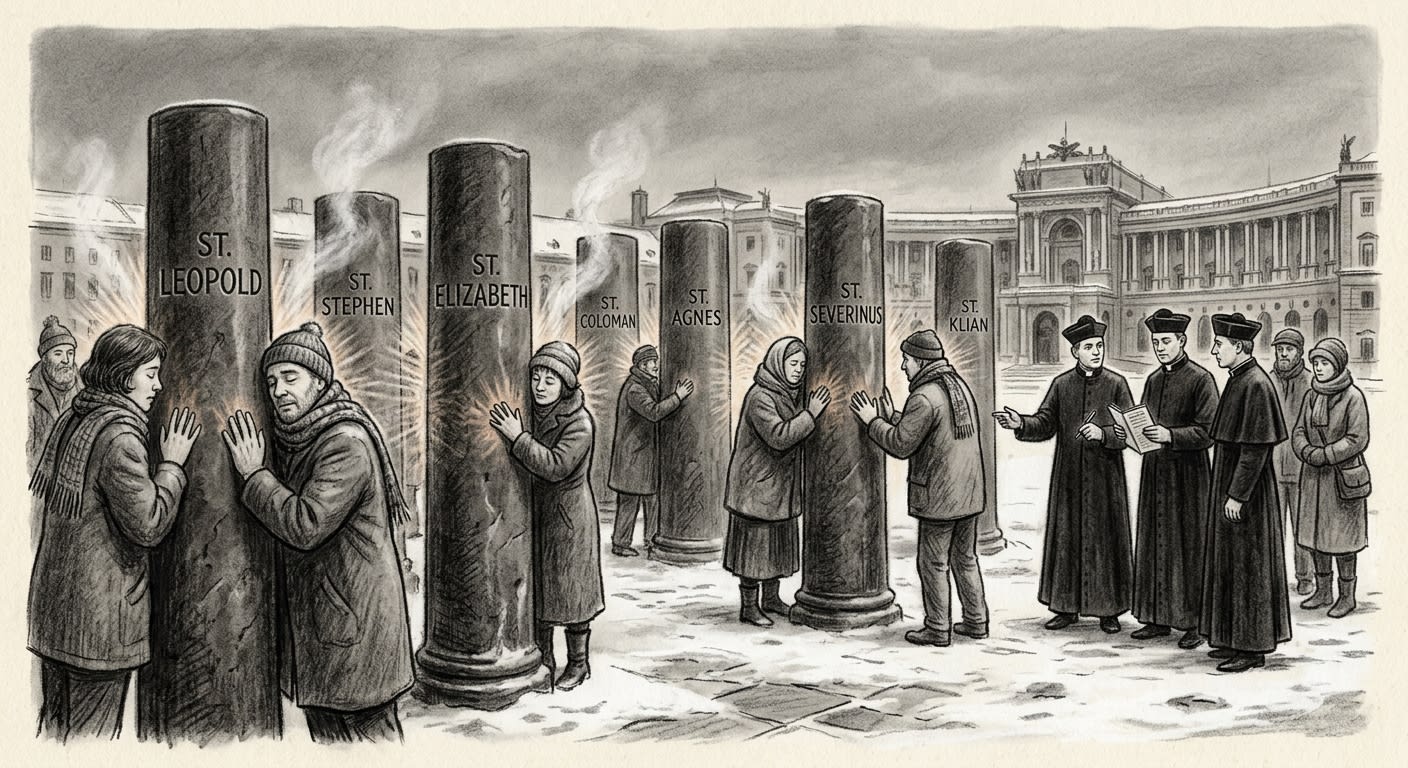
The Heldenplatz stands. The Synod reconsecrated it in A.S. 95, following the Siege of Vienna, and erected upon the site of the seven pyres a monument of black basalt — seven columns, each bearing the name of a saint whose effigy was burned on that spot, each column warm to the touch regardless of the season. The Bureau of Engineering has measured the columns and confirmed that they radiate a constant heat of thirty-seven degrees — the temperature of living blood. The Bureau of Doctrine has classified this as "Sustained Providential Correction, Category: Exothermic Rebuke." The Bureau of Engineering has classified it as "thermally anomalous masonry, mechanism pending."
Pilgrims visit. They place their hands upon the columns and feel the warmth that the Rationalists' fires could not produce. The Bureau of Pilgrimage issues seven thousand permits annually for the Vienna Warmth Pilgrimage, and the Bureau of Tithes collects a levy of three Crowns per visitor, because the Bureau of Tithes collects a levy on everything, including — one suspects — the act of breathing, should it ever find a way to meter it.
The fires burned cold. The columns burn warm. The Bureau considers the symmetry instructive, and the instruction sufficient.