

#On the Man Who Found a Volcano Beneath the Sea
Professor Gérard Molyneaux of the Académie des Sciences in Vienna deserves a place in the Codex because error, when sufficiently decorated, becomes an institution. He was the first public author of the volcanic hypothesis during the Year Without Dawn, A.S. 32, and his phrase — “stratospheric particulate diffusion from sub-Adriatic vulcanism” — entered Rationalist lecture halls with the speed of a lie that has been waiting for an educated mouth.
Observe the craftsmanship. A volcano beneath the Adriatic: no eruption observed, no tremor logged, no sulphur stink in the harbours, no ashfall on the decks, no frightened fish boiling to the surface with the common courtesy of evidence. Yet the sun had withheld itself, Europe stood beneath a flat grey vault, and the Rationalist Republic required a cause with Latin bones and no kneecaps for the Creator.
Molyneaux supplied it.
He was not a fool. This must be said early, lest charity accidentally creep into the room disguised as contempt. A fool may be forgiven for mistaking smoke for weather. Molyneaux had instruments, assistants, observatory logs, maritime reports, barge charts, midwife depositions, crop ledgers, and enough contradictory measurements to drown an honest man in ink. He chose the one explanation that preserved the Republic's altar: mechanism without judgment, nature without accusation, sky without Heaven.
#On the Academy and Its Appetite for Explanation
The Académie des Sciences occupied a suite of rooms in Vienna that had once belonged to a cathedral chapter before the Treaty of Regensburg made sanctity administratively inconvenient. By A.S. 32, the old chapter stalls housed cabinets of glass, brass, mercury, polished lenses, meteorological charts, and men whose confidence had been burnished by three decades of being applauded for despising peasants.
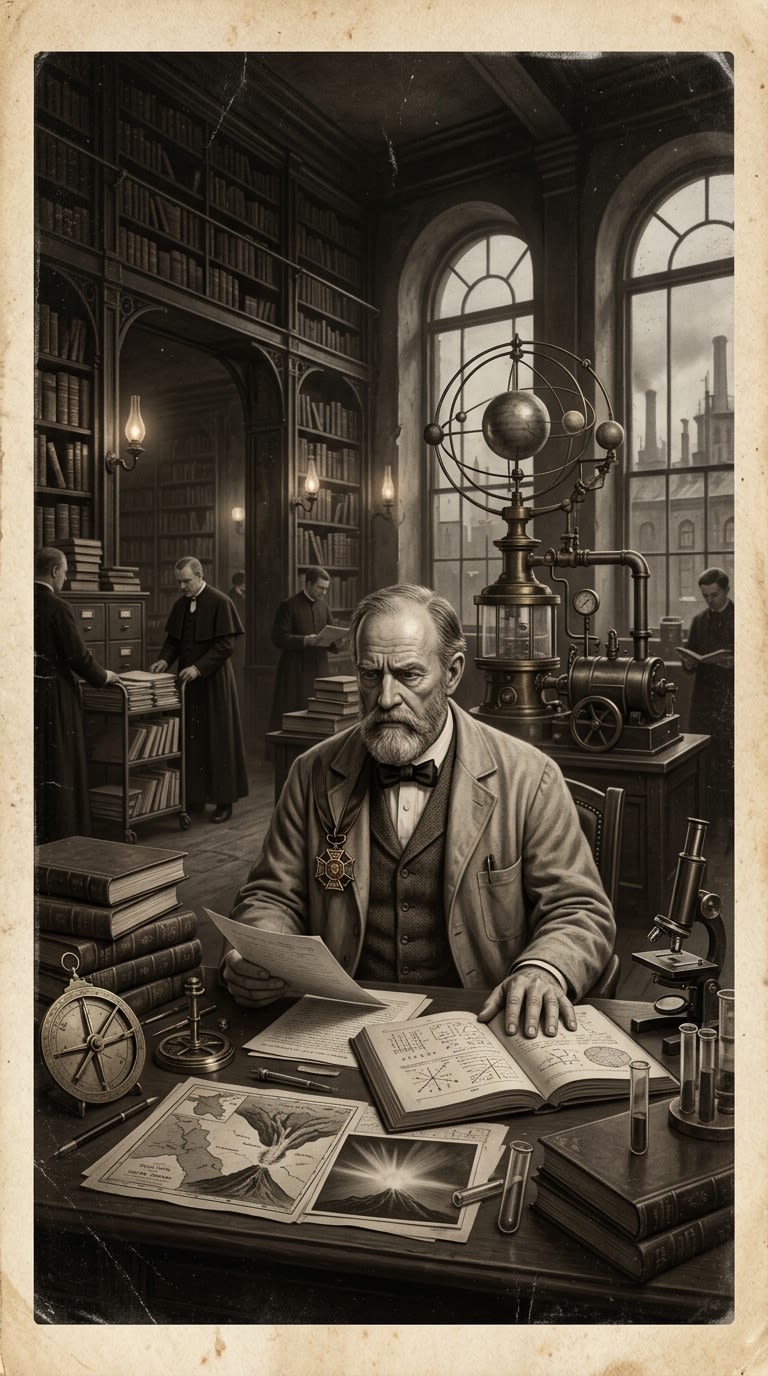
Molyneaux belonged perfectly there. His surviving lecture notes show a hand trained in cleanliness: long ascending strokes, obedient margins, equations aligned like choirboys who have never heard a shell. He specialised in atmospheric mechanics, which in Rationalist usage meant the art of explaining the sky without mentioning the One who owns it. Students admired him. Colleagues cited him. Public Instruction borrowed phrases from him when a crowd required calming through superior vocabulary.
The Academy rewarded speed. The first treatise appeared within days of the sun's failure, when Europe still waited each morning with animal hope and received instead that same grey dismissal. The paper's argument was elegant in the way a noose is elegant: every loop returned to the neck. The Adriatic floor had erupted invisibly. The upper air had received particulate matter without depositing it. The sun remained mathematically present and optically delayed. The instruments, where uncooperative, had been affected by the very phenomenon they were measuring. The absence of evidence became evidence of atmospheric subtlety.
That last manoeuvre is the scholar's knife under the sleeve.
Several post-Concordat primers described Molyneaux's hypothesis as “primitive science overwhelmed by limited instruments.”
Corrected. The instruments were adequate to reveal the fraud. The fraud survived because it flattered the instrument-keepers. Error committed under pressure is weakness. Error polished, published, rewarded, and cited four hundred and twelve times is doctrine in borrowed shoes.
#On the Forty Days and the Seventeen Treatises
The Cold Fires of Vienna had burned without heat two years before. Dr. Albrecht Klemm nearly understood them and then fled into the cowardice of terminology. Molyneaux inherited that cowardice as an academic atmosphere. When the sun failed, he did what trained Rationalists did under miracle: he measured the wound and accused the ruler.
Seven treatises appeared in nine days. Molyneaux wrote the first. Aldric Venn of the Strasbourg Lyceum contradicted him with solar cycle mathematics. A third author blamed meteoric debris. A fourth blamed British smoke, which remains the funniest serious proposal in the archive. The fifth claimed the sun had risen normally and that the population of Europe, including crops, cod, sheep, and unborn children, had suffered mass perceptual error.
Molyneaux did not retract. He revised.
By the second week his notebooks had thickened with anomalies. Danube barge pilots reported sandbars where the charts showed navigable water; later examination found calcium aggregate of indeterminate biological origin. North Sea catches arrived soft and translucent, as if death had boarded the nets before the fishermen. Sheep in the Rhineland walked in circles. Greyling children were born in Lyon, Hamburg, Kraków, and Seville with eyes washed nearly colourless and no impulse to cry. Militia columns marched east into the grey and did not return.
Molyneaux filed addenda. Particulate density. Prolonged low-light behavioural effects. Obstetrical stress. Navigational error. Military communication failure. The labels became smaller as the facts became larger.
#On Reward
The Republic gave Molyneaux the Academy's Gold Prize after the sun returned. Medals were struck. A parade was held in Vienna. A man who had identified an invisible volcano beneath a sea that had not erupted walked beneath banners while the faithful in cellars whispered prayers through fingers and bread marks.
One must admire the Republic's courage. It saw the abyss open under its proofs and held an awards ceremony on the rim.
The prize citation praised “clarity under public agitation” and “mechanical fidelity to natural cause.” The phrase mechanical fidelity deserves preservation, like a beetle in amber or a heretic in minutes. It names the Rationalist virtue exactly: fidelity, yes, but to the machine they had imagined, not to the world that stood before them refusing to operate. The sun came back because the Creator permitted it. Molyneaux received a medal because the Republic required a receipt.
Within two years, the Red Flood of the Danube boiled crimson through the continent's river-veins. Within six, the Eastern Silence swallowed correspondence from the Balkans. Within thirteen, the Sundering tore the world open and introduced the Republic's philosophers to phenomena without peer review.
Molyneaux kept writing. The papers from A.S. 34 onward are thinner, more heavily corrected, and sourer in their margins. One note beside a draft response to the Red Flood reads: mineral causation must precede symbolic reading. Must. There is the whole man in one modal verb: a professor ordering reality into sequence so he would not have to kneel.
#On the Basement in A.S. 48
Molyneaux's public trail disappears during the Collapse and the early Great Retreat. Some place him among the clerks who fled Vienna's Academy quarter when the Council of Nine began leaving sentences unfinished in its own minutes. Some say he served a remnant observatory in Prague, logging ashfall from skies no instrument could locate. A sealed Shadows note, already cross-filed with the Klemm dossier, places a man of his description in Vienna after the Sundering, returning to the Academy cellars with a satchel of papers and the stubbornness of a rat entering a pantry whose cat has died.
In A.S. 48, the liberation force found his body in the basement of the Academy of Vienna.
The chamber had no window. The desk held his notebooks, sorted by phenomenon: Cold Fire, Dawn Failure, Red Water, Eastern Correspondence Loss, Sundering Light. A candle had burned down to the socket. It was still burning. Three years without fuel, according to the Bureau of Rites' later calculation, though Rites has since classified the arithmetic as spiritually indelicate.
Above the desk, scratched into the wall, was a single word.
The word is classified.
BUREAU OF RITES — RECOVERY ANNEX, VIENNA ACADEMY CELLAR, A.S. 48 Subject: Gérard Molyneaux, presumed deceased. Candle: active flame; no measurable wax reservoir; heat output inconsistent with visible combustion. Wall inscription: ███████████████████████████ Initial reader response: one sergeant knelt; one clerk bled from the nose; one engineer asked for a measuring cord and was removed for his own mercy. Recommendation: seal, copy nothing, demolish after acoustic review.
The Bureau of Bells examined the room. The room sang. Its frequency matched no registered bell in the Codex. The Bells report contains four words: We recommend immediate demolition. The room was demolished. The singing continued for seven days from the rubble, then from the earth, then from no locatable source. The Bureau filed the event under Resolved, which is the administrative form of throwing a blanket over a corpse and calling it furniture.
#On His Condemnation and Use
Molyneaux is condemned for false witness under the pressure of revelation. He saw the sky refuse its office and named the refusal weather. He watched Europe starve beneath grey noon and blamed an invisible volcano. He received reports of children born without ordinary eyes and called them variance. He read refugee accounts of silent columns stacked in towers and filed them as exaggeration. Then, when the world cracked and proved him wrong in the language of sulphur, he returned to his papers as if sufficient annotation might make damnation footnoteable.
The Bureau preserves his first treatise in the Forbidden Stacks beside Klemm's Ironmouth memoranda and the Council of Nine's emergency broadsheets. It is assigned to advanced catechists under the unit Reason's Failure Before Portent. Junior pupils are denied access because they laugh too readily at the Adriatic volcano. Laughter is understandable. It is also premature. Molyneaux's error killed by reassuring people who should have been afraid.
A prior Doctrine syllabus called Molyneaux “the fool of the Year Without Dawn.”
Amended. Fool is inaccurate. A fool lacks the equipment required for grand refusal. Molyneaux possessed equipment, training, witnesses, contradiction, and time. He used all five to remain wrong with dignity.
His Gold Prize medal survives. The Bureau of Records holds it in a felt-lined tray marked CONFIDENCE OBJECT, RATIONALIST, A.S. 32. The medal is cold to the touch in summer and warm during approved dawn prayers. Records denies both details while continuing to require gloves.
Molyneaux's body was buried without public marker in Vienna's scholar field after the A.S. 95 reconquest, when the Synod had acquired the leisure to decide which dead deserved names. His papers were catalogued. His candle was divided into three sealed fragments. One fragment went to Rites, one to Bells, one to Doctrine. All three inventories disagree about weight.