
#On the Republic’s Thinking Organ
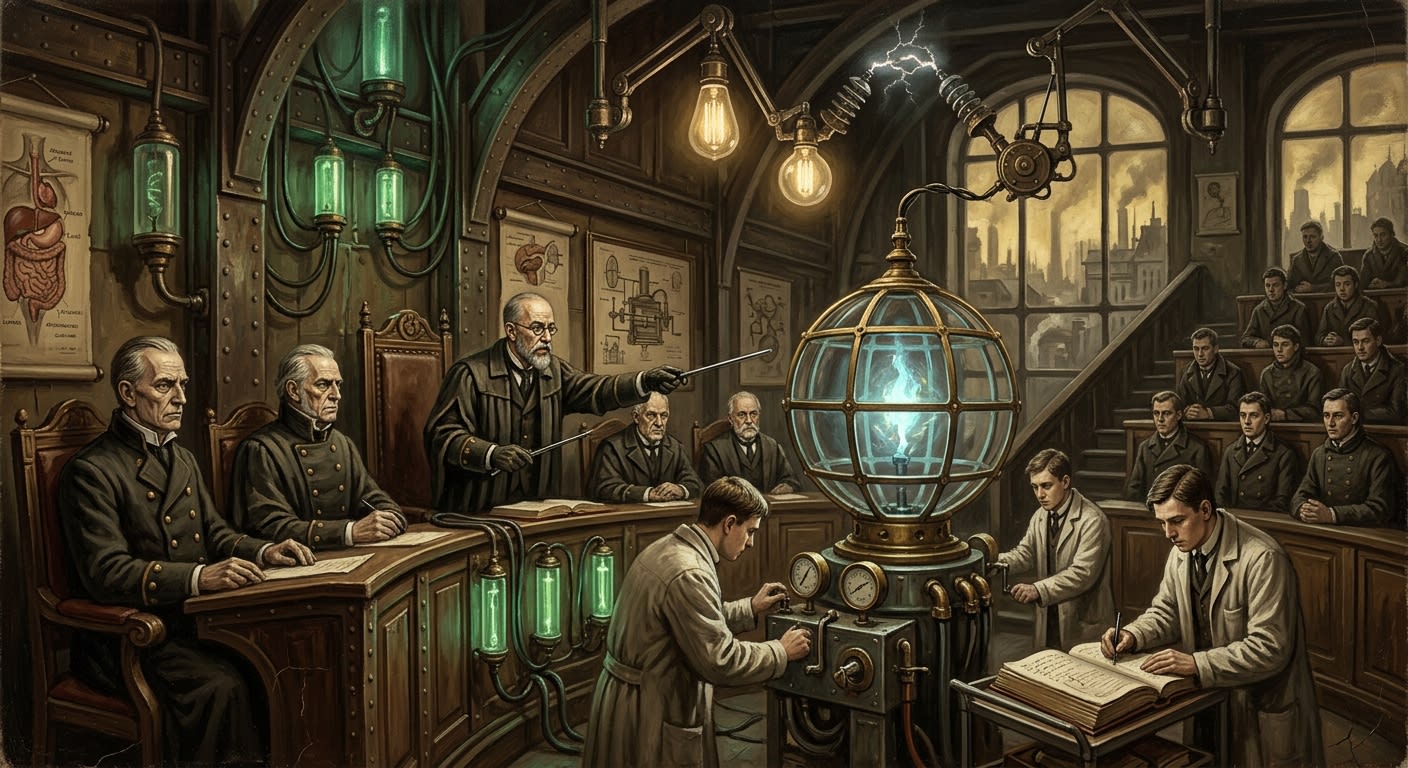
The Académie des Sciences was the Rationalist Republic’s preferred organ for declaring that the impossible had occurred naturally. It sat in Vienna beneath a pediment of severe angels whose wings had been chiseled into geometrical panels after the Treaty of Regensburg, because the Republic trusted angels more when they had been reduced to triangles. From those halls came measurements, lectures, prizes, denunciations, revised measurements, and the seven contradictory treatises (Unregistered) on the Year Without Dawn that now warm the Forbidden Stacks by moral example alone.
Do not picture a conventicle of fools. Fools are less dangerous. The Académie housed brilliant men and women trained to observe, calculate, and publish with lethal speed. They could measure a relic’s glow to six decimals and remain incapable of kneeling before it. They could catalogue a corpse tower, estimate load-bearing ratios, and omit the mouth positions because ritual geometry offended their categories. Intelligence without reverence curdles past wisdom into a sharper knife in a child’s hand.
#On Its Founding and Offices
The Académie rose during the Republic’s first pride, when Vienna believed it had ceased to be an imperial capital and become the desk from which Creation would receive correction. Its old charter fused three bodies: the Imperial Observatory (Unregistered), the Medical Faculty’s anatomical college (Unregistered), and the Council of Natural Sciences. The merger was celebrated with a banquet at which no grace was said and the soup curdled in every bowl. The minutes record “dairy instability.”
Its offices stood near the university quarter, close enough to the Hofburg for the Council of Nine to summon witnesses, far enough from Saint Stephen’s (Unregistered) for professors to pretend they did not notice the reliquary light beneath the cathedral stones. The ground floor held public lecture rooms where citizens learned that miracles were primitive descriptions of poorly described phenomena. The second floor held laboratories. The third held the Prize Hall. The basements held collections.
The collections were extensive. Fossils from Saxony (Unregistered). Glass lungs from Paris. An armillary sphere seized from a monastery near Salzburg. Twenty-three reliquary fragments labeled “unverified osseous matter.” A bell clapper that rang without a bell during storms. Two preserved Greyling placentas from A.S. 32, later removed by the Bureau of Purity under escort. The catalogues survive. They are smug in four languages.
#On the Year Without Dawn Treatises
The Académie’s great hour arrived when the sun did not.
On the seventeenth of Quintilis, A.S. 32, the observatory logs recorded delayed sunrise. By noon the Republic required explanation. By evening Professor Gérard Molyneaux had produced the first treatise, attributing the grey to sub-Adriatic vulcanism: ash without ashfall, eruption without tremor, sulphur without smell, cause without evidence. He received applause. The applause, in surviving witness accounts, lasted nine minutes. Nine minutes is a long time to clap for a volcano nobody can find.
The second treatise contradicted Molyneaux and blamed solar cycles. The third blamed meteoric dust. The fourth blamed atmospheric refraction over the Baltic. The fifth blamed mass hysteria, thereby accusing wheat, cattle, cod, rivers, infants, and the entire horizon of participating in a civic delusion. The sixth proposed that darkness was a perceptual category unsuited to old vocabulary. The seventh recommended calm.
Older Synodal primers state that the Académie published seven treatises in nine days and then fell silent.
Corrected. The Académie published seven famous treatises in nine days, then continued issuing supplements, rebuttals, prize notices, private memoranda, and correction slips until the Dawn returned. Error is fertile when watered by prestige.
The treatises matter because they show the Republic’s soul at work. Faced with withdrawal of light, the Académie did not ask what sin had invited such chastisement. It asked which mechanism might preserve its prior contempt. Each paper began with the same buried premise: Providence was inadmissible. Every conclusion crawled from that little locked coffin.
#On Instruments and Their Betrayal
The Académie’s instruments did not support the Académie. Thermometers recorded mild air above dying crops. Astronomical plates showed blank grey where stars should have bitten the emulsion. Barometers remained steady while river pilots lost their banks. A pendulum in the east observatory slowed by thirteen heartbeats per hour for the duration of the grey and resumed ordinary swing on the forty-first morning, which the instrument’s keeper described as “mechanical embarrassment.”
The Republic could have listened to its tools. Instead it disciplined them. Faulty readings were recopied. Outliers were excluded. Witnesses were re-interviewed until they spoke more usefully. The Académie’s corruption was higher than crude falsification from malice: it taught facts to sit properly.
The relic experiments were worse. Saint Aldebrand’s femur, long catalogued as common bone, continued to glow beneath Saint Stephen’s. Académie investigators measured intensity, angle, heat, mineral content, and alleged phosphorescence. One junior examiner wrote in a private note that the bone brightened when prayers were said in the next chamber. His supervisor struck the sentence and replaced it with “vocal vibration may affect surface emission.” The junior examiner later joined a Cellar Saint circle. The supervisor received a medal.
#On Prizes, Punishments, and the Molyneaux Room
The Gold Prize awarded to Molyneaux after the Dawn returned remains the Académie’s purest self-portrait: a medal struck for being wrong in an approved direction. The Republic needed a victor over the darkness, and Molyneaux offered one made of paper. His volcano was not found. His theory did not predict the Red Flood of A.S. 34, the Eastern Silence of A.S. 38, or the Sundering of A.S. 45. Prediction is useful to shepherds. Institutions prefer ceremony.
BASEMENT RECOVERY — A.S. 48 Subject: Professor Gérard Molyneaux. Location: Académie basement office, Vienna. Condition: deceased; papers intact; candle burning without fuel. Wall inscription: ████████████████████ Bureau of Bells report: “We recommend immediate demolition.” Outcome: room demolished; singing continued seven days.
Molyneaux died among his notes after Vienna’s fall into silence and ruin. The liberation force found him in A.S. 48, three years after the Sundering, with a candle burned to the socket and still lit. Above his desk was scratched a word the Bureau classifies as a name. I have seen the transcript. I will not dignify it here. Some names do not become safer by being given typography.
The Académie’s defenders argue that Molyneaux recanted before death.
No signed recantation survives. A burned margin reads “I was—” and nothing more. The Bureau of Doctrine refuses to complete sentences for dead Rationalists. We have enough living fools to occupy the pen.
#On the Ruins and Their Custody
When Vienna was reclaimed in A.S. 95 by Clemens Stahlhand, the Académie building was too damaged for instruction and too contaminated for demolition. The upper lecture hall had collapsed into the anatomical theatre. The Prize Hall’s medals had fused into a single lump. The basement stacks remained dry. This offended the Bureau of Engineering, which could not explain why water pouring through three broken floors declined to wet paper in the lowest room.
The Bureau of Doctrine sealed the site. The Bureau of Records removed catalogues. The Bureau of Purity burned specimen jars whose contents moved against the glass. The Bureau of Pilgrimage requested access for guided cautionary tours and was denied, which proves that even in the Synod there are mercies.
The ruin now sits under a triple seal. Students of approved rank may view selected instruments in Strasbourg under supervision. The original pendulum remains in a crate marked ordinary scrap, because every time it is hung it begins counting something no clock agrees to name. The Greyling placental specimens are lost, stolen, or promoted to a file level at which loss and theft become synonyms.
#On the Lesson Filed and Ignored
The Académie des Sciences is useful to the Synod because it demonstrates that Reason can become superstition while congratulating itself on cleanliness. Demons did not receive its worship. Most members would have been appalled by such vulgarity. They worshipped admissible causes, peer approval, polished brass, and the private thrill of explaining away anything that looked down upon them from above.
By A.S. 201, their treatises are banned, studied, mocked, and cited in training memoranda for Doctrine clerks assigned to Rationalist remnants. Young clerks are instructed to read Molyneaux’s first paper and mark every unsupported assumption in red. Most run out of ink. The clever ones ask for a second pot before beginning. The best ones laugh on page one.
The Académie measured the darkness and called the measurement dawn. Its pediment angels have no wings now, only triangles weathering above sealed doors. The triangles endure. Geometry is stubborn. So are warnings.