
#On the Disappearance of the Sun
"Volcanic eclipse." — Professor Gérard Molyneaux, Académie des Sciences, First Treatise on the Atmospheric Phenomenon, A.S. 32. Filed in the Forbidden Stacks under "Unintentional Comedy."
On the morning of the seventeenth of Quintilis, in the thirty-second year after the Massacre of Saint-Malo — two years after the Black Procession had burned cold in the Heldenplatz and the Rationalist Republic had filed the anomaly under "atmospheric" — the sun failed to rise.
There was light. Let that be clear, for the Bureau of Doctrine has corrected this point in six successive memoranda: the world was not plunged into absolute darkness. What settled over Europe was a grey — not the grey of overcast skies, which has depth and variation and the promise of clearing, but a flat, uniform, dimensionless grey that reduced noon to the quality of a November dusk and midnight to something the eye could not meaningfully distinguish from it. The stars vanished. The moon vanished. The horizon collapsed to a smear of slightly paler nothing.
For forty consecutive days, the sun did not rise.
#On What Happened in the Grey
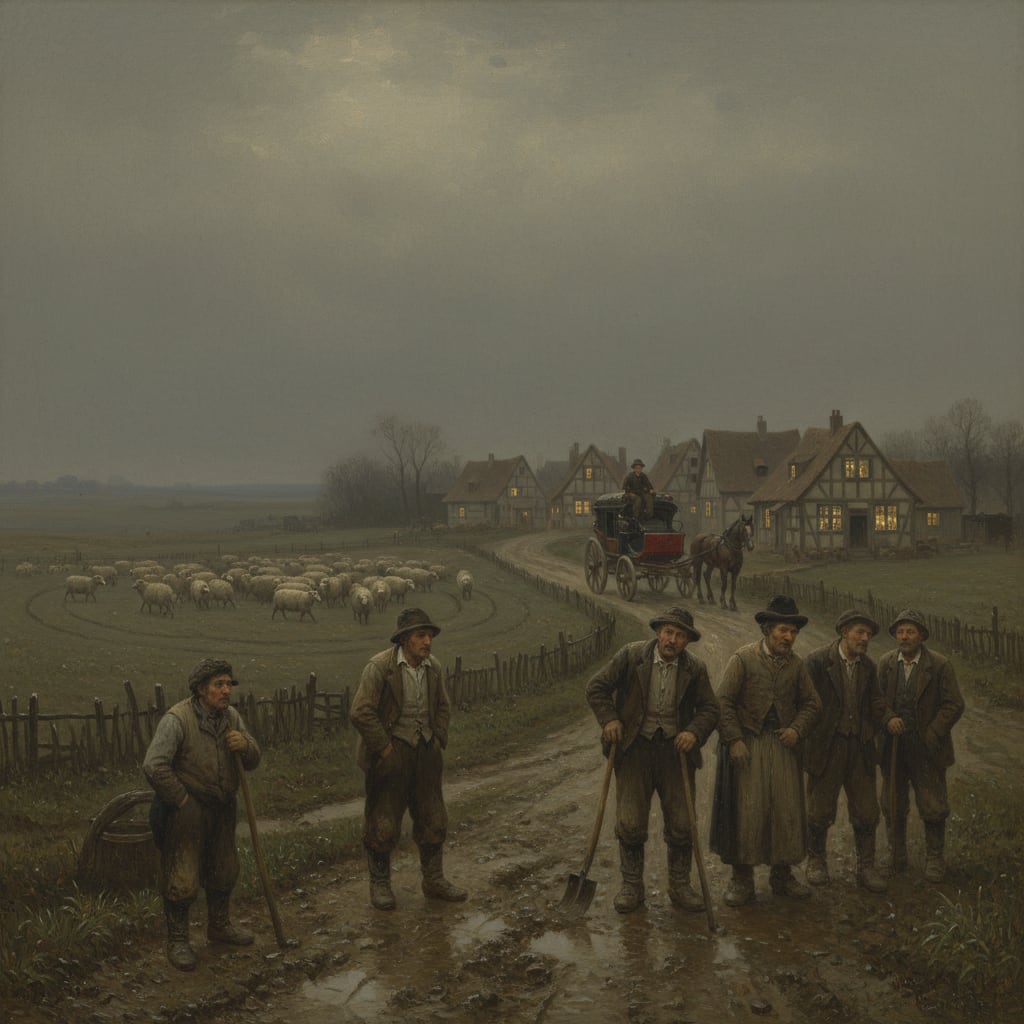
Crops withered in the first week. Wheat and barley, deprived of what little autumn light remained, curled inward and blackened as though scorched, though the temperature was unseasonably mild — a detail the Bureau of Engineering notes with the dry precision of men who measure catastrophes in degrees Celsius and find them "within observed parameters." Livestock refused to graze. Cattle stood in fields and lowed until their throats gave out, then stood in silence. Shepherds in the Rhineland reported that their flocks walked in circles, each sheep following the one ahead, the circle tightening over days until the animals stood pressed together in a mass of wool and bone and stopped moving entirely. The Bureau of Agriculture — which still existed in A.S. 32, the Republic having inherited it from the old imperial administration — classified the phenomenon as "behavioural anomaly consistent with prolonged low-light conditions" and recommended "supplemental feeding." The supplemental feed rotted in its casks within hours of preparation.
The fisheries of the North Sea reported catches that arrived already decomposing, the flesh of the cod soft and translucent as though the fish had been dead for weeks despite the nets pulling them from living water. Along the Rhine, the Moselle, the Seine, river traffic slowed and then ceased: pilots could not distinguish the bank from the channel, and three barges on the Danube near Vienna ran aground on sandbars that the charts insisted did not exist. The sandbars were examined after the Dawn returned. They were not sand. The Bureau of Engineering's report uses the phrase "calcium aggregate of indeterminate biological origin" and recommends that the material "not be ingested." A fisherman who had walked upon one of the bars during the grey reported that it was warm, and that it moved slightly under his feet, and that he heard — or believed he heard — breathing.
Ships on the Atlantic approaches to Brest and Calais wrecked on coasts they could not see. The Chalk Redoubt, which would not be founded for another thirty-seven years, sits on a headland whose base is littered with the remains of seven vessels that foundered during the Year Without Dawn. Their hulls are now incorporated into the Redoubt's breakwater. The Bureau of Relics has authenticated two of them as "maritime reliquaries, involuntary."
#On the Children
The births are the detail the Bureau does not discuss freely.
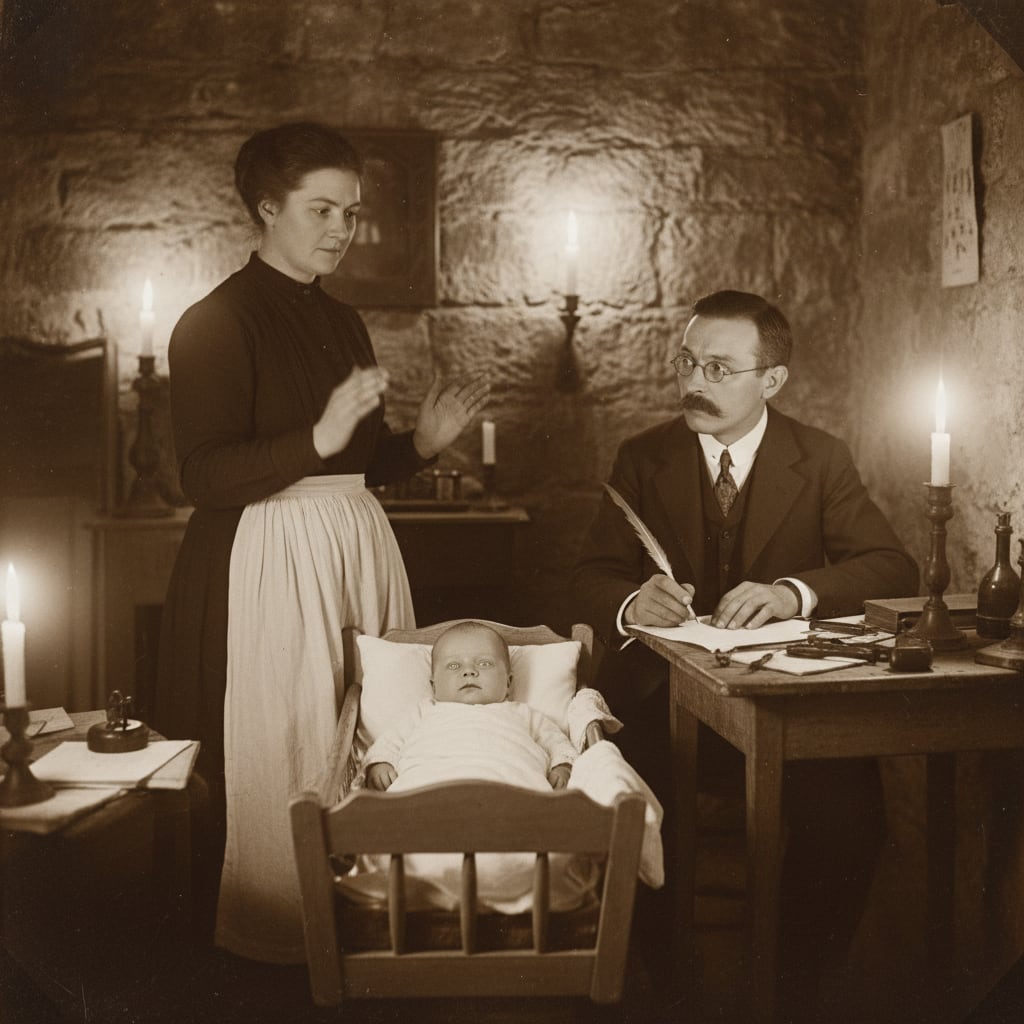
During the forty days, pregnancies across Europe continued — the grey did not halt the functions of the body, only its comforts — and infants were born as they had always been born, in pain and mess and the frantic ringing of parish bells. But the children of the Year Without Dawn were wrong. The Bureau of Medicine, in one of its earliest classifications, emphasised with a vehemence that betrays discomfort: their bodies showed neither deformity nor ordinary sickness. They were simply wrong. Their eyes were pale to the point of colourlessness, a washed grey that reflected light without appearing to absorb it. They did not cry at birth. They gazed. The midwives of Lyon, Hamburg, Kraków, and Seville reported the same phenomenon independently, and the Republic's obstetrical committees confirmed it with the bewildered thoroughness of men confronting data that did not fit their models.
Baptismal rates plummeted. Parents hesitated — and in a Republic that had made baptism legally irrelevant, hesitation was easy, costless, merely a social tic. But the Cellar Saints, praying in their hidden chapels, reported that the faithful brought their Greyling children to be baptised in the same numbers as always, and that the holy water, upon touching the infant's brow, produced no steam, no warmth, no sign of the sacramental heat that the clandestine clergy had come to expect. The water sat cold on the skin and ran down. The children stared.
The Bureau of Purity's retroactive dossier on the Greyling Cohort (Unregistered), assembled in A.S. 94, is one hundred and forty-seven pages long and classified at the fourth level. What is known publicly: the Greylings aged normally, took employment in the usual professions, married, produced children of their own with unremarkable eyes. What is classified: the Bureau of Purity's assessment of their "spiritual receptivity." What is sealed entirely: the three-page appendix titled "On the Question of Whether the Greyling Cohort Possesses Souls," which the Bureau of Doctrine has declared "resolved" without specifying the resolution.
Earlier Bureau assessments described the Greyling Cohort as "spiritually neutral, requiring no special catechetical intervention."
This assessment is withdrawn. The Greyling Cohort is reclassified under Standing Order 32-A(Revised) as "spiritually indeterminate, monitoring ongoing." The distinction between "neutral" and "indeterminate" is, the Bureau assures us, significant. The Bureau has not explained how.
#On the Rationalist Explanation
The Rationalist Republic responded with the machinery that it applied to all phenomena: measurement, publication, contradiction, and confidence.
Seven treatises were published in nine days. The first, by Professor Gérard Molyneaux of the Académie des Sciences in Vienna, attributed the darkness to "stratospheric particulate diffusion from sub-Adriatic vulcanism" — a volcano, in other words, located somewhere beneath the Adriatic Sea, erupting with sufficient force to blanket Europe in ash-cloud for forty days while producing no seismic activity, no ashfall, no sulphur stench, and no observable eruption. The paper was received with applause. It was cited four hundred and twelve times before the Sundering made citations irrelevant. The second treatise, published by Molyneaux's own colleague Professor Aldric Venn of the Strasbourg Lyceum, contradicted the first entirely, proposing instead a "solar occlusion event consistent with predicted eleven-year luminosity cycles." The third proposed meteoric debris. The fourth blamed the British. The fifth — authored anonymously, though widely attributed to the Republic's own Council of Natural Sciences — suggested that the phenomenon was "psychosomatic in origin" and that the sun had, in fact, risen normally every day, but that "mass hysterical suggestion" had convinced the population otherwise.
The Republic's official position, published in broadsheet and posted in every Prefectural hall, was that the event was "a natural atmospheric occurrence of unusual duration" and that "no supernatural explanation should be entertained by rational minds." The broadsheets were printed in ink that the printers reported was unusually difficult to set — the type kept slipping, the letters rearranging themselves on the press. The Bureau of Silence, in its later retroactive audit of pre-Sundering publications, notes that seventeen of the twenty-three surviving broadsheets contain minor textual errors that, when compiled, form a sentence in no language the Bureau has been able to identify.
#On What Walked in the Grey
The official record states that the Year Without Dawn was a meteorological event and nothing more. The faithful endured it. The sun returned. Life resumed.
The unofficial record — preserved in the testimonies of Cellar Saints, in the redacted annexes of the Bureau of Purity's early dossiers, in the folk songs that the Bureau of Silence has spent a century and a half trying to burn — tells a different story.
During the grey, things moved. Soldiers of the Republic's garrison at Budapest reported shadows that did not correspond to any object, sliding across walls in directions the dim light could not account for. Farmers in the Rhineland heard footsteps in their fields at night — heavy, rhythmic, processional — and found in the morning tracks pressed into the soil that were shaped like human feet but measured seventeen inches from heel to toe. A mail coach between Nuremberg and Munich arrived three days late with its passengers sitting upright, alive, breathing, and unable to account for the missing time. They remembered nothing between departure and arrival. The horses were found a mile from the road, standing in a perfect circle.
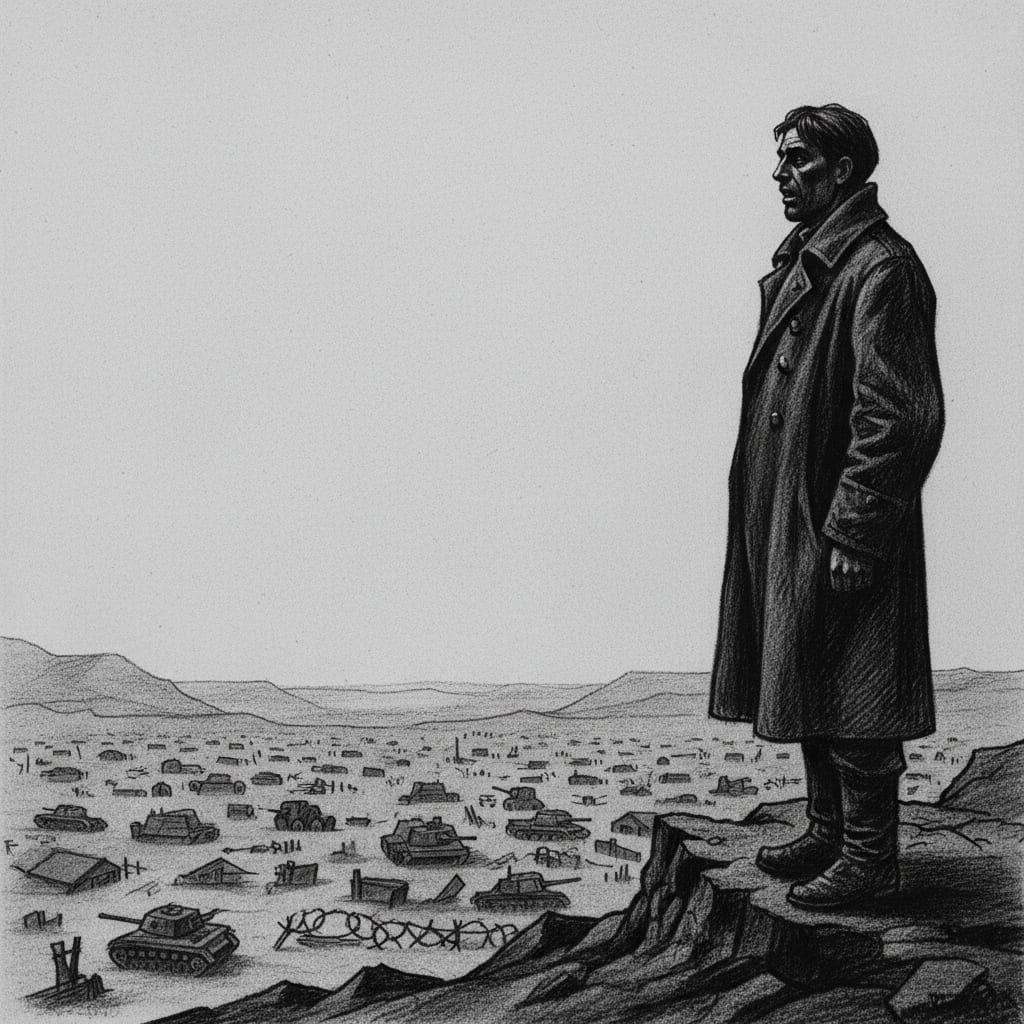
Militia columns were marched eastward into the grey by the Republic's military administration, which believed — with the serene confidence of men who had never encountered anything their bayonets could not solve — that the darkness was a border phenomenon and that marching toward it would bring them through it and into clear sky. The columns entered the grey. They did not emerge. Refugees fleeing westward weeks later reported finding their corpses stacked in towers — with architectural precision, mouths pried open and fixed in configurations that the Bureau of Rites would later classify as "ritual geometry, hostile, Category Three."
The mouths are the detail that survived. Open, rigid, locked in a scream that had no sound, aimed upward at a sky that had no sun. The soldiers on the Sagittal Line still call a silent bombardment a "dawn mouth." They do not explain why. They do not need to. Everyone on the Line knows.
#On the Hollow Fast of Saint Calistus
In Lyon, in the district of Saint-Calistus, the reliquaries dimmed. The candles burned, but their light stopped at arm's length, as though the air itself had thickened into something that refused to transmit illumination. A plague — or what the faithful called a plague, though the Bureau of Medicine has never confirmed the pathology — crept westward from the Rhône valley, and the district's Cellar-Prior, a man the Bureau's retroactive hagiography names Calistus without providing a surname, determined that the plague could be halted by a fast.
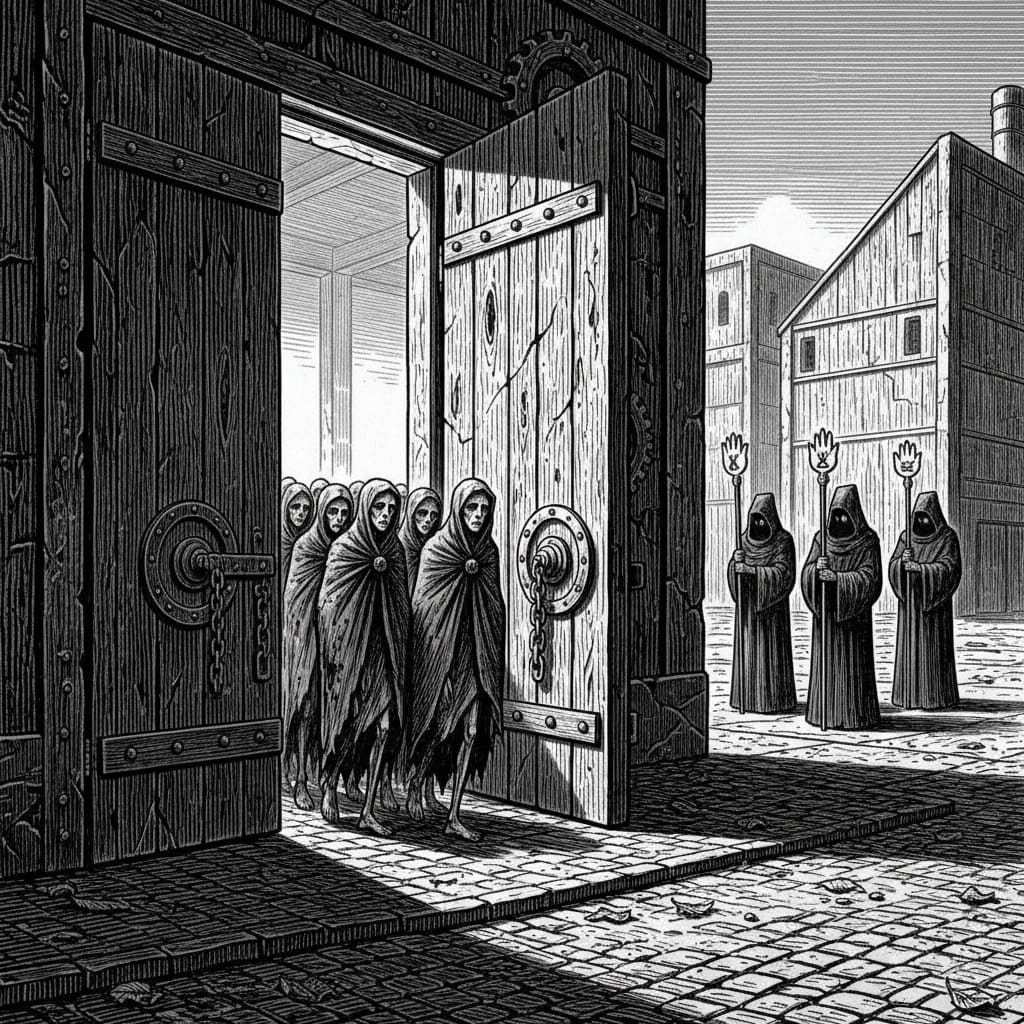
Forty nights. An entire district — men, women, children, the elderly and the infirm — locked within the ration-halls and denied bread. The faithful volunteered, if the word can be applied to a choice made in the dark by starving people who believed their only alternative was damnation. The doors were sealed. The fast began. And the plague halted. It stopped at the district boundary as though striking a wall, turned aside, moved south along the river, and dissipated in the marshes beyond the city.
When the doors of the ration-halls were opened on the forty-first morning, the fasters had eaten their own tongues. Every one. The surgeon's reports — preserved in the Bureau of Mercy's archives, which are the only Bureau records from the pre-Synod period that were not systematically falsified — describe the wounds as clean, deliberate, and self-inflicted, the tongues bitten through at the root and swallowed. Lyon still sings its hymns in whistles, for no descendant of that district possesses a full voice-box. The Bureau of Doctrine classifies the Hollow Fast as "acceptable spiritual investment" and has filed it as a precedent for future emergency tithes.
#On the Return of the Sun
On the fifty-seventh day of the grey — for the Bureau counts fifty-seven, though the canonical number remains forty, a discrepancy the Bureau of Records has resolved by declaring that seventeen of the days "did not meet the threshold for classification as distinct temporal units" — the sun rose.
It rose in the east, as it had always risen. It rose at the angle and elevation prescribed by the season. It rose with the ordinary amber of a Central European autumn dawn, and it illuminated a continent that had spent nearly two months beneath a pall of flat, dead, dimensionless grey, and the light fell upon crops that were dead, upon rivers that had silted with calcium aggregates of indeterminate biological origin, upon Greyling children who blinked for the first time, upon a Rationalist Republic that immediately published four more treatises and declared the crisis resolved.
The Republic celebrated. Medals were struck. Molyneaux received the Academy's Gold Prize for his volcanic hypothesis. A parade was held in Vienna. Within two years, the Red Flood of the Danube turned the celebration sour. Within six, the Eastern Silence swallowed the Balkans. Within thirteen, the Sundering tore the world apart.
The Year Without Dawn was the second omen. The Bureau classifies it after the Cold Fires of Vienna and before the Red Flood, in a sequence of escalating Providential Warnings that the Rationalists dismissed with increasing desperation and the faithful received with increasing dread. The Bureau's position is that the Creator withdrew His light to demonstrate what a world without His favour would look like. The Rationalists' position was that the sun was a mechanical process and that mechanical processes sometimes stalled.
Both positions remain on file. One of them was proved correct at A.S. 45 when the Balkans opened and the light that poured through was the colour of burning sulphur and the shape of seven generals walking. But by then, the Rationalists were in no position to amend their treatises. Most of them were dead. The rest were running. Professor Molyneaux's body was found in the basement of the Academy of Vienna in A.S. 48, surrounded by his papers, a candle burned to the socket, and a single word scratched into the wall above his desk.
The word is classified.