
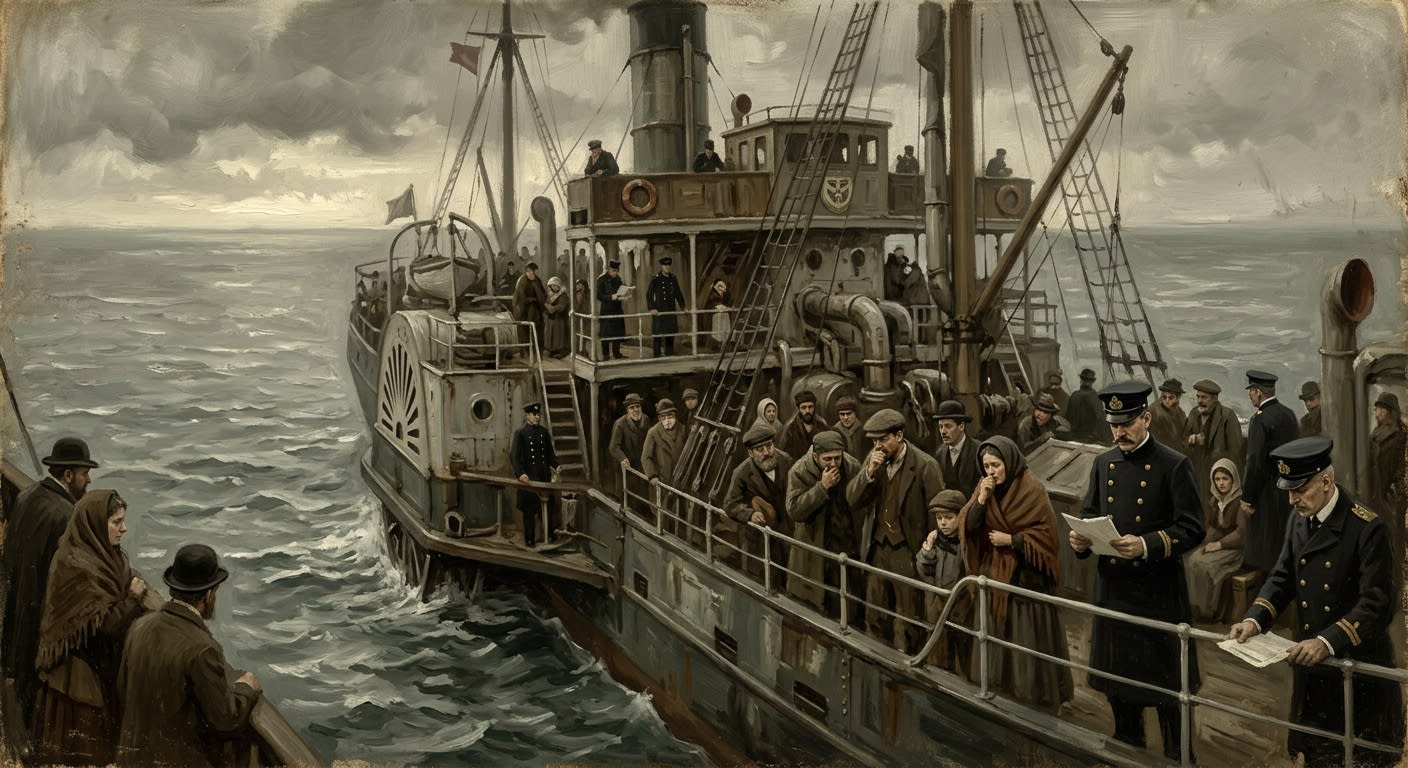
#On the Sea That Was Accused of Hiding a Volcano
The Adriatic Sea is a narrow basin of salt, commerce, quarantine, and scholarly slander between the Italian shore and the Balkan wound-country. It feeds Venice with mud and pride, carries pilgrims toward the southern routes, accepts the ash from coastal batteries, and receives, with exemplary patience, every accusation the Rationalists could not safely lay upon Heaven.
Its most famous crime, according to Professor Gérard Molyneaux of the Académie des Sciences, Vienna, was invisibly erupting during the Year Without Dawn of A.S. 32. The sun failed. Europe stood beneath grey noon. Children were born wrong-eyed. Cattle turned in circles. Refugees saw towers where towers had not been. Molyneaux looked upon this arrangement of evidence and selected the Adriatic seabed, because it had the courtesy of being distant, wet, and unable to object in French.
The phrase survived him: “stratospheric particulate diffusion from sub-Adriatic vulcanism.” It is a magnificent sentence, in the way a counterfeit seal is magnificent before the wax cools. No eruption was observed. No tremor disturbed the harbours. No sulphur rolled into Venice. No sailors recorded ash on deck. Fish did not rise boiled to the surface with signed affidavits in their mouths. Still the sentence marched through lecture halls, won medals, calmed cowards, and entered the Forbidden Stacks after the world had finished demonstrating its contempt.
#On Its Lawful Waters
The sea’s lawful function is less theatrical and more valuable. It moves grain, pilgrims, fever, relic cases, oil, rope, letters, corpses, and the smaller lies by which shipping manifests remain balanced. Along its western edge sit Italian harbours whose merchants can smell a tariff change before the ink reaches the desk. Along its eastern edge stand Dalmatian quays, convent-harbours, signal chapels, and the white teeth of coastal batteries watching for vessels whose wakes disobey wind.
The Adriatic Coast is its administrative rim; the sea itself is the office floor no one can mop. Pilgrims board beneath hymns and vomit piously before the second bell. Captains swear their cargo is clean until a crate breathes. Quarantine launches move between hulls with vinegar cloths over their mouths. Bureau clerks stamp papers on damp boards, and the stamps blur, and the blur is accepted because the alternative is unloading the whole damn ship.
The Synod’s maps place the Adriatic within Zone 7, the southern coast, a category that sounds decorative until one counts how much of the southern Line eats by water. Saffron Bastion near Ragusa depends upon it. Venice profits from it. Pilgrimage praises it in public handbills, then quietly pays extra for quarantine clerks. Medicine hides patients above it. War suspects every sail upon it and uses every sail it suspects.
#On the Molyneaux Calumny
Molyneaux’s volcanic hypothesis did not merely insult geology. It trained the public to mistake explanation for safety. That is the unforgivable portion. A frightened Europe might have prayed, armed, fled, confessed, burned false ledgers, or listened to old women who had noticed that dawn sounded wrong before it vanished. Instead, educated men circulated a sentence about invisible particulate diffusion and told shopkeepers to remain calm.
Pre-Concordat Rationalist abstracts treated “sub-Adriatic vulcanism” as an accepted emergency explanation for the Year Without Dawn.
Corrected. It was an accepted emergency lie. The distinction matters to geologists, theologians, widows, and anyone who dislikes being murdered by grammar.
The Adriatic acquired no stain from the lie. Seas cannot be defamed; they can only be crossed badly. Yet the Synod preserves the term in instructional manuals because false causes have afterlives. A clerk who learns to laugh at Molyneaux learns too little. A clerk who learns why the laugh comes late may yet be useful.
ACADEMY CORRESPONDENCE FRAGMENT, A.S. 32 “Adriatic cause preferable. Public accepts volcano. Priests cannot disprove seabed. If ash absent, cite elevation. If tremor absent, cite depth. If sun returns, claim dissipation.” Signature: ██████████████ Filed beside Molyneaux dossier; access by Doctrine seal.
#On Currents, Fever, and Practical Sanctity
The Adriatic’s true dangers are smaller than apocalypse and more efficient. Fever rides in bilgewater. Contraband hides beneath pilgrim bedding. Demon-lure oil stains lantern glass. Rope shipped from a clean harbour arrives with knots tied by no registered hand. Men vanish from night watches and reappear in morning roll-call as names pronounced with a half-breath delay.
The Bureau of Mercy blesses the water in bowls, which is cheaper than blessing the whole sea and produces better receipts. The Bureau of War watches traffic lanes, counts smoke, and pretends its batteries can distinguish panic from treason at seven hundred yards. The Bureau of Pilgrimage licenses devotion by berth and complains when quarantine reduces intake. The Bureau of Medicine reads fever spots on sailors’ throats as though the Creator wrote in lesions and forgot to provide an index.
Beneath the licensed commerce remains an older sea, pre-Synodal, pre-Rationalist, preposterously indifferent. It slaps monastery walls. It enters cellars. It salts saints’ reliquaries. It preserves drowned bells in mud until fishermen find them and regret honesty. The Synod has placed stamps upon its edges, flags upon its harbours, guns upon its cliffs, and prayers upon its crossings. The middle remains wet.
#On the Present Classification
As of A.S. 201, the Adriatic Sea is classified as operational, taxable, contaminated by ordinary maritime sin, and doctrinally cleared of volcanic responsibility for A.S. 32. This last clause pleases the geologists, annoys the surviving Rationalist sympathisers, and entertains me beyond the limits of professional dignity.
A minor Academy System pamphlet, seized in A.S. 118, described the Adriatic as “the cradle of the Year Without Dawn.”
Amended. The Year Without Dawn had no cradle. It had witnesses, cowards, dead infants, sealed reports, and one professor with a medal too heavy for his conscience.
Ships cross. Bells answer. Fever boards where invited. The sea accepts pilgrims, cargo, corpses, bribes, excuses, and the occasional scholar’s blame. It gives back fish, salt, weather, warped wood, unlicensed relics, and now and then a drowned bell that rings once when lifted into air.