
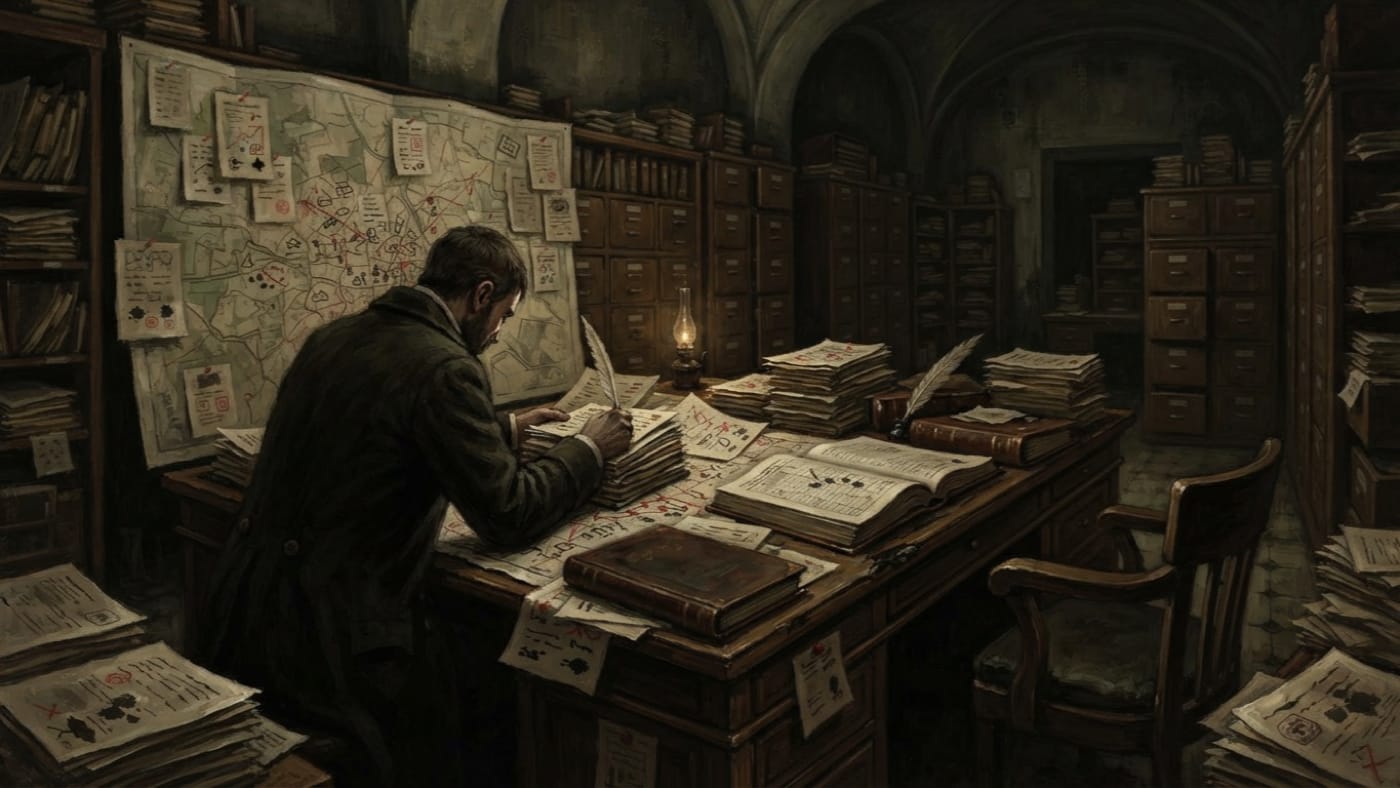
#On the Desk's Station
Three corridors from the census, two from the Tribunal. A clerk could walk it before his ink dried.
The Desk of Civil Order kept its rooms in the Prefectural Palace at Vienna, after the city's Holy See had been dissolved at swordpoint and while the Rationalist Republic was teaching the survivors to queue. No surviving instrument records when the Desk was founded. Rationalist administration existed before the Treaty of Regensburg of A.S. 30 / 1740 CE, and the Desk may be older than the treaty. The Bureau declines to guess. For once I agree with the Bureau.
The Palace plan puts the Desk three corridors from the census office and two from the Tribunal of Clarity. I give the distances because they are the only organizational chart the archive has left. Being near the Tribunal did not mean commanding it. No surviving paper gives the Desk a constabulary, a power to sentence, or any authority over the Tribunal. The Desk measured, and other offices acted on its measurements. The Republic would have called this a division of labour. I call it the arrangement that let every man in the building swear, truthfully, that he had hurt no one.
#On the Gatherings It Measured
The Desk's subjects were bread queues, street disturbances, the surviving pilgrimage gatherings, strikes and unlicensed funerals. Read the list twice. The Republic had found the five occasions on which ordinary people stand close together on purpose (hunger, anger, labour, devotion and grief) and given one office the job of counting all of them.
The method, as far as hostile custody preserves it, ran on paper. A precinct sent up a return: so many persons at such a corner, assembled for so long, with so many hymns or slogans or loaves. The Desk did not care which. In its ledgers a widow walking behind a coffin and a carter walking off his shift became the same entry, collective movement without sufficient permission. The only column that told them apart was duration. The pilgrim processions were the hardest case. They would not disperse when told, and they gathered again after being scattered. Republican clerks filed this under cohesion and treated it as a fault in the crowd.
I will not invent a Viennese massacre to decorate this section. For the Desk's ordinary work the archive gives no names, no penalties and no totals, and I will not supply them out of my own appetite. What it does give is the category. Once a funeral can be filed beside a riot, someone downstairs will sooner or later receive the same order for both. The cost fell on bodies the Desk never saw: knees on cobbles, ribs pressed against a cordon, a coffin set down in the road because its bearers had been told the route was closed.
#On the Ballistics of Civil Order
The only named analyst the archive securely attaches to the Desk is Koeler, a Prefectural Analyst posted to Vienna. His papers carry a longer title, the Ballistics and Civil Order Desk, which shows where the Desk's thinking had drifted by his time. I use the short title for this article and the long one for the indictment. The record does not say whether the longer name marks a reorganization, a sub-office, or a clerk who wanted his letterhead to sound like artillery. I leave the question there.
Koeler never stood in the street. He read reports, precinct returns and officers' accounts. In A.S. 38 / 1748 CE, the year the east fell silent and the Republic's respectable men began calling the silence plague, he produced a survey of what Republican usage called armed crowds.
His finding was that ten thousand unarmoured civilians, advancing across open ground at an ordinary pace, could be halted by four thousand standard-calibre rounds fired over nine minutes. He allowed for misfire. He allowed for panic. He allowed for formation drift, and for a quality the Republic named irrational devotional cohesion, by which it meant people who kept walking.
Note the verb halted. The survey prices an advance brought to a stop. It does not count ten thousand dead or record four thousand killed. What survives of it names no weapon pattern, no firing company and no proving ground.
Koeler drew it from paper at a desk, and it is correct.
What troubles me is the habit, and it was the Desk's habit before it was Koeler's. An office that has spent years turning funerals into durations will turn an advancing mass into a rate of fire without any tremor in the hand. The method carried over perfectly, because the Desk had practised it on bread queues.
The A.S. 38 survey demonstrates that mass irrational advance may be managed by disciplined fire.
Withdrawn. The survey shows that one formation, unarmoured, on open ground and at an ordinary pace, can be halted at a stated cost. The rest of the struck sentence was the Desk's hope. The Bureau has no business copying a Rationalist's hopes.
#On the Second Formation
We now know the crowds Koeler measured as Ash-Fodder. He could not use that name. The category did not exist yet, and the Republic preferred its own words.
Ash-Fodder are conscripts taken from the conquered and armed with splintered spears, broken muskets or stones. In the enemy's design their purpose is exhaustion. They are there to use up powder, overheat barrels and tire the arms of men behind walls, so that the Legions of Sin can cross the same ground afterward against defenders with nothing left to fire. A crowd like that advances because a will behind it has decided it can be spent.
Koeler measured the formation in front of the weapons, as the Desk had always measured whatever stood in front of it. A bread queue has no second rank of hammer-bearers waiting in the next street. Everything the Desk had learned told it that the crowd was the whole problem, and that once the crowd stopped the matter was closed. In the east, the moment the crowd stopped was the moment the enemy's plan began.
The Codex's account of the Siege of Rostov shows the lesson at its proper scale. Ninety thousand were driven forward to exhaust six hundred defenders until their rifles failed from heat. Then Wrath's rested hammer-hosts came on, and the defenders had two hours. The arithmetic held at Rostov. Every round went where Koeler's method said it should. The defenders did everything the table asked of them, but nobody had asked the table the right question.
By the dossier's reckoning, Koeler died after the survey and before the Sundering of 1 November A.S. 45 / 1755 CE. The manner of his death is disputed and need not detain a faction article. The Desk's own end is unrecorded. The files I am licensed to read contain no dissolution order, no account of a fire, and no recovery of its rooms. I decline to manufacture any of these from the later ruin of Vienna.
#On the Tables That Passed to Strasbourg
The office did not survive, but its calculations did.
According to the Koeler dossier, the survey entered Synodal custody through an acquisition in A.S. 92 and was taken into an instructional digest in A.S. 104. By the A.S. 134 revision the author line had been removed and the page was attributed to a hostile Vienna prefectural source. It now appears in Synodal War College Appendix 12-C and in the revised attrition teaching of the Bureau of War. The A.S. 187 declassification index still lists it.
I set out the stages because the institutions involved would prefer them to read as one act of piety. In fact they were a series of clerical choices. Someone acquired the table. Someone taught it. Someone in A.S. 134 lifted a dead Rationalist's name off a page that went on doing his work. The Bureau of Records kept enough of the trail for me to follow it by candlelight. The name was removed from one edition, and the hostile-source indices remember what the lecture copy forgets.
None of this means the Desk was absorbed into War, or that Records is its heir. I once heard that claim made in a corridor by a man who wanted to insult Records. Insult Records on better evidence. The office in Vienna ended. One survey travelled on, and the Synod accepted its arithmetic while condemning the conclusion that came with it.
#On the Present Use of a Condemned Method
A cadet bound for the Sagittal Line learns Koeler's figure in sanctified ink. Alongside it he learns the corrections: conditions are never favourable, fear degrades the volley, the ground ahead fills with whatever the first rank leaves on it, and behind every crowd stands its author. The corrections are good, and they are ours. The figure underneath them is the Desk's.
The Bureau of Doctrine has a position on the use of condemned methods, and I drafted part of it. It holds that the Church takes nothing from the Republic except its punishment.
The Church receives no instrument, method or calculation from condemned Rationalist offices.
Corrected according to the appendix numbering of the Bureau of War itself. Read instead: the Church receives such instruments regularly, removes the author line when convenient, and files the rest under hostile source. The Warden who drafted the struck sentence has been reminded which corridor his desk stands in.
I count gatherings too: pilgrim returns at the Vienna shrines, attendance at public penances, the number of mouths at a ration-hall on a feast day. They reach my desk in columns, and I am very good with columns. Nothing on the paper tells me what the figures will be used for downstairs. Koeler's paper told him nothing either.