
#On the Arithmetic of the Enemy
"I have been asked how many demons the Lie (Unregistered) commands. The answer is: fewer than you fear. I have been asked how many men the Lie commands. The answer is: more than you can bear to count." — Bureau of War Operational Estimate, A.S. 187, filed under 'Uncomfortable Truths, Category: Permanent'
The tavern-singer knows the Enemy as a howling tide of clawed fiends boiling up from the cracks of the earth. The child pressed against the dormitory wall pictures horns and wings, red eyes in black fog, the whole painted menagerie of Catechism primers and Feast-day puppet shows. Both are wrong. The Bureau permits these fictions because the truth is administratively inconvenient and theologically worse.
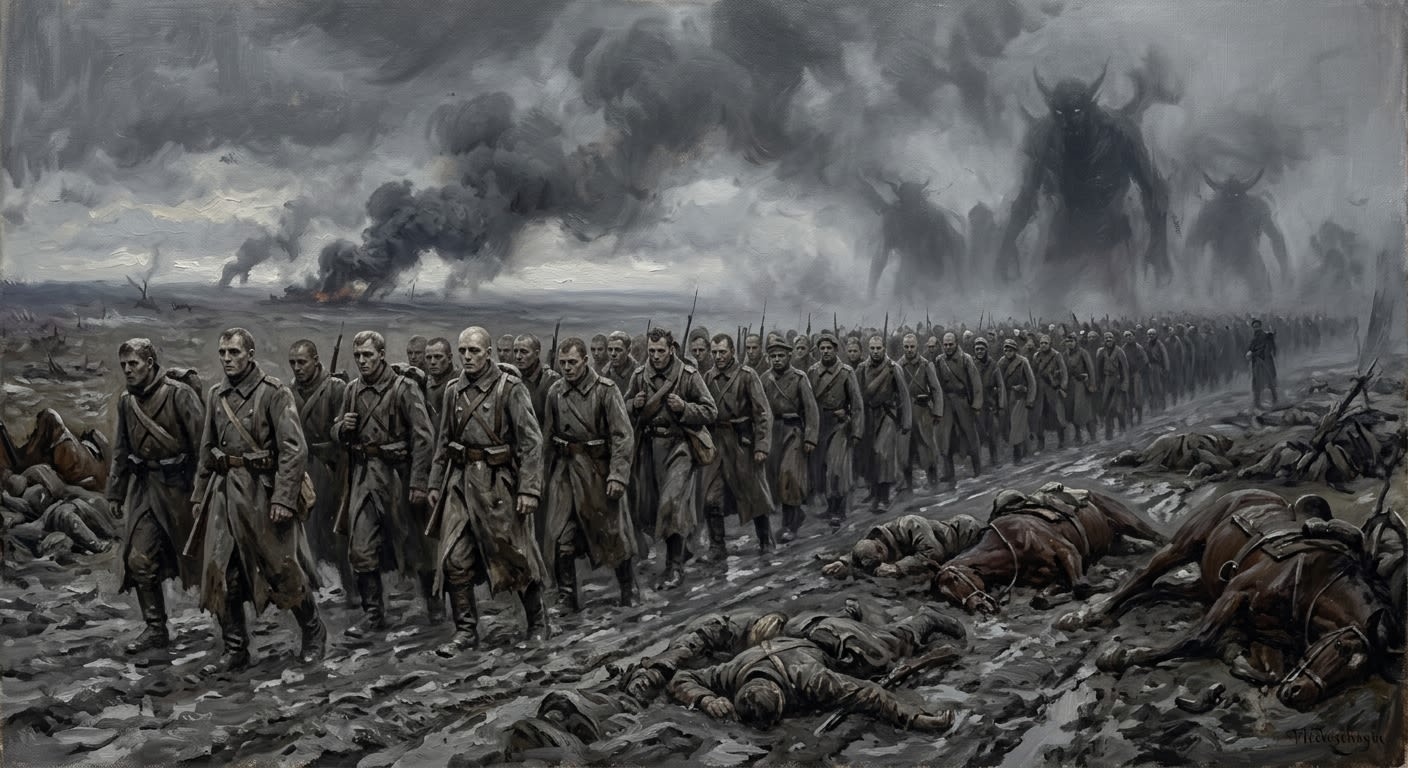
The true tide of the Shadow Court is human.
The mathematics are blunt and the Bureau of War has never tried to pretty them. For every true demon that crosses the Sagittal Line — every Forge-Beast, every Maw-Born, every shrieking thing the official documentation catalogues under its lurid bestiary headings — there march ten, twenty, sometimes a hundred mortal bodies. Human bodies. Branded, broken, emptied, packed with bile or babies or both, driven forward by whips no less cruel for being wielded by other humans who were, themselves, driven forward a year or a decade earlier. The Lie does not waste its own flesh. Veil-breaches are costly. Sorcery exhausts itself. True demonkind is finite, however much Doctrine insists otherwise in its public catechisms. And so the Adversary has discovered what our own Rationalist forebears worshipped: that the cheapest soldier is a man.
This entry concerns itself with those forty-seven. The mortal host of the Shadow Court. The taxonomy of the broken.
I take no pleasure in the cataloguing. I take considerable pleasure in the prose.
#On the Thralls
The simplest and most numerous. A sigil seared upon the forehead or branded across the sternum shaves away the self — not cleanly, the way a barber shaves a jaw, but messily, the way a fire shaves a library. What remains is a husk. Lungs that pump because lungs pump. Legs that march because the sigil says march. Eyes that see nothing worth reporting to a mind that has vacated the premises.
Thralls do not protest, do not question, do not flinch when rifle-shot takes the man beside them. Their silence is the silence of furniture. Doctrine classifies them as "disposable auxiliaries," which is a term that manages the remarkable feat of being both accurate and obscene simultaneously.
Their weapons are often blunt or broken. The Lie does not require that Thralls win. It requires that they absorb — volleys, powder, time, the attention of our gunners while true abominations close the distance behind them. A Thrall column is a sponge with legs, soaking up ammunition until the defenders' barrels glow and the real assault begins.
The sigil burns hotter the closer a Thrall is driven toward sanctity. They are therefore aimed directly at reliquary emplacements, kindling themselves into cinders on holy wards. The tactical logic is sound: the Thrall's death clears the ward; the demon following behind walks through the gap. The Bureau of War calls this "sequential attrition." The trenches call it murder with extra paperwork.
At Metz, Ordinal Valtrix reported a column of Thralls ten thousand deep marching into cannon fire without breaking stride. They did not scream. They collapsed in silence, forming a bridge of corpses across which Wrathforged hammer-hosts advanced at their leisure. At Prague, Thralls branded with half-formed sigils retained just enough voice to moan the names of their families — an act of accidental cruelty so effective that entire Synod companies lost sleep until the trench was torched. At Lyon, a cohort's sigils overheated simultaneously. The bodies turned to brittle ash-statues mid-step and shattered in unison, as though struck by a hammer no one could see.
The Bureau of Records estimates three million Thralls have been spent since the Sundering. The estimate is filed alongside the Bureau's estimate of ammunition expenditure. The columns are adjacent. The paper does not flinch at the comparison.
#On the Hollowed
If the Thrall is the empty vessel, the Hollowed is its refinement into ordnance.
These are mortals whose insides have been carved out — the phrase is metaphorical in the catechism and literal in the field surgeon's report. The Lie scoops out what makes a person whole and fills the cavity with something more immediately useful: bile, powder, sorcery-flame packed in wax bladders, occasionally parasites of a kind the Bureau of Engineering declines to classify on the grounds that classification would require closer inspection than anyone is willing to provide.
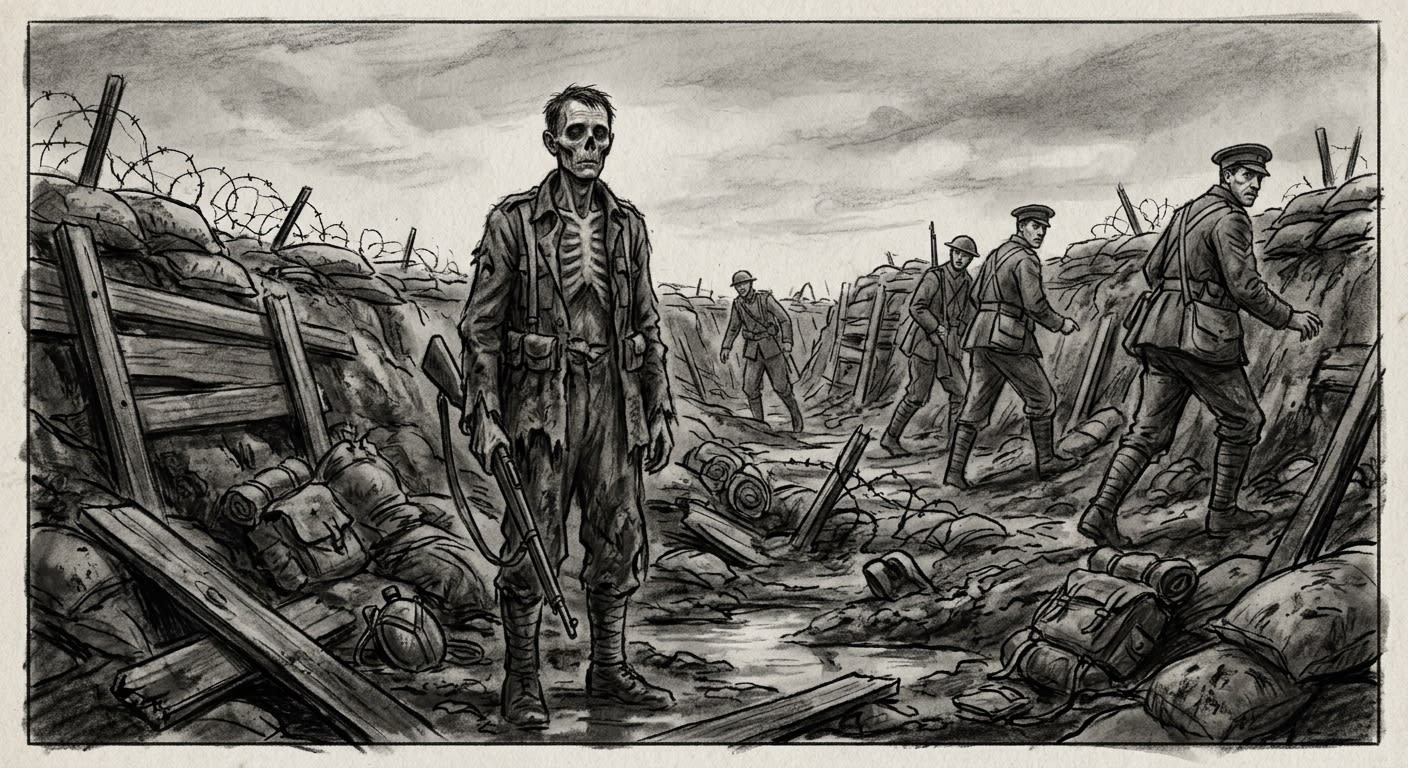
Their eyes are the tell. Sunken, cavernous, the orbits deepened as though the soul itself has been scraped out behind them. When they walk, their torsos rattle faintly — ribs become loose cages for the cargo within. Our soldiers call them "coffins on legs." Doctrine calls them "delivery bodies," which is the sort of euphemism that earns a clerk a commendation and a soldier a drinking problem.
The cruelty of the Hollowed is tactical. To strike one is to trigger the payload. To leave one standing is to wait for the command-word that detonates it. The choice is between acting too soon and acting too late, and the Enemy has calibrated the mechanism to ensure that both choices are wrong.
At Constantinople, during the Vigil of the Hollowed in A.S. 170, a column of Hollowed staggered into the Sixth Ravelin behind Maldrake's Hellbow Legion. When the defenders cut them down, their chests burst open, releasing sorcery-flame that ate stone the way a candle eats wax. Forty-seven members of the garrison entered the breach-cement singing, and the wall was sealed with their bodies inside it. At Worms, every Hollowed in an assault column collapsed simultaneously when a Pale Chanter struck a single note — the corpses burst, and the trench was buried in bone-shards. At Ghent, dozens were packed with lantern oil, set alight, and driven forward as human torches. Survivors swore the burning Hollowed cried thank you as they burned. Doctrine reminds us this is "auditory corruption." The survivors remind Doctrine that auditory corruption does not usually weep.
#On the Ash-Mothers
I hesitate.
This is a professional document — a Codex entry, stamped and sealed, intended for the education of officers and the edification of clergy. I do not hesitate because the subject is distasteful. Distaste is a luxury the Bureau cannot afford. I hesitate because the Bureau's own language buckles under the weight of what must be described, and my prose — which is, I remind the reader, the finest in the Synod's employ — cannot ennoble what is irredeemably foul.
The Ash-Mother is a factory.
Chained in pits. Drugged or branded into submission. Driven to bear without cease. The infants are not raised — they are harvested. Some are fed into sorcery engines as combustible material before they have drawn breath enough to cry. Others are kept: raised as Thralls, as Hollowed-in-waiting, as the next generation of expendable arithmetic. The mothers themselves are gaunt and grey-skinned, cracked from overuse, their wombs reduced to furnaces for the Lie's industry. When they expire, their ashes are scattered across mustering fields. The practice is believed to seed obedience in the recruits who march upon them.
At Debrecen, our Radiant Fusiliers unearthed a pit containing seventy Ash-Mothers chained in a circle, their infants cast into a central pyre. The smoke rose in the shape of a hand and clawed the sky until driven back by reliquary bells. At Zaragoza, the bombardment of a breeding compound produced an ash-fall that blanketed the city for three days. Citizens reported that the ash tasted of salt and milk, and children who breathed it slept for three days without waking. At Metz, Inquisitors traced an entire regiment of Thralls back to a single Ash-Mother whose surviving descendants numbered in the thousands. Her ashes had been mixed into the mortar of the enemy's bastion, so that every stone was birthed of her agony.
Soldiers report weeping in the night trenches where no infants are present — the echo of violated wombs, ringing through the earth.
Doctrine labels this "unreliable testimony."
I label it a confession the ground itself has chosen to make.
#On the Blood-Tithes
If the Thrall is silence and the Hollowed is detonation, the Blood-Tithe is extraction stretched across weeks until the screaming becomes architecture.
Prisoners are fitted with leeching tubes of brass and bone, tethered in rows like cattle at a fair, their veins tapped with the unhurried precision of a Bureau of Tithes Assessor weighing grain. Each man is made a barrel. Each vein, a tap. They are not slain quickly — the Lie is not so wasteful. Instead they linger for weeks, sometimes months, shrieking between gasps as their blood trickles into vats where sorcery ferments.
The blood, churned with sigils and ash, becomes both ink and fire. It is scrawled into the earth as contracts of annihilation — the Lie's own version of the bureaucratic writ, signed in a currency the Rationalists once derided as "barbaric superstition." They learned too late that blood is arithmetic in liquid form. Every pint measured. Every drop tallied. The Lie tithes itself — in blood.
Those who collapse under the draw are not released. They are pulped into slurry and spread across the approach to enemy lines, so that the air itself thickens with iron and despair. The Bureau of Medicine has classified this slurry as "Category Three Biological Hazard, Morale-Adjacent." The soldiers who must advance through it have a shorter classification: hell.
At Debrecen, a Blood-Tithe pit ruptured under artillery bombardment. The blood geysered skyward, and for three days crimson rain fell across the battlefield, corroding every piece of iron it touched. At Metz, Inquisitors swore a sorcery-barricade was powered by Blood-Tithes whose screams could still be heard behind the wall — each shriek making the barrier harder to breach, as though agony itself had been converted into masonry.
#On the Wormhosts
The Wormhost is literal.
Mortals are seeded with parasitic entities — vermiform, serpentine, sometimes resembling nothing in the Bureau of Engineering's fourteen-volume catalogue of classified fauna. The things burrow deep, coiling about bone and organ, fattening quietly while the host walks and breathes and fights and appears, to every casual inspection, human.
The trick is patience. The Wormhost is left intact — sometimes for months, sometimes planted among refugee columns or surrendering soldiers — until battle, when a sorcerous command ruptures the shell. The parasite erupts from the chest, the throat, the belly, disgorging armoured coils into the middle of a defensive line. No fortification was designed to repel a thing bursting from a man standing beside you.
STAMPED ERRATUM — Bureau of Doctrine, 14th Revision, A.S. 195 Previous editions of this Codex stated that Wormhosts were "rare." Bureau of Records (uncensored) reveals the opposite: entire villages hollowed and seeded, whole processions hiding infestation beneath cloaks. The word "rare" has been reclassified as "comforting" and withdrawn from operational use.
At Worms — aptly named — an entire auxiliary battalion detonated mid-assault. Hundreds of parasites swarmed through the trench, chewing men into mortar for their new nests. At the Odessa Fields, harvesters turned Wormhost split open in the wheat, spraying parasite swarms until the crop itself writhed like muscle. At Ghent, refugees admitted through the gates ruptured in the night, and the parasites nested in the barracks rafters until the roof collapsed under the writhing mass and fire purged what remained.
The Bureau of Purity now mandates a seventy-two-hour quarantine for all persons crossing the Line from enemy territory. The quarantine catches, by the Bureau's own estimate, roughly one in five. The other four walk through the gates singing hymns with something coiled around their spines.
#On the Processional Slaves
The Lie's most exquisite cruelty is not what it does to bodies but what it does to the men who must decide whether to shoot them.
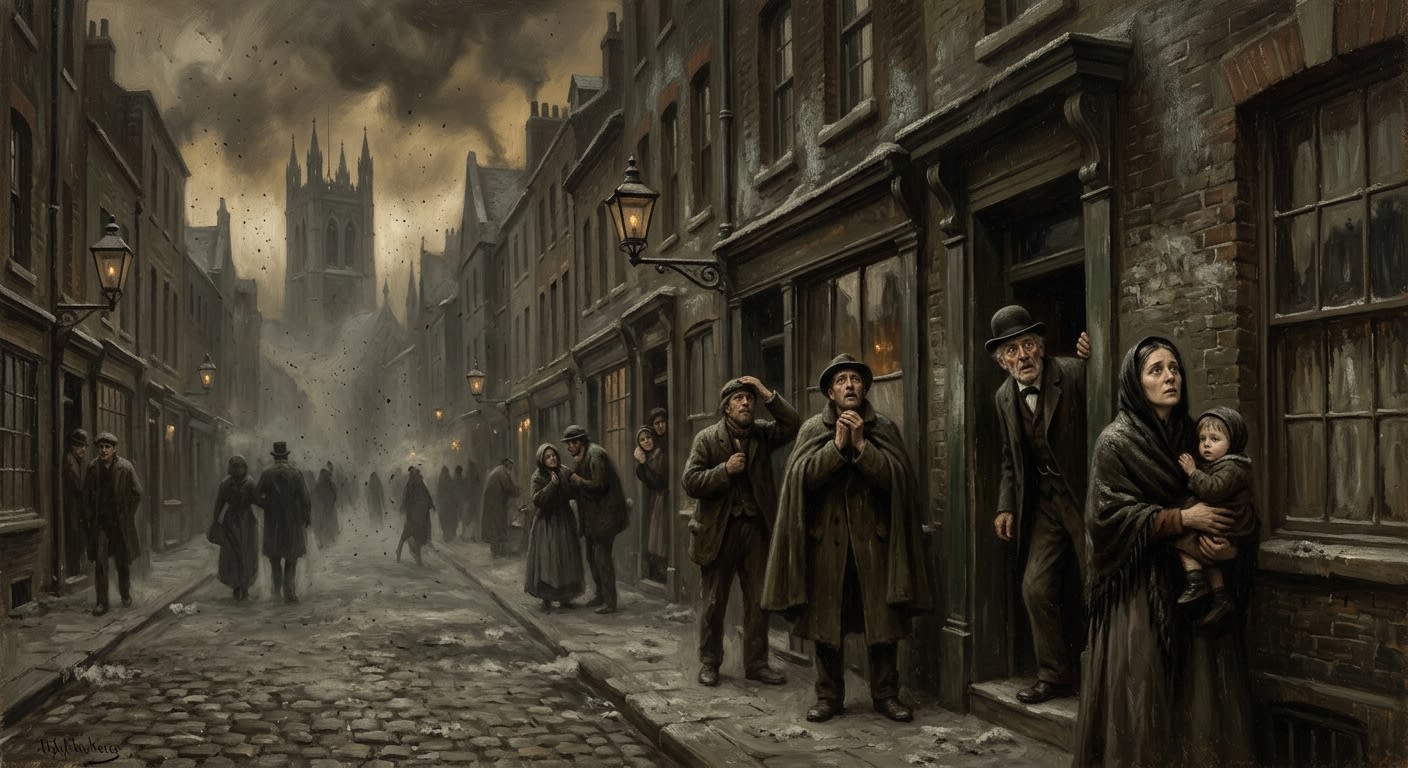
Processional Slaves (Unregistered) are civilians — women, children, the elderly, the broken — herded before demon hosts as walls of living flesh. They are driven by whips and iron gags, chanting litanies they do not comprehend. Some litanies are genuine hymns, inverted by corruption. Others are nonsense syllables whose repetition accomplishes nothing except the systematic destruction of the listener's will to fire.
Our rifles falter when aimed at them. Our Shield-Paladins hesitate to cut them down, for they are neighbours, kin, sometimes defectors recognised by name across the wire. The Shadow Court knows this. The Shadow Court depends on this. The pause between recognition and trigger-pull is long enough for a Forge-Beast to close the distance, and every general on the Line has lost men to that pause.
At Belgrade, thousands of slaves were marched barefoot through snow, chanting until their lips froze solid. Their corpses, still upright, became walls of ice shielding Velkara's perfume brigades behind them. At Prague, a flood of Processional Slaves drove our forces into retreat; the Inquisitors who authorised the torching of the entire mass — peasants and demons alike — branded it "merciful incineration" and filed the report under a classification I shall not name here because even I have limits, and the classification exceeds them.
#On the Ash-Fodder Militias
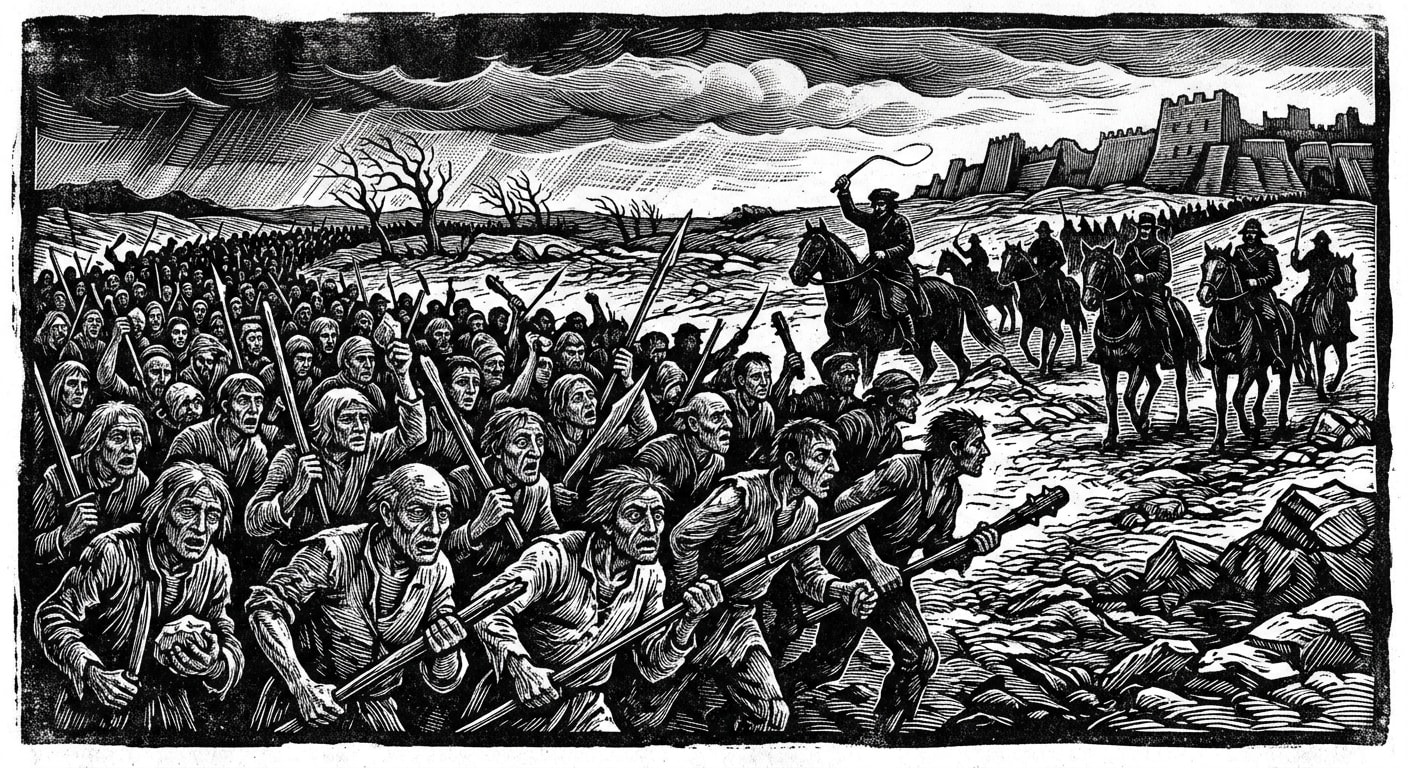
Last and least. Most numerous and least valued. The dregs scraped from the bottom of the Enemy's barrel — conscripts culled from conquered populations, armed with splintered spears, broken muskets, or nothing at all but the stones beneath their feet and the certain knowledge that running backward earns a worse death than running forward.
Their purpose is exhaustion. They exist to soak up volleys, to force Shield-Paladins to hold formation until fatigue buckles their arms, to consume powder so that the true abominations following behind arrive at a line already spent. An Ash-Fodder column can number fifty thousand. The Rationalists once mocked them as "armed crowds." Armed crowds, it transpires, still bleed. Still clog trenches. Still pave roads of meat across rivers for demon hosts to stride.
Their name comes from their end. When they fall — and they always fall — the corpses are collected, burned, and rendered into ash to fuel sorcery engines. Flesh becomes fuel. Bones become lime for new bastions. Death becomes perpetuation. They are remembered as measures of powder consumed and calories recovered, with neither soldier's honor nor man's name attached.
At the Brașov crossing, fifty thousand Ash-Fodder were driven into the Danube. Their corpses created a bridge of bodies across which Velkara's hosts marched dry-shod to the far bank. At Rostov, militia waves flung themselves at fortifications until the defenders' rifles melted from sustained fire. Only then did Wrath's hammer-hosts appear, fresh and unhurried, striding across a carpet of the dead.
#On the Economy of Flesh
The Bureau's theology is, for once, approximately correct. The Shadow Court's mortal host is a confession of limitation. Veil-breaches are expensive. True demonkind cannot be squandered on every ditch and hamlet. And so the Adversary has built an economy of flesh — a machine in which human bodies are the raw material, human suffering the fuel, and human death the product, refined and recycled until even the ash is put to use.
The Bureau of Engineering, in one of its characteristic moments of bloodless precision, once calculated that a single mortal body, properly processed through the Shadow Court's apparatus, yields the sorcerous equivalent of fourteen standard bell-hours of reliquary charge. The Bureau filed this calculation under "Interesting But Unwelcome." The Bureau of Doctrine stamped it "Suppressed." I read it anyway.
The reader will have noted that this entry contains no section titled "On the Countermeasures." The omission is deliberate. The countermeasure to a mortal host is the same as the countermeasure to any army: kill it. The spiritual difficulty remains — for the men in the Thrall columns were baptised, the women in the breeding pits bore names recorded in the Ledger of Souls, and the children rendered into ash were, by every sacramental measure the Bureau possesses, ours.
The Shadow Court's mortal apparatus is the war's ugliest arithmetic. The Lie spends forty-seven men to buy the advance of one demon, and the Synod spends powder, faith, and the sleep of its soldiers to buy back the ground those forty-seven men were spent to take.
STAMPED ERRATUM — Bureau of Records, 5th Revision, A.S. 201 The previous edition's casualty figure for "enemy mortal auxiliaries neutralised, cumulative, A.S. 45–200" has been revised from 2.1 million to 4.7 million. The discrepancy is attributed to "a rounding error in the original census methodology." The Bureau notes that rounding errors of 2.6 million persons are "within acceptable statistical variance for wartime conditions."
The entry is complete. The taxonomy is filed. The mortal host of the Shadow Court — Thralls, Hollowed, Ash-Mothers, Blood-Tithes, Wormhosts, Processional Slaves, and the ash-fodder conscripts who fill the gaps between them — is committed to the Codex in ink the Bureau assures me is permanent.
The people committed to the ground are permanent too.
I am informed that this is not the same thing.