
#On the Classification
"Ash-Fodder Militias, Category 1-F: mortal auxiliaries, expendable class, no sorcerous enhancement required. Armed or unarmed. Self-replenishing via territorial conquest. Disposal: standard field cremation. Remains: allocated to sorcery-engine fuel stores per Bureau of Engineering requisition schedules."
The Bureau of War's Memorandum 12-C devotes eleven words to the Ash-Fodder Militias. Eleven words for the single largest component of the enemy's order of battle. One word — expendable — does all the work. The remaining ten are jurisdictional, ensuring the Bureau of Engineering receives whatever remains the pyre produces. I have seen Memorandum 12-C. I have initialled it. There is nothing wrong with it except that it describes human beings as fuel and does so in a hand I recognise as my own.
The Legions of Sin taxonomy classifies the enemy's mortal forces in six tiers, from the Thralls whose wills have been branded into vacancy, through the Ash-Mothers whose bodies are production lines, down to the lowest category — the one that fills more graves than all the others combined. The Ash-Fodder Militias occupy that lowest tier. They are ragged conscripts culled from conquered populations, armed with splintered spears, broken muskets, or bare hands, and driven forward with a single operational purpose: to die in sufficient quantity that the soldiers behind them — the real soldiers, the sorcery-fed abominations and the Wrathforged (Unregistered) hammer-hosts — may advance unresisted.
They receive no enhancement. They are sorcerously unbonded. They bear no sigils. The Shadow Court has not invested a single calorie of demonic power in them, because the entire logic of their deployment rests on the principle that human flesh costs nothing.
#On the Arithmetic
The Rationalists, in their last decade of governance, observed the phenomenon and called them "armed crowds." The phrase appears in a survey published in Vienna, A.S. 38, by a Prefectural Analyst (Unregistered) named Koeler whose name the Bureau of Records has since misplaced with its customary thoroughness. Koeler's survey is precise, clinical, and useless. He calculated the average ammunition expenditure required to halt a crowd of ten thousand unarmed civilians moving at a walking pace across open terrain. The number is four thousand rounds of standard calibre, fired over nine minutes. He published this as a reassurance.
Koeler's arithmetic was correct. His conclusion was idiotic. Four thousand rounds is a company's entire allocation for a day's engagement. Nine minutes is an eternity when the crowd is followed by Wrathforged shock troops timing their advance to the moment the last rifle barrel overheats. The Shadow Court does not send Ash-Fodder to win. It sends them to empty magazines, to exhaust Shield-Paladins who must lock against them until their arms tremble, to clog trenches with dead weight so that the armoured hosts can stride across the corpses like men crossing a stream on stepping-stones.
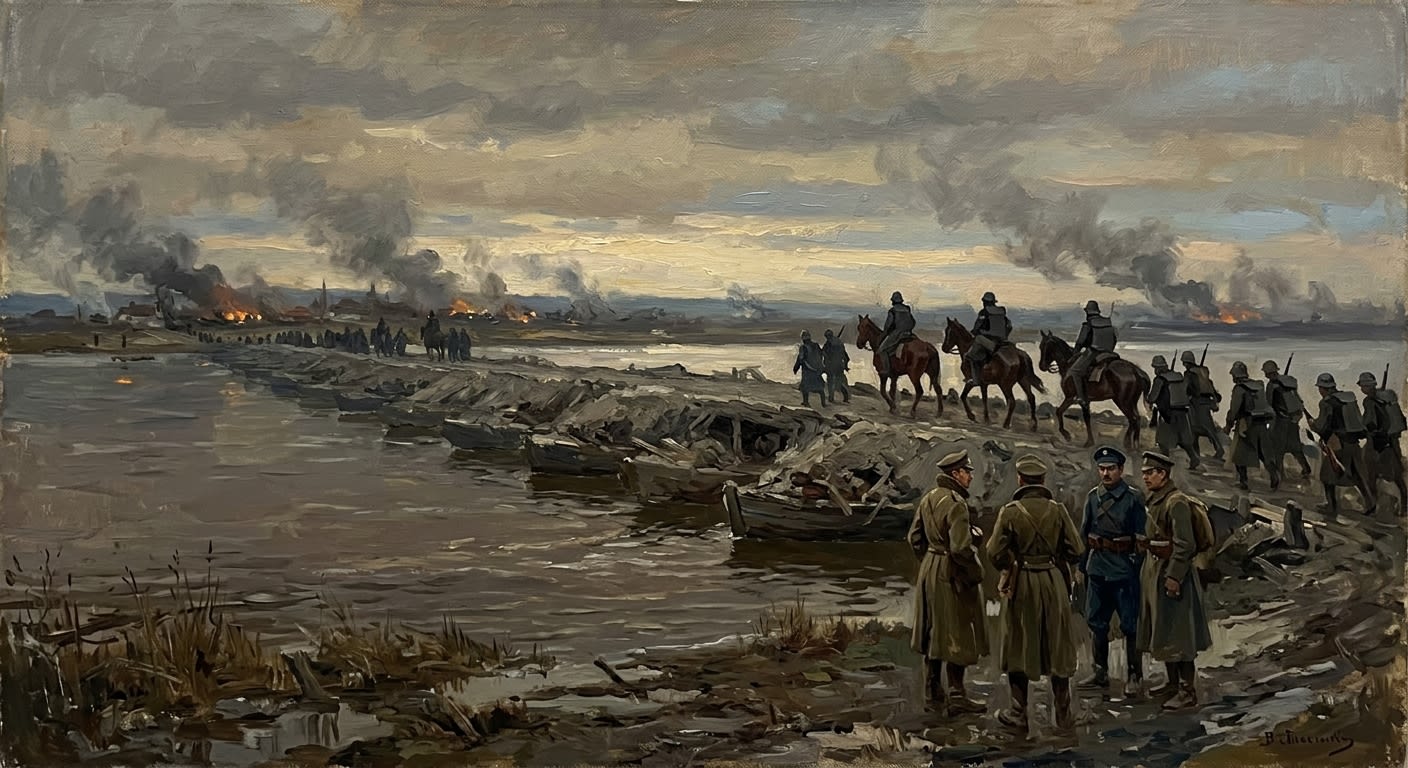
The scale defies what the Bureau calls "comfortable enumeration." A single Ash-Fodder wave can number tens of thousands. The largest recorded — the Brașov Flood, A.S. 110 — fielded fifty thousand. Fifty thousand men, women, and adolescents driven into the Danube by Velkara's overseers with whips and iron gags. They drowned in their thousands. Their corpses choked the current, beached against the shallows, piled upon one another in the river's bend until the water ceased to flow and the dead formed a bridge of meat three hundred yards wide. Lust's hosts marched across it. The crossing took four hours. Scouts on the Synod's bank reported that the bridge was still settling — still compressing under the weight of hooves and iron — when the last column passed.
Previous Codex editions attributed the Brașov Flood to Kargath's forces.
Bureau of Records, Seventh Revision: the operational command at Brașov was Velkara's. Kargath's forces had consumed the city proper; the Flood was a follow-on exploitation using captives from the surrounding lowlands. The distinction matters to the Bureau. To the fifty thousand, it did not.
The arithmetic is the weapon. The Bureau of War's strategic models — I have seen them; they are printed on paper so thick it feels like parchment, as though weight might lend the numbers dignity — calculate enemy attrition rates with the assumption that Ash-Fodder are infinitely replaceable. "Infinitely" is the Bureau's word. I suggested "practically" as a more honest qualifier. The Chief Logistician told me "practically" would require a footnote explaining where the supply ends, and no one in the Bureau wishes to write that footnote, because the answer is when the conquered population is fully consumed, and to write that is to admit that the enemy's strategy and our own share a family resemblance the Bureau prefers to leave unacknowledged.
#On the Canonical Engagements
Three incidents define the Ash-Fodder in Synod memory. There are hundreds more — every major engagement since A.S. 65 has featured expendable human waves in some capacity — but these three were witnessed by officers who survived, who filed reports the Bureau of Records did not immediately seal, and whose testimonies arrived in Strasbourg before the relevant committees could convene to debate whether testimony itself constituted a security risk.
The Brașov Flood, A.S. 110. Addressed above, but its aftermath warrants expansion. The corpse-bridge held for nine days before the current finally broke it apart. Synod sappers who surveyed the southern bank afterward found that the dead had been sorted before drowning — the strongest placed at the bottom of the river where the current was fastest, the weakest layered on top where their bodies would compact rather than wash free. This was engineering. Someone — some thing — had calculated load-bearing capacity per cadaver and arranged the drowning accordingly. The Bureau of Engineering received the sappers' report, read it twice, and filed it under "Structural Precedents, Hostile" without comment. I am told the filing clerk requested a transfer that afternoon.
The Siege of Rostov, A.S. 153. Maldrake's forces deployed Ash-Fodder waves against the city's Covenant garrison for eleven consecutive days. The waves came in shifts — dawn, midday, dusk — with mechanical regularity. Each wave numbered between eight and twelve thousand. The garrison's rifles overheated on the fourth day. By the sixth, the defenders were using bayonets. By the ninth, they had resorted to pikes improvised from furniture legs and iron railings. On the eleventh day, when the garrison's ammunition was entirely spent and its defenders stood behind barricades of enemy dead stacked higher than a man's head, the Ash-Fodder waves ceased. The silence lasted forty minutes. Then the Wrathforged appeared — the true assault force, rested and fed, their armour singing with heat — and Rostov fell in two hours.
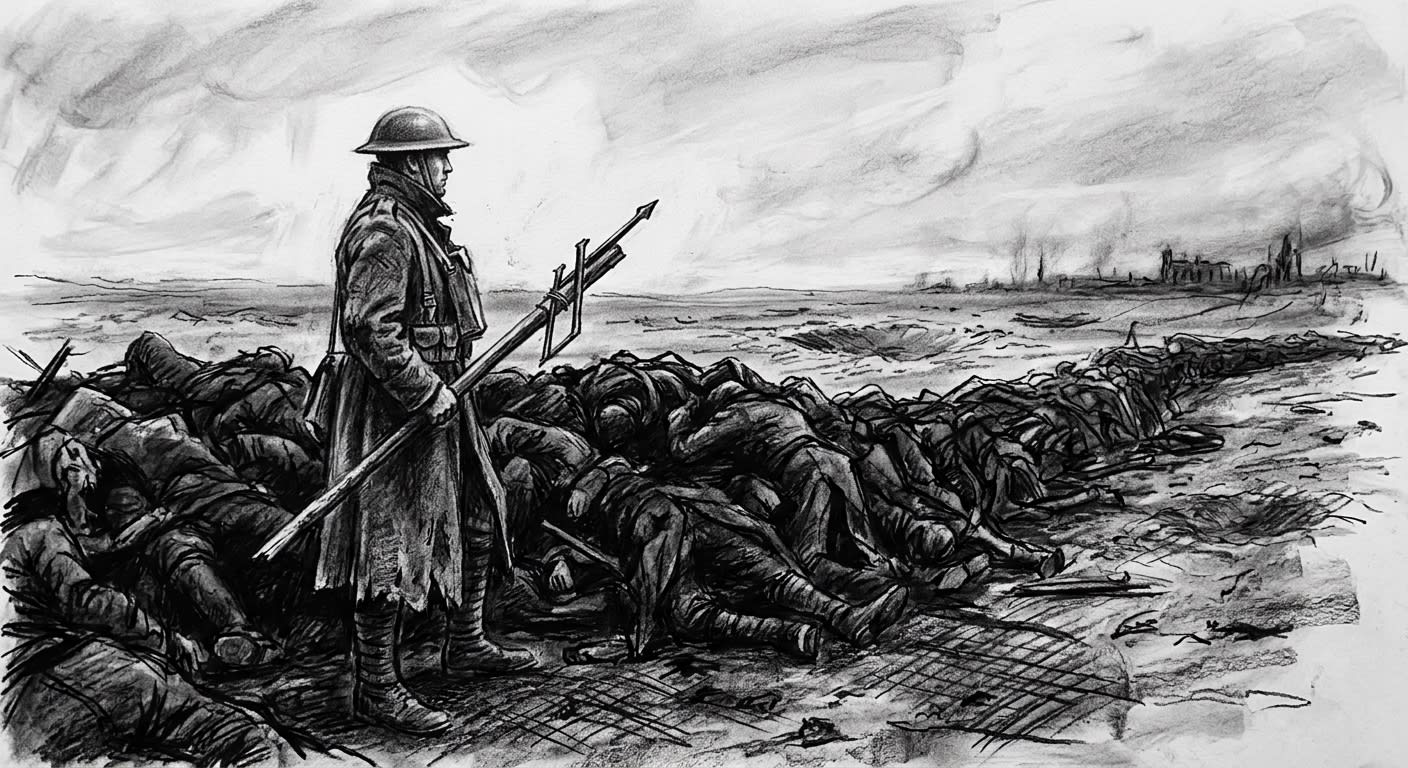
The Bureau of War's after-action report calculates that Maldrake expended approximately ninety thousand Ash-Fodder to exhaust a garrison of six hundred. The ratio is one hundred and fifty to one. The report notes this ratio with the flat notation: "Within expected parameters." The six hundred are listed by name. The ninety thousand are not.
The Year Without Dawn, A.S. 32. The earliest recorded instance, predating the formal classification by six decades. During the eclipse that smothered Europe in the early years of the Rationalist Republic, entire militia columns were marched eastward into the darkness and never returned. Refugees fleeing westward reported finding their corpses weeks later — stacked in towers, mouths pried open, arranged in configurations the Bureau of Rites would later classify as "ritual geometry, hostile, Category Three." The mouths were the detail that survived in folk memory. Open, fixed, as though screaming into an eclipse that had already passed. Soldiers on the Line still call a silent bombardment a "dawn mouth" and do not explain why.
#On Their Composition
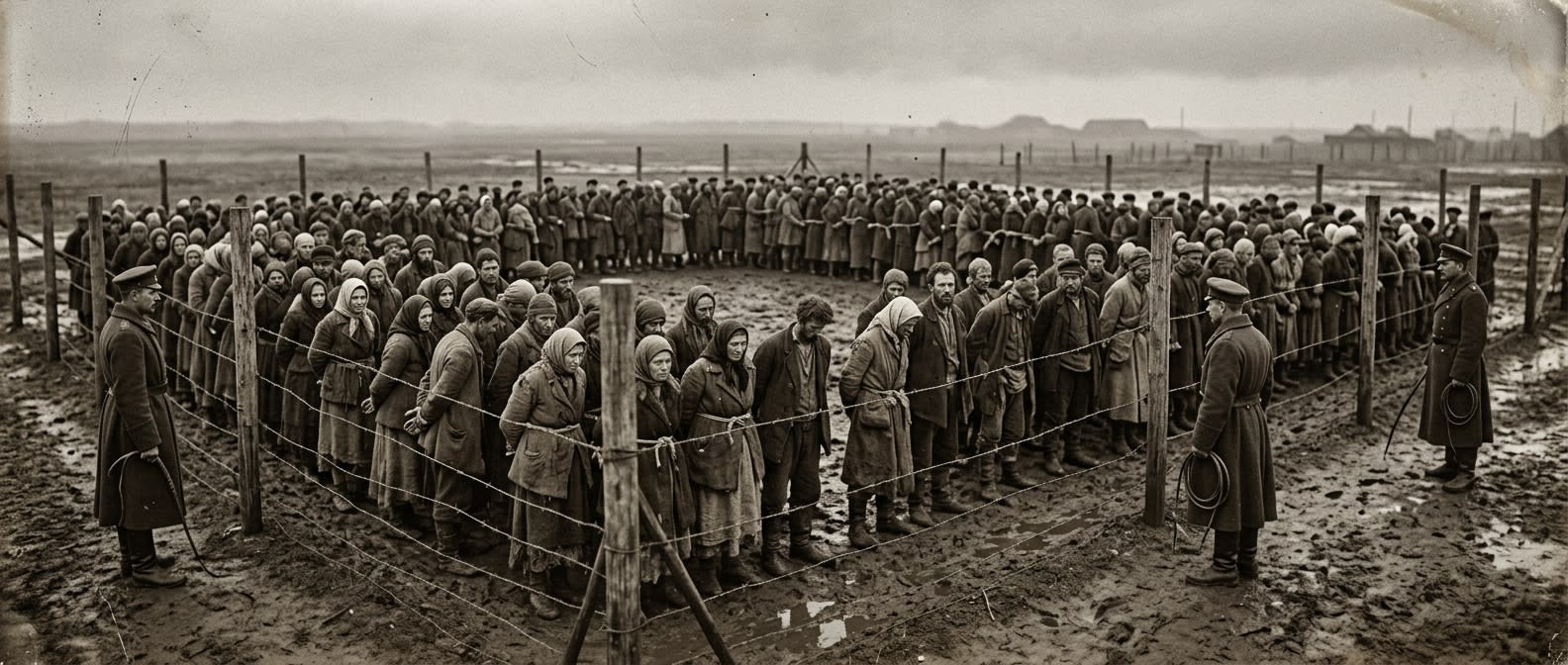
The Ash-Fodder are drawn from conquered populations without discrimination. Age, sex, physical condition — the Shadow Court does not sort at this tier. Those with military value are drafted upward into Thrall conditioning or worse. Those without are left as they are: unbranded, unmodified, unarmoured. They receive no sorcerous enhancement because enhancement would represent an investment, and the entire doctrine of the Ash-Fodder is that they cost nothing.
Their weapons, when they carry them, are salvage. Splintered pike-shafts from old battlefields. Muskets with cracked stocks and no flints. Knives. Farming implements. At Brașov, several thousand carried nothing at all — they had been marched from the holding pens with their arms bound behind them, the bindings cut only at the riverbank, where there was nothing to pick up except mud and the hair of the already-dead.
They are herded by Thrall overseers — branded men with enough volition remaining to swing a whip — and driven forward by the simple expedient of making retreat more dangerous than advance. The Shadow Court's rear echelon includes what the Bureau of War designates "motivational sorcery": fire-walls, agony-fields, corridors of auditory torment through which no sane person would willingly walk backward. The Ash-Fodder go forward because forward is the only direction that contains the possibility, however remote, that the suffering will end.
#On Their End
Their name tells the story. When they fall — and they always fall, because they are sent to fall — the dead are collected. Corpses are stripped of anything metallic, stacked on pyres, and burned. The ash is gathered by Thrall labour gangs and carted to sorcery-engine installations behind the enemy's front. There it is rendered: calcium for mortar,ite for fuel-paste, calcium phosphate for reactive compounds the Bureau of Engineering has catalogued in a restricted appendix it titles "Hostile Energetic Materiel."
The Bureau of Engineering's analysis confirms that sorcery-engine installations in the eastern sectors consume approximately four hundred metric tons of bone-ash per month. At standard cremation yields, that represents roughly thirty-two thousand individual corpses. Per month. The Bureau includes this figure in its quarterly intelligence summary without commentary. I have added commentary. The commentary reads: "Thirty-two thousand." I felt repetition was sufficient.